Author: Mark Liskey

  • How to Massage a Bodybuilder

    How to Massage a Bodybuilder

    Science doesn’t know that hands can shriek, but we, massage therapists, do. In fact, it happened to me the other day. Mr. Universe walked into my office looking for a deep pressure massage. AAAHHH!, screamed my hands. (Only dogs could hear it). Then I said, Relax, hands. Remember, we know how to massage a bodybuilder pain-free. Use deep, precise pressure on the tight spots and drop down to firm pressure for the glide.

    You Lost it Bro

    I know what you’re thinking: Mark, you’ve lost it. You’re talking to your hands AND you’re telling me to work deep on tight spots. That deep, precise pressure is going to kill my hands!

    I’ve only half lost it. I do talk to my hands, but the advice I’m giving is not crazy. Let me explain.

    How Not to Massage a Bodybuilder

    Here’s how Mr. Universe can hurt your body.

    As you try to sustain deep pressure throughout the entire massage your body never gets a chance to recover. Your neck, shoulders, arms, back and hands get overworked and bad body mechanics ensue, like reaching too far in a deep pressure glide stroke.

    Trying to sustain deep pressure throughout the entire massage is what I believe to be at the core of many MT pain conditions and injuries.

    Interestingly, I used to be an advocate of sustained pressure.

    Challenging Sustained Pressure

    When my wife, Lisa, and I started our hotel massage business I created a training manual for MTs who worked for us.

    And guess what I taught them?

    Yep, sustained pressure.

    Why I Changed

    Years later, I changed my mind because of pain issues from using sustained deep pressure on clients like Mr. Universe.

    After some experimenting I came up with this formula for working on Mr. Universe: firm pressure for the general massage, but deep pressure for tight spots and areas of requested focus.

    It was a success.

    The proof?

    My body felt a heck of a lot better and Mr. Universe loved the massage.

    He loved the massage even without killer deep pressure everywhere?

    Yep.

    Why?

    My guess is that I scratched the itch. I provided pain relief for his tight spots and areas of concern with deep, precise pressure, and I relaxed him with the  firm pressure everywhere else.

    This brings us back to the concern of killing your hands doing deep, specific pressure on tight spots.

    How to do Deep and Precise Pressure Pain-Free

    It won’t happen if you:

    (1) put yourself in the best position to lean with your body weight.
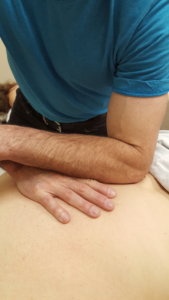
    That means you have your work in front of and below you. In this position you can generate your pressure through leaning which is ultimately easier on your body than pressing.

    (2) combine body parts to make it easier on your fingers.
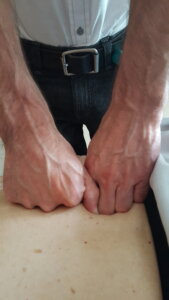
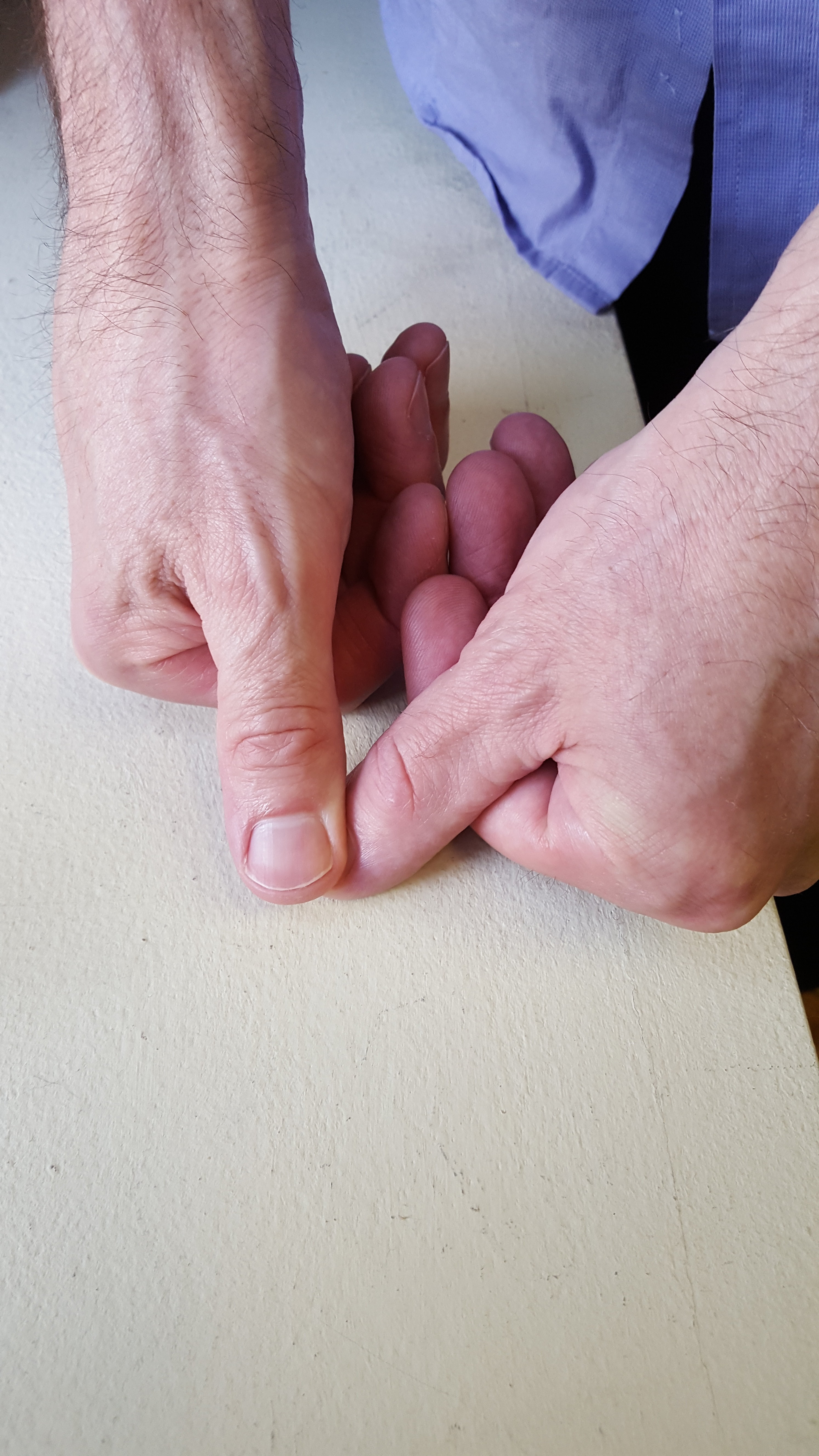
    Think of all the ways you can brace and support fingers. In the picture above, most of the pressure is being directed through my middle finger of my left hand. The other hand is there for support.

    (3) use a massage tool.
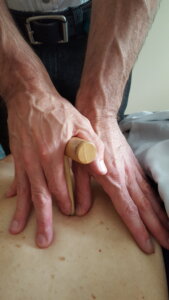
    See how my hands are relaxed? Here’s how you do that: Massage Tools Can Save Your Hands.

    This is going to sound as crazy as me talking to my hands, but when you’ve got all three things working right, applying deep/precise pressure to tight spots is actually a rest for your body.

    And don’t be surprised if you find yourself actually looking forward to working on tight spots.

    Alright, here’s my 3 step version of how to massage a bodybuilder.

    Massage a Bodybuilder Step-By-Step

    Step #1: Note Mr. Universe’s requested areas of focus.

    Let’s say Mr. Universe wants full body, deep pressure with a focus on traps and neck. Traps and neck should be tops on your parts-to-do list.

    Step #2: Find the tight spots and pain areas within the requested areas of focus and use deep, precise pressure on them.

    Remember that your hands should feel fine when doing deep and precise pressure because you’re going to use good body mechanics, combined body parts and massage tools.

    Step #3: Use firm pressure with your glide strokes, but when you find a tight spot go deep.

    Here’s a hypothetical. I’m starting on one of Mr. Universe’s requested area of focus, his left trap, and I’m going to glide down to his sacrum.

    a. First I find a tender spot in his trap and press with deep, precise pressure until I feel it’s time to move on.

    b. Then I lighten my pressure to firm pressure and start my glide.

    c. At T1, I find a tight spot, so I pause and ramp my pressure up to deep.

    d. I rinse and repeat all the way down the spinal erectors.

    This video should help you out with gliding and ramping your pressure up to deep:

    [embedyt] https://www.youtube.com/watch?v=s2GcDbM0R5I[/embedyt]

    How to Massage a Bodybuilder Line Graph

    Another way to visualize “deep pressure for tight spots” and “firm pressure for the glide” is to think of a line on a graph.

    The tight spots where you apply deep, precise pressure are the dots (the data points) on the graph.
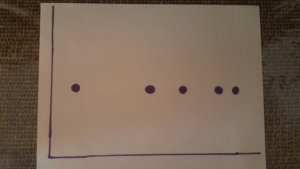
    The moving with firm pressure is the in-between (lines connecting the dots).

    You start with deep pressure on dot 1 (e.g. upper rhomboid), then glide with firm pressure until you get to dot two (e.g. lower trap).
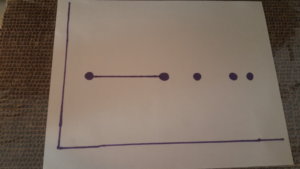
    You apply deep pressure on dot 2, then glide with firm pressure until you discover dot 3 (e.g., a tight spot in T12 erectors) and on and on…

    This is the what the entire length of the stroke looks like on paper.
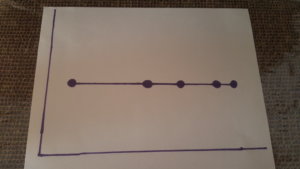
    You can see that you’re covering more distance with firm pressure (the lines) than you are with deep pressure (the dots).

    That should make your neck, shoulders, elbows, wrists and hands happy.

    Hans and Franz Short Version

    If you were short on time and read the opening, then skipped down here to the wrap-up, here’s how I massage a bodybuilder in the fewest words possible: Firm on the glide. Deep on the tight spots.

    How to Deliver Deep Pressure Online CEU Course

    Can you be an expert with deep pressure without hurting yourself and for cheap AND get CEU credits without leaving your house?

    Yes.

    Go here.

     

  • How to Survive Client Loss (and Market Crashes): Balanced Client Base

    How to Survive Client Loss (and Market Crashes): Balanced Client Base

    Sometimes clients leave. Hey, that’s the nature of business, right? But if you lose a couple key clients at once and can’t replace that income reasonably fast, you’re going to be in trouble. Here’s how you make sure that you can handle any client-loss situation: build a balanced client base.

    Balanced Client Base

    You can classify clients in a lot of ways, like monthly client, weekly client and occasional client.

    But in order to survive client attrition (and market crashes), I think of my clients in two ways: (1) recession-proof clients and (2) non-recession-proof clients.

    A recession-proof client will come to you no matter how bad the economy is. She’s loaded.

    A non-recession-proof client can pay for massage, but she has limitations, like if she loses her job, you’re out a client.

    You need both.

    No, I’m Not Smoking Crack

    I know that it seems like just going for the recession-proof clients is the way to go. But it’s not for two reasons.

    1. Relying too much on recession-proof clients means you’re open for a quick, significant and long-lasting income reduction if one or more of them stop coming in for massage.
    2. Recession-proof clients are harder to find than non-recession-proof clients. And if the poop hits the fan, you’re going to need to bring clients in fast.

    Here’s an example of a recession-proof-client-base meltdown.

    Loretta Leaves

    Loretta has more money than the state of New Hampshire. You work on her, her husband, Raul, and their son, Raul Jr. every week.

    One day, Raul Jr. goes off to college.

    Okay, you think, I got this. I just need to find another rich client who likes massage a lot.

    But as you start to work on the rich client project you begin to realize that you can’t just walk down to the local country club and put up a flier on their bulletin board that says “Hey, if you’re a rich person (which I’m assuming you are because you belong to a country club), come get a massage and pay me lots of money” and expect clients to come running to you.

    The truth is that finding a wealthy client is a bit of a slog, right?

    Then comes more bad news: Raul Sr. gets sick, like really sick and can’t come in for a massage. Now, it’s getting scary. You start juggling bills.

    A month later you see a glimmer of hope. Raul is getting better and will be coming in for a massage soon.

    But the next time Loretta comes in for a massage she hits you with this: She and Raul Sr. are moving to Hawaii!

    Can you say “screwed”?

    The Rich Client Leaving Solution

    Recession-proof clients will get you through economic downturns.

    But non-recession-proof clients will get you through the times when you need money fast.

    Remember non-recession-proof doesn’t exclude a client from being a weekly or monthly client. It just means that he can’t afford massage under certain circumstances.

    Client-Balance Strategy

    If you want a balance between recession-proof clients and non-recession-proof clients, you’re going to need to build referral resources in both areas.

    Take it from me, you don’t want to wait until a recession hits (thank you, 2008) to have strong referral sources. Have them in place as soon as possible. Once you do, it’s just a matter of priming the pumps.

    Recession-Proof Referral Sources

    Think broad when looking for recession-proof referral sources.

    What services do people with disposable income spend their money on?

    Here are some: boutique personal trainers; out-of-pocket chiropractors; out-of-pocket PTs; private-lesson, yoga instructors; private-lesson, Pilates instructors…you get the idea.

    Start building relationships with those service providers. First, cast a wide net and investigate many sources. But as soon as one seems promising, go all in with that one.

    Here’s how I build rapport with service providers: How to Grow Your Business with Zero $.

    Not every referral from these sources will be recession-proof, but there’s a better chance of finding one here than at other places.

    Non-Recession-Proof Referral Sources

    For a non-recession-proof referral source, it’s more of the same, but with one main difference: You’re NOT focusing on the higher-priced services.

    For example, a non-recession-proof referral source might be a chiropractor who’s inexpensive or a bike store manager.

    Again, once you find a winner, drill down.

    If you want to take it a notch up read: How to Get More Massage Clients: Nurture the Connectors.

    Balanced Client Base In Action

    Let’s see what all this might look like with another Loretta example.

    Now imagine that you have two main referral sources: A high-end personal trainer (recession-proof-referral source) and an inexpensive chiropractor with crazy volume (non-recession-proof referral source).

    You Need to Adjust Quickly

    It’s May and on a whim Loretta decides to take her family to Italy for 2 months starting in July.

    So, you immediately ramp up your marketing efforts at a local chiropractor’s office by doing demo massages.

    By the time Loretta, Raul and Raul Jr. leave for vacation, you’ve gotten 5 new clients. One comes in every 2 weeks and the other 4 come in on average once every 8 weeks.

    While Loretta et al. are away you’re new clients come in for a total of 8 massages.

    If you had done nothing, you’d be down 24 massages during Loretta’s mini vacation (mini for Loretta). 8 weeks x 3 massages per week = 24.

    So now you’re only down 16 massages (24  – 8 = 16).

    There’s more good news.

    You worked on your new clients a total of 6 times before Loretta and her family went on vacation. That means you’re only 10  massages down (16 – 6 = 10).

    Basically, you’ve cut the damage of Loretta and her family’s absence by more than ½ (58%).

    But we’re not done.

    Loretta and her family come back. Every time you see one of your new clients you chip away at the 10 massage deficit. In about 2 months you’ve made up for the time Loretta was away–and everything after that is extra income.

    You Have More Time to Adjust

    Next trip for Loretta is in 6 months. Great. You have time to work on getting a recession-proof client. So you turn your attention to the personal training boutique where Loretta works out.

    You offer free demo massages and stretching post-workout. Latisha takes you up on the deal. Lo and behold, you find out that Latisha is Loretta’s friend.

    Can you say, YES!

    Latisha becomes a once a week client. Now you’ve added one recession-proof client and have 5 non-recession-proof clients.

    You’ve both protected your business if Loretta goes away for good and have grown your business at the same time.

    Balanced Client Base Recap

    Having recession-proof and non-recession-proof referral bases is very doable and you need both for a balanced client base.

    When you need a client yesterday, prime the non-recession-proof client pump.

    When you’re not desperate take some time to protect your business from an economic downturn and target service providers with recession-proof clientele.

    You can do demo massages or other forms of marketing to prime the pumps.

    As soon as you have a balanced client base, you’ll be able to survive the unexpected while building your practice at the same time.

    The Next Step

    If you’re ready to start a massage business or take a meh massage business to the next level, then I have two courses  that can help you out.

    If you’re starting a massage business, this course will give you everything you need to know to launch and take your massage business to 30K: Jumpstart. (And it’s free.)

    If you need to take a meh massage business to beyond paying the bills, then this course will finish the job for you: Accelerator.

  • How NOT to be a Massage Expert (and be Very Successful)

    How NOT to be a Massage Expert (and be Very Successful)

    True or false: You have to be a massage expert to be successful in massage?

    My guess is that you said false.

    But does your answer match what you’re actually doing in your work life right now?

    In other words, have you stalled with starting a business, growing your business or adding an extra stream of income because you don’t know enough, because you’re not an expert?

    If so, waiting to become an expert could actually be a way to avoid moving forward with something.

    I get it.

    I was an expert at avoiding the next uncomfortable step to increasing my income.

    I can’t open my own neuromuscular massage business until I’m as good as Paul St. John.

    I can’t teach CE courses until I command the classroom like Professor John Keating in Dead Poets Society.

    I can’t become a writer until I win the Hemingway Award.

    And the list goes on…

    Granted, you need some knowledge and skills to deliver a good service or to create a decent product. But you don’t need to be an expert.

    You simply need to be competent.

    Massage Competent Versus Massage Expert

    Competence is the ability to do something successfully or efficiently.

    Having expertise means you have a comprehensive and authoritative knowledge/skill in a particular area.

    Immediately you can see an advantage of competence over expertise: time. You can become competent faster than you can become an expert.

    Competence has a huge psychological advantage, too.

    When I say “expert” what do you think?

    I think: How will I know when I’m an expert? That makes becoming an expert seems like a never-ending deal.

    Now what do you think when you hear the word “competence”?

    I think: Oh, hells yeah, I’m going to get me some competence and then some!

    Fortunately for me, I had a friend who helped me understand the value of approaching business (and life) from a competency perspective.

    Tigers, Stripes and Behavior Change

    My friend Bill Hass was a corporate psychologist. He and his team utilized emotional competence as a strategy in their business coaching program.

    Here’s a piece of research they did: Tigers, Stripes and Behavior Change.

    My favorite tiger.

    Whenever Bill and I had lunch together, we’d talk about emotional competence. One day, I decided to apply what we talked about to my personal life.

    My Emotional Competence Experiment

    So I worked towards emotional competence in my marriage, and here are 3 things that I noticed:

    1. There was no barrier to entry.

    Becoming competent was not an intimidating proposition. In fact, it made me want to get on it right away because I couldn’t stand the thought of being incompetent!

    1. When I screwed up, I didn’t want to quit because the goal—to become emotional competent—still seemed reachable. I just needed to make an adjustment or two.
    2. Once I got a quick win, I became confident that I could get more wins quickly.

    Massage Expert Challenge

    Next, I applied the competence model to my massage life. Interestingly, when I did, I not only gained competency in certain areas, I also started to recognize when I was already massage competent in something but was holding back because I wasn’t a massage expert.

    For instance, a while back I wanted to develop a niche market with runners, but the core of my massage work over the years had been backs and necks.

    Damn, I thought, I need to become a massage expert with running injuries.

    But wait, I was already competent with working on legs. I had worked on tons of runners, cyclists and triathletes over the years.

    Being an expert was an excuse. So I went out into the running world, drummed up business and refined my knowledge base as I went along.

    Competent to Start a Business

    If you’re thinking about opening a massage business and are wondering if you’re actually a competent massage therapist, ask yourself these questions:

    1. Do I have repeat business?
    2. Do my current clients refer to me?
    3. Do I convert some first-time customers into regular clients?

    If you answered yes to all the questions, congrats. Move onto this step: How to Get Massage Clients: Referrals.

    If you need to tweak some things about your massage read this: How to Stand Out From the Crowd.

    Competent to Grow Your Business

    If you’re floundering with growing your business because you’re not a massage expert, ask yourself these questions:

    1. Can I make a client feel relaxed?
    2. In general, are most clients in less pain after I work on them?

    If you answered yes to both questions, get out there and start marketing! This will help: Two Tips (Not 10) To Get More Clients.

    If you need to work on competence, check out this article: How to Get Good at Pain Relief Massage.

    Get Competent

    Ready to get competent?!

    Not a great rallying call, I know.

    But here’s the deal: You’re going to sit and rot in your chair if you’re waiting to become a massage expert before you make a move.

    If you’re not competent, get competent.

    Then market your competency.

    And refine your skills and grow your knowledge base as you go along.

    Email Group

    If you haven’t heard, I have an email group. It’s free (and you can unsubscribe anytime). Sign up below and I’ll direct you to the information that you’ll need to get you moving in the right direction:-)

    Get It Done Online, CEU Courses

    If you’re ready to start a massage business or take a meh massage business to the next level, then I have two courses  that can help you out.

    If you’re starting a massage business, this course will give you everything you need to know to launch and take your massage business to 30K: Jumpstart. (And it’s free.)

    If you need to take a meh massage business to beyond paying the bills, then this course will finish the job for you: Accelerator.

  • How to Get Good at Pain Relief Massage

    How to Get Good at Pain Relief Massage

    I don’t like hype, but what I’m about to say is gonna sound hype-y. Ready?  Want to be a hit with pain relief massage? Then get good at using moderate pressure.

    I say this for two reasons: my experience and a research study.

    Let’s start with the study.

    Massage Pressure and Pain Relief

    In 2010, Tiffany Field, PhD, director of the Touch Research Institute at the University of Miami School of Medicine, published a  study about massage pressure and how it relates to relieving pain in the International Journal of Neuroscience.

    Field had this to say about the study: “The critical thing is using moderate pressure. Light pressure, just touching the surface of the skin or brushing it superficially, is not getting at those pressure receptors. Light pressure can be stimulating, not relaxing.” (Source: Arthritis Foundation)

    The heck with light pressure, Mark, what about deep pressure? I have clients that I need to pound with everything I got.

    Me, too! (By the way, here’s how to pound clients without hurting yourself.)

    That said, I believe that the deep pressure clients are not the norm.

    Why?

    For one, the client who needs deep pressure for pain relief will stand out in your memory (then get labeled as the norm) because he’s harder to work on than everyone else.

    And two, if you get a reputation for deep pressure, you’re going to attract deep pressure clients. And suddenly it’ll seem like everyone who wants pain relief also wants deep pressure.

    Moderate Pressure

    So let’s talk about moderate pressure. What is it?

    Well, I can tell you what it’s not. Moderate pressure is not when you pet or bruise the client—the only two types of pressure I knew how to do when I first started massage.

    “Hey, Mark, can you go deeper?”

    Picture source: birchbox.com

    “Sure!” I’d say as I rolled up my sleeves, then pressed with my forearm until the client couldn’t breathe.

    Neuromuscular Pain Scale

    I did improve over time, but things didn’t really start to click until I studied neuromuscular therapy (NMT). With my NMT training, I learned how to communicate with the client via a pain scale.

    Here’s how it works. Imagine a pain scale from 1 to 10. One means a little pain, ten means a lot of pain.

    For pain relief, the goal was to operate in a 4 to 5. So, the MT would press a tight or tender area until she elicited a 4 or 5 from her client. Then she’d hold the spot for less than 10 seconds.

    If the pain lessened during that time, great, she successfully reduced the pain. If not, she’d revisit the spot a little later, but with less pressure.

    I demonstrate how to do that in this video.

    Moderate Pressure = Firm Pressure

    What I like about the pain scale is that it’s based on the client’s experience of pain.

    So, if Aria’s 5 is Benjamin’s 10, no biggie. Since the value of each number on the scale (1-10) is determined by each client’s experience, I would never be in danger of making Benjamin jump off the table by using Aria’s idea of moderate pressure on him.

    As time went on, I started to see that not only did most of my pain-relief clients want moderate pressure, so did my relaxation clients.

    But my relaxation clients had a different name for moderate pressure. They called it firm pressure.

    Tying everything together, in general, this what moderate pressure looks like in my mind: moderate = firm = 4 or 5 on the pain scale.

    How to Nail Moderate/Medium Pressure

    If you want to perfect moderate pressure, do this:

    1. Use the pain scale technique.

    If you’re worried about the flow of the massage, just use the pain scale technique once at the beginning of the massage. That way you won’t interrupt flow and you’ll get enough info to calibrate your medium pressure for the rest of the massage.

    1. Ask for feedback.

    I would ask for feedback with non-paying customers.

    1. Get a massage.

    A great time to work on your pressure delivery is during a workshop or CE class. During the exchange, it’s easier to picture yourself applying the same pressure as your partner if you’re both doing the same technique.

    Feeling Competent with Pain Relief Massage

    You’re going to feel confident with pain relief massage once you become competent with moderate pressure.

    It’s not hard to do, you just need to get your reps in.

    Refer back to this video to get the pressure scale technique down.

    And if you’re thinking about getting really serious with pain relief massage, then check out this article: Build a Practice with Pain Relief Massage.

    If you want more info about pain relief massage and (fill in the blank), join my email group. I’ll let you know when I have new tutorials, articles and videos out.

    My email group is free and you can unsubscribe anytime.

    Sign up here:-)