Blog

  • Cheap Massage Insurance | Affordable and Comprehensive Coverage Options

    Cheap Massage Insurance | Affordable and Comprehensive Coverage Options

    Cheap Massage Insurance: Your Guide to Finding Affordable and Comprehensive Massage Insurance


    I went on a search to find cheap massage insurance.

    I found two options. One for $94 and the other for $96.

    But deciding on which massage insurance to buy is not as straightforward as finding the cheapest.

    Many organizations bundle massage insurance in with membership.

    Membership comes with bonuses, like “free” massage CEs, but surprise, surprise, bundled packages typically cost more.

    Hmm…paying a little more to get “free” CE courses sounds good…but wait, renewal is every 2 years (if you’re in PA)…should I pay a little more to get “free” CEs every year?…am I really saving money?…and what if I hate the CE courses…hey, this one gives me a free website…but wait, I don’t own the domain name…

    Ugh!

    Take a deep breath in. We can get through this – and it’s important to get through this. Why?

    Why I Have Massage Insurance

    My number one reason to have massage insurance is to protect me against client injuries. If I make a mistake or if I am accused of making a mistake, I want some liability protection. For that protection, you’ll pay anywhere from 74 cents/day for a policy with professional amenities (like access to free rental agreement forms) to 26 cents/day for a policy with no bells and whistles.

    In addition to the massage insurance policies being affordable, I have confidence that the massage insurance providers will be there for me if I need it. I say that for a reason.

    The Good Old Days

    If you haven’t been doing massage as long as I have, you won’t remember the good old days when you just bought cheap massage insurance and that was it.

    No “free” websites that never get noticed.

    No newsletters that you never read.

    No upselling you scheduling software and massage business services.

    No massage insurance the next year because the company you bought from vanished into thin air! (Yep, that happened to me.)

    Okay, so it wasn’t all that great.

    The reality is, we’ve got a lot of choices now.

    We just need to wade through them–and that’s what I’m going to help you do.

    Before we get started please note that some of the links below are affiliate links. That means I get a paid a fee if you purchase through an affiliate link. But you don’t pay more for going through my links. 

    Affiliate fees help keep this blog going, and thank you if do choose to support my work.

    My goal with this article is simply to give you the spreadsheets so that you can compare policies. You make the decision regarding who you want to go with. 

    Lastly, if you have a massage insurance liability question for any company mentioned in this article, send it to me. I will make sure that you get an answer.

    Sound good?

    Alright, let’s get started.

    Here’s What I Did to Find Cheap Massage Insurance

    To make things easier, I divided up the many massage insurance options into two categories: Just Insurance and Insurance with Extras.

    Here’s what a Google search turned up for the Just Insurance options.

    Just Massage Insurance

    a. $94/year: Insure LMT

    b. $96/year: Insure Bodywork (BBI)

    c. $109/year: American Massage Council

    Here are the Insurance with Extras options.

    Massage Insurance with Extras

    a. $169/year: Massage Magazine Insurance Plus

    b. $175/year: Hands On Trade

    c. $179/year: NACAMS

    d. $199/year (and $229/year): ABMP

    e. $204.99/year: NAMASTA [$99.99 (associate membership) + $105 (insurance)]

    f. $235/year: AMTA

    g. $269/year: Alternative Balance

    In this category there are 7 options.

    Now let’s compare the options in Just Massage Insurance.

    I Just Want Freakin’ Massage Insurance

    Here’s what the 3 options for Just Massage Insurance look like on a spreadsheet:
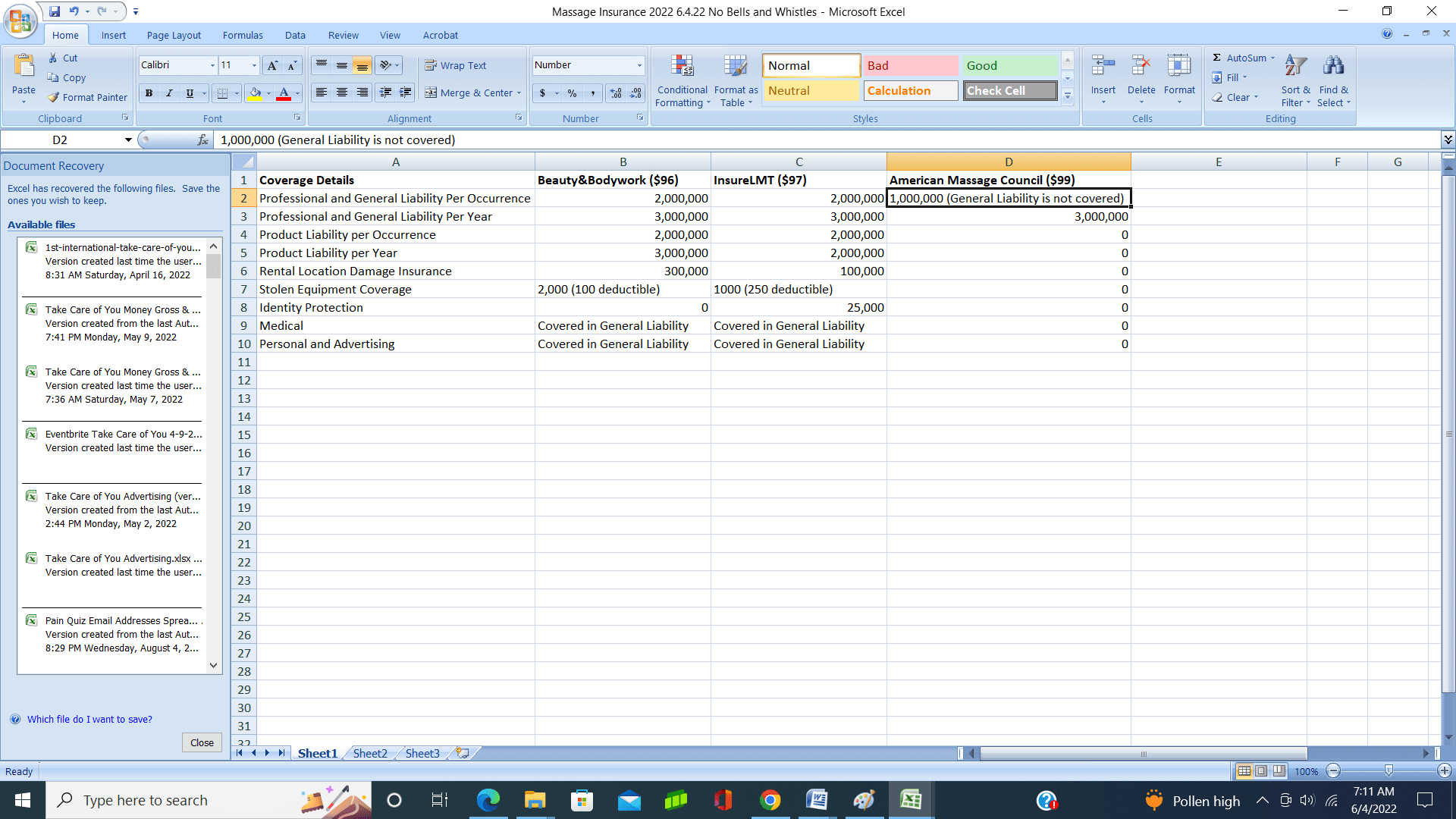
     

    Spreadsheet comparing cheap massage insurance coverage details with Insure LMT, Beauty & Bodywork and American Council.

    Immediately you see that the American Massage Council’s policy is lacking in 8 out of 9 categories when compared to Insure Bodywork (BBI) and Insure LMT.

    In 5 out of 9 categories, both Insure Bodywork (BBI)and Insure LMT provide the same coverage amount. Of the 4 remaining categories, Insure Bodywork (BBI) wins: 3 (win) -1 (loss).

    So, Insure Bodywork (BBI) is $2 more than Insure LMT, but is better than Insure LMT in 3 categories.

    Claims Versus Occurrence Insurance Policies

    Both InsureBodywork (BBI) and Insure LMT are occurrence policies. BBI was a claims policy but switched to occurrence near the end of 2024.

    That’s a good thing. Here’s why:

     Allen Financial Insurance Group explains the difference between a claims policy and an occurrence policy:  

    A claims policy covers the insured for an incident that occurred during the policy period and was reported as a claim while the policy remained in force.”

    An occurrence policy “provides coverage for ‘alleged incidents’ (injuries) that happened during the policy year regardless of when the claim is reported to the carrier. It provides a separate coverage limit for each year the policy is in force. It doesn’t matter if the policy is active when the claim is reported. It only matters that the policy was active when the alleged incident occurred.”

    Huh?

    I’m with ya. Let’s put it in massage language.

    A Claim Happens 

    You have an occurrence massage liability policy.

    Kyle, a client, trips over your massage stool and breaks his wrist when the policy is in effect (while you have the occurrence insurance).

    The next year you buy a different massage liability policy and that next year Kyle makes a claim.

    No problem because you’re covered under the occurrence policy that you had the year before even though you no longer have that policy.

    Now, say you had a claims-made policy when Kyle tripped and broke his wrist. But the next year (the year Kyle makes a claim) you had a different insurance policy.

    Guess what?

    You’re not covered because the claim was made when your claims-made policy was not in effect.

    In the Kyle scenario in order to be covered with a claims-made policy you would have had to renew your claims-made policy the year Kyle reported a claim.

    Important stuff to know, but not the end of the world, right?

    So, like I said before, the good news is that both Insure Bodywork (BBI) and InsureLMT are occurrence policies.

    So, if you want to save a couple of bucks, go with InsureLMT.

    If you want higher payout limits in a couple of categories, go with InsureBodywork (BBI). 

    Massage Insurance with the Bells and Whistles

    Take a look at the spreadsheet:

    Spreadsheet comparing cheap massage insurance coverage options with Insure LMT, Massage Magazine Insurance Plus, AMTA, ABMP, Hands on Trade, NAMASTA, NACAMS, and Alternative Balance.

    A quick glance reveals that in categories 1 – 5 all options are fairly comparable except for NAMASTA. Their numbers are the lowest.

    Also, worth noting is that the ABMP and AMTA have the best numbers in categories 1 – 5.

    Let’s look at categories 6 – 9. HandsOnTrade scores the worst. And ABMP, AMTA and NAMASTA have goose eggs in two out four categories.

    NAMASTA is looking a little rough here. We’ll come back to that a little later.

    But what about added value? Here’s a spreadsheet of the extras you get with each option.
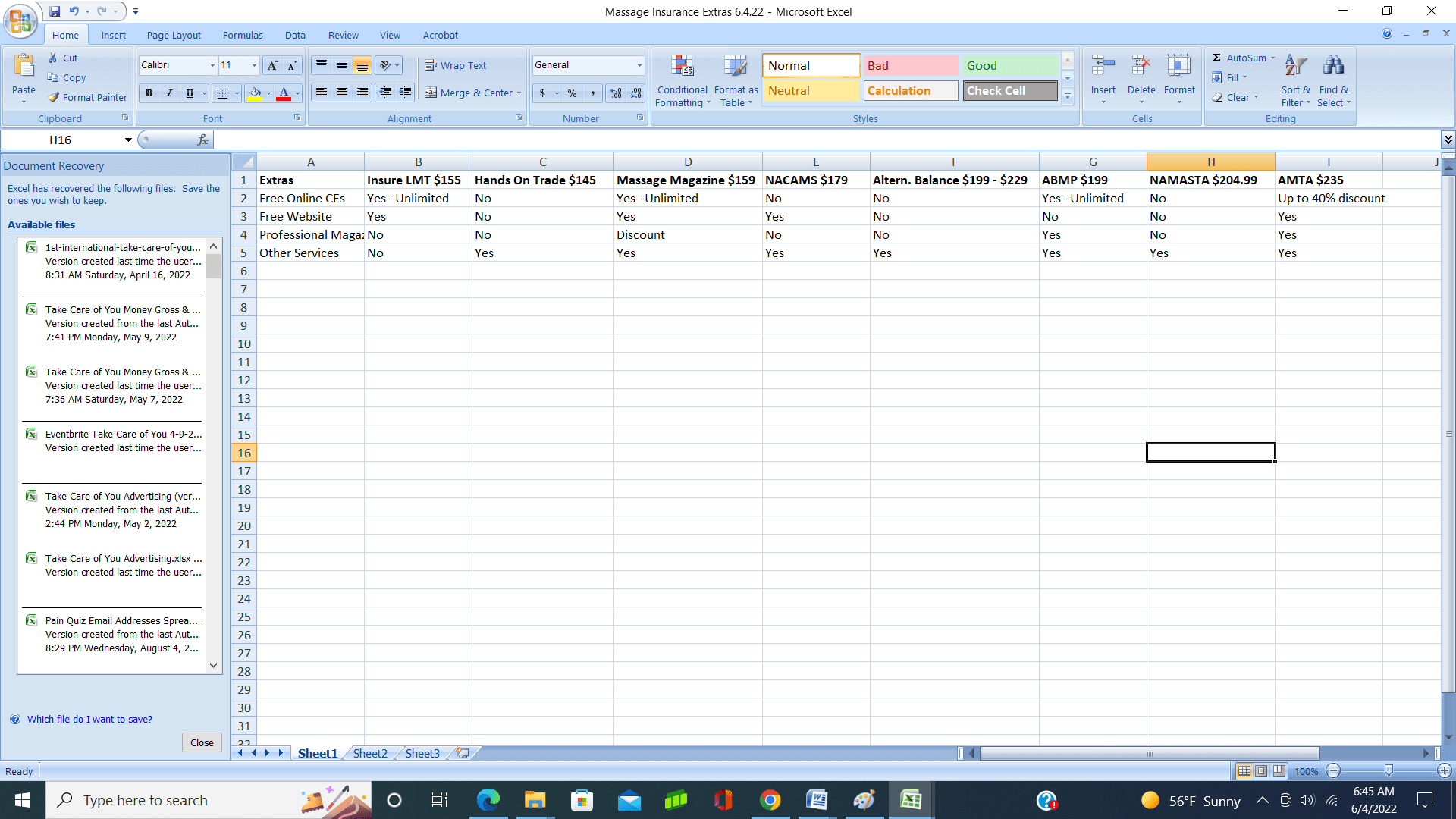
    Spreadsheet comparing cheap massage insurance extras with options with Insure Massage Magazine Insurance Plus, Hands on Trade, Insure LMT, NACAMS, Alternative Balance, ABMP and AMTA.

    At this point, if I were leaning towards buying insurance through a professional organization, I’d look at the column that is labeled “Extras” and decide which extras are important to me.

    Once you decide what’s important to you, it will be easier to select a professional organization that meets your needs.

    Free Websites Don’t Work

    Okay, I have to say something here.

    If you’re jacked about the free website you’re going to get with your insurance, don’t be.

    It will be as generic as vanilla ice cream and your URL will be unprofessional and make the client wonder if you can afford sheets.

    Build a massage therapy website yourself (as cheap as $60/year to start). 

    Okay, back to the business of picking insurance.

    Massage Insurance Bundle Deals

    You might be wondering if a bundle deal through a professional organization could save you money via the bonuses and perks.

    Good question.

    Here Massage Magazine Insurance Plus ($169) stands out because they offer unlimited online CEs and have solid insurance. Massage Magazine Insurance Plus also throws in $500+ in industry discounts..

    But before you whip out your Visa, here’s something to think about…is buying an insurance option with unlimited CEs cheaper than buying BBI at $96 of InsureLMT policy at $97 and getting your CEs elsewhere?

    Well, today I found 24 online CEs for $55. So, the answer would be you if you want the absolute, cheapest massage insurance and an online CE combo then buying an insurance policy with no bells and whistles and finding a cheap online CE provider can save you a little bit of money.

    But if you want cheap, no hassles and unlimited CEs always at your disposal, go with Massage Magazine.

    It’s Not Always About the Money

    But buying massage insurance through a professional organization isn’t always about money, right?

    Sometimes it’s about category 4–“Other”. In other words, it’s about having the support of a professional organization.

    For a deeper dive into “Other”, here are the links to the additional perks with each option. I’ll see you in the paragraph after the links. (Oh, warning: when you see the word “access”, that usually means you have access to something that you’ll have to pay for.)

    MassageMagazine extras

    HandsOnTrade extras

    MassageMagazine extras

    AlternativeBalance extras

    NACAMS extras

    ABMP extras

    NAMASTA extras

    AMTA extras

    How’d it go? Did one organization resonate with you? If so, maybe that’s the one to buy from. But before you do, let’s do a quick review.

    My Massage Insurance Cautions

    These massage insurance options fell significantly short of their competitors.

    In the Just Insurance category, the American Massage Council insurance coverage was the weakest

    And NAMASTA fell behind the rest of the pack in the Insurance with Extras category.

    But if you liked the extras NAMASTA offers, you could become a member (and get the extras) without buying the massage insurance from them.

    And in Conclusion…

    Does it seem like it’s getting complicated again?

    Let’s un-complicate it.

    Do you want cheap massage insurance?

    If so, go with the least expensive Insure LMT ($94) or Insure Bodywork (BBI) ($96) with higher coverage in damage to premises rented to you and medical expense coverage.

    Do you want cheap massage insurance and “free” CEs?

    Then go with Massage Magazine Insurance Plus ($169 with unlimited CEs and the massage industry discounts).

    Do you want the support of a professional organization?

    Decide which organization has the perks that are best for you. And if at the end of a year, it turns out to be a bad fit, you can always switch to another option.

    It’s your hard-earned money. 

    Spend it where it makes the most sense for your needs. 

    Frequently Asked Questions about Cheap Massage Insurance

    What type of insurance does a self-employed massage professional need?

    Another way of asking this question is: as a self-employed, sole proprietor, massage therapist, do I need additional insurance beyond massage insurance (professional liability insurance) such as a general liability policy (protects against third-party injuries or property damage occurring on your premises)? The good news is that most massage insurance policies have some kind of general liability protection included in their policies. Here are three examples: 

    1. American Massage Therapy Association (AMTA):

    • Professional Liability Insurance: AMTA provides professional liability insurance with coverage limits of up to $2 million per occurrence and a $6 million annual aggregate. This coverage includes general liability, which protects against third-party injuries or property damage occurring on your premises.

    2. Associated Bodywork & Massage Professionals (ABMP):

    • Professional Liability Insurance: ABMP offers professional liability insurance with coverage limits of up to $2 million per occurrence and a $9 million annual aggregate. This policy includes general liability coverage.

    3. Massage Magazine Insurance Plus (MMIP):

    • Professional Liability Insurance: MMIP provides professional liability insurance with coverage limits of up to $2 million per occurrence and a $3 million annual aggregate. This coverage includes general liability.

    What you have to decide: While these policies offer substantial coverage, it’s important to assess whether they meet your specific needs. For instance, if you own your practice space, you might need additional commercial property insurance to protect your equipment and workspace from damage or theft. Additionally, if you offer specialized services or have unique risks, you may require higher coverage limits.

    Best Practices:

    • Review Your Policy: Carefully read the terms and conditions of your insurance policy to understand the coverage limits and exclusions.
    • Assess Your Risks: Evaluate the specific risks associated with your practice, such as the value of your equipment, the nature of your services, and the location of your practice.
    • If you need more help, consult an Insurance Professional: Consider speaking with an insurance agent who specializes in massage therapy to ensure you have adequate coverage tailored to your needs.

    Do I have to have massage insurance?

    If you work for someone, they probably require massage insurance – and some states do, too. In addition, some cities and counties may have their own rules. You’ll have to do your research. 

    Can I get massage insurance if there is no licensing in my state or my modality is not recognized under massage state licensing?

    The answer is yes. For a deeper dive, go here to see the specifics and to find out which massage insurance providers don’t require proof of training.

    I don’t have the money upfront – are their policies I can buy month to month?

    Yes. Insure Bodywork (BBI) offers $9.99/month.


    Insurance Terms

    Here’s a list of insurance terms and definitions to use as a reference. All are taken from the HandsOnTrade website, except for one definition that is noted. I made one grammatical edit to Hands On Trade definitions.

    Claims Made Policy : Claims-made policies provide coverage only for claims that are made while the policy is active. If your claims-made policy expires, and someone files a claim against you later, you would have no coverage, even though you were insured at the time of the incident. (Osborne, Karrie, What Are Your Risks?, Massage & Bodywork Journal, January/February 2014.)

    Occurrence Based Policy: Insurance that pays claims arising out of incidents that occur during the policy term, even if they are filed years later or if the policy is no longer in effect.

    Malpractice: Professional misconduct or lack of ordinary skill in the performance of a professional act which renders the practitioner liable for damages.

    Professional Liability Insurance: The obligation that a professional practitioner has to provide care or service that meets the standard of practice for his/her profession.

    General Liability Insurance: A form of insurance designed to protect practitioners from liability exposures arising out of accidents resulting from the premises.

    Product Liability Insurance: Insurance on a professional practitioner from suits arising out of damage caused by a product used on a client.

    Damage to Premises: Property Damage to any one premises while rented by the Insured or in the case of damage by fire, while rented by the Insured or temporarily occupied by the Insured with permission of the owner of premises.

    Per Occurrence limit: This is the limit for all damages, whether property damage or bodily injury resulting from one occurrence.

    Aggregate limit: This is the maximum limit for all claims against you during the policy period. Each claim paid reduces the remaining coverage for the period until the aggregate amount is paid.

    Free Resources

    If you’re trying to build a massage business without spending a lot of money, this free program will help you out: Jumpstart.

    Check out more ways I save money on my resources page.

    Sign up to be in my email group to get my latest information.

    Last, if you find this information helpful and want to continue to hear a perspective outside the usual industry voices, please share this cheap massage insurance guide. It’s the only way this kind of independent insight gets out there—and it helps more therapists like us stay informed.

    About Mark Liskey: 

    Mark is not a bot. He is a business owner, neuromuscular massage therapist of 30+ years, teacher, writer and blogger. In this blog, he shares best practices for inexpensively growing a business. You can also find Mark’s articles here: Massage Magazine and Massage & Bodywork Journal. Mark loves working in his massage businesses – PressurePerfect Massage and Pain-Free Massage Therapist.


  • Sign Up For Make the Most of Massage Email News

    Get my latest post, articles and videos. It’s free. 🙂 Sign up below.

    Ways to Save Money and Build Your Practice:

    Massage Insurance: Who has the Cheapest Massage Insurance

    Website: Cheapest Way to Build a Website.

    Rent a Massage Room: How to Rent a Massage Room for Cheap.

  • Table Height is EVERYTHING!

    Table Height is EVERYTHING!

    What is the right massage table height for you? It is the table height that allows you to effectively deliver force without hurting your body. You’ll need to experiment to figure out what table height setting works best for you. In a few minutes I’ll give you my recommendations. But first, I have a question for you: What’s your table height set at now? Twenty-five years ago I was taught to set my table height this way: my distal knuckles should touch the top of the table when my arms were at my sides. Look on the Internet and you’ll find a range of table height advice, like: the height of your table should be your height divided by two. Though well intended, a standardized table height setting should not be your gold standard for setting your table height. Why?
    1. Different sizes.
    2. Different body part requests.
    3. Different pressure request.
    4. Different massage styles.
    5. Different chronic conditions and injuries.

    1. Different Sizes

    When I say different sizes I’m not just talking about massage clients–I’m talking about massage therapists, too. Let’s start with massage therapists.

    MTs Come in Different Limb Lengths

    Two people at the same height don’t necessarily share the same limb length.  Jennifer and Shanice are 64 inches tall. When they stand against the same massage table, Jennifer’s fingertips are 1 inch farther away from the table than Shanice’s. Imagine Jennifer and Shanice are leaning to apply pressure. Depending on the massage style of Jennifer and Shanice, a 1 inch differential in arm length could make a difference in how high or low each sets her table.

    Clients Come in Different Thicknesses

    Clients come in all sizes. Ricardo, who weighs 305 lbs, is “thicker” than Jamar who weighs 150. That means if Ricardo and Jamar were lying on a table side-by-side, the top of Ricardo’s body would be an inch or two higher off the table than Jamar’s. If you set your table height at the Jamar level for each massage, you’d be giving up an inch or two of leaning leverage when working on someone big, like Ricardo.

    2. Different Body Part Requests

    When a client is lying on the table, body parts stick up at varying heights. For instance, glutes will stick up off the table higher than calves. If you’re focusing on glutes and your table height is too high, you won’t be able to generate enough pressure from leaning.

    3. Different Pressure Requests

    Light pressure is less important in terms of dialing in on table height. A high table can help keep the flexion out of your back and a low table is workable if you know how to use the massage table for support. However, a request for medium or deep pressure should make your ears prick up. In general, when talking about leaning to generate pressure, medium and deep pressure require you to apply more force. You safely do that by leveraging more of your body weight onto the client and/or driving from your legs. Whether you are more of a using-your-body- weight leaner or a driving-from-your-legs leaner depends on your massage style.

    4. Different Massage Styles

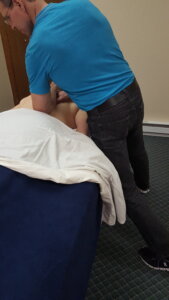
    Which body part would you pick to work on hamstrings using medium to deep pressure? Are you an elbow/forearm or a fist/knuckles or a palms/fingers massage therapist? Knowing which body parts you’ll use the most during a massage is a key for setting your table height at the beginning of the massage. If you’re a forearm/elbow MT you’ll need less leaning leverage than you would if you’re a fist/knuckle MT. So your table will probably be higher. What about your techniques? Are you more of an ischemic compression/trigger point therapist or gliding/relaxing therapist? My massage emphasis is ischemic compression/trigger point so I look more like a chiropractor when I massage, meaning I’m taking full advantage of my body weight to generate pressure by working on a low table. A forearm massage therapist who doesn’t need to be over the table may prefer a higher table to lean into. In a lunge stance she doesn’t need to use all of her body weight to generate force because she can drive from her back leg.

    5. Different Chronic Conditions and Injuries

    The last thing you’ll need to consider when setting your table height are any chronic conditions and injuries you have. I started out my massage career as a forearm/elbow massage therapist. Twenty years into massage the forearm/elbow technique hurt my neck and shoulders. So, I switched to fists/knuckles. In order to be able to transfer all of my body weight onto the client if I needed to, I lowered my table, much lower than when I was a forearm/elbow massage therapist.

    Set Your Table to Save Your Body

    At this point you may be thinking that setting your massage table height to save your body is crazy complicated. It’s not. It just requires asking yourself some basic questions and then doing some experimenting

    Table Height Experiment

    Step #1: To get your general go-to setting pick the body part that you use the most to massage with (e.g., forearm, fists, knuckles, palms, massage tools) and start leaning at your normal table height setting. This will be your baseline to compare higher table and lower table leaning. If you’re already using your body weight to generate pressure, then skip to the next step. Step #2: Try leaning at a table height higher, one notch, than your normal table height. Step #3: Try leaning at a table height lower than your normal table height. For a lower table I recommend experimenting with one notch if you’re a forearm person and no more than three, until you get used to low table leaning, if you’re a fist person. If you’re new to low-table leaning, you’ll want to read this article before you start experimenting—How to Use the Massage Table for Support. As you experiment with leaning keep these things in mind: If you’re leaning in an asymmetrical (lunge) stance, lock your back leg and drive from your back foot to generate extra force. If you’re leaning on a low table make sure that your using the table for support. Once you have your go-to table height nailed down, you can then make situational adjustments as they come up.

    Making Adjustments on the Fly

    For instance, let’s say your normal table height was 30 inches but your new go-to table height is 31 inches. Thomas is your next client and he’s really thick. So, you decide to lower your table to 30 inches so that you can lean more effectively. Or your normal table height was 30 inches and your new go-to table height is 24 inches. Tara is you next client and she is thin and likes light pressure. So, you decide to raise your table up to 26 inches so that you can be more upright without having to use the table for support. Personally, I set my table height as low as possible (with the lower table legs off) so that I am always prepared for deep pressure. The challenges with using the lowest table setting for each client means that I’m not at an ideal table height for light pressure requests and thin clients. I get around the body mechanic challenges by adapting to a low table. Specifically, I use the massage table to support my body weight and help me regulate pressure. And I break static posture when I want to stretch my back or get vertical. .

    Set Your Massage Table Height Recap

    Set your table height so that you can lean effectively and pain-free. Leaning allows you to take your upper-body out of the massage and can reduce neck, shoulders and arm strain. Your go-to table height may be your current table height or it may be lower or higher than your current table height. You won’t know until you experiment. Start your experiment by leaning at your current table height. Then try leaning at a lower and higher setting. When you’re in a lunge stance (asymmetrical stance) lock your back leg and drive from your back foot to generate more force. When you’re in a parallel foot stance on a low table use the table for support and shift your body weight to the balls of your feet so that you can leverage all your body weight onto the client if you need to.

    Learn my approach:

    If you want to learn my approach and body-saving techniques when doing medium to firm pressure, I have an online CE course that will help you out: How to Deliver Deep Pressure Without Hurting Yourself (3 CEU).

    Questions?

    I am here. Email me a mark@makethemostofmassage.com! 🙂  
  • How to Rent a Massage Room For Cheap

    How do you rent a massage room for cheap?

    1. Find a business in the health/wellness field that has a waiting room and a room that serves as a massage room or could work as a massage room.
    2. Meet with the owner/manager of that business and propose a per-massage or a share-the-room rent agreement.
    3. If the owner/manager wants a one year rent deal, then propose that the first 3 to 6 months of the agreement be a pay-per-massage arrangement.

    Okay, so those are 3 important steps for renting a massage room for cheap.

    But there’s a whole lot of in-between that needs to be filled in for this to get off the ground.

    Affordable Massage Room

    First, let’s make sure we’re on the same page.

    You have no money and you want to work on your own, right?

    How the hell do you afford a massage place?

    Well, you can’t actually afford a massage place.

    So, get that picture of clients walking into your waiting room out of your head…at least for now.

    Okay, so how about affording a massage room?

    Yeah, that ain’t happening either.

    If you are as broke as I was when I first started out, we’re talking you can afford to do massage in the Walmart parking lot…if you have enough gas to get there.

    But as I had mentioned before there’s a way around this pesky needing-money-to-rent-a-room thing,

    It’s called pay-per-massage.

    First, instead of renting a space that has a room and a waiting room, you look for someone who is already renting that type of space.

    Let’s say Tylese has a yoga studio and is paying $2500 a month in rent.

    And she says that you could sublet a room from her for $500 a month.

    Wait, Mark, $500 a month is more than the “nothing” upfront you said that I could pay!

    Okay, so instead of subletting the room from Tylese for $500 a month, you ask her if you could pay her a percentage of each massage as rent.

    Pay Per Massage

    So, if you charge $70 for a 60 minute massage, you might agree to pay 20% of what you collect for a 60 minute massage.

    In this case, you’d pay Tylese $14 every time you did a 60 minute massage.

    The great thing about paying a percentage per massage is that you don’t have to put any money out to rent space. You pay as you go (after you collect the money from the massage).

    The disadvantage is that you don’t “own” the room 24/7. In other words, since you’re not paying a monthly rent, Tylese can/will rent that room out to other practitioners on an hourly basis.

    But a goal could be that once you got busy enough, you could sublet the room month-to-month instead of paying per massage and make that space 100% yours.

    That’s what I did. More about that later.

    Find the Pay Per Massage Place

    So, where do you find a place that would let you massage your clients on a per massage basis?

    They’re all over. Here’s a short list to work from:

    1. Wellness center
    2. Chiropractor
    3. Yoga studio
    4. Pilates studio
    5. Acupuncturist
    6. Personal training studio
    7. Independent fitness center/health club

    Don’t go after chains, like LA Fitness. Chains usually have a corporate way of doing things. Look for that local fitness center where there’s more operating flexibility.

    1. CrossFit and other boutique workout facilities

    If you don’t like doing body-parts massage and are not workout oriented you may want to pass on programmed work-out places.

    1. Massage businesses

    Some massage businesses will offer a “pay per massage” deal to independent MTs as a way to offset operating costs. You just have to ask around.

    1. Physical therapy offices

    National physical therapy companies won’t bite, but the local PT business operating as a wellness center could be willing to talk to you. More about that here: How to Get Your Massage Into Mainstream Medicine.

    Before you start working your list you need to know one more thing.

    You’re not only looking for a massage room to use on a per massage basis, you’re also looking for a good business relationship.

    The Relationship Part of the Deal

    To me that means that the person I’m making the deal with shares the same core business values that I do.

    One of my core values is to provide above-and-beyond care for my clients—which brings me to my pay-per-massage, success story.

    Years ago, some of my clients lived far away from my massage office. Getting to me during rush hour was becoming a strain and I needed to find a space closer to them.

    So, I talked to a chiropractor, Heather, who had an office in the area that was closer to these  particular clients.

    Heather and I hit it off right away, and we shared core business values, like the client/patient relationship comes first. So, we struck a deal ($10 per massage) and I used one of her spare  rooms to do massage on a pay-per-massage basis.

    Within a year or two my practice at this location grew, and I switched to subletting the room from her for a monthly rate ($200/month).

    Now the room was 100% under my control. I was paying way less than if I went out and rented a space on my own. And Heather and I had a great relationship and often referred patients/clients to each other.

    Eventually, my wife and I opened up a massage office in the same building where I had sublet a massage room from Heather.

    Don’t Do This

    On the flip side, here’s what you don’t want to do when you don’t have any money to rent a room: Go into debt renting office space with no viable plan to bring in clients.

    Paying more than you can afford is a mistake that everyone can make, even experienced MTs.

    My friends Liz and Jamar, a husband and wife team, had been doing massage for a while. Each had solid followings, and they decided to start a wellness center using a “build it and they will come” business plan.

    The wellness center had a beautiful, grand room that could be used for workshops/group classes and a bunch of high ceiling rooms that could be used as offices for a variety of health practitioners.

    Liz and Jamar waited…and waited…and waited…but no health practitioners came.

    I was one of the health practitioners they were waiting for.

    Why didn’t I go?

    It didn’t make sense for me to because my source of clients came from the fitness center where I had my office.

    Eventually, Liz and Jamar closed their wellness center and began to work their way out of tens of thousands of dollars of debt.

    Massage Room on the Cheap In a Nutshell

    When you’re first starting out, think minimal expenditures.

    Find a deal where you can pay for a massage room on a per massage basis, but make sure you and the person you’re dealing with share core business values.

    As you get more clients, move into the monthly sublet.

    When you out grow that room you can rent your own space where you are a stand-alone business.

    Other Ways to Save Money

    As you know already, you have to run lean to make it in the beginning of your business startup. So, it’s especially important to not only save money with rent, but also to save money everywhere else you can. The great thing about saving money from the get-go is that the savings will add up to thousands and thousands of dollars over the lifetime of your business.

    Start saving more money by finding cheap (but good) massage insurance.  If you don’t have a website, build a website for cheap. As your your word-of-mouth marketing grows, gather new clients email address and pick a free email service and market your new services and special deals to your clients. Finally, get as much free advice as possible. My startup advice is here in a free program I call Jumpstart. If you are in the US, use this free business mentorship service.  I use it all the time!

    I hope that you are starting to see that there are many different ways to start and run a business expensively, but you will have to DIY it. That’s okay. I did it. You can do it. And I’m here to help (mark@makethemostofmassage.c0m). 🙂


  • 3 Tips (Not 10) to Get Massage Clients

    Here are 3 massage marketing tips that produce big results, won’t cost you any money and are within your current marketing capability to implement (even if you’re just starting out as a massage therapist). Ready? 

    1. Stop doing everything that marketers tell you to do.
    2. Run a special.
    3. Do demo massages.

    Hey, I’ve been where you are now–binge watching massage marketing videos on YouTube, hoping to get my marketer on by trying to be something I’m not.

    So much failure.

    So much angst.

    But here’s the thing, you don’t need to acquire a whole new set of skills to build your business.

    In fact, you already have the best marketing tool.

    You.

    You do a good massage and you have great customer care.

    That will sell.

    You just need the opportunities to demonstrate those skills to potential customers, which brings us to…

    Massage Marketing Tip #1: Stop doing everything that marketers tell you to do.

    I know that sounds weird, but it’s not once you let this thought marinate.

    Marketers are all about getting people to call. And you obviously can’t win a client over if she doesn’t call.

    But their marketing will either cost you money–you know that money you were saving to get that cavity filled–or time.

    The money part is straightforward.

    Online ads cost money. Marketing services aren’t cheap. Website designers probably ain’t gonna barter.

    The costing time (which is actually money, too) is harder to see.

    Here’s what I mean. 

    You download a 20 Ways to Market Your Massage for Free e-manual. 

    Okay, so which idea are you going to start with?

    Has the idea been tested in a real world situation?

    How long is it going to take to see a dollar return on your time investment?

    Do you need to do all 20?

    You try one. It doesn’t really work.

    You try another.

    But then you wonder if you gave up on the first one too soon.

    So, you do the first one and the second one together, but things are going too slow.

    Cats are hungry. Bills are backing up. Taxes are due.

    You add a third and a fourth and a fifth tactic.

    Now you’re going in a thousand different directions.

    At the end of the day you’ve invested tons of time for a small, income bump-up.

    So, all marketing is a waste of a time except what you’re suggesting, Mark?

    Absolutely not.

    I’m not saying don’t ever do any other marketing other than what I’m about to tell you here.

    I’m saying, if you are just starting to build your massage business or you need to grow a meh business, try these two next two tips first because (1) you already have the skills to make these tips work, and (2) from my 25+ years of owning a massage business, I know that these two tips work.

    Before I go on, I want to explain how the rest of this article is laid out. I’m going to show you how to apply the next two tips for two different stages of a massage business—just starting out and a meh business that needs to jump to the next level. So, you’ll see under each tip the headings “Just Starting Out” and “Meh Massage Business”.

    Also, at the end of the article I’ve added an additional marketing tip for COVID-19, not because the other two tips  don’t work during COVID-19. I’ve added the additional tips because in order to maximize your marketing effort now you need to adapt to what has changed in the massage world as a result of COVID-19.

    Onward.

    Massage Marketing Top #2: Run a special.

    Just Starting Out Massage Business – Run a Special

    I’m going to be blunt: Get used to the idea of “discount” and “free” for a while.

    And devalue my service?!

    Yes.

    And free massage is a pain in the ass because it’s a lot work for no dollars.

    Oh, also, your ego will be bruised because you know that you’re worth more than “free” and “discounted”.

    So what’s the upside?

    Clients. Lots of them.

    And here’s how you’re going to do it.

    The easiest way to run a special is to run a Groupon.

    But I don’t have a massage room, Mark.

    Read this post. It will help you figure that out. What else you got?

    Groupon is soooo 2010.

    True. But it still works to bring in clients AND it’s not something that you’re going to do for a long time.

    Doing a Groupon is just an initial way to get people walking into your massage room quickly.

    As soon as you have enough clients to the leave the job you hate, bye-bye Groupon.

    Still having trouble breathing?

    I know, it’s gonna suck a little, but I promise that when you get through it, you’ll thank me.

    This may help you persevere.

    My Groupon Experiment

    In 2014, I wanted to re-energize my practice in one of my offices. I ran a Groupon, Living Social and Amazon Local (no longer in existence).

    Back then, here’s how it worked. I pretended my 60 minute massage was $80 because Groupon was going to sell it at half price.

    If I had said $70 (what I charged at the time), the half price would have been $35. Halving $80 took us to $40 (they actually sold it at $39) which meant an extra $5-ish to carve up between Groupon and me.

    Of the $39, I kept $20-ish on average. (I ran a couple Groupons and with each new contract the percentages changed.)

    Hang in there. The numbers get a little bit better.

    More Math

    Average tip for me when someone redeemed a Groupon was $10. So that put me at $30 an hour.

    Of course, you have to subtract sheets, cream and rent. So let’s say I was making $25 an hour.

    Okay, so that’s still way low for an hourly rate (including tip) BUT think about this, you’re not only getting paid to do a massage with Groupon, you’re getting paid to advertise with your hands.

    Each Groupon customer who walked through my door was a potential client and/or a referral source. I just needed to win some over.

    More Clients

    By the way, all Groupon buyers are not discount shoppers. My client repeat rate (meaning the person came back for another massage at full price) was around 15%. So for every 100 Groupons, 15 became clients.

    Who became my clients?

    People who got massage regularly and were actively looking for a new massage therapist, massage therapists who were looking for a massage therapist for their aching arms and shoulders, and people who were new to massage.

    So, I made some money and got some new clients and there’s more…drum roll please…

    More Goodies

    When my Groupon first launched, I got a small response. That was disappointing, but what I didn’t realize was that Groupon sales are driven by reviews. Once I started to get positive reviews, my Groupons really started selling.

    What I also didn’t get at the time was the importance of reviews for my overall business. Once I got a bunch of positive Groupon reviews, I could use them in my advertising anywhere, like on my website.

    And last but not least, I collected about 150 customer email addresses. Easy as pie to do.

    We have a line for an email address on our intake form. You can download our intake form here: Massage Intake Form Download Final 

    Once you have names and email addresses you now have a list. Here’s a quick primer on how to engage and sell to that list: How to Email in More Clients.

    When You Can Stop

    I stopped my Groupons after about 200 sales. At the end of the day, I had more money in my pocket, about 30 new clients, 150-ish new email addresses and good reviews that I could use to help advertise my services.

    Oh, there’ll be a percentage of Groupon customers who don’t redeem their vouchers. You still keep the money. For me it was probably in the 20% range.

    If you’re trying to take a meh business to a great business with tip #2 (run a special), do this:

    Meh Massage Business – Run a Special

    First, yes, I’m going to ask you to do a special, too. But your  special will be different special than the Starting a Business group.

    Why?

    You don’t a crush of clients coming in at once to get your business off the ground because your business is already off the ground even if it’s flying low. Instead of an onslaught of new clients coming in, you need a consistent flow of new clients, like one or two each week.

    Enter the one-time, introductory massage special.

    I know that I’m treading on thin ice again because a lower price seems like you’re devaluing your service, but I’ve got proof that a one-time lower price does NOT ultimately devalue your service.

    I’ll show you the proof in a minute. First, I want to explain the introductory massage special rationale.

    I just told you about my Groupon experiment and how successful that was.

    A special introductory massage price can work the same way. You offer a lower price than your normal rate just to get clients through the door.

    I learned this tactic from national massage spas.

    A while back I was doing some espionage work at a national massage spa and the massage spa was running an introductory special. It worked. In fact, that massage spa chain still runs an introductory special.

    By the way, that’s my proof that an introductory massage special works. If it didn’t, massage chains would have stopped doing it years ago.

    I have more proof. It works for my business.

    Yes, some new customers are one and done, but that’s okay—one-and-done(s) pad my book and can produce referrals. And though I haven’t been tracking this on a spreadsheet, my Spidey senses tell me that I’m getting more repeat clients than I would with a Groupon.

    Why?

    Because the people who are taking advantage of the introductory massage special rate are paying less than my normal price, but more than they would for a Groupon massage rate. That means that I’m keeping the bargain basement shoppers away.

    A bonus to an introductory massage special is that anyone who comes in—no matter if she becomes a return client or not—has the potential of spreading the word about my business.

    That’s cheap advertising.

    But how do you go from intro rate to normal rate, Mark?

    For point of reference, our normal massage price is $80/hr. Our introductory massage special is $59/hr, the same introductory price of the local massage spa nearby.

    The conversation of $59 to $80 for the next appointment is easy.

    First of all, most first-time clients are aware that they’re paying an intro special rate, especially if they’ve found us online or saw one of our signs.

    Many ask: How much is the regular price?

    I tell them and then throw in that we have a no tipping policy so that they know that will be their out-the-door cost.

    Others already know our regular price and just ask for confirmation.

    The beauty of this approach is the same as it was with Groupon—you got your hands on the customer which is your best shot at getting her/him to come back, and, in our case, pay $21 more.

    Here’s the next marketing tip.

    Massage Marketing Tip #3: Do demo massage.

    Just Starting Out Massage Business – Do Demo Massage

    This is not a willy-nilly process.

    You’re going to target specific referral sources, health practitioners who don’t rely entirely on insurance money and businesses that might be a good fit with massage, like a running or bike store.

    I go into detail about how to do demo massages in How to Grow Your Massage Business with $0. Here’s the short version:

    1. Target a health professional you respect. Her business model should include, if not solely be based on, cash paying customers.
    2. Target a business that’s a fit with massage. Think running store, bike store or a yoga studio (that doesn’t offer massage).
    3. Offer this deal: 15 minute demo massages to their clients, patients or customers.
    4. Offer the owner of the business and her employees free 30 minute massages. Ultimately, the owner and her employees are going to be your best, on-going referral source. Treat them nice!
    5. If things go well, look for other ways to connect with your referral source, like doing a promotional event together, providing a free massage gift certificate for an event they are doing, and/or linking websites.

    Okay, so now you’ve got a lot of good stuff going on. Once you feel like you’re getting enough of a customer base to reach your goal, stop the Groupon, but keep the demo massages running.

    In other words, run a Groupon to initially get massage clients. Then get the hell out (but keep doing demo massages)!

    Value Up

    Now you can start to work on “valuing up” your massage again.

    It’s an easy fix.

    When someone calls and asks for the Groupon deal price, you say no.

    Your value just went up:-)

    Avoid Mission Creep

    So, if you’re motivated now, good, but you need to be vigilant here.

    Because in the time it takes to get your Groupon and demo massages set up, you’re going to find a list somewhere that says you should make a brochure or hand out 15 minute gift certificates to people you know so that they can hand them out to someone they know…do you see where I’m going here?

    It’s so much easier to hand out a brochure or gift certificate than it is to lay it on the line and actually demonstrate your value.

    But in the beginning if you focus on advertising massage through your hands, you’re going to drive a respectable amount of customers through your door in a short period of time.

    Getting Massage Clients Via Groupon & Demo Massages

    Remember the end game for strategically running a Groupon is new clients, referrals, money, good reviews, and growing an email list.

    Get in, get out.

    By the way, 99% of my Groupon customers were great. Of the bad ones, one was rude and the other was odd (but not in a dangerous way; I think she was self-medicating).

    Also, you’ll need a website to run a Groupon deal.

    If you don’t have one, you can make one fast and for less than $70 for the year: How to Build a Website FAST.

    Doing demo massages, on the other hand, is a long term tactic that will build the relationships that you’ll need to sustain your business.

    Believe me when things get rolling, you’re gonna have some fun:-)

    Okay, now to apply tip #3—do demo massage—to a meh massage business.

    Meh Massage Business – Do Demo Massage

    I’m going to insult you again. Sorry. You know how to get a business started. Think about what you did—you built your practice so far mainly through referrals, right?

    Here’s the insulting part: You didn’t do enough of it.

    That’s the main reason why you’re stuck with a business that just pays the bills.

    You need to create referral machines.

    A referral machine can be a client. It can be a business you engage. It can be a health practitioner with whom you co-ordinate client care.

    But you can’t have a referral machine unless you got out and find them.

    The easiest way to find referral sources who are not clients is to offer free, demo massages (in your office during COVID-19).

    If you’ve already done this to get your business off the ground, do it again.

    But this time be more persistent and strategic with your demo massage offerings.

    Persistent: If you can’t reach a potential referral source via calling, try emailing.

    If the person you are trying to contact in a particular business isn’t responsive, try another person.

    I spent a year trying to get my foot in the door with a local running store. The person I was talking to was super-nice, but wearing too many hats. I almost gave up, then one day I said, Screw it, and I walked into the store and the manager was there.

    We hit it off and the manager and I have become good friends and business allies.

    So try thinking this way when you hit what seems to be road closure:

    I will not stop until I have a physical therapist or PTA referral source.

    I will not stop until I have a chiropractor referral source.

    I will not stop until I have a business referral source (e.g., running store, bike store, yoga studio).

    I will not stop until I have a personal training studio referral source.

    Strategic: Don’t offer demo massages to a chiropractic who offers massage therapy in her office.

    Spend less time on referral sources that aren’t producing; double-down on ones that are.

    When you have a client who is seeing another health practitioner for the same issue she is coming to see you for, reach out to that health practitioner to coordinate care AND offer free, demo massages to her and her staff.

    Okay, when you reinvest your energy into your practice, you’re going to feel like you’re starting over and that you’re too good for free, demo massages. I get it. That’s how I felt when I was stuck with a 40K business, but had been doing massage for a while.

    But those feelings and thoughts will vaporize once you find the referral sources that truly value your service and provide a steady flow of referrals.

    Here’s the recap for meh business owners when applying tip #2 (do demo massages):

    Recharge your current referral sources by double-downing on the referral sources that are working.

    Stop spending time on the referral sources that aren’t great.

    Find new ones by offering demo massages.

     Okay, those 3 marketing tips—(1) stop doing what marketers tell you to do, (2) run a special, (3) do demo massages—are evergreen tips. In other words, they work no matter what’s going on.

    Massage Marketing Tips in a Nutshell

    We got a lot covered. Let’s do a recap.

    Massage Marketing Tip#1: Stop doing everything marketers are telling you to do.

    Listen to me instead. Haha.

    Well, listen to my experience as a massage therapist who took his business from 40K to 80K+.

    Massage Marketing Tip #2: Run a special.

    If you’re starting out try a discount coupon service like Groupon.

    If you’re massage business is meh, try an introductory massage special.

    Massage Marketing Tip #3: Do demo massage.

    Find potential referral sources by offering free, demo massages. If you’re trying to take your massage business to the next level, double-down on the referral sources that are working, eschew the ones that aren’t and go get more.

    How to Keep it Going

    If you’re ready to start a massage business or take a meh massage business to the next level, then I have two courses  that can help you out.

    If you’re starting a massage business, this course will give you everything you need to know to launch and take your massage business to 30K: Jumpstart. (And it’s free.)

    If you need to take a meh massage business to beyond paying the bills (80k+), then this course will finish the job for you: Accelerator.

    Have a question? Ask me anything (mark@makethemostofmassage.com). I’m not going anywhere:-)


  • The Power of “I Don’t Know” in Business Growth

    The Power of “I Don’t Know” in Business Growth

    The Power of “I Don’t Know” in Business Growth

    I stared at the numbers on my screen. We were expanding our massage business, bringing in more therapists to grow our business. The math was simple and terrifying: to support these new team members, I needed to double our client intake rate. Double. I had successfully grown the business to its current size, but this felt daunting.

    “How do I double our client base?” I asked myself. The answer came immediately, with uncomfortable honesty: “I don’t know.”

    The Power of Three Words

    Most of us have been conditioned to view “I don’t know” as professional suicide. In boardrooms and classrooms, on sales calls and job interviews, admitting ignorance feels like waving a white flag. We equate knowledge with competence, and uncertainty with incompetence. This conditioning creates a false choice: either know everything or face inevitable failure.

    But what if we’ve got it backwards?

    Reframing the Moment of Not Knowing

    “I don’t know” isn’t an ending—it’s a beginning. There’s a profound difference between willful ignorance and acknowledged gaps in knowledge. When we honestly assess what we don’t understand, we’re not admitting defeat; we’re demonstrating wisdom and self-awareness.

    The moment I acknowledged my uncertainty about doubling our client base, something shifted. Instead of pretending I had all the answers or spiraling into panic, I had created space for actual problem-solving to begin.

    From Defeat to Discovery

    Our brains are wired to interpret uncertainty as danger. When faced with the unknown, we experience what feels like doom, despair, or defeat. But this discomfort doesn’t have to be a stop sign—it can be a growth signal.

    Just as physical discomfort during exercise indicates muscles adapting and strengthening, intellectual and emotional discomfort often signals we’re approaching a breakthrough.

    The key is to recognize “I don’t know” as an inflection point. This is where growth happens because forward movement requires us to figure something out. We can’t coast on existing knowledge; we must expand our capabilities.

    The Seeker’s Advantage

    When I admitted I didn’t know how to double our client base, something unexpected happened: I felt liberated. The pressure to be the all-knowing expert lifted, replaced by permission to become a unabashed seeker and discoverer.

    This shift in identity carries real advantages. Experts often become trapped by their existing knowledge, filtering new information through old frameworks. Seekers, however, approach problems with beginner’s mind—curious, open, and unencumbered by assumptions about what will or won’t work.

    Business coaches have told me that curiosity often beats out credentials. While expertise has its place, the ability to learn, adapt, and discover provides a competitive edge in our rapidly changing world.

    Building Your “Not Knowing” Muscle

    That first honest admission—”I don’t know how to double our client base”—became my reference point. Instead of wallowing in uncertainty, I got to work:

    First, I focused on the big rocks—the marketing activities that would have the greatest impact. No more scattered efforts across dozens of small tactics.

    Second, I created a concrete plan with specific timelines and measurable outcomes.

    Third, I built in regular evaluation periods to assess what was working and what needed adjustment.

    Fourth, I got serious about knowing my numbers, developing key performance indicators (KPIs) that would guide decision-making.

    Each step forward built confidence for the next moment of uncertainty. I was creating a personal reference bank: proof that not knowing something didn’t have to derail progress.

    Did I Succeed?

    To be determined.

    Sorry. I’m still in the throes of doubling our business. However, the numbers show we are moving in the right direction—and we have a plan that we can test and tweak as we go along, all born from the words “I don’t know”.

    Will you succeed?

    I don’t know.

    No one knows when they try to start, grow or build something. It’s just part of the deal of moving into a new space.

    So, say it out loud: “I don’t know.”

    It’s okay—it’s reality.

    Now, figure it out. 😊

    P.S. If you need help, grab a SCORE mentor. There is no cost. If you want to throw a question my way, I’m here: mark@makethemostofmassage.com.

    FAQ Section

    Q: Is saying “I don’t know” bad for business?
    A: Not if it’s followed by a plan to find the answer—it can actually build trust and lead to innovation.

    Q: How can I use uncertainty to grow my business?
    A: Treat uncertainty as an opportunity to learn, adapt, and explore new strategies.

    About Mark Liskey: 

    Mark is not a bot. He is a business owner, neuromuscular massage therapist of 30+ years, teacher, writer and blogger. In this blog, he shares best practices for inexpensively growing a business. You can also find Mark’s articles here: Massage Magazine and Massage & Bodywork Journal. Mark loves working in his massage businesses – PressurePerfect Massage and Pain-Free Massage Therapist.

  • Your “About” Page Matters More Than You Think

    If there’s one page on your massage website you shouldn’t overlook, it’s your About page. According to massage website expert Gael Wood, it’s often the most-visited page on your site. Why? Because it’s where potential clients go to decide if they trust you.

    That means your About page shouldn’t just be a list of credentials or modalities. Yes, your training matters—but people want to know who you are and why you do this work.

    In an article I wrote for Massage Magazine, I dig into how to make your About page more effective. A few highlights:

    • Start with your “why.” Why massage? What do you love about it? That’s what builds connection.

    • Avoid the laundry list. Instead of stacking credentials, tell a story your clients can relate to.

    • Build trust. Help visitors feel what it’s like to be on your table—safe, seen, cared for.

    👉 You can read the full article here: How to Craft the Perfect About Page for Your Website

    Want to see what that looks like in action?
    Check out my own About page: www.pressureperfectmassage.com/about.html

    Bonus tip: You can use ChatGPT or other AI tools to help shape your About page—but be careful. AI can sound stuffy, overly repetitive, or just off. It’s a great tool to get started, but always go back and make it sound like you.

    Because in the end, your About page is a trust builder—and trust builds business.

  • Why Pain-Free Massage is Possible


    I used to think pain was part of the job.

    I’d finish a day of deep tissue work with my wrists barking, my shoulders stiff, and my thumbs barely able to hold a pen. I told myself it was just the price of helping people.

    The problem is, that price adds up.

    Pain isn’t a badge of honor. It’s a warning sign. If your hands hurt, your body’s telling you something. And if you ignore it long enough, it’ll make sure you listen—by cutting your career short.


    You can do excellent massage work—deep, effective, therapeutic work—without hurting yourself. But you’ve got to unlearn some things first.


    1. You have to stop muscling through sessions.

    This is the big one. Most therapists rely too much on their hands, arms, and shoulders to generate pressure. That leads to burnout fast. Muscling through every stroke might get you through the session—but it won’t get you through a long career. You shouldn’t be using your strength to deliver massage. You should be using your structure.

    2. You have to rethink what “deep” really means.

    Clients say they want deep tissue, but what they really want is results. You can create depth through slower pacing, better body mechanics, and focused attention—not just by pressing harder. Real depth isn’t about pressure. It’s about intention, engagement, and staying connected to the tissue without overloading your own.

    3. You have to start using your body the way it was built to move—by leaning, not pushing.

    Leaning lets your body weight and gravity do the work. It protects your wrists, thumbs, shoulders, and neck.

    When you lean in from your core—not just from your arms—you create pressure with less effort. You stay relaxed. Your strokes become smoother and more sustainable. Over time, you’ll be shocked by how much you can get done with less strain.


    These days, I do most of my work seated. I’m not exaggerating—my colleagues joke that I sit for 80% of every massage. And they’re not wrong. I lean, I work close, I let my body weight do the job instead of my hands.

    In essence, I’m efficient and effective—and I’m not in pain at the end of the day.


    Pain-free massage is possible because pressure doesn’t have to come from shear muscular force. It can come from smart mechanics. From gravity, body weight and alignment.

    When you stop pushing and start leaning, when you stop working against your body and start working with it—you protect your hands and your career.

    And that’s what we’re going to build together here.

    More body mechanics information at www.painfreemassagetherapist.com