Author: Mark Liskey

  • How to Stretch Your Back (While Doing a Massage)

    How to Stretch Your Back (While Doing a Massage)

    One of the great things about relaxation massage is that you can go on automatic pilot. And when you’re on automatic pilot, you can still do a good job even though you’re thinking about other things. Not so long ago, I discovered another benefit when I’m on automatic pilot: I can work on my posture.

    My Terms Didn’t Work 

    For the first decade and a half of my massage career, I did massage on my terms. I used my upper body to deliver deep pressure and stuck my elbow anywhere I felt like it. But eventually, “my terms” caught up with me, and, well, kicked my butt.

    As my body started to falter, I was forced to pay attention to how I was actually executing the massage. Over time I figured out massage strategies and techniques that didn’t aggravate the persistent conditions I had, like cervical radiculopathy.

    These strategies and techniques often involved establishing a neutral back (neither flexed or extended). When I was implementing these techniques, I’d notice that I was sometimes struggling to maintain good posture. That’s when I started to experiment with ways to re-establish a neutral back while doing a massage.

    Here are my 3 favorite improve-your-posture moves:

    Back Stretch/Reset When Working the Occiput

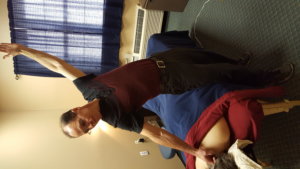
    One time a client wanted a ridiculous amount of pressure in his occiput. He was a big person and my thumbs weren’t cutting it. I was in the early stages of experimenting with leaning and had my table low. I decided to lean into his occiput with my knuckles (middle knuckle transmitting the most pressure).
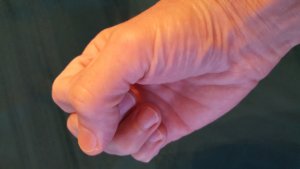
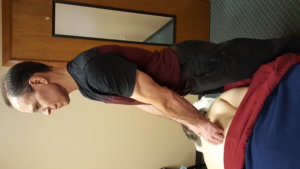
    It was a huge success. It saved my thumbs, and I could generate more pressure. Here’s what it looks like:
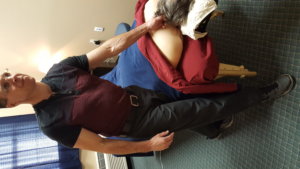
    It works with a T-bar, too.
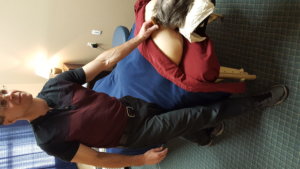
    With a lot of deep pressure techniques I have two hands on the client, but with this move I couldn’t have two hands on the client. What was I going to do with the other hand? Stretch, of course!
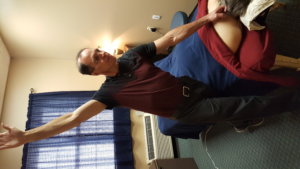
    Okay, so it’s a little dramatic. But I love this move because it’s a good stretch and a good reminder to stand tall when I can. Also, it feels like I’m getting away with something—like being paid to do yoga (a bastardized version of yoga) during a massage.

    If I switch my leg position so that the forward leg is the same side as the hand that is pressing into the occiput, I can generate even more pressure. I do this by leaning back over the table and into the client’s occiput. I simply regulate my pressure by shifting my weight between the heels and balls of my feet.
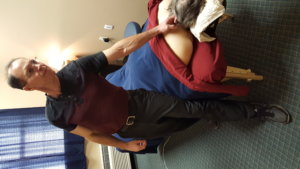
    Below is a picture of the back stretch from this position:
    Low-In-The-Saddle Reset

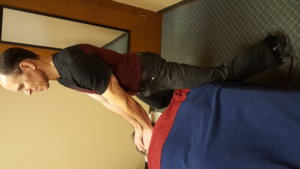
    There’s a challenge with setting a low table when working a specific area. It can be too low for other areas, like the neck. But there’s an easy solution—bend your legs instead of bending from the back.

    Often times I will find myself in a stance where my feet are roughly parallel to each other and my knees are bent. I call this stance Low-In-The-Saddle. (High-In-The-Saddle is when my knees are locked).

    In this picture I’m working the cervical erectors with double thumbs. My pressure is coming from my lean into the client’s cervical erectors. When I lean, my weight shifts to the balls of my feet and one or both legs lean into the table. The combination of being in a balanced stance and leaning into the table/client allows me to be in a well-supported position. In this well-supported position it’s easy to reset and maintain a neutral back.
    Back Reset Breath and Lift

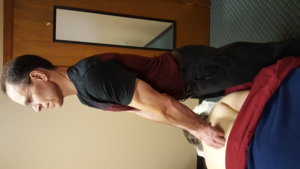
    As I get absorbed in my work or get tired, I sometimes find myself bending from my back. When I feel my back flexing, I hit this reset move: I breathe in while lifting my rib cage up. Next I slightly suck in my stomach until I feel there is no rounding in my lower back, and then I relax my stomach.
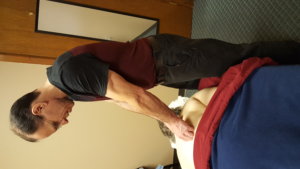
    Starting to slouch.
    Raise rib cage.
    Relax your back.

    This move feels good and can be done in most any stance.

    It’s About You Too

    Twenty-five years ago, if you had said that I would be working on my posture while doing massage, I would have laughed out loud. For one, I thought I was indestructible and, two, I thought massage was all about the client.

    What I didn’t know was that the massage was actually about me, too. If I’m hurt, I can’t do massage. And if I’m in pain, I don’t want to do massage.

    When I was forced to face the bad habits that were contributing to my massage career demise, I discovered that I could save my body by minding my massage posture.  In addition, when my massage posture improved, the easier it became to do my work.

    Here are three quick ways you can work on your posture during a massage:

    1. While leaning into the occiput with your knuckles or a massage tool, raise the other hand up and stretch.
    2. Step into a Low-In-The-Saddle stance, lean into the table/client, and then reset your back to neutral.
    3. When you feel that your posture is slipping, breath in, lift your rib cage up and on the exhalation allow your back to relax.

    If you take of yourself, you can take care of your clients for a long time.

    Can you learn how to massage pain free AND get CEU credits?

    Yep.

    Go here.


  • How to Polish the Chrome on Your Massage: Transitions

    How to Polish the Chrome on Your Massage: Transitions

    A while back, I trained MTs to do hotel massage. Some were fresh out of massage school. I used to get overwhelmed trying to tweak their massages, but eventually I discovered something important: If I could help them master transitions, big things, like flow and maintaining consistent pressure, would fall into place.

    Hotel Massage Training

    Hotel massage comes with extra pressure. For example, during a hotel massage the MT has to create a “massage space” before the client even gets on the table.

    So when I was training MTs for hotel massage, I wanted to take some of the pressure off them by thoroughly preparing them. One way to prepare them was to make sure that they could confidently handle the number one massage request: a relaxation massage with some focus work.

    Relaxation massage with some focus work was of special interest to me because I really struggled with it for the first 5 years of my massage career. I wish I had understood good transitions back then.

    [bctt tweet=”Guinness Book of Massage Records: Me–took the longest time to do a decent massage.” username=”Mark LiskeyMarkLiskey”]

    Transitions

    I break down transitions into 2 categories: location and body parts.

    A location transition is when you’ve been working in one area and then move to another area.

    A body part transition occurs when you change how you’re applying pressure. For example, going from fist to thumbs or palms to elbows would be body part transitions.

    Location Transition

    Good location transitioning, moving from one body area to another area, is not necessarily straightforward. There are 3 things that a client could experience during a location transition that would make the massage feel less relaxing:

    1. Varying pressures.

    This happens when you start moving and your pressure changes.

    1. The massage feels rushed.

    You don’t think you’re going to get everything done so you start rushing.

    1. Massage therapist seems disconnected.

    If you’re not searching for things (e.g., tight areas) underneath your fingers (or whatever body part you’re using to massage with), you have a greater chance of going off into la-la land. When that happens the client may feel like you’re just going through the motions.

    Consistent Pressure is Relaxing

    To maintain consistent pressure move you feet. Moving your feet allows you to position your body so that you can easily apply pressure.

    If you’re positioned in front of the client’s head and you’re reaching to work the lumbar area, you’re overextended. In this position, it’s difficult to maintain consistent pressure. However, if you work from the side of the table, near the head, and move your feet (location transition) to get to the lumbar area, you’ll be able to easily maintain consistent pressure.

    In this video I show you what I mean: Moving Your Feet Video.

    Quality Over Quantity

    When I try to slow MTs down, I have them do the One Minute drill. Here’s how the One Minute drill works: The MT has one minute to massage a foot, calf and upper leg. New MTs often panic when I say go, and they rush to get as much done as possible.

    When I do the One Minute drill on the MT trainee, I dial my stroke pace down and I go slower than I normally would. Why? Because for relaxation, it’s been my experience that one slow relaxing stroke blows away ten fast strokes. During the exercise, I may only get a couple of strokes in from foot to ischium—but you better believe those strokes are relaxing.

    Search to Stay Engaged

    Losing focus with your fingers can also happen when making a location transition. Again, the thought of having to get somewhere—I need to get to the traps to do the detail work—sometimes overrides the importance of keeping the stroke relaxing.

    But when your fingers (or whichever body part you’re using to do the massage) are engaged you won’t lose focus and the client will probably relax even more. For one, engaged fingers are sensors and will warn you when a pressure adjustment is needed. Also, engaged fingers demonstrate that you care about what you’re doing. This helps build therapeutic rapport which can further help the client relax.

    Body Part Transitions

    Body part transitions, changing how you apply pressure, like palms to thumbs, can seem intimidating, especially when it’s done in the middle of the stroke. And sometimes an MT will overuse a body part because he’s simply not comfortable transitioning to another body part.

    But transitioning between body parts is not difficult, if you keep this in mind:

    Keep body part #1 on the client while you’re putting body part #2 on the client.

    For example, if you’re using your right thumb to glide and want to switch to your left, keep your right thumb down until your left thumb is on the client as well. When both body parts are down, you can calibrate pressure–make sure your right and left thumbs are exerting the same pressure. You will also maintain constant contact with your client by always having a hand on the client. Constant contact is relaxing and reassuring.

    For deep pressure, combining body parts (e.g. two fists side-by-side) will save your hands. Switching between combined body parts is no different than switching between single body parts–you just need to keep a hand, fist or forearm on the client at all times.

    Here’s I how do it: How to Combine Body Parts to Deliver Pressure video. (In the video I refer to combined body parts as “power tools”. I no longer use the term power tools because it got confusing when I would talk about massage tools and power tools at the same time.)

    In a Nutshell

    Here are my 3 top picks for doing solid transitions:

    1. Move your feet to put yourself in a position to exert even pressure while transitioning.
    2. Keep body part #1 on the client while putting body part #2 on the client in order to maintain constant contact and even pressure when making a tool transition.
    3. Slow down—even when you’re out of time. One good, slow stroke is better than 10 rushed strokes.

    If you want to see transitions in video form, here they are:

    1. Moving Your Feet Video 
    2. How to Combine Body Parts to Deliver Pressure Video

    And if you’re new to massage, you may want to check out New Therapists Can Be Good Therapists. I firmly believe you can gain years of experience in a short time if you practice the right stuff.

    Join My Email Group

    Want to get my latest info about how to do a great massage, make more money and grow a massage business while staying pain-free in the massage room?

    Sign up for my email group below. It’s free:-)

  • Tension Headaches: A Muscle Overlooked

    Tension Headaches: A Muscle Overlooked

    Not one of my clients would ever pass up on suboccipital work for a tension headache.  But as good as suboccipital work can be for relieving headache symptoms, there’s evidence to suggest that jaw muscles could also be contributing to tension headaches. And one in particular—the masseter—is easy to overlook.

    Why Jaw Muscles?

    Jaw muscles may be involved in tension headaches via trigger points. In general, a trigger point can be looked at as a tender, soft or tight area within a muscle that can produce pain elsewhere.

    Why would jaw muscles have trigger points? Science writer, Paul Ingraham speculates that dysfunction could be one reason.

    Partial Antagonist

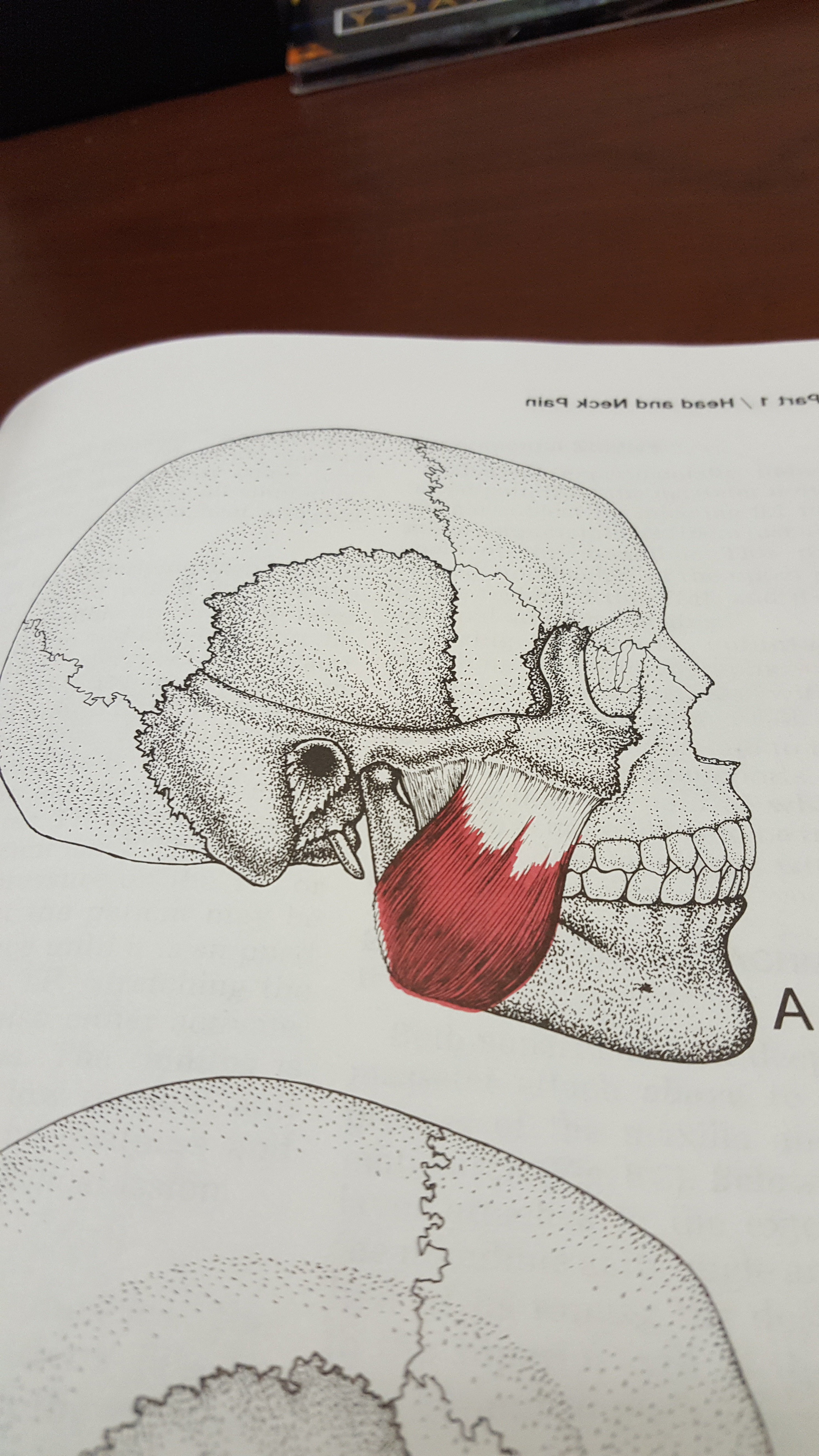
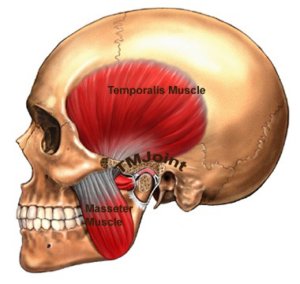
    The suboccipitals along with other neck muscles help balance the head on the spine. Interestingly, the jaw muscles act as partial antagonists to the suboccipitals.

    Really? But they’re not connected to the spine so how can they act against the suboccipitals to balance the head?

    According to Ingraham, it doesn’t matter if they are connected: “…muscle studies have shown that the jaw muscles behave much like they would in a more normal push-pull relationship with the suboccipitals. They function together and dysfunction together.” (Quote taken from PainScience.Com)

    Dysfunction stresses muscles, and it’s reasonable to assume that trigger points could develop as a result of the added stress to the muscles.

    It’s also worth noting that the masseter is a muscle used for grinding and chewing. The combination of dysfunction and muscle overuse could ramp up muscle tension even more.

    jaw-muscles

    Spread the Rub

    Even knowing this (thank you Paul Ingraham), I sometimes still forget to work the masseter—mainly because it’s not right next to the headache area.

    Meanwhile, muscles that are close to or are part of the area where the headache is occurring, like the temporalis, get lots of my rubbing. That’s why I have to constantly remind myself to spread the rub. Sorry.

    My Approach

    I don’t believe there’s one pain-relief massage formula for tension headaches. Here’s one that works for me:

    Step 1: Go to the headache pain.

    I always go to the headache pain area first for two reasons. One, I want the client to know that I’ve heard her by addressing her actual headache area. When I do this, I’m building  therapeutic rapport.

    Two, if I can desensitize (reduce the pain in) the headache area, my client will start to reap the benefits of a calmer central nervous system.

    By the way, to understand if I’m effectively reducing a client’s pain,  I use a pain scale. Here’s the video for the pain scale approach: Pain Relief Massage: How to Find the Right Pressure Video.

    Step 2: Work any area the client associates with the headache.

    If the person has pain somewhere else (neck or jaw) before or at the same time the headache actually occurred, I work that area using the pain scale system.

    By doing so, I further connect with my client because I again show her that I’m listening to her. Secondly, I can start to desensitize a secondary pain area and continue to evoke a parasympathetic response.

    Step 3: Get that masseter before you forget!

    Finally, I cover the other neck and jaw muscles that weren’t covered in steps 1 and 2–like the masseter!

    Here are my “at the bare minimum have to get muscles” on my tension headache hit list:

    Temporalis

    Masseter

    Suboccipitals

    Jamaar’s Headache

    Here’s what it looks like in action. Jamaar came into my office complaining of headache in the front and sides of his head. As we continued to talk, he grabbed the base of his skull and said that he thought it started there.

    When I got him on the table, the first thing I did was to reduce the pain in his temporalis and frontalis muscles (the headache pain). Next, I reduced the pain in his suboccipitals (the area he grabbed and associated with his headache pain).

    Lastly, I worked the remaining muscles that could be contributing to his headache pain, like the masseter.

    Once all the work was done, I finished up with a scalp massage. Hmm…that sounds pretty good. Sign me up!

    Quick Glance

    Tension headaches are in our pain-reduction wheelhouse. I’ve found these keys to be helpful when treating clients with tension headaches:

    1. Communicate with the client to gauge if you’re helping her. I use a pain scale system: Pain Relief Massage: How to Find the Right Pressure Video.
    2. Go to the headache pain.
    3. Work any pain area the client associates with the headache.
    4. If you haven’t already gotten them, go for the temporalis, masseter, and suboccipitals.

    Join My Email Group

    Want to get my latest info about pain-relief massage, how to make more money and how to grow a massage business while staying pain-free in the massage room?

    Sign up for my email group below. It’s free:-)

  • -ITIS vs. -OSIS: Why You Need to Know the Difference

    -ITIS vs. -OSIS: Why You Need to Know the Difference

    Research has shown that most people diagnosed with conditions like plantar fasciitis actually don’t have inflammation (-itis) anymore. Instead they have a condition (-osis), like tissue degeneration.

    The medical treatments for tissue inflammation and degeneration are different and may negatively impact treatment outcomes if misapplied. By understanding the difference between the two diagnoses, you can not only fine-tune your massage, but you can also help your client get the correct diagnosis and find the best medical treatment.

    The Past

    It’s a common misconception that inflammation is always associated with tendon/fascia problems. But when researchers examined the tissue of people with conditions diagnosed as plantar fascittis (research study), they didn’t find a lot of inflammation. Instead they primarily found collagen degeneration.

    [bctt tweet=”Most plantar fasciitis cases are degenerative not inflammatory. This changes treatment.” username=”Mark LiskeyMarkLiskey”]

    So What?

    This is big. For one, if a tendon/fascia condition is not an inflammatory condition, then “corticosteroid injections and nonsteroidal antiinflammatory medications (NSAIDS) may not be the most effective options”.

    This could mean that your client who has persistent plantar fasciitis may never have had the appropriate treatment plan.

    What May Help?

    Preliminary research (plantar fasciitis study, hamstring tendinopathy study) suggests that eccentric strengthening exercises may be helpful with -osis conditions (which is what most people have).

    But since many doctors still bundle the terms tendinitis and tendinosis together, they may not appreciate what this can mean for the person in terms of treatment and treatment outcome.

    What’s It Mean for Us?

    Knowing the difference between –isis and –osis changes how I work with a client before, during and after the massage.

    Pre-Massage

    For example, let’s say Sabrina is a runner and she comes to my office with a diagnosis of tibialis posterior tendinitis. First, I’m going to check for visual evidence of inflammation. Is there swelling in the tendon/attachment areas and are they warm?

    During the intake, I will find out if her condition has been persistent (staying the same or getting worse over a course of many weeks). What treatments has she had? Did she have injections that gave her temporary relief? Typically, the positive effects from injections are short lived when it’s a tendinosis condition (Treatment of Tendinopathy: What Works, What Doesn’t and What’s on the Horizon).

    If there are no visible signs of inflammation and Sabrina has had the condition for a while, I’m going to treat her condition as an –osis.

    During the Massage

    This means that I’m going to massage the tendon and foot attachments, rather than avoid them. However, using a 1 – 10 pain scale, I will only work within a 3 – 4 to reduce the pain in these areas. In the surrounding area and the body of the tibialis posterior, I will work in a 4 – 5.

    For a quick tutorial on the pain scale system I use, check out this Pain Relief Massage: How to Find the Right Pressure video.

    Post-Massage Recommendations

    Here comes the tricky part. If you suspect that your client is misdiagnosed and she should get rechecked, you’re going to want to put that bug in her ear. Here’s how I do it.

    First, I lay the groundwork during the intake. After I look for inflammation and consider my client’s injury history, I explain my treatment plan. This is the perfect time to mention the research around “-itis” versus “-osis”.

    Next, since I use a pain scale approach when working tendon/fascia conditions, I’m regularly interacting with the client throughout the massage. This would be another opportunity to talk about “-isis” versus “-osis”.

    I’ve found that during this time the client will often circle back to the pre-massage conversation of finding a solution for her condition. At this point, I go deeper into the topic of “-isis” versus “-osis”.

    After the massage, I do a wrap up. In the wrap up, I tell the client what I did and what I think might be helpful going forward, like getting rechecked to make sure she has the correct diagnosis. It’s not uncommon for me to start by saying, “If it were me…” or “If it were my (fill in the body part)…”.

    Follow-Up

    Finally, I follow up 2 to 3 days after the massage. In this conversation, I don’t press the client about going back to make sure the diagnosis is accurate, but I will give her my opinion if she asks for it.

    Ultimately, my goal is to provide my client with the most current information so that she can make an informed decision about her tendon/fascia condition.

    Getting it Done In 3 Steps

    If you think your client has an “-osis” condition instead of an “-isis”, help her this way:

    1. Tailor your massage to reduce her pain by using a pain scale system and appropriate pressure.
    2. Make her aware of the symptom and treatment differences between “-osis” and “-isis”.
    3. Follow up and answer her questions.

    At times, you may feel like an outsider because you’re operating with the most current information which, in this case, challenges conventional thinking. But your client will thank you for your effort—especially if you can help her get out of pain.

    If you want my latest information about pain relief massage and growing a massage business, sign up for my email group. It’s free:-)