
Author: Mark Liskey

  • A Quick Way to Connect with a Client

    A Quick Way to Connect with a Client

    Pam had a neck problem and had come to see me. I was working for a chiropractor at the time and had recently been certified in neuromuscular massage therapy. During the intake Pam talked about how she hurt her neck and I diligently took notes. While she was changing, I figured out which muscles I was going to focus on. I went back into the room and did the massage. After she left I changed the table for the next client, but before I had finished the chiropractic stepped into the room to deliver some bad news. Pam did not like the massage.

    Needless to say, I was upset. What had I done wrong? The chiropractor offered a piece of constructive criticism. He said that I was being too clinical. I thought about what he had said and after a few more awkward massage endings I started to see that it was deeper than just me being too clinical: I didn’t know how to connect with the client.

    Disconnected

    When you connect with a client, the client feels that you value her. For instance, if you had asked me to describe Pam’s pain condition a few days after I had done the massage, I would have said her right, cervical erectors were hypertonic. But if you had asked me to recall one detail about her life, I would have drawn a blank. The fact that I viewed Pam only as a “patient” and not as a whole person made her feel disconnected to me.

    Obstacles in the Way

    Sometimes there are obstacles in the way to connecting with a client. One obstacle is time—we have to get a lot done (intake, massage, wrap-up, change the table) in a short period of time. Feeling rushed sometimes means we chop out any small talk during the intake and miss an opportunity to connect.

    Lack of confidence as an MT can be another obstacle. Looking back I now see that when I worked on Pam I over-emphasized neuromuscular therapy during the intake and avoided interaction on a personal level because she might had seen that I was nervous.

    Lack of confidence can also be situational. You could simply be having a low confidence day in your personal life which could have a global effect and spill over into your work life. No matter the obstacle, here’s a way around it.

    Instant Connection

    Listening is an important component to connecting with a client, but listening by itself is not connecting. To connect you need to demonstrate to the client that you were listening. In other words, you need to let the client know that you heard her. One way to do that is to immediately acknowledge that you heard the client by responding to her right then. For example, the client says that she likes to eat pizza. You might ask: What’s your favorite type of pizza?

    However, for greater connectivity impact, hypnotist Mark Tyrrell (his blog) suggests that instead of acknowledging a detail about the client’s life right away, hold back and work that detail into the conversation later. For example, applying Tyrrell’s suggestion to massage, when doing the intake with your client write down a trivial (unrelated to the massage) thing that client has said in passing, but don’t comment on it then. At a later point during the massage (if appropriate) or after the massage, work that piece of trivia back into the conversation. Tyrrell explains that when you don’t immediately acknowledge the small detail of life that the client shares with you, the client forgets about it. And when you bring it up later the client thinks: “Wow, she really was listening to me to remember that detail!”

    Cheesy?

    On the surface gathering details about a client’s life and then working them into a conversation later may seem a little cheesy. However, in the massage setting this planned connectivity is a tremendous way to build therapeutic rapport. It also forces us to see the client as a whole, rather than just a person with a pain condition. And for anyone struggling with confidence, it’s a great way to develop therapeutic rapport with the client without having to put yourself out there during the intake.

    Need  More Help?

    Sign up for my email group and get my latest info. It’s free and you can unsubscribe whenever you want:-)
  • New Therapists Can Be Good Therapists

    New Therapists Can Be Good Therapists

    Years ago I needed a photographer for my parents’ 5oth anniversary party. I chose a wizen-faced photographer who had been in the business for decades. After all, if you’ve been in business for that long, you had to be good…well, let me just say that we didn’t buy one of the pictures he took at the 5oth anniversary party. The flip side is also true—just because you’re relatively new at something doesn’t mean you’re going to be bad at it. It’s been my experience that the MTs who are good from the get-go do one thing extremely well: they find tight spots and provide pain relief in those areas.

    It’s Important

    How important is finding and effectively working tight spots? Very.The act of searching for tight spots shows the client that you’re engaged in the massage, that you care about what’s under your fingertips. And if you can provide pain relief to those tight areas, you’re going to have one happy client. Surprisingly not all therapists do this, including seasoned MTs. In addition, searching for tight spots and providing pain relief to those areas requires an MT to be able to operate in the full range of pressures (light, medium and deep). Honing your pressure skills through finding tight spots and providing pain relief makes hitting the “parasympathetic” pressure mark easy during a relaxation massage.

    How to Search For Tight Spots

    Here is my key for searching for a tight spot: create contrast. To create contrast, go to the area where you think the tight spot is, then go back and forth in a broad motion over the area. If you’re still having trouble finding it, press a little deeper. If that doesn’t work, do your back-and-forth stroke faster.

    Make it Hurt So Good

    Once you’ve found the tight spot, you want to apply the pressure that elicits the “hurts so good” response from the client. This is not always straightforward. Sometimes it requires more pressure than you’re using for the rest of the massage. Sometimes it requires less. You can handle establishing the pain-relief pressure a couple of ways.

    Once you’re on the tight spot, you can flat out ask the client: Is this the “hurts so good” pressure? If not, adjust accordingly. Another way is to set up a 0 to 10 pain rating system with the client. Zero means there’s no pain and ten means there’s a lot of pain. Tell the client that when you press and hold a tight spot, you want the pain to be no greater than a 5. (You don’t want to promote a sympathetic response). If the client is experiencing anything greater than a 5, lessen your pressure.

    Lastly, you can simply look for reaction signs to determine if your pressure is on target. Reactions signs are cues that the client is given you in response to the massage. The cues can positive, like deep breaths and sighs or they can be warning cues that you are applying too much pressure, like involuntary jumps, squirming and tightening of muscles. Warning cues mean you will need to lighten your pressure.

    Get it From a Different Angle

    Varying the angle of approach is another strategy for relieving tight spot pain. If you’ve pressed on the tight spot straight on with limited success, try pressing the tight spot on an angle or from the side. Also, if you vary your angle of approach you’re less likely to overwork an area and create a situation of diminishing returns.

    You Don’t Need to Know Everything

    Lack of experience does NOT mean you have to wait 5 years to be a good therapist. Nor do you have to know the name of every muscle you’re working on or be able to execute the latest massage technique to make a client happy. Practice finding tight spots and providing pain relief. As a result, you’ll feel comfortable with all ranges of pressure, and you can always layer on more anatomy and new techniques in the years to come.

    Free Course to Jumpstart Your Massage Business

    If you’re just starting a massage business and aren’t making 30K a year working for yourself take this free course: Jumpstart.


  • Massage Tools Will Save Your Hands

    Massage Tools Will Save Your Hands

    The benefits of hand-held massage tools are that they can save your hands (e.g., spell tired thumbs) and improve the quality of your massage (e.g., get into certain areas of the body more effectively than fingers and thumbs). But many MTs shy away from massage tools because they haven’t been shown how to safely and effectively experiment with them. Here are my four guidelines for helping you to incorporate hand-held tools into your massage:

    1. Use your thumb or finger next to the tool to maintain sensitivity.

    Hands down, thumbs and fingers are the go-to tools for palpation. That said, if you put a thumb or a finger next to the part of the tool that is in contact with your client you’ve reestablished your means to pick up tight spots. Another way to overcome the loss of sensitivity with a tool is to do an exploratory stroke without the tool to find the area you want to work, then place the tool down once you’ve found the area.

    2. Use a light grip and not a clench-fisted grip when holding the tool.

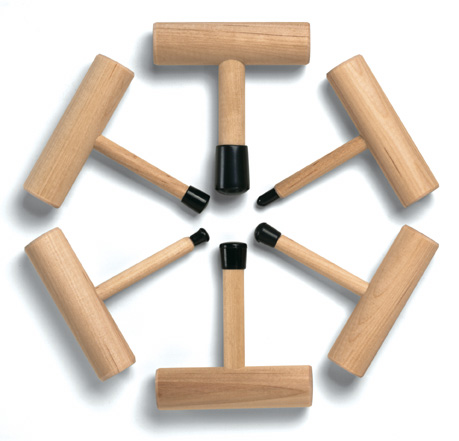
    Most hand-held massage tools aren’t custom-designed. For instance, the handle for the T-Bar tool I use is too small for my hand and I tend to over-grip the handle, which can cause hand and wrist pain. However, if I grip the tool lightly and with my fingers tips (as opposed to having the tool in the palm of my hand) I can overcome the undersized handle short-coming.

    3. Vary your grip frequently when using a tool.

    Because we really only need to steady the massage tool as we press, we have the option of holding tools in virtually unlimited ways. This is huge in terms of reducing repetitive stress injuries. The more often you can share the workload between your fingers and thumbs by switching grips when using the tool, the less likely you will over-stress a particular joint, tendon or muscle.

    4. Lean and don’t muscle the tool with your hand/forearm/arm and shoulder.

    Steady the tool with a light grip, then lean without tightening your grip. If you feel like you need to tighten your grip as you ramp up the pressure, experiment with a new grip. Find the grip that requires the least amount of “gripping” and practice with it.

    The T-Bar

    Currently, the T-Bar with a beveled edge tip is my favorite hand-held tool. For one, it’s light and balanced, so it’s not going to be a strain on my hand. In addition, I can generate a focused pressure in the lamina groove, much better than I can with my thumbs or fingers. In the video I demonstrate how to use a T-Bar on the rotatores and multifidus. Remember to place your thumb or finger next to the beveled edge tip of the T-Bar and you’ll have all the sensitivity you’ll ever want.

    My Best Massage Tools Online CEU Course

    A while back I almost quit massage because of pain and injuries.

    Then I spent a year revamping my massage to see if I could massage pain-free. Massage tools help saved my hands and upper-body.

    Most massage therapists shy away from using massage tools because, less face it, it’s hard to be sensitive with a piece of plastic or a hunk of wood–that is unless you have work-arounds.

    I use massage tools in every massage from focused pressure work to total relaxation. I can do this because the work-arounds work and are easy to implement.

    So, if you’re ready to take the plunge and delve into massage tools, I have an online, home-study course that will make your learning life easier.

    Here it is: How to Use Massage Tools (Fearlessly and Effectively).

  • Competing with Bob for Clients

    Competing with Bob for Clients

    Whether you like it or not, you compete with other MTs for business. If that makes you a little uncomfortable, that’s okay. I was uncomfortable with competition at one point in my massage career, too. But as time went on I learned that competition brought out the best in me and that my success depended primarily on one key skill: the ability to deliver the full range of pressures (light, medium and deep).

    Competing with Bob

    My first job out of massage school was with a chiropractor. Bob, another massage therapist, started about the same time I did. Bob had great hands and was outgoing. He quickly developed a solid client base. I, on the other hand, was shy and unsure. I struggled to retain clients and I didn’t want to compare myself to Bob because I was afraid to face the truth.

    Ask Yourself: How Do I Compare?

    Eventually I got a few repeat clients and I felt a little better about my job performance. It was at that point that I mustered up the courage to finally ask myself how I compared to Bob. This was terrifying. And liberating. The terrifying part was that Bob had about twice as many clients as I did. The liberating part was now that I saw this cold, hard fact, I could do something about it. And I did.

    Pressure is King (And Queen)

    In order to be more competitive with Bob I studied and became certified in St. John’s Neuromuscular Therapy (NMT). But you might be surprised when I tell you that working the transverse attachments of a client’s QL (NMT methodology and techniques) was not the game-changing key that brought my client base up to Bob’s. Rather it was my ability to effectively deliver the full range of pressures—light, medium and deep—something NMT also taught me.

    The importance of pressure was further reinforced to me when I was training MTs for hotel massage. The main complaint I would hear from new clients was that a previous therapist hadn’t worked deep enough.

    Three Key Elements to Delivering Pressure

    In order to become confident with your pressure, you’ll need to understand three things:

    1. Pressure should be consistent throughout a massage. Here’s how you accomplish this: First ask the client during the intake process what pressure she likes. Her answer is only used as a rough starting point. Why? Say your client says she wants medium pressure. Is her perception of medium pressure the same as yours? Maybe—but you don’t know for sure. So you will need to start with your medium pressure, then after a couple of strokes you’ll need to ask her if the pressure you’re doing is the pressure she likes? If not, then you need to adjust your pressure. Once you establish the pressure the client likes best you’ll then reproduce that pressure throughout the massage. I also leave the door open for the client to communicate if she needs more or less pressure by saying: At any point during the massage if you need more or less pressure, just let me know.
    2. Pressure should be appropriate to the client’s needs. For example, say the client wants deep pressure. So you start by establishing the deep pressure the client wants, but then you hit a tight area and the client jumps. You’re obviously going to want to back off on your pressure. However, if you hit a tight area and the clients wants you to go deeper, you’ll have to ramp up your deep pressure to super-deep. Each client is different. The important thing is to figure out quickly which action—more or less pressure—produces a pain relief and/or a relaxing response and then apply the appropriate pressure.
    3. Pressure should be precise when working a tight or tender area so that you can zero in on the exact area of pain. Fingertips, thumbs, knuckles and elbows are the best tools to transmit precise pressure. A tool transition from a broad tool (palms, forearms and fists) to a precise tool (fingers, elbows and knuckles) can be seamless with a little practice. Take a look at the Deep Tissue—Transitions video on our Facebook page https://www.facebook.com/themassageinstitute.net/.

    Where Do You Stand?

    It’s never easy when you compare yourself to other MTs. If you’re in a fragile state it’s okay to wait until you get a couple of wins under your belt, aka, happy customers. But at some point you have to look up, survey the people in the room and ask yourself: Where do I stand amongst my colleagues? If you don’t like the answer, take a good look at your pressure. Is it consistent throughout the massage? Is it the pressure the client requested? And is the pressure appropriate and precise for tight/tender areas? If you fix the pressure, you more than likely will find your competitive edge (whether you want it or not).

    How to Deliver Deep Pressure Online, CEU Class

    In this massage body mechanics course I’m going to make sure that you know exactly what to do to be competent at delivering deep pressure without hurting yourself.

    However, there’s a caveat here: You’re going to be challenged in this course. Not in a bad way.

    You’re going to be challenged to use your body in a non-traditional way that will allow you to deliver pressure efficiently and with minimal effort.

    Specifically, you’re going to learn how to lean so that you can use your body weight to generate pressure. That means your upper-body won’t be taxed.

    Yep, it’s going to feel a little awkward at first, but I promise you that once you get the lean down, you’ll never want to muscle your way through a massage again.

    As you learn how to lean I then show you how to use the table for support to take any tension out of your back.

    Next, I teach you how to get vertical. In other words, you’re going to stop massaging in the hunchback-massage position. In fact, you’re going to straighten up and stretch during the middle of the massage.

    To save you hands, I show you how to combine body parts.

    And at the end we smooth out your new body mechanics with killer transitions and an introduction to massage tools for very precise pressure.

    Check it out here: How to Deliver Deep Pressure Without Hurting Yourself.