Here are 3 massage marketing tips that produce big results, won’t cost you any money and are within your current marketing capability to implement (even if you’re just starting out as a massage therapist). Ready?
- Stop doing everything that marketers tell you to do.
- Run a special.
- Do demo massages.
Hey, I’ve been where you are now–binge watching massage marketing videos on YouTube, hoping to get my marketer on by trying to be something I’m not.
So much failure.
So much angst.
But here’s the thing, you don’t need to acquire a whole new set of skills to build your business.
In fact, you already have the best marketing tool.
You.
You do a good massage and you have great customer care.
That will sell.
You just need the opportunities to demonstrate those skills to potential customers, which brings us to…
Massage Marketing Tip #1: Stop doing everything that marketers tell you to do.
I know that sounds weird, but it’s not once you let this thought marinate.
Marketers are all about getting people to call. And you obviously can’t win a client over if she doesn’t call.
But their marketing will either cost you money–you know that money you were saving to get that cavity filled–or time.
The money part is straightforward.
Online ads cost money. Marketing services aren’t cheap. Website designers probably ain’t gonna barter.
The costing time (which is actually money, too) is harder to see.
Here’s what I mean.
You download a 20 Ways to Market Your Massage for Free e-manual.
Okay, so which idea are you going to start with?
Has the idea been tested in a real world situation?
How long is it going to take to see a dollar return on your time investment?
Do you need to do all 20?
You try one. It doesn’t really work.
You try another.
But then you wonder if you gave up on the first one too soon.
So, you do the first one and the second one together, but things are going too slow.
Cats are hungry. Bills are backing up. Taxes are due.
You add a third and a fourth and a fifth tactic.
Now you’re going in a thousand different directions.
At the end of the day you’ve invested tons of time for a small, income bump-up.
So, all marketing is a waste of a time except what you’re suggesting, Mark?
Absolutely not.
I’m not saying don’t ever do any other marketing other than what I’m about to tell you here.
I’m saying, if you are just starting to build your massage business or you need to grow a meh business, try these two next two tips first because (1) you already have the skills to make these tips work, and (2) from my 25+ years of owning a massage business, I know that these two tips work.
Before I go on, I want to explain how the rest of this article is laid out. I’m going to show you how to apply the next two tips for two different stages of a massage business—just starting out and a meh business that needs to jump to the next level. So, you’ll see under each tip the headings “Just Starting Out” and “Meh Massage Business”.
Also, at the end of the article I’ve added an additional marketing tip for COVID-19, not because the other two tips don’t work during COVID-19. I’ve added the additional tips because in order to maximize your marketing effort now you need to adapt to what has changed in the massage world as a result of COVID-19.
Onward.
Massage Marketing Top #2: Run a special.
Just Starting Out Massage Business – Run a Special
I’m going to be blunt: Get used to the idea of “discount” and “free” for a while.
And devalue my service?!
Yes.
And free massage is a pain in the ass because it’s a lot work for no dollars.
Oh, also, your ego will be bruised because you know that you’re worth more than “free” and “discounted”.
So what’s the upside?
Clients. Lots of them.
And here’s how you’re going to do it.
The easiest way to run a special is to run a Groupon.
But I don’t have a massage room, Mark.
Read this post. It will help you figure that out. What else you got?
Groupon is soooo 2010.
True. But it still works to bring in clients AND it’s not something that you’re going to do for a long time.
Doing a Groupon is just an initial way to get people walking into your massage room quickly.
As soon as you have enough clients to the leave the job you hate, bye-bye Groupon.
Still having trouble breathing?
I know, it’s gonna suck a little, but I promise that when you get through it, you’ll thank me.
This may help you persevere.
My Groupon Experiment
In 2014, I wanted to re-energize my practice in one of my offices. I ran a Groupon, Living Social and Amazon Local (no longer in existence).
Back then, here’s how it worked. I pretended my 60 minute massage was $80 because Groupon was going to sell it at half price.
If I had said $70 (what I charged at the time), the half price would have been $35. Halving $80 took us to $40 (they actually sold it at $39) which meant an extra $5-ish to carve up between Groupon and me.
Of the $39, I kept $20-ish on average. (I ran a couple Groupons and with each new contract the percentages changed.)
Hang in there. The numbers get a little bit better.
More Math
Average tip for me when someone redeemed a Groupon was $10. So that put me at $30 an hour.
Of course, you have to subtract sheets, cream and rent. So let’s say I was making $25 an hour.
Okay, so that’s still way low for an hourly rate (including tip) BUT think about this, you’re not only getting paid to do a massage with Groupon, you’re getting paid to advertise with your hands.
Each Groupon customer who walked through my door was a potential client and/or a referral source. I just needed to win some over.
More Clients
By the way, all Groupon buyers are not discount shoppers. My client repeat rate (meaning the person came back for another massage at full price) was around 15%. So for every 100 Groupons, 15 became clients.
Who became my clients?
People who got massage regularly and were actively looking for a new massage therapist, massage therapists who were looking for a massage therapist for their aching arms and shoulders, and people who were new to massage.
So, I made some money and got some new clients and there’s more…drum roll please…
More Goodies
When my Groupon first launched, I got a small response. That was disappointing, but what I didn’t realize was that Groupon sales are driven by reviews. Once I started to get positive reviews, my Groupons really started selling.
What I also didn’t get at the time was the importance of reviews for my overall business. Once I got a bunch of positive Groupon reviews, I could use them in my advertising anywhere, like on my website.
And last but not least, I collected about 150 customer email addresses. Easy as pie to do.
We have a line for an email address on our intake form. You can download our intake form here: Massage Intake Form Download Final
Once you have names and email addresses you now have a list. Here’s a quick primer on how to engage and sell to that list: How to Email in More Clients.
When You Can Stop
I stopped my Groupons after about 200 sales. At the end of the day, I had more money in my pocket, about 30 new clients, 150-ish new email addresses and good reviews that I could use to help advertise my services.
Oh, there’ll be a percentage of Groupon customers who don’t redeem their vouchers. You still keep the money. For me it was probably in the 20% range.
If you’re trying to take a meh business to a great business with tip #2 (run a special), do this:
Meh Massage Business – Run a Special
First, yes, I’m going to ask you to do a special, too. But your special will be different special than the Starting a Business group.
Why?
You don’t a crush of clients coming in at once to get your business off the ground because your business is already off the ground even if it’s flying low. Instead of an onslaught of new clients coming in, you need a consistent flow of new clients, like one or two each week.
Enter the one-time, introductory massage special.
I know that I’m treading on thin ice again because a lower price seems like you’re devaluing your service, but I’ve got proof that a one-time lower price does NOT ultimately devalue your service.
I’ll show you the proof in a minute. First, I want to explain the introductory massage special rationale.
I just told you about my Groupon experiment and how successful that was.
A special introductory massage price can work the same way. You offer a lower price than your normal rate just to get clients through the door.
I learned this tactic from national massage spas.
A while back I was doing some espionage work at a national massage spa and the massage spa was running an introductory special. It worked. In fact, that massage spa chain still runs an introductory special.
By the way, that’s my proof that an introductory massage special works. If it didn’t, massage chains would have stopped doing it years ago.
I have more proof. It works for my business.
Yes, some new customers are one and done, but that’s okay—one-and-done(s) pad my book and can produce referrals. And though I haven’t been tracking this on a spreadsheet, my Spidey senses tell me that I’m getting more repeat clients than I would with a Groupon.
Why?
Because the people who are taking advantage of the introductory massage special rate are paying less than my normal price, but more than they would for a Groupon massage rate. That means that I’m keeping the bargain basement shoppers away.
A bonus to an introductory massage special is that anyone who comes in—no matter if she becomes a return client or not—has the potential of spreading the word about my business.
That’s cheap advertising.
But how do you go from intro rate to normal rate, Mark?
For point of reference, our normal massage price is $80/hr. Our introductory massage special is $59/hr, the same introductory price of the local massage spa nearby.
The conversation of $59 to $80 for the next appointment is easy.
First of all, most first-time clients are aware that they’re paying an intro special rate, especially if they’ve found us online or saw one of our signs.
Many ask: How much is the regular price?
I tell them and then throw in that we have a no tipping policy so that they know that will be their out-the-door cost.
Others already know our regular price and just ask for confirmation.
The beauty of this approach is the same as it was with Groupon—you got your hands on the customer which is your best shot at getting her/him to come back, and, in our case, pay $21 more.
Here’s the next marketing tip.
Massage Marketing Tip #3: Do demo massage.
Just Starting Out Massage Business – Do Demo Massage
This is not a willy-nilly process.
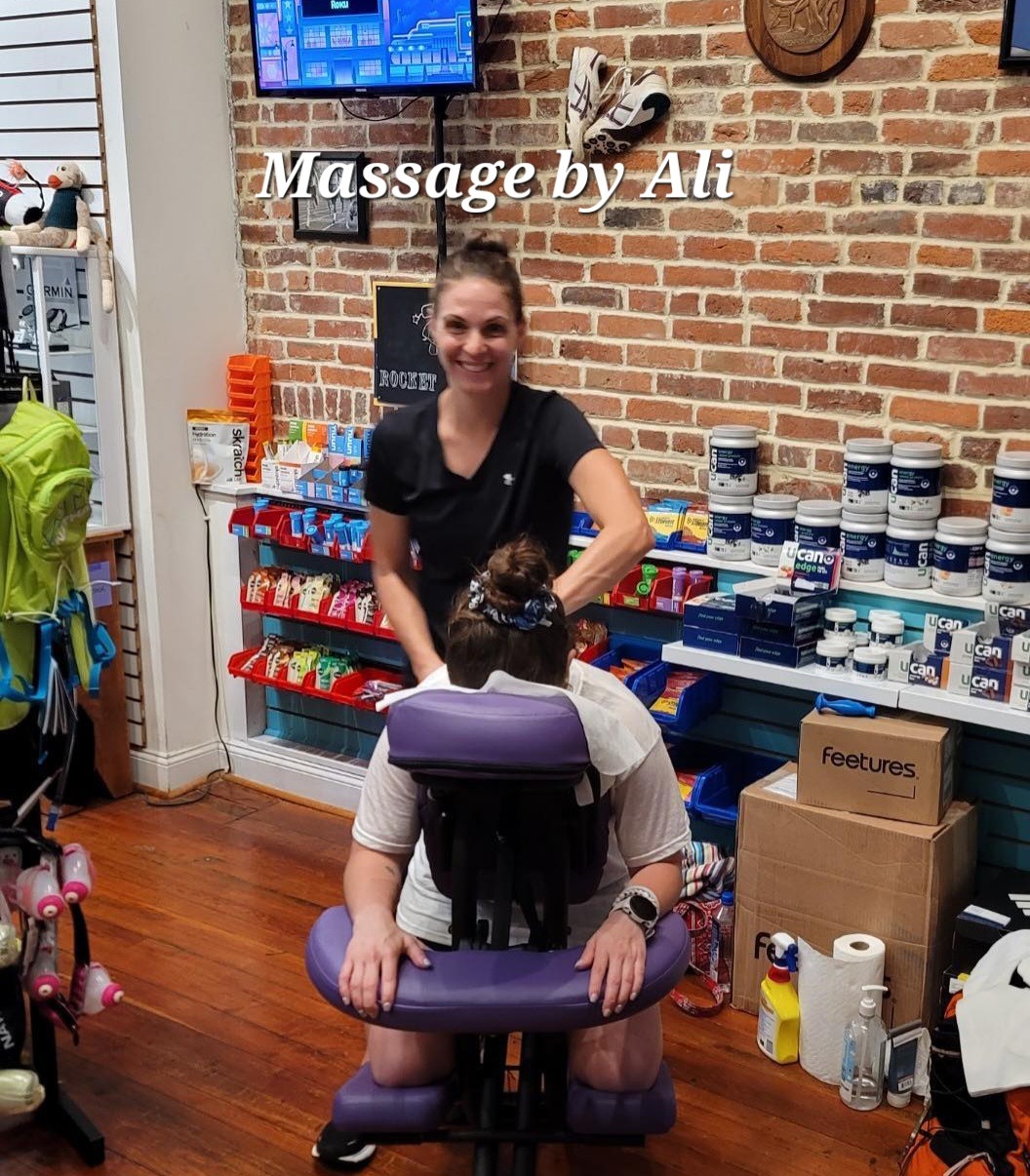
You’re going to target specific referral sources, health practitioners who don’t rely entirely on insurance money and businesses that might be a good fit with massage, like a running or bike store.
I go into detail about how to do demo massages in How to Grow Your Massage Business with $0. Here’s the short version:
- Target a health professional you respect. Her business model should include, if not solely be based on, cash paying customers.
- Target a business that’s a fit with massage. Think running store, bike store or a yoga studio (that doesn’t offer massage).
- Offer this deal: 15 minute demo massages to their clients, patients or customers.
- Offer the owner of the business and her employees free 30 minute massages. Ultimately, the owner and her employees are going to be your best, on-going referral source. Treat them nice!
- If things go well, look for other ways to connect with your referral source, like doing a promotional event together, providing a free massage gift certificate for an event they are doing, and/or linking websites.
Okay, so now you’ve got a lot of good stuff going on. Once you feel like you’re getting enough of a customer base to reach your goal, stop the Groupon, but keep the demo massages running.
In other words, run a Groupon to initially get massage clients. Then get the hell out (but keep doing demo massages)!
Value Up
Now you can start to work on “valuing up” your massage again.
It’s an easy fix.
When someone calls and asks for the Groupon deal price, you say no.
Your value just went up:-)
Avoid Mission Creep
So, if you’re motivated now, good, but you need to be vigilant here.
Because in the time it takes to get your Groupon and demo massages set up, you’re going to find a list somewhere that says you should make a brochure or hand out 15 minute gift certificates to people you know so that they can hand them out to someone they know…do you see where I’m going here?
It’s so much easier to hand out a brochure or gift certificate than it is to lay it on the line and actually demonstrate your value.
But in the beginning if you focus on advertising massage through your hands, you’re going to drive a respectable amount of customers through your door in a short period of time.
Getting Massage Clients Via Groupon & Demo Massages
Remember the end game for strategically running a Groupon is new clients, referrals, money, good reviews, and growing an email list.
Get in, get out.
By the way, 99% of my Groupon customers were great. Of the bad ones, one was rude and the other was odd (but not in a dangerous way; I think she was self-medicating).
Also, you’ll need a website to run a Groupon deal.
If you don’t have one, you can make one fast and for less than $70 for the year: How to Build a Website FAST.
Doing demo massages, on the other hand, is a long term tactic that will build the relationships that you’ll need to sustain your business.
Believe me when things get rolling, you’re gonna have some fun:-)
Okay, now to apply tip #3—do demo massage—to a meh massage business.
Meh Massage Business – Do Demo Massage
I’m going to insult you again. Sorry. You know how to get a business started. Think about what you did—you built your practice so far mainly through referrals, right?
Here’s the insulting part: You didn’t do enough of it.
That’s the main reason why you’re stuck with a business that just pays the bills.
You need to create referral machines.
A referral machine can be a client. It can be a business you engage. It can be a health practitioner with whom you co-ordinate client care.
But you can’t have a referral machine unless you got out and find them.
The easiest way to find referral sources who are not clients is to offer free, demo massages (in your office during COVID-19).
If you’ve already done this to get your business off the ground, do it again.
But this time be more persistent and strategic with your demo massage offerings.
Persistent: If you can’t reach a potential referral source via calling, try emailing.
If the person you are trying to contact in a particular business isn’t responsive, try another person.
I spent a year trying to get my foot in the door with a local running store. The person I was talking to was super-nice, but wearing too many hats. I almost gave up, then one day I said, Screw it, and I walked into the store and the manager was there.
We hit it off and the manager and I have become good friends and business allies.
So try thinking this way when you hit what seems to be road closure:
I will not stop until I have a physical therapist or PTA referral source.
I will not stop until I have a chiropractor referral source.
I will not stop until I have a business referral source (e.g., running store, bike store, yoga studio).
I will not stop until I have a personal training studio referral source.
Strategic: Don’t offer demo massages to a chiropractic who offers massage therapy in her office.
Spend less time on referral sources that aren’t producing; double-down on ones that are.
When you have a client who is seeing another health practitioner for the same issue she is coming to see you for, reach out to that health practitioner to coordinate care AND offer free, demo massages to her and her staff.
Okay, when you reinvest your energy into your practice, you’re going to feel like you’re starting over and that you’re too good for free, demo massages. I get it. That’s how I felt when I was stuck with a 40K business, but had been doing massage for a while.
But those feelings and thoughts will vaporize once you find the referral sources that truly value your service and provide a steady flow of referrals.
Here’s the recap for meh business owners when applying tip #2 (do demo massages):
Recharge your current referral sources by double-downing on the referral sources that are working.
Stop spending time on the referral sources that aren’t great.
Find new ones by offering demo massages.
Okay, those 3 marketing tips—(1) stop doing what marketers tell you to do, (2) run a special, (3) do demo massages—are evergreen tips. In other words, they work no matter what’s going on.
Massage Marketing Tips in a Nutshell
We got a lot covered. Let’s do a recap.
Massage Marketing Tip#1: Stop doing everything marketers are telling you to do.
Listen to me instead. Haha.
Well, listen to my experience as a massage therapist who took his business from 40K to 80K+.
Massage Marketing Tip #2: Run a special.
If you’re starting out try a discount coupon service like Groupon.
If you’re massage business is meh, try an introductory massage special.
Massage Marketing Tip #3: Do demo massage.
Find potential referral sources by offering free, demo massages. If you’re trying to take your massage business to the next level, double-down on the referral sources that are working, eschew the ones that aren’t and go get more.
How to Keep it Going
If you’re ready to start a massage business or take a meh massage business to the next level, then I have two courses that can help you out.
If you’re starting a massage business, this course will give you everything you need to know to launch and take your massage business to 30K: Jumpstart. (And it’s free.)
If you need to take a meh massage business to beyond paying the bills (80k+), then this course will finish the job for you: Accelerator.
Have a question? Ask me anything (mark@makethemostofmassage.com). I’m not going anywhere:-)