What’s the difference between a thriving massage practice and a surviving massage practice?
Massage business relationships. Thrivers knows how to develop them. Survivors—not so much.
Most of us tend to ignore them.
For good reason: A business relationship is a little weird.
To sustain one, you can’t just keep talking about the weather nor do you want to be sharing deep, dark secrets.
Business relationships are in this awkward middle. They’re not superficial. They’re not super personal. And if you you don’t have experience with them, you’re going to do what I did and make them something they shouldn’t be.
Massage Business Relationships Mistake #1: Superficial
Years ago I wanted to build massage business relationships. So I made a list of doctors, PTs, and other health practitioners in my area. Then I called them.
“Hi, this is Mark Liskey. I have a massage business down the road from you. I was wondering if I could talk to Dr. Goaway…oh, she doesn’t take calls…could I drop off some of my business cards?…fantastic, I’ll drop some off tomorrow.”
Checkmark next to Dr. Goaway on the list. Cards to her the next day. Bam! Let the referrals roll in!
Crickets.
Why?
Because Dr. Goaway didn’t care. Why would she? I hadn’t had a meaningful interaction with her.
Massage Business Relationships Mistake #2: Too Personal
Other times, I went the “let’s be buds” route.
Years back I contacted a chiropractor. We hit it off. I did demo massages at his office, promoted him to our clients, and went out of my way to get to know him.
All was peachy and getting peachier until one day at his office I heard him express his unsolicited political views to a patient.
As time went on, I noticed he did this quite frequently. It was almost as if his practice was a platform for him to rail against X, Y and Z.
Some patients agreed with him, others put up with him, while others asked him to stop (he didn’t).
Can you say unprofessional, un-therapeutic and offensive?
Pulling out of that business relationship was complicated and left a little bit of a rift between the two of us.
Aim for the Middle
Eventually, I started to realize that the most successful business relationships I had contained these two elements: I strongly connected to the other business person over one or two shared values that related to work AND I didn’t go out of my way to explore the relationship outside the business context.
For me, shared work values are (1) pride in the work one did, (2) a desire to help clients/patients get better, and/or (3) a compassion for people in general.
A Success Story
Here’s a massage business relationship that was a winner
A while back I contacted personal training studios in my area and I offered to work on the owners for free. (Check out How to Build a Massage Business for $0 for more help with setting up demo massages.)
Out of five businesses owners, two bit. Of the two, one business owner had moved into corporate fitness exclusively. The other business owner, Rita, came in for a demo massage.
While Rita was vetting me (getting a massage), we connected on how to get and keep clients out of pain.
After the massage, she encouraged another personal trainer who worked for her to get a demo massage from me.
As the momentum built I offered to do demo massages at Rita’s studio. Rita was more than happy to have me there—especially because she wanted me to work on some of her clients that were in pain.
Rita started sending me clients and our business relationship grew.
Do I know how Rita votes?
Don’t want to know.
Do I know who Rita’s best friend is?
I know it’s not me.
Do my wife and I go out with Rita and her spouse for dinner?
Never gonna happen.
And yet our business relationship is just fine because we both value doing everything we can to get and keep clients out of pain.
When You Can’t Help Yourself
Have there been times when one of my business relationships turned into a good friendship?
Yep, a few over the years. Justin, a personal trainer, was one of them.
The relationship got tricky at times.
For example, if Dr. Suzi Sunshine hadn’t sent me a referral for awhile, I would think, Okay, time to do some demo massages at her office to get things moving again.
But if my good friend Justin hadn’t…hmm…what the hell was that all about?!
Is he mad at me?
Did he find another MT to refer to?
Better not have or he’ll be painting is apartment all by himself next week…butthead…
At the end of the day, our business relationship survived because we prioritized our friendship and didn’t obsess over the business part, which probably didn’t make it the most productive business relationship in the world.
The Quick Version
If you’re new to massage business relationships, here’s what I recommend doing:
Recognize when and why you connect with someone. It’s a go if the connection is related to getting clients better, pride in your work or compassion in general.
Don’t set out to be friends.
Think of massage business relationships as being on a scale. Superficial is on one end. Good friends on the other. Shoot for the middle mark.
If a friendship happens, just know it’s going to be a little more complicated to figure out—but not impossible.
Take my brother-in-law, a natural salesperson, and me, an anti-salesperson, and give us the same vacuum cleaner to sell and it’s pretty obvious who’s going to reach ten sales first. (By the way, I won’t totally be shut out because I’d get a pity buy.)
And this is how I went around most of my life, comparing myself to my brother-in-law, thinking that I was a lousy salesperson, which was really not good since I worked for myself.
But within the past five years, I started to realize that if I was a totally suck-y salesperson, my massage practice of 20+ years would’ve failed.
Anti-Salesperson Breakdown
So, I started to take a closer look at Mark the Anti-Salesperson to see what I was working with and this is what I found.
Anti-Salesperson Mark never…
looked at sales as a game and the customer as a number,
worked from a sales script,
steered the customer,
manipulated the customer,
pressured the customer,
had a close.
Damn, what the hell was I left with?
This: I cared.
I cared how the potential customer felt went I talked to her.
I cared that I was giving her the best information that I had.
I cared that when she walked away—whether she bought from me or not—she had a good experience.
And from that caring mindset I managed to have an okay business.
Just okay?
Yep, just okay.
I say that because other massage businesses who used traditional sales tactics had more clients than Anti-Salesperson Mark.
But that’s not the end of my anti-salesperson story.
Caring on Roids
I eventually realized that “caring” was killer at growing a business once the person walked through the door, but “caring” wasn’t great at getting the person to the door.
That is until I figured out this: If you took the same caring mindset and plugged it into other marketing platforms, good things start to happen.
For example, a website is a powerful marketing platform when you inject care into it.
Seriously?
Seriously.
Here’s how that works. When you show that you care on your website people are engaged (spend time on your website).
Higher engagement helps to improve Google search rankings.
When you move up in the search ranking, more people will see your website.
And what happens when all these new people land on your website?
They see that you care.
Caring is the unspoken close.
In other words, it makes the phone ring.
On our website people see that we care in no less than 6 ways.
We also have a video on how to use a self-massage tool that cost less than $5.
2. An advertised customer care policy.
Viewers can see that we put customers first when they read our About Page.
3. Easy scheduling.
Though we don’t have an online scheduler for logistical reasons, we do offer 2 ways for customers to contact us: phone and email.
We also explain that we may not be able to pick up the phone when they call, but we will get back to them ASAP.
4. Introductory special.
Here’s what I like to think our introductory special says to potential customers: Hey, we know you work hard for you money and we want you to try us out. So, we’re going to take a few bucks off the first massage as a way of saying thanks for giving us a shot.
5. Customer reviews.
We take our reviews seriously and that is why we invite potential customers to look at them.
Not to mention that our reviews show that we care.
Over the past year we’ve added another care category to our website.
6. COVID-19 Safety Policy
I don’t want to give, spread or get or COVID-19 through my actions—and I want our COVID-19 business operations procedures to reinforce our COVID-19 safety goals.
So, our COVID-19 safety policy is the first thing that a visitor sees on our website.
Subtext: We are a safe place to get a massage.
Our COVID-19 safety message is not just reserved for our website. When I answer our business phone, I let the other person on the line know what we’re doing to keep her COVID-19 safe.
Our COVID-19 safety procedure also goes on our Google My Business (GMB) page.
If you don’t have a GMB page, you need one. Go here.
In addition to the content on our website, here’s another way that I use care to sell massage: I let potential clients know that we coordinate care with other health professionals.
Coordinating Care
For example, if a client comes in with a neck issue, I find out if she is working with other health professionals for her neck pain. If so, I ask her if she would like me to contact those health professionals so that we all can be on the same treatment page. Coordinating care is also stated on our website.
Coordinating care alone won’t get you clients beating down your door, but it could be an important consideration for potential clients who are in pain.
Isn’t this cool?
Providing care is what you do. It’s a reflex. You don’t have to think about. Now, if you simply highlight the things that you do to care for you clients on your website, GMB page and when you talk to potential clients, “caring for your client” suddenly becomes a potent sales strategy.
As you start this process of highlighting how you care, you will see new ways to care.
New Ways to Care
For example, how do you answer the phone?
Do you answer the phone like my Uncle Norman did for his business: Hello, Fehr’s Nursery!
By the way, that exclamation point was not a “Great to hear from you, Bob!”. It was more like a “What the fuck do you want, asshole?!”.
Do you return calls and texts promptly?
I’m still working on that one.
How does your office look? Does it look like you care? If it does, then take a picture of it and put it on your website or GMB page.
I have to fess up here. I have a condition called slob-osis. You won’t find it in any medical dictionary because it’s new; in fact, I just made it up.
It’s a chronic condition and it basically means I can’t be held accountable for how messy my office looks because it’s beyond my control.
So, you shouldn’t have a messy office, but I can because I’m sick.
Okay, seriously, I need to work on that one, too.
Care and “care more” seem so easy to do, don’t they?
But what about the times when you’re having a bad day and you don’t care.
Bad-Day Care
Well, the good news is that caring is already built into the non-human parts of your business. For example, caring is built into your website and GMB page. No one knows that you’re having a bad day because your website and GMB page are your interface with the potential client online. They’re doing the caring work for you.
But what if you answer your business phone right after your dog just chewed up your couch? How do care about your client or potential client then?
Actually, it’s easy.
You become a good faker.
Wait, that seems so duplicitous, Mark?
Maybe it will sound better when I explain what I mean.
Caring about clients is your natural set point, right? You build your business around the fact you care and that is reinforced every time a client walks into your room or a potential client talks to you on the phone.
Over and over again your brain is rewarded for caring. Great massage!Thank you for calling my PT. Can I book next week?You are the best part of my week.
The rewards and reinforcements of caring solidify caring as an automatic response whenever you interact with clients and potential clients.
In other words, you’re not thinking about caring when you’re at work; it just happens at an unconscious level—even when you’re having a bad day.
Recently a client, Nefri, commented my chiropractor friend, Heather, and I were always so happy and wonderful to be around and that is one of the reasons she looooooved coming to us for treatments.
I almost laughed out loud because I was struggling that day. It was my normal day off, but clients were beating at my door and I relented and booked out the day. To be honest, at that very moment Nefri was gushing about Heather and me, I resented being at work.
Yet Nefri had no idea that I was still pouty over my decision. To her it looked like normal Mark—present, pleasant and all in.
Why?
Because my automatic pilot took over my therapeutic-rapport plane the second Nefri stepped into the massage room, like it has done time after time, always making a safe landing.
Am I faking it?
Yes and no.
Yes, in the sense that I’m not letting Nefri know how I really feel.
No, in the sense that this automaticity is real.
My automatic pilot is a part of me. And I trust my automatic pilot to produce the best treatment outcome for Nefri and the best business outcome for me.
The Anti-Salesperson Strategy in a Nutshell
How does all this caring play out?
I can’t say 100% for sure that caring (improving engagement) is the main reason why our Google ranking is high and makes more and more customers call us for the first time each month.
But I can say that since our website is 100% anti-salesperson that something about our caring approach is working really well.
So if you’re not sales-y, try amplifying the fact that you care.
(1) Do a massage that sets you apart from the competition.
(2) Have solid therapeutic rapport.
(3) Have referral sources that send you new clients.
(4) Create a COVID-19 safe environment.
(5) Coordinate care.
(6) Follow up after the first massage.
Notice that none of the recommendations to get repeat massage clients had to do with discounting your price.
Why?
Because if you follow these recommendations, you’ll never need to entice clients to come back by shaving dollars off your price.
By the way, the recommendations above helped take my meh business to my Yay! business. You can read more about me here.
Okay, let’s get you some repeat clients by starting with:
(1) Do a massage that separates you from the competition.
Wait, don’t get your credit card out to sign up for the latest specialty massage class. When I’m talking about separating yourself from the massage therapists in your neighborhood, I’m talking about finding and highlighting what makes your massage unique.
That doesn’t mean you have to be a myofascial expert or have a firm understanding of reflexology. It means you have to find what people like about your massage and then take it to the next level.
If you want a shortcut to standing out from the crowd, try this: Get competent with pressure.
If your pressure is spot on (is appropriate and feels good to the client), clients will love your massage. Surprisingly, not all massage therapists get this. That is why nailing the pressure during a massage can be your differentiating factor.
And that’s the case for me. I’m competent with pressure and I’ve taken pressure to the next level by become competent with precise pressure, too.
Becoming competent with precise pressure gives me a leg up on my competition.
For one, I can specifically treat a tight/tender area with very precise pressure.
Also, precise pressure is sometimes the only way I can find the “That’s it!” spot. And precise pressure feels like more of complete and comprehensive treatment to clients as opposed to general pressure especially when working on specific tight and/or tender areas.
If you’ve backed off very precise pressure because it hurts your body or it feels intimidating, here’s how to change that.
Precise Versus VERY Precise
In general, I use general pressure to find areas of tender/tightness. To do this, I use a variety of body parts, from big (forearms and fists) to small (thumbs and fingers).
However, if I want to examine the tender/tight area in detail I use very precise pressure. And that’s often when I find the “That’s it!” spot. For precise pressure I use smaller body parts (thumbs, fingers, massage tools).
Here’s an example. Ali comes in with neck and shoulder pain. Using my knuckles around the scapula I find the locus of his pain area in his levator scapulae attachment (general pressure).
Next I start examining the area of pain in the levator scapulae attachment with my middle knuckle, looking for that exquisitely tender or tight spot (precise pressure).
What to Use to Find the “That’s It!” Spot
If it hurts your hands to work with precise pressure, I have three suggestions:
Combine body parts.
Stack and/or brace (support) body parts.
Combine a massage tool with a body part.
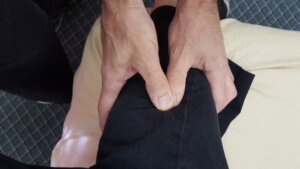
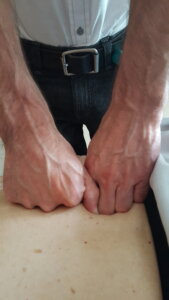
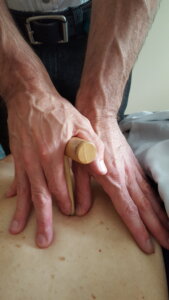
Pictured below are my 3 favorite ways to deliver precise pressure.
Stacked Fingers/Thumbs
Try not to press. Instead lean into your fingers/thumbs. The bottom finger/thumb is the primary palpation vehicle.
Knuckle-Thumb
In this picture I’m directing my pressure into the middle finger of my left hand. You’ll notice that my right thumb is bent to fit in comfortably next to my left middle knuckle. This is not a mistake. In this case, my thumb’s primary role is for palpation, not for delivering pressure. My right thumb’s companion four fingers form a loose fist. They take most of the weight that I put on that hand, not my thumb.
Tool-Thumb
In this picture my thumb is a support, guide and the primary sensing instrument. I’m directing most of my “leaning” pressure into the tool, not my thumb.
That’s a taste of precise pressure which helps to differentiate me from my competition.
More about how to use massage tools to deliver precise pressure here.
But as I said in the beginning, what uniquely makes you “you”, doesn’t have to be what makes me “me”.
Finding Your Uniqueness
So, does your uniqueness have to be precise pressure?
No.
But your pressure has to be spot on to make clients happy—and right there you have the beginning of a uniqueness formula. Adding precise pressure is an easy next step.
That said, you don’t have to go the precise pressure route. Your uniqueness could be specializing in a modality or combining modalities or your specific take on a modality or something as basic as doing a fantastic relaxation massage.
The point is to find your uniqueness and make sure that it’s connected to happy clients. Once you know the two are connected you can hone that skill.
Next, let’s talk about therapeutic rapport.
(2) Have solid therapeutic rapport.
Have you had the experience of being referred to an expert in a field and that expert turns out to be a complete a-hole?
Bye-bye, right?
In massage you don’t need to be an a-hole for someone not to come back. It could be that you didn’t show enough care towards the client.
For instance, if you’re having a bad day, thinking about yourself and not the person on the table, that could just be enough for your client to pass over you next time for Kiesha who is good at massage AND is present during the session.
Being a good listener and a good conversationalist (when the client wants to talk) are also ways that allow you to really connect with a client.
In fact, my wife, Lisa (also a massage therapist) and I agree that a big reason why our clients keep coming back is due to how we interact and connect with them.
Making your massage unique and having solid therapeutic rapport are two things that you must have to get a good flow of repeat clients, but if you want to make converting clients into repeat clients a whole lot easier, do this: Get referral sources to refer clients to you.
(3) Have referral sources that send you new clients.
A client who is referred to you from a referral source (a business/person who recommends your massage to her/his clients/customers/patrons) is primed to become a repeat client.
Why?
Because the referral source is endorsing you.
Don’t believe me?
Do a thought experiment. Margo does a Google search and you show up third in the local search. She goes down the list and calls the first two massage therapists but they don’t pick up. However, when she calls you, you do pick up. Do you expect that Margo will feel confident that she’ll get a good massage from you?
Maybe…I mean she only has your website to go on.
Okay, now imagine Tara the PT referred Margo to you because Tara personally knows you and respects your work—can you say potential client has been primed to come back to you?
It just makes sense that the more a referral source likes you and your work, the more she is going to talk you up to the person she’s sending your way, which makes that person a prime candidate to be a repeat client.
So, I talked about how to get repeat clients during normal times, but how about during abnormal times, like during a pandemic.
Specifically, what can you do get repeat clients during COVID-19?
Simple.
Do this:
(4) Create a COVID-19 work-safe environment.
Creating a COVID-19-safe-as-possible work environment is not only the right thing to do, it’s a way to expand upon care and further deepen your connection with the client.
Oh, by the way, this care connection starts before the client even walks though our door.
Think about when a potential client hits your website. With our website I want the client to know that we’re taking her safety more seriously than any other outfit in town.
I’m not going to overwhelm website visitors with policy. I’m going to point out key safety features we’re employing, like forehead temperature checks, masks, disinfecting and limiting the number of people we have in the office at one time.
And I’m going to give potential clients clear direction on how the appointment will go down so that there is no confusion or ambiguity in their minds.
This is the COVID-19 safety video that I made for our website:
So, with the video and the verbiage on our website I’m addressing safety barriers that may be preventing that person from calling:
(1) Is massage safe?
(2) Is this place safe?
(3) How safe is this place compared to other places?
This is the start of our care connection that will continue to build once the client arrives at our office.
Does above-and-beyond safety and care during COVID-19 guarantee a repeat client?
Not necessarily, but it makes the checkmark in the therapeutic rapport box a big one.
I have two more recommendations that have helped my repeat client average. The first is…
(5) Coordinate care.
By coordinating care I mean if the client comes to you for a specific pain issue, ask the client if it would be okay if you reach out to the other health professionals who are helping her with that specific issue.
That means you could be contacting orthopedists, podiatrists, PTs, PTAs, personal trainers, exercise physiologists and chiropractors.
The majority of health professionals that I coordinate care with are PTs, PTAs, chiropractors and personal trainers.
I get a huge positive response when I ask the client if I can coordinate care with the health professional on his pain issue case, and I often get referrals from that health professional.
Lastly, I need to mention…
(6) Follow up after the first massage.
By following up after the first massage (2 to 3 days after) you open the door for a dialogue about the massage session the client just had with you.
It’s at this point that you are more likely to get a candid reaction about the massage.
Nine out of ten times you will get a positive response. And the fact that you called after the massage shows the client that you care.
Again, think cumulative not specific. In other words, lots of caring actions add up. Keep heaping on the caring and the choice of where the client wants to go for a massage becomes a no-brainer.
How to Get Repeat Clients in a Nutshell
Getting repeat clients is not rocket science, but it does take some targeted actions.
First, you need to know what separates you from your competition. It doesn’t have to be a technique or modality. It can simply be that you deliver great pressure during a relaxation massage.
Also, throw in some good ole therapeutic rapport. Listen. Be a good conversationalist when appropriate. Coordinate care and follow up after the first massage session.
Find referral sources that consistently send you clients.
And during COVID-19 create a safe as possible environment and let clients know this on your website and in your advertising.
Getting repeat clients does not happen because you did one thing right. You get repeat clients by doing key things (what I mentioned above) competently.
Extra Help
If you’re just starting out and/or making less than 30K as a massage therapist, check out this free course to get your repeat clients rolling: Jumpstart.
If you’re trying to take your meh business to a Yay! business, go here: Accelerator Program.
If you want to get my latest info for free, sign up below:-)
Do meh-massage and you won’t be able to build a business or keep a massage job.
Number two–stay out of pain–is less obvious.
Stay Out of Pain
In fact, it often sneaks up on us, MTs.
The right thumbs starts to ache a little.
You ignore it the first week.
The second week you can’t.
Week three you get grumpy.
And by week four you’re wondering if this is your new status quo.
If pain and doing a good massage don’t trip you up to succeeding as a massage therapist, then getting your name out there probably will.
Get Your Name Out There
You know, on second thought, Mark, let’s go back to talking about doing a good massage—
Wait!
That’s exactly what I’m talking about.
When you’re not making enough money to make ends meet, you automatically go back to taking more courses on techniques and modalities, thinking more knowledge and skill will translate into more clients.
Has it?
My guess is that the answer is more meh. You got a few more clients, but you probably need a ton more.
Falling back on honing your craft is safe and easy.
Getting your name out there makes you pee your pants.
We’ll take care of you peeing your pants in a minute.
But let’s not jump the gun. Let’s figure out what you need to work on first so that you can succeed as a massage therapist.
If your massage is good and you’re not in pain or worried about being in pain then it’s time to tackle the toughest thing for most MTs to do: Get your name out there.
Are you hyperventilating?
Go ahead, get a paper bag to breathe into…I’ll wait…
Better?
Good.
Because I have something interesting to show you.
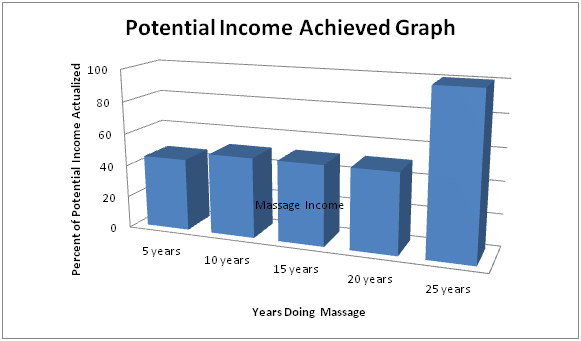
This is a rough bar graph of the percentage of my potential income achieved from doing massage over my 25+ year career.
The obvious striking aspect of this chart is the spike of income that happened in a couple years, between 20 and 25 years .
Why did it take me so long to actualize my full earning potential doing massage?
Well, it took me a few years to get confident with my massage.
Then around year 5 the pain crept in.
But in a relatively short period of time I figured out what I needed to do to deal with most of my pain issues.
So then why did I stay at the same income for the next 15-ish years?
Here’s why: I wasn’t good at getting my name out there.
Once I figured that out I experienced the biggest growth in my massage income over the shortest period of time in my massage career.
Succeed as a Massage Therapist Formula
So, what’s the secret sauce to getting your name out there?
Accepting the fact that you’re a runner.
Whenever you need to bring in more clients you’re gonna run to the CE course catalog.
When you do please do yourself a favor and pause.
Think about my graph.
Can you afford to wait 20 years before you start kicking some serious ass?
Work on getting your name out there right now.
It doesn’t have to be cheesy.
It doesn’t have to be complicated.
You just have to stick with it.
Here’s how I got my name out there: Jumpstart. It’s a free course.
Let’s do this How to Succeed as a Massage Therapist thing one more time.
How to Succeed as a Massage Therapist Recap
You can realize your maximum earning potential when you…