Author: Mark Liskey

  • How to do a Longitudinal Massage Stroke When Your Shoulder Hurts

    How to do a Longitudinal Massage Stroke When Your Shoulder Hurts

    How do you do a longitudinal massage stroke when your shoulder hurts?

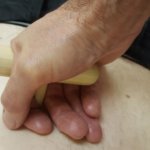
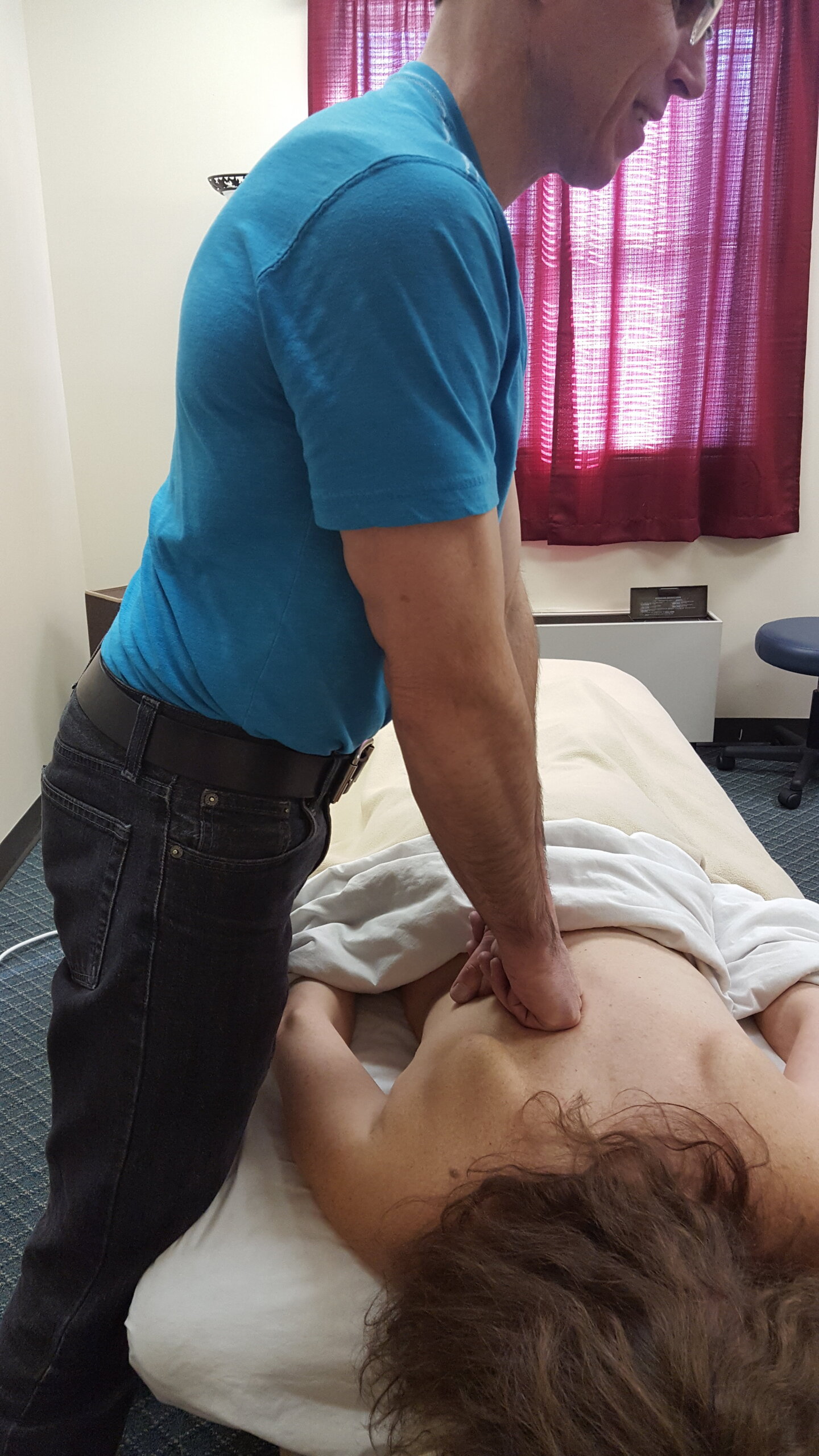
    1. Pick a side, lean and start gliding with fingers, thumbs, knuckles, fists, elbows or forearms.
    2. Pause when your it becomes harder to keep consistent pressure through leaning only.
    3. Move your feet.
    4. Start gliding until you lose your mechanical advantage again.
    5. Rinse and repeat.

    Okay, that seems easy enough, right? But before you attempt this strategy you need to know something.

    You’re going to have to break an unwritten, massage rule.

    Hey, I’m not a rule-breaker by nature. I get that rules are important. They keep societies together.

    However, some rules are bad or don’t serve a useful purpose any longer.

    In relaxation massage we have a doozy. It is in order for a stroke to be relaxing, it must be continuous (no stopping and starting).

    If you’re having shoulder and neck pain, take a look to see if you’re following this rule.

    It could be making things worse.

    Following the Rule

    I was taught that an uninterrupted stroke (e.g., gliding from the upper back to the lower back without stopping) is super relaxing to the client.

    I was double convinced when it was my turn to be on the table. Continuous strokes felt incredibly relaxing!

    And that’s how I did my relaxation massage for about 15 years.

    Pain Made Me Stop

    But then I noticed that my chronic shoulder condition would act up when I stood at the head of the table and glided with both hands from shoulders to the base of the sacrum.

    Oddly, even though I knew this move hurt me, I continued to do it for a couple more years.

    Hey, what can I say, rules are hard to break once they’re ingrained.

    Eventually though, as the frequency of pain episodes increased, I stopped doing the move and miraculously (lol) my shoulder stopped troubling me. 

    Back to Following the Rule Again

    But old Marky couldn’t let it go.

    I went back to doing a longitudinal massage stroke in one, long swoop but with a twist.

    Instead of standing at the head of the table, I now picked a side and did a continuous stroke (upper back to sacrum) using knuckles and a fist braced together.
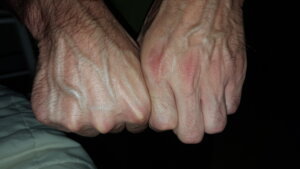
    That worked.

    Well, actually it only worked for a short while, but then my other shoulder started to bother me—especially when doing deeper work.

    Son of a B.

    I Broke a Massage Rule and I Liked It

    Alright, there had to be a takeaway here.

    And there was.

    I noticed that in both cases, when doing the old, longitudinal massage stroke at the head of the massage table and the new, longitudinal stroke at the side of the table, shoulder pain occurred when I started to extend my shoulder (when my elbow and shoulder joint were not stacked over top of each other).

    In order to NOT do this, I needed to move my feet.

    But if I moved my feet during the stroke, I would have to stop my stroke so that I could balance myself as I shifted my weight—and I would break the continuous stroke rule.

    Ruh-roh.

    Waiting for the Lightning Bolt

    Believe me, I approached breaking this rule cautiously because I was sure that clients were going to walk.

    First, I did a quick pause while doing a longitudinal massage stroke on an unsuspecting client and I didn’t get a reaction.

    Okay, so on the next client I did two pauses in a stroke and held them longer than my maiden pause.

    Guess what?

    All good.

    Hmm…how far could I take this?

    Well, I started to experiment with pausing doing a single, longitudinal massage stroke as many times as I needed (sometimes 5 or 6 times during a longitudinal back stroke) to stay in good form.

    Again, I didn’t lose a client—and my shoulders felt great because now I could move my feet so that I could get in the best position to deliver pressure while gliding.

    I tested the pause stroke out on MTs and got the same reaction. Both the continuous and the pause stroke were relaxing.

    What Gives?

    So, if it wasn’t the continuous movement of a stroke that made the client relax, what did?

    I don’t know for sure, but my guess is that it has to do with pressure.

    If the pressure is the same during the glide phase as it is during the non-glide (pause) phase, then the person on the table is probably less likely to notice or care that I’m pausing.

    Additionally, pressure seems to override stroke in this way: A client is more likely to put up with most any stroke if the pressure is spot on for relaxation.

    However, I don’t think the fanciest stroke in the world would ever cancel out pressure that is NOT relaxing to the client.

    Alright, enough wondering why, let’s get this show on the road.

    Here’s the step-by-step for pausing when doing a longitudinal massage stroke.

    How to Do a Longitudinal Massage Stroke with Pausing


    1. Pick a side.

    This is going to seem weird enough if you do most of your back strokes from the head of the table. But trust me working from one side allows you to stack your joints which will make your shoulders feel happy.

    Now, which body part are you going to massage with? Your fingers, thumbs, knuckles, fists, elbows or forearms?

    Picking a side gives you a lot of options to experiment with so that you can find the best one for your shoulder.

    Now, lean and then start to glide.

    2. Pause when it becomes harder to keep consistent pressure through leaning only.

    Yes, your massage stroke is going to be short, but have no fear it will feel like a continuous stroke if you maintain the same pressure throughout each short movement.

    3. Move your feet. 

    As you’re moving your feet to get in position to continue your stroke maintain the same pressure on the client.

    This video will help you out with that.

    4. Start gliding until you start losing your mechanical advantage again.

    You won’t go far before you feel that it’s becoming harder to maintain a consistent pressure without putting stress into your shoulder(s), especially when doing deep pressure. Then you’ll need to…

    5. Rinse and repeat.

    I call this rinsing and repeating process Short Stroke Massage. You can can read more about there here: How to Do Short Stroke Massage.

    Rethinking How You Do Massage

    So, what do you think?

    Remember, I’m not asking you to give up the awesome, longitudinal massage stroke if your shoulder hurts.

    I’m simply asking you to rethink how you do it.

    Find a way that works for you.

    Pausing so that I can re-position my feet and continue the stroke with good alignment from shoulder to elbow to wrist works for me.

    When I do this I’m forced to slow down because pausing and shuffling my feet take time. 

    That extra slowness makes the stroke even more relaxing in my book.

    At this point I want to mention that I have an online, home-study “how to massage pain-free” course. 

    It’s a 3 CEU course that has the strategies and techniques (like short-stroke massage) that enabled me to do more massages a day at 55+ than I could at 35. 

    Check it out here: How to Deliver Deep Pressure Without Hurting Yourself.

    So, what do you say, ready to break a rule?

    The continuous stroke rule gave you structure to work within when you first started massage, but when you mix in “taking care of your body” as you rack up the massages, it’s a rule that can hurt you.

    It’s time to think: How can I get the job done (make the client feel great) without hurting my body?

    And that’s when a rule should be challenged.

    Oh, one more thing. 

    Substitute “life” for “massage” when talking about rules.

    What happens?

    Right, some of those life rules are probably holding you back, too.

    If you’re ready to break some rules (aka, habits that aren’t working for you), sign up for my free, info-sent-weekly, email group below. 


  • Don’t Be Chuck (Don’t Stay In Pain)

    Don’t Be Chuck (Don’t Stay In Pain)

    Is massage causing you pain? Don’t let it. Here is a way that I’ve found to be super effective in changing the pain game: Recognize and eliminate perpetuating factors.

    Save Yourself $5000

    You may have read an earlier post of mine—I Saved My Client $5000 (By Using My Most Important Neuromuscular Tool)—where I explain how to help a client get out of pain by eliminating perpetuating factors. I define a perpetuating factor as anything one does (bad work posture to bad decision making) or has (a structural imbalance) that activates, aggravates or prolongs a pain condition.

    The same is true for you and me. If we can eliminate perpetuating factors while doing massage, we can stay out of pain.

    The trick is to pay attention to the little things. Because the little things can add up to a big reason why you’re in pain.

    The Little (But Costly) Perpetuating Factors

    I’d like you to meet Chuck. Chuck is a handyman who did work at my mom’s house. He has pain issues. One day Chuck and I teamed up to paint my mom’s basement. Midway through Chuck started to complain about his knees. I looked over and saw that he was kneeling on concrete.

    When I suggested rolling up a blanket for a knee cushion, he declined. Later when I saw him using a paint roller on the wall, I noticed that instead of bending from his knees, he was bending awkwardly from his back. (Probably because his knees hurt from kneeling on concrete.)

    Guess what his next complaint was about? You got it—his back.

    These incidents may not seem traumatic enough to cause Chuck pain, but I guarantee you that Chuck kneels on hard surfaces and bends in a way that’s bad for his back over and over every day. And the cumulative effect is enough to keep him in pain.

    Become Aware of Your Pain

    Now instead of picturing Chuck in my mom’s basement, imagine you’re in your massage room. If you were able to watch yourself do a massage you, like I watched Chuck paint, you’d probably see yourself doing something (perpetuating factor) over and over that’s activating a pain issue.

    You can start to figure out what may be causing you pain during a massage by simply paying attention to when the pain occurs and noting what you’re doing when it happens.

    Change How You Do Things

    Next, I’m going to ask you to do something a little more difficult. Ready? Stop doing whatever it is that you’re doing when the pain occurs AND think of another way to get the job done.

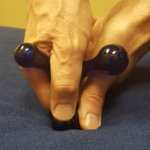
    For example, if your right thumb is bothering you when you start to use it for firm detail work, then try your left thumb. If a thumb starts to bother me in the middle of a glide stroke, I will often switch to a knuckle or a power tool, like a knuckle braced by a fist, or a T-bar.

    The key is to get comfortable with as many tools (fingers, thumbs, knuckles, fists, elbows/forearms) as possible. That way you will never run out of options. In this rough-cut, YouTube video—Massage Techniques–Deep Tissue Basics (Tools and Power Tools)—you can see what I mean.

    Change How You Think

    As your pain area starts to feel better, it will be tempting to stop self-monitoring. Don’t.
    My right shoulder had bothered me every since high school football. When I had eliminated a key perpetuating factor, reaching too far during a glide stroke, my shoulder pain disappeared.

    But then I got used to feeling good and I reintroduced the perpetuating factor (extending too far when gliding). It didn’t take me long to activate my right shoulder pain again. But this time my other shoulder was bothering me from working out. It was a dicey month or two before I was able get back to the “feeling good” baseline.

    It was all absolutely avoidable if I had continued to self-monitor.

    Remember Chuck

    I know that in other areas of my life I can be Chuck. I think something is unfixable because I don’t have or am not willing to accept the information that will help me.

    But when it comes to my body, I can’t afford to be Chuck. Neither can you.

    During a massage, note what you’re doing when the pain occurs. Then eliminate the perpetuating factors that are activating the pain issue and find another way to get the job done. Continue to self monitor. Feel better!

    My Best Body-Mechanics, Online, CEU Course

    A while back I almost quit massage because of pain and injuries.

    Then I spent a year revamping my massage to see if I could massage pain-free. That’s where incorporating the lower half of my body into the massage came in along with a bunch of other strategies that ultimately saved my massage career.

    I pulled all that first-hand experience together and made a live CEU class which I taught for about 5 years. During those 5 years I listened to the massage therapists taking the course and worked out the learning kinks.

    Now I have an online version of the live body mechanics class that will help you massage pain-free.

    Check it out here.

  • Which is the Best Massage Tool for a Massage Therapist?

    Which is the Best Massage Tool for a Massage Therapist?

    Which is the best massage tool for a massage therapist?

    That’s an easy answer.

    The massage tool that works best for you (the massage therapist).

    The harder question is: Which massage tool works best for you?

    To answer that question, you need to ask yourself more questions:

    1. Does the massage tool stress my hand when I use it for a few minutes?

    In 2018, I wrote a massage tools article for Massage & Bodywork Magazine. I wanted to write exclusively about the T-bar because it was my go-to massage tool.

    But the editor rejected that idea and asked me to do a comparative massage tools article. So, I went to the local massage supply store and played with the massage tools on display.

    I eliminated 80% of the massage tools for the article by simply pressing them into the display table. If I had hand or wrist discomfort and couldn’t figure out a way to grip the massage tool so that I didn’t—adios.

    By the way, I didn’t care if the packaging said “Voted Best Massage Tool for Feet” or “Designed by NASA Engineers!”, if it hurt my hand, it hurt my hand. Period.

    I should point out something here: Like any hand-held tool, a massage tool is going to bother something (your palm, fingers or wrist) if you hold it too long.

    That said, the massage tool that you don’t want to buy causes immediate discomfort when you hold it AND scores low on question #2.

    2. Can I hold the massage tool comfortably in multiple ways? 

    Basically, when you’re using any massage tool you will need to mix up your holds.

    As I mentioned above, if you hold anything one way for a long period of time (even a pencil), you are going to over-stress certain joints and muscles.

    When you use different holds you spread the workload (and stress-load) out.

    You can spread the workload out even more by becoming ambidextrous with the massage tool. Don’t worry about that right away. That will come with time.

    How do you figure out different holds?

    You allow your hands to experiment with different holds. I call this adapting to the massage tool.

    Adapting to the Massage Tool

    If the massage tool works well in the cervical erectors with one hand, but hurts your hand in the thoracic erectors because you have to tighten your hold, try using two hands on the massage tool.

    More about holding a massage tool here.

    So, adaptation isn’t only limited to holds. Adaptation should also influence how you use the massage tool.

    How you hold a massage tool and how you use a massage tool often work together.

    In other words, trying different holds will often result in you being able to use the massage tool in more areas than you first thought you could.

    In this video, I demonstrate various adaptation responses when using a long T-bar.

    https://www.youtube.com/watch?v=-1uF_FkjBDs

    The last question to ask regarding which massage tool is best for you is:

    3. Is the massage tool only good for one pressure or can I use it for light, medium, and  deep pressure? 

    A lot of massage tools are fine for light pressure, but for medium or deep, not so much.

    To do medium and deep pressure, I advocate leaning your body weight into the massage tool, rather than pressing with your upper body.

    Massage tools with handles are ideal for leaning because they provide enough surface area to lean into.

    That’s why I’m not a big fan of the Jacknobber for medium to deep pressure.

    It doesn’t have a place for me to rest my hand comfortably. And it makes my hand ache when leaning to do medium or deep pressure.

    Putting it All Together

    All that to pick out one freakin’ massage tool, Mark!

    Well, finding one or two massage tools that are perfect for you are going to change how you do massage forever.

    When you do you’ll be able to increase your massage max while saving your body.

    Here’s the criteria I use for picking the best massage tool on the market (aka, the best massage tool for you):

    1. The massage tool doesn’t stress my hand when I lean into it for a reasonable amount of time.

    2. I can comfortably hold the massage tool many different ways.

    3. The massage tools is good for light, medium and deep pressure.

    How to Use Massage Tools Fearlessly and Effectively Online, Home-Study Course (2.5 CEU)

    If you get competent with massage tools you can increase your massage max (make more money) and brand your massage.

    It just takes knowing what to do and a little practice. Get competent with massage tools here: How to Use Massage Tools Fearlessly and Effectively (2.5 CEU).

  • You Are Set Up For Pain In The Massage Room

    The stabbing pain in my upper-back seemed to be connected to the electrical feeling in my elbow and the constant tingling in my hands. The orthopedist diagnosed me with cervical radiculopathy, cubital tunnel syndrome and unstable left shoulder. Before I could tell him about my achy fingers, he said: If I were you, I’d find a new job.

    It was practical advice, what I would expect a doctor to say, but here’s the thing: I had worked through aches and pains in the massage room before, why couldn’t I do it now? Granted, these were bigger issues than before, but what if I ran an “experiment” in my massage room where everything was on the table (no pun intended)? In other words, I wouldn’t assume what I knew about body mechanics was correct. Anything goes; winner takes all.

    I went with the experiment. I gave myself a year to figure out how to massage without being in pain, and at the end of the day, I was able to do massage without hurting myself or triggering old problems.

    I usually tell this story before I teach my body mechanic classes to help participants understand my rationale behind my class. I’m telling you this story because if you have or are massaging in pain, there’s a reason why: You’ve been set up.

    Massage is Physical

    Here are two facts about massage: It’s a physical job that stresses joints, and your income as a massage therapist is dependent on how many massages your body can handle in a day. That’s a recipe for pain and injury.

    With a job so “body” dependent, it’s still alarming to me when massage therapists, after reading my book, The Pain-Free Massage Therapist, ask me, “Why didn’t they teach me how take care of my body in school?”

    It’s a question I have asked massage teachers. Here are the answers I get: I would like to teach more body mechanics but I have to cover so much material I don’t have time to cover it thoroughly and I have to teach for passing the licensing exam.  

    These answers make sense to me, and I want to be clear: I’m not saying it’s your  massage teacher’s fault that you hurt. The teachers I know work their butts off trying turn out massage therapists who are knowledgeable, competent and ready to work out of the gate. They are kind and caring and do everything they can to support their massage students.

    The Massage System

    The problem is with the massage system which includes massage schools, licensing boards, regulatory agencies, professional groups, massage businesses, massage product suppliers, massage CE providers and media outlets.

    The system is based on business relationships and financial transactions between all the parties mentioned above. Because of the financial interconnectivity, ultimately, the system doesn’t “care” how long you do massage or if you are in pain when doing massage.  Don’t take it personally. It’s business.

    Massage schools don’t fill seats by saying massage is tough on your body and you better know what you are doing or you will be injured or in pain and quitting massage if you don’t. Regulatory agencies are created for the health of the profession, not your health. Professional groups straddle the line between looking out for the massage therapist and keeping massage employers, massage schools,  sponsors, donors and advertisers happy. Media outlets publish what is popular and are beholden to advertisers and/or parent companies that may have a business agenda where massage is a minor part.

    Look Out For Yourself

    The bottom line is you have to look at for you in the massage room until the system changes. Here’s what you do to look out for you in the massage room:

    1. Trust yourself. You know when a technique is hurting you. Stop doing it and find a replacement that doesn’t hurt your body. Easier said than done sometimes, especially when you think it is helping a client get out of pain. My guess is if you stop doing the technique that is hurting you and start substituting techniques that don’t hurt your body, you’ll find one that both works for you body and helps to reduce your client’s pain.
    2. Experiment. If you want to look out for your body in the massage room, you need to think about your body during the massage. I’m not saying to prioritize your body over the quality of the massage—the two, a good massage and a safe massage for your body—are not mutually exclusive. I’m saying be aware of massage techniques and body mechanic strategies that are causing you pain. Once you are aware, you can experiment with making adjustments.

    Here’s what you do to change the system:

    1. Buy courses and study modalities with the massage-therapist’s body in mind.

    You have already graduated from massage school, and learning “the best body mechanics for your body” did not happen. Massage schools are not motivated to put our bodies first until market forces push them to do so.

    That said, we can start this process by demanding that modalities and CE courses are designed with massage therapists’ bodies in mind. Don’t think: I am paying a course provider to teach me a new technique. Think: I am paying a course provider to teach me a new technique and to NOT hurt my body. The provider should have or be able to create workarounds for any of their techniques that may cause you pain because of your body type, massage style or a pre-existing pain condition. Period.

    Change From the Top Down

    Ultimately, the massage world is selling us what we are willing to accept. Right now, we accept the next shiny massage-technique because it will make us more money or help our clients feel better no matter the toll it takes on our bodies. But the reality is you don’t make more money and help more clients by doing less massage because your body hurts from doing techniques that weren’t designed with your body in mind. So, buy classes that are “body friendly”. To protect your body in the massage room now, trust yourself to know when a technique causes you pain. Then experiment to figure out workarounds or to find substitutes. Always, I’m here if you need help.