Author: Mark Liskey

  • How to Advertise Better Than Massage Envy

    How to Advertise Better Than Massage Envy

    Who do you think of when I say massage advertising?

    Jenny’s massage?

    Hardly.

    I think of massage spas, like Massage Envy.

    Massage spas have fat advertising budgets.

    Private practice MTs not so much.

    But we’ve got something else. And it’s a massage advertising dynamo when it becomes a habit: It’s the practice of building rock-solid relationships with other health practitioners.

    I’m not talking about a “I’m just gonna drop off my business cards” kind of connection.

    I’m talking about an ongoing, highly interactive relationship that (1) improves treatment outcomes, (2) makes clients happy because you’re all in (and they know it), and (3) spreads your name like crazy.

    Yeah, Mark, I already do that.

    For twenty years, I thought I was doing it. But then I learned that’s there’s another level to connecting with health practitioners that I wasn’t doing.

    By the way, connecting with health practitioners is something massage spas can’t do.

    For one simple reason: Their business model won’t let them.

    Imagine a Massage Envy owner telling one of her MT employees this: “Go ahead and text Bob (the client) to see how he did after his adjustment yesterday?”

    Or: “Did you check in with Tara’s PT yet to make sure that you’re on the same page?”

    Not going to happen.

    Why?

    A massage spa has to protect its business.

    If a MT walks or gets fired, a massage spa doesn’t want her to have access to a client’s information, like a cell phone number, for fear she might take the client.

    Also, we all know that massage spas tend to have a high MT turnover rate.

    And if a MT employee has a great therapeutic relationship with a client, built by going the extra mile, that client is likely to follow him when he leaves.

    So, incredo therapeutic rapport is actually a double-edged sword for a massage spa.

    The inevitable consequence of this business model is “above and beyond” gets dialed down and interchangeability gets dialed up.

    Which means we OWN strong relationships.

    Our advantage. Forever. Period.

    (Unless massage spas change their business model…psst…they’re not going to….they’re making way too much money doing it their way).

    To see the biggest business benefit from strong relationships with other health practitioners, you need to execute 3 steps (the 3rd one is the “next level” step).

    Here are the steps:

    Massage Advertising Through Strong Relationships

    Step #1: In-depth intake and permission to consult.

    I do a thorough intake with the client. If the client has a pain issue I’m going to be working on, I make sure that I know who she’s currently working with to resolve the problem.

    I then ask the client if it would  be okay if I talked to ———– (the health practitioner working with her).

    I’ve never had a client say no. And who isn’t happy knowing that everyone is working together on her/his behalf?

    Step #2: Email/call the health practitioner.

    From the get-go, I want the health practitioner I’m contacting to know that I’m there to support his/her work.

    Sometimes the person you contact may want to meet you. Whether you meet face-to-face or not at all isn’t important.

    The fact that you’re checking in and supplying your piece of the puzzle is the most important thing.

    Step #3: Do steps 1 and 2 with each client who has a condition/issue and is seeing another health practitioner for that same condition/issue.

    This is the step that will take your business to the next level and is the step that’s the easiest to screw up.

    Why?

    Because it takes effort to make steps 1 and 2 a habit and not a random act of kindness.

    Also, you won’t see the business benefits from your efforts right away.

    But if you stick with it, your name will start to spread among area health practitioners and within their patient/client bases.

    You know you’ve got a good massage advertising system in place when a client hears about you from two different sources.

    My acupuncturist gave me your card, then my friend, Joanne, said that she saw you last year for her back because her chiro recommended you.

    This is free (time as payment) massage advertising on steroids. And there’s an added bonus.

    The Added Bonus

    When you start connecting with a client’s health support team you learn a lot. And you become a better therapist.

    Massage Advertising Through Relationships in a Nutshell

    Own massage advertising by doing what the big players can’t.

    1. Deep dive into the intake and ask for permission to consult.
    2. Contact the appropriate health practitioner.
    3. Do this with each client who has a condition/issue and is seeing another health practitioner for that same condition/issue.

    It’s free massage advertising that massage spas can’t will never do.

    For more about how you can grow your business by understanding the business model of massage spas, check out: How to Compete with Massage Envy.

    Wait, Mark, too much info, I’m just starting to build my massage business.

    No problem, go here: Jumpstart.

    And if you’ve got a meh massage business (30K or less a year) and need to crank it up, go here: Accelerator.


  • Take the Strain Out of Occiput Work

    Take the Strain Out of Occiput Work

    Over the years occiput work beat up my fingers and thumbs. At one point, my hands ached so bad that I thought about taking occiput work out of my massage.

    But instead I experimented for about a year and discovered that when I changed one bad habit and found other ways to get the job done, my hands felt better. Here’s what I did.

    The Supine Habit

    In massage school I learned how to do occiput work when the client was supine. The idea was this: the weight of the client’s head on your fingertips would be the force that “generated” the pressure. Do it this way and there would be less strain on your hands.

    But my hands told a different story. They ached from years of supine occiput work. When I started to pay attention to my hands, I realized that supine occiput work wasn’t just about supporting the weight of the client’s head with my fingers. More times than not it also involved pressing up into the client’s skull in order to generate enough pressure.

    It was time to try prone.

    Go Prone

    I was first introduced to prone detail work while training to be a neuromuscular massage therapist. We used a T-bar in the lamina groove.

    I liked prone work because I could generate the pressure I needed by simply leaning into the client with my body weight. Using the T-bar in the lamina groove inspired me to experiment with my thumbs and knuckles in the lamina groove.

    1. Thumbs and Knuckles

    A middle knuckle is a wonderful thing. It’s especially helpful for prone occiput work. Why? Because you can generate all the pressure you’ll ever need (and then some) by leaning in with your knuckle.

    Another great prone occiput technique is double thumbs braced together. I use double thumbs for light to medium pressure and I use my middle knuckle when I have to apply deeper pressure.

    The key to these techniques is to use the massage table to help support your body weight.

    In this video, 2 Prone Occipital Massage Techniques, I show you how to work the occiput using double thumbs and a middle knuckle.

    1. T-bar or L-bar

    6 Finger Pic

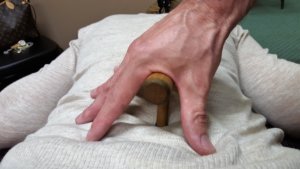
    A great way to give your fingers a break is to you use a T-bar or a L-bar. In the occiput, you can use a T-bar or L-bar even more precisely than you could use your thumb.

    In addition, you don’t need to exert a lot pressure because the tips of these massage tools are small and the pressure is focused. And when you position your hand so that it rests against the client’s upper trap, it couldn’t be easier on your hands.

    In this video, T-bar for Occiput and Back Muscles, I show you some easy-to-pick-up T-bar techniques for the lamina groove and occiput.

    1. Fourth and Fifth Fingers

    Take a look at your hands. Which fingers do you use most during a massage?

    My finger usage rating, from most used to least used, goes like this: 1. Thumb, 2. 2nd finger, 3. Middle finger, 4. Fourth finger, 5. Pinky.

    Another way to gauge finger usage during a massage is to ask yourself: if I only had time to cut three fingernails on each hand before I did a massage, which ones would they be? My guess is that your fourth finger and pinky would not make the cut. (Pardon the pun.)

    If you really love supine occiput work and don’t want to remove it entirely from your massage repertiore, try using your middle, fourth and 5th (pinky) fingers when doing supine occiput work.

    It will feel weird at first, but after a couple of times, you’ll fingers will adapt. Once they do, you can give your go-to fingers a break when doing supine occiput work.

    Where There’s a Will There’s a Way

    You can do some great occiput work without killing your hands. Here are my three favorite techniques:

    1. Prone occiput work with a knuckle or double-barred thumbs.
    2. Prone occiput work with a T-bar or L-bar.
    3. Occasional supine occiput work with non-dominant fingers (for me my 3rd, 4th and 5th fingers).

    I am 100% convinced that by breaking bad habits and thinking creatively you can do a great massage and stay out of pain.

    Save-Your-Body, Online, CEU Course

    A while back I almost quit massage because of pain and injuries.

    Then I spent a year revamping my massage to see if I could massage pain-free. That’s where incorporating the lower half of my body into the massage came in along with a bunch of other strategies that ultimately saved my massage career.

    I pulled all that first-hand experience together and made a live CEU class which I taught for about 5 years. During those 5 years I listened to the massage therapists taking the course and worked out the learning kinks.

    Now I have an online version of the live body mechanics class that is kink-free and will help you massage pain-free.

    Check it out here.


  • How to Get Your Massage Noticed

    How to Get Your Massage Noticed

    I could kick myself when I think about all the massage business marketing mistakes I had made, especially when I didn’t understand and execute this:  HEY, I’M HERE!

    To me, HEY, I’M HERE! is a must for MTs trying to grow a practice. By the way, the caps and exclamation point are on purpose.

    View them in contrast to the massage business marketing strategy I had used before: Hey, I’m here.

    Noticeable difference, huh?

    HEY, I’M HERE! is screaming. You have to turn your head and look at me.

    With Hey, I’m here. you only hear me if you’re 2 feet away from me. It just doesn’t get the job done.

    I know what you’re thinking: I’m not a HEY, I’M HERE! kind of person.

    Neither am I.

    But you can convey HEY, I’M HERE! without being obnoxious.

    Source: moulderjohny.com

    Massage Business Marketing: HEY, I’M HERE!

    Here’s how I do it.

    1. HEY, I’M HERE! just needs to be impactful enough to be noticed.

    For signage, impactful means it needs to be seen from a distance. And it needs to capture the passersby’s attention. You can capture someone’s attention with content and/or design.

    This is my car magnet sign:

    I wanted to convey that we are confident in our ability to do good work.

    Impact with a website could be content driven, too.

    I offer this deal…

    I’m different than the competition because…

    Here’s my opening for our Google blurb to differentiate us from our competition:

    If you want a massage without a membership contract or a chakra re-balancing, you’re at the right place. We help avid runners, weekend warriors, arthritis…

    Impact on a website could be highlighting great online reviews.

    And pictures have impact.

    Think happy clients. A warm waiting room. Your smiling face.

    Speaking of your smiling face, if you’re really shy, read this. It will help you start moving in the right direction.

    On to tip number two…

    2. Execute HEY, I’M HERE! from a customer’s point-of-view.

    Put yourself in the perspective of your customer when trying to get noticed, especially when it comes to signage.

    At our one office, we’re at the corner of an intersection. We have multiple signs outside the office building. Two marquee signs, a banner sign and 2 tent signs.

    Recently, a new client, Riya, said that she had seen our banner sign for the past couple of years but never called.

    Why?

    Because the banner sign she saw every day going to and from from work was next to the side of the building and didn’t direct her to the entrance. It left her confused. Was our office in the building or somewhere else?

    Also, since she didn’t know where the entrance was she couldn’t determine if our office looked safe and inviting, a place she’d want to try out.

    One banner sign on the side of the building directing potential customers to the front of the building coming up!

    Here’s the last tip.

    3. HEY, I’M HERE! needs to be in multiple marketing areas.

    Guess what ultimately drew Riya through our doors?

    Not the sign she passed by 100s of times.

    It was our website.

    She did a search, pulled our website up and we just happened to be the place she drove by all the time.

    Thankfully, we were using the HEY, I’M HERE! strategy with our website.

    So with Riya, here’s what we got right with HEY, I’M HERE!: Impact and  multiple marketing areas.

    We missed “execute from a customer’s view point”. And here’s what it cost us.

    For about 2 years, Riya’s husband had been telling her to go to the massage place (us) that she passed by the days she went to work. After all, they lived within walking distance.

    Finally, she did (not because of our signs). She liked us and was used to getting massaged regularly, so she started coming to us once a week.

    But, here’s the kicker, she’s moving very soon.

    Hmm…what if we had gotten her to try us 2 years ago?

    Let’s go conservative. 40 weeks x 2 years x $70 (our charge) = $5600.

    Can you say waah?

    HEY, I’M HERE! in Three Steps

    Get your massage business marketing moving by having the right strategy in place.

    Try HEY, I’M HERE!.

    Make it (1) impactful enough to get noticed, (2) execute it according to the customer’s perspective and (3) cover multiple marketing areas.

    Need some help with your massage business marketing?

    Try this free Jumpstart Program.

    Trying to turn  a meh business into a yeah! business, then you may want to look into advanced marketing.

    And I’m here if you need help: mark@makethemostofmassage.com.


  • How to Fix Your Massage Career

    How to Fix Your Massage Career

    Remember when you first started on your massage career journey?

    You were going to have a big, fat client book, steady money, and you were always going to be flying high because you were getting good mojo from helping people.

    And then what happened?

    Well, you developed a following, but you needed 3 or 4 more clients a week to be good. Money was up and down. And some clients drained the life out of you while others hurt your body.

    Is that about right?

    Be honest.

    Honesty hurts. But brutal honest is the place to start if you want to fix your massage career.

    So, let’s be brutally honest.

    Massage is hard.

    But so are most occupations, right?

    Plumbers have to crawl into spaces we’d never want to crawl into.

    Psychologists have to listen to other peoples’ problems then deal with their own problems.

    Executives have to travel and spend time away from their families.

    Massage is hard but not harder than most occupations.

    Fix Your Massage Career Step #1

    So, the first step to fixing your massage career is to simply accept the fact that massage is hard work.

    Fix Your Massage Career Step #2

    The next step is to accept that “more” is even harder.

    More?

    As in make more money.

    Get more clients.

    Find a place that values you as an employee.

    Work with a segment of the population that makes you feel fulfilled.

    Teach massage.

    Start a massage business.

    Grow a massage business.

    Become the manager of a massage business.

    Work as a massage therapist in a resort at your favorite vacation place.

    Add a side gig to your massage career.

    Become an authority on a particular type of massage.

    Write for a massage magazine.

    Write a massage book.

    Have a massage podcast.

    Have a massage blog.

    Build a second career from your massage career.

    Go away for 3 months and come back to your massage practice.

    These massage career goals are in your grasp if you (1) accept that massage is hard, (2) accept that “more” is harder AND accept a third condition: (3) Pressure and discomfort are good things.

    Fix Your Massage Career Step #3

    Accepting pressure and discomfort as a positive force was my biggest stumbling block to experiencing “more” in my massage career.

    Fresh out of massage school I had this notion that a job where I was helping people was going to be easy.

    I quickly learned it wasn’t. At the end of a long day my body hurt and the money wasn’t there.

    I wanted more.

    So I went out on my own.

    But I had no money to advertise.

    That meant I needed to hustle.

    Hustle?

    Do demo massages for free.

    Do talks and special events for free.

    I did that. But then I felt like I was getting used because the free massage I was doing was only netting a few clients. By the way, rent was due.

    So what did I do?

    I bailed on the massage marketing and I grabbed some personal training clients.

    At the end of the day, the pressure was off and the discomfort had temporarily subsided.

    But what had I lost out on?

    Actualizing the dream of having a massage business that actually met my needs and provided me with other business options down the road.

    Later on in my massage career I learned that if I had stuck with my free massage marketing strategy, I would’ve seen a strong return after 2 or 3 months.

    Here’s a recent example of how accepting the conditions of (1) massage is hard, (2) more is even harder, are (3) pressure and discomfort are good can work to advance your massage career.

    A while back, my wife, Lisa, and I traveled to Seattle, 2,821 miles away, to teach 3 courses during the beginning of this week at Oasis spa.

    That distance was a first for us. And it was a major stretch since we had just opened up another massage office 3 weeks prior to the Seattle trip.

    Let me tell you, there were tantrums, panic attacks and I pulled my hair out.

    Okay, the hair was already long gone.

    But we stuck it out because we knew that the discomfort and extreme pressure were temporary conditions.

    And if we had stopped short we wouldn’t have known if the pain was worth the experience to be gained.

    By the way, it was.

    Okay, so as you noticed there wasn’t a lot of cheerleading going on in this piece.

    Why?

    Because cheerleading alone won’t get you “more”.

    You need to accept that…

    1. Massage is hard.
    2. More is harder.
    3. Pressure is good.

    Then push on.

    Need more help with your massage business?

    Get a massage business off the ground with this free course: Jumpstart.

    Take your current massage business to the next level with this program: Accelerator.

    Join my email group.

    I’ll send you my latest information weekly.

    It’s free.