Author: Mark Liskey

  • How to Price Your Massage to Make Money

    How to Price Your Massage to Make Money

    Massage pricing is not easy, but also not as hard as you may think.

    The other day I read a post and the LMT who wrote it said that she never lowers her price because it devalues her work.

    She added that LMTs who discount their massage do a huge disservice to the industry because clients start shopping for lower prices.

    And if we all vowed to never lower our prices, held hands and sang Kumbaya around the massage table, we’d all be happy and well-paid.

    Okay, that was a little nasty of me and, honestly, I have no room to talk. When I first started massage I was Mister I-Discount-Every-Massage-Because-I-Think-I-Suck.

    Add up all that money that was lost because I discounted my massage and think of all the money I could have spent—I mean saved.

    But that’s not the end of my pricing story. After I got confidence (go here for some) as a massage therapist, I started to over-value my service, and I missed business because I was too expensive.

    I was a pricing pendulum.

    Eventually I realized that the price I should charge shouldn’t solely be determined by my gut (how much I felt I was worth). Something else needed to be factored in.

    Competition

    Whether you like it or not, competitors, the massage businesses in your space, are free agents and are probably not going to agree to price fixing.

    What they charge matters.

    Why?

    If you’re charging $85/hr and Johnell down the street is charging $70, you better be $15 better than Johnell.

    And it doesn’t matter if you think you’re worth the extra $15. Trish, the customer, has to think to think you’re worth it.

    And how is Trish going to determine if you’re worth it?

    Someone OR the Internet will tell her.

    Referrals

    Having a client refer Trish to you is pure sweetness.

    In that scenario, price expectations are already set because your price was probably already mentioned when the referral was made.

    But if the Internet tells Trish that you’re good, things are a little different.

    Let’s say that Trish goes to your website, sees that you have good reviews and likes what you say. But the $85 is a little more than she wants to spend.

    She then lands on Johnell’s website, another good fit with good reviews, BUT Johnell is charging $15 less.

    Who’s Trish going to call?

    Not you.

    So because of the Internet I need to do massage at $65 an hour, Mark!

    No.

    But you need to do some serious price thinking.

    Fix Your Website

    First, you need to make sure that your website is all that it can be–it needs to engage Trish.

    1. Are you answering her questions? If not read this.
    2. Do you have great reviews?

    You need them. Lots of them. As many if not more than Johnell. If you need more reviews ask existing clients to give you reviews.

    1. Is your website optimized for a local search?

    No biggie. Click here and you’ll find how to do that in this website guide.

    Okay, now you’re on even footing with Johnell in terms of your website presence.

    Finding the Right Price

    Now, let’s talk actual pricing.

    You want $85. Johnell’s at $70.

    Hmm…what would happen if you offered a one-time, introductory special of say $59 or $65?

    This is what happened to us: People started calling.

    Once you get them through the door, then you just need to give them reasons to come back.

    I have no doubt that you’ll do a great massage–and that will be a pretty convincing argument to come back.

    But what about your price? Is that convincing?

    Is the $15 difference between your price and Johnell’s price a deal breaker?

    Maybe your price in the Johnell market should be $75.

    And lose $10 a massage, Mark!

    Well, let’s do the math.

    The old way: $85 x 0 (the number of Internet clients that you were getting) = $0.

    OR the new way: $75 x 4 (the four new online clients that come back to see you in a month) = $300.

    But, here’s the thing, you may not need to adjust your price at all.

    It could be your $85 is spot on because customers experience your value as higher than the other LMTs around.

    You’ll know if you’re spot on in a couple of months.

    How?

    Are those introductory massage clients coming back at your $85 normal rate?

    If not, you may want to start retooling your price.

    Massage Pricing to Compete

    There’s no way around that we’re emotionally connected to our price.

    BUT unless you’ve got serious self-devaluing issues and are always discounting your hourly rate, you need to be willing to adjust from your ideal price if you want to be competitive with the LMTs around you.

    First, know the market you compete in.

    Who’s good?

    Who’s got a big clientele?

    What are they charging?

    Set a price around that rate.

    Get the client to call by having an engaging website.

    Once the client comes in, the price testing has begun.

    If your intros are not coming back, you might be too high.

    If they talk about what a great deal you are, your price may be too low.

    Pricing is not rocket science, but it shouldn’t be pure gut either.

    By the way, if you want to save money buying massage insurance, I wrote this article: WHO HAS THE CHEAPEST MASSAGE INSURANCE?

    Need help?

    Check out my free massage business crash course: Jumpstart.

    I also have an email group. Sign up and I’ll send my latest everything weekly. It’s free:-)

  • I’m Not A Cover Band

    I’m an artist.

    Actually, I can’t paint. I don’t play guitar. And I have no spatial sense.

    But I do share one characteristic with some of the most famous artists.

    Artistic outbursts.

    That is I have an overwhelming desire to express myself.

    Unfortunately, artistic outbursts in business can bite you in the butt.

    My Business Card Outburst

    Here’s a perfect example. When I first started massage I had some business cards made up.

    Expensive stock paper. Raised printing. Pretty classy and professional if I do say so myself.

    But then I had an artistic outburst.

    I took colored pencils and magic markers and started to personalize my nice, white business cards with pictures of flowers and plants and abstract shapes.

    And, OMG, my “Would you like a massage from a professional massage therapist?” business card turned into “I might have some issue that I’ll need to talk about while I’m giving you your massage…wait, why are you walking away” business card.  

    My wife, Lisa, girlfriend at the time, did warn me that my artistic outburst on my business cards may turn people off, but I couldn’t help myself—and I handed them out.

    Funny, I can’t remember anyone ever asking me for more cards to give to friends.

    But anyway, you live and learn, right?

    Well…not exactly…

    I still have self-expression outbursts.

    The difference is now I know that I need to manage these outbursts in order to have a good business (life).

    By the way, I did say manage, not squelch.

    Because if you truly have a unrelenting desire to express yourself, it’s gonna find a way out.

    So what do you do?

    Here’s what I do.

    How to Make Self-Expression Work for You

    First, I view business as a medium where self-expression will happen.

    But then I do something a little different than allowing myself to have artistic license to do anything. I manage my self-expression.

    How?

    By being strategic. Some self-expression I’m going to let out. Other things I’m not.

    Why?

    Because for self-expression to work in the business medium there are certain rules that I don’t want to break.

    This one in particular: Don’t repel customers with self-expression.

    This rule is self-explanatory. If you drive customers away with artistic outbursts, you won’t be in business for long.

    There’s an interesting flip-side to repelling customers with self-expression.

    You can actually attract customers with strategic and properly dosed self-expression.

    For example, what would have happened if instead of drawing primitive pictures on my business cards I had a “loving to help other people” outburst.

    Well, here’s what happened.

    Massage Envy and Me

    Ten years ago, Massage Envy moved into our neck of the woods.

    I’m just going to be blunt. I don’t like their business model.

    If there business model was a totem pole with four faces on it, the top face would be a Massage Envy corporate executive, under that a franchise owner, under that a customer, and at the bottom a massage therapist.

    Lisa and I want to challenge that business model.

    So, it was time to channel an artistic outburst.

    And I got my colored pencils out and started drawing pictures of Massage Envy being eaten by a dragon…

    Haha. Not this time.

    This time Lisa and I funneled our self-expression into our business philosophy, which isn’t fancy, profound or groundbreaking.

    It’s just two words that are missing in the massage franchise world.

    Fairness matters.

    We are determined to express fairness in everything we do in our business, especially with each client who walks through the door and with each massage therapist who chooses to work for us.

    (Though I still reserve the right to draw a dragon eating Massage Envy on my business cards).

    Self-Expression and Your Massage Business

    But we’re still a little broad here, right?

    Let’s talk about how self-expression could be making or breaking your business right now.

    When Salvador Dali was asked Do you do drugs? his response was I am the drug.

    Is your website like Salvador Dali’s response?

    Do you only talk about you?

    That’s fine if you’re a brand like Erik Dalton or John Barnes.

    But if you don’t have that kind of clout you might want to engage the potential client by showing him that you get him.

    And because you “get him”, you have an answer to his problem/quest: Your massage.

    Conversely, if you don’t talk enough about you, your website will be too generic.

    I can help you sort out self-expression on your website here.

    How about this: Are you too much into your art (massage style)?

    I only do deep tissue trigger point clients, and I’m not rubbing anyone to sleep, said former massage therapist, I.M. Artist.

    I know you’re thinking that I’m trying to stamp out the artist in your massage and your massage business.

    Believe me, I’m not.

    I haven’t come to this point in my life to be a cover band either.

    We are originals.

    We want to play our own music.

    And we can.

    BUT to have success in the business medium, we need to figure out how to play in a way that actually builds a business.

    Play originals when working with the clients who like that or who can be influenced to like that.

    Play cover songs for the rest.

    But there’s so much of me that I want to express through my massage, Mark!

    By all means express yourself, BUT find other venues to express yourself when a particular self-expression will hurt  your massage business.

    Lisa and I are vegan.

    We just started a vegan education non-profit because we thought force feeding our clients green smoothies before they get on the table might be bad for business.

    Drawing stream of consciousness figures on my niece’s birthday card made me happy and didn’t hurt my relationship with my niece (I think…lol).

    Drawing weird sh** on my business cards creeped out potential clients and set me back a year or two.

    Making Self-Expression Work

    Figuring out how to express yourself in your business takes some thinking and experimenting.

    Too much of yourself and you may repel customers.

    Too little and you won’t attract them and/or you might lose interest in your business.

    It helped me out a lot when I realized that I could express things about me that could be bad for business through non-massage ways.

    If you need to reverse engines so that you can change the trajectory of your massage business, click here.

    If you just need some guiding and nudging, join my free, email group.

    I’ll send you my latest info weekly.

    Sign up below:-)


  • Build a Massage Business Using Massage Tools

    Massage tools will not only save your hands, they’ll help you build a unique practice and differentiate yourself from the competition. This is my quick tutorial for building a massage business with massage tools.

    Massage Tool Guy Not

    First, you may think that I’m known as “the massage tool” massage therapist, but I’m not. Okay, some of my clients know I use massage tools and connect massage tools to my massage, but most don’t. Instead, they connect me with focus work—as in, I have the ability to deliver precise pressure. From a marketing standpoint, that really works for me.

    Imagine you’re designing a Facebook ad. What sounds better: “massage tool massage” or “massage with focus work”? Most people don’t have an experience to connect with massage tools and it’s hard to imagine what that experience might be. Is the massage tool going to be electric? Will it be relaxing?

    Not to mention “massage tool” sounds intimidating to some. So there’s no need to scare them away by advertising you might be using massage tools. And there’s no need to hire a marketing person to sell your “massage tool” massage. The marketing beauty of massage tools is that your marketing is simply you using massage tools in a massage.

    What clients feel on the table will be what sells your “massage tool” massage. Clients will feel very precise focus work. More precise than a thumb? Yes. Your thumb comes in one size. But massage tool tips come in many different sizes, some smaller than a thumb.

    The preciseness is one of things that makes “massage tool” massage unique and will give you an automatic advantage over a massage therapist who is using a thumb or another body part instead of a massage tool.

    Here are other advantages massage tools will give you: You’ll be able to sustain pressure a long time without fatiguing or injuring yourself. And you’ll be more durable than a traditional massage therapist because you won’t overuse thumbs and fingers, and compromise joints. That means you’ll be able to do more massages and increase your income.

    Overcoming Perceived Barriers

    What’s stopping you from becoming a “massage tool” massage therapist? You might be afraid that you’re going to lose sensitivity when using a massage tool.

    There’s a solution for that: Why You’re Not Using Your Massage Tool.

    Maybe you tried a massage tool and it saved your thumb but hurt your hand. That happened to me early on in my massage career. I spent many years figuring out how to hold a massage tool so that it wouldn’t stress my hand. This is what I came up with: Save Your Thumbs: The Mighty T-Bar.

    That’s basically it. To build a “massage tool” massage business, (1) practice with a massage tool to deliver focused pressure, (2) advertise massage tools as focus work, detail work, precise pressure or focused pressure, and (3) let your clients sell your work.

    How to Get it Done

    One last thing: Simply identifying a barrier won’t get you across the finish line and make you a “massage tool” massage therapist. You have to experiment and practice with massage tools.

    I have two massage tools, online (home-study) classes that will guide you through experimenting and practicing. You can view them here along with the Pain-Free Massage Therapist online classes package.

    Also, anytime you need help, I’m here. Just shoot me an email. 🙂

  • How to Fearlessly use a Contoured Edge Massage Tool

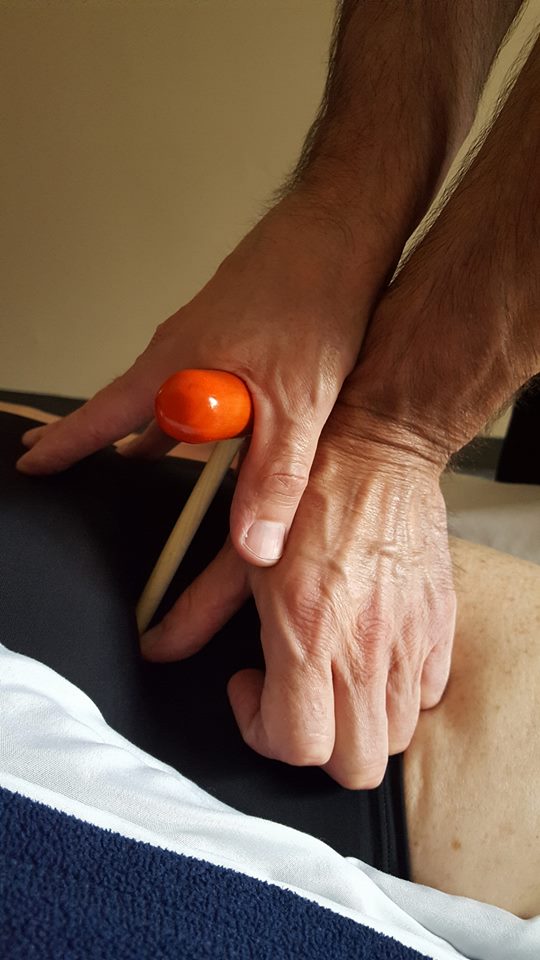
    A massage tool with a contoured edge may look like there’s going to be some blood on your sheets after the massage is over, but I have a way to make it less scary: Put a guide finger/thumb (from the hand that’s not holding the massage tool) next to the contoured edge.

    I’m going to show you how I do that in a minute, but, first, let’s look at two examples of tools with contoured edges.

    This is a wooden tool.

    This is a plastic tool with a contoured edge.

    Yeah, they’re a little scaring looking.

    Time to make them less scary.

    Ready?

    Take your thumb or finger from the hand that’s not holding the massage tool and put it next to the contoured edge of the massage tool.

    That guide finger/thumb is a sensor.

    And it’s wired to your brain.

    So, you’re going to be able to maintain sensitivity when using the contoured edge.

    Now, slide your guide finger/thumb over part of the edge on the massage tool.

    You can use that finger/thumb to help you press and get very precise pressure.

    Wait, Mark, why do all that?

    Why not just press using the tip of the T-bar?

    1. Spread out the pressure.

    You can, but if an area is too sensitive for pinpoint pressure (tip of the T-bar), the contoured edge of the T-bar might just do the trick.

    Why?

    The contoured edge is not as pinpoint as the tip of the T-bar and it’s more likely to contact surrounding tissue outside the pain area.

    That could reduce pain through distraction.

    In other words, it’s harder for the client to feel (focus on) the pain when other tissue around the pain area is being stimulated.

    There are more things you can do with the contoured edge.

    2. Cross-Fiber Friction

    The contoured edge is great for cross-fiber friction while being kind to your thumbs.

    It’s easy.

    Ready?

    Find your spot.

    Press down with the contoured edge and your guide finger.

    Have at it going back and forth across the affected fibers.

    The contoured edge can also be a great tool for palpation.

    3. Palpation

    To find tight/tender areas I place the contoured edge down on the area I want to examine.

    Next comes my guide finger/thumb.

    I press down on the contoured edge.

    I go back and forth east and west and/or north and south creating contrast as I press.

    When I find an area of tightness I can home in on it by pressing the guide finger onto the contoured edge where the pressure is needed.

    Fearlessly Using a Contoured Edge Massage Tool

    Using a contoured edge is not so scary anymore, right?

    Keep that guide finger/thumb next to the contoured edge to sense and palpate.

    And use that finger to help apply more precise pressure on the contoured edge when you need to get more exact.

    Here’s a quick video to help you out:

    More about using massage tools here.

    Massage tools for sale soon at Pain-Free Massage Therapist.

    Also, if you want to get crackin’ on getting competent with massage tools, I have an online, home study course: How  to Use Massage Tools and Fearlessly and Effectively.