Author: Mark Liskey

  • How to Do VERY Precise Pressure

    How to Do VERY Precise Pressure

    There are benefits to treating a tight/tender area with very precise pressure. One, you can sometimes only find the “That’s it!” spot with very precise pressure. Another is that very precise pressure is a more thorough treatment than a massage with less precision. Most clients appreciate thoroughness. If you’ve backed off very precise pressure because it hurts your body or it feels intimidating, here’s how to change that.

    Precise Versus VERY Precise

    In general, I use precise pressure to find areas of tender/tightness. I use a variety of body parts, from big (forearms and fists) to small (thumbs and fingers) to apply precise pressure.

    I use VERY precise pressure to further examine the tender/tight area. However, I only use smaller body parts (thumbs, fingers, massage tools) to apply very-precise pressure.

    While I’m examining the tender/tight area with very-precise pressure, I may find a spot within that area of pain that is more tender or is tighter than the rest of the pain area. (Clients sometimes shout out “That’s it!” when I hit it.) I then treat the “That’s it!” spot using very-precise pressure.

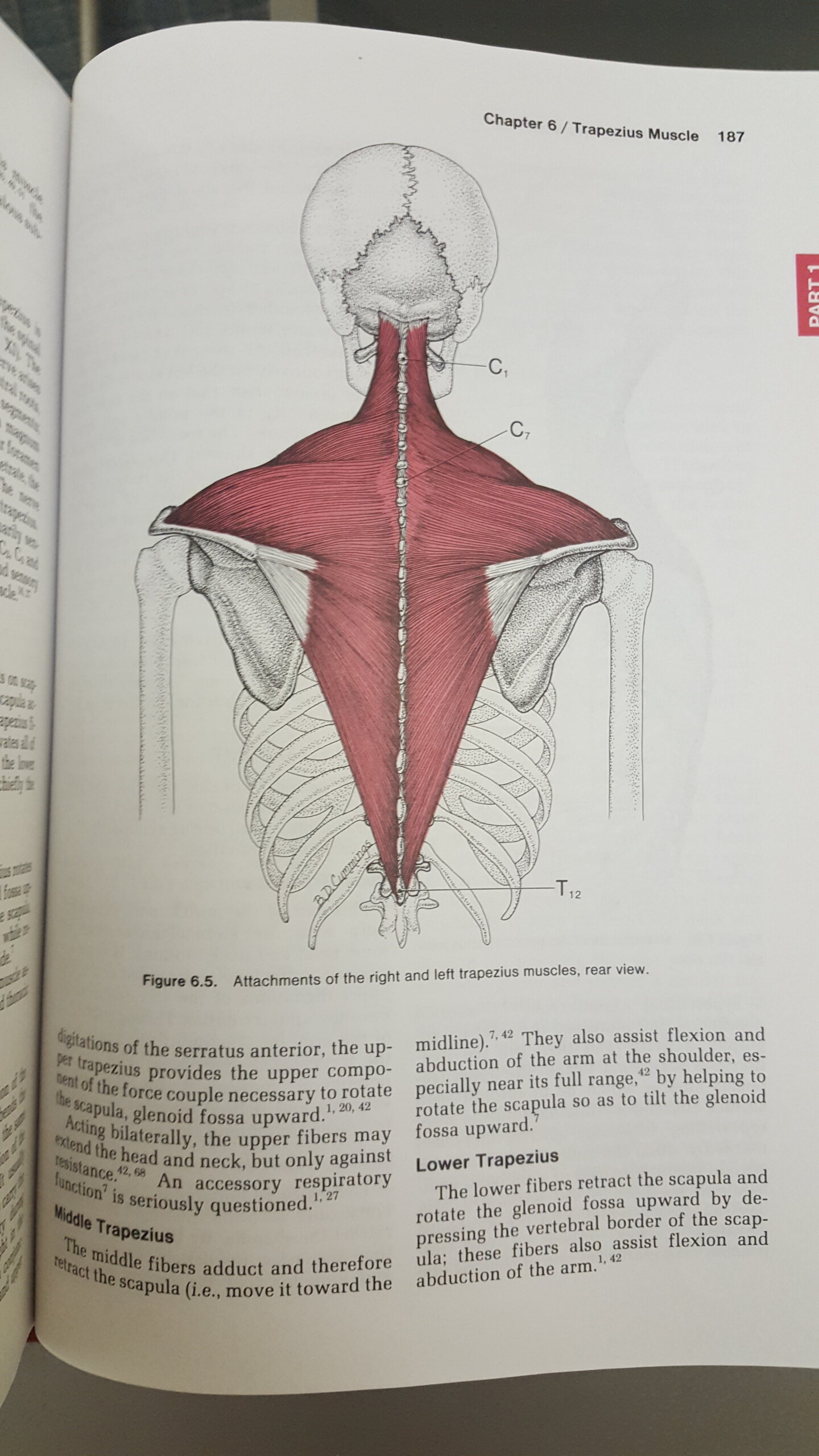
    Here’s an example. Ali comes in with neck and shoulder pain. Using my knuckles around the scapula I find the locus of his pain area in his levator scapulae attachment (precise pressure).

    Next I start examining the area of pain in the levator scapula attachment with my middle knuckle, looking for that exquisitely tender or tight spot (very-precise pressure).

    What to Use to Find the “That’s It!” Spot

    If it hurts your hands to work with very-precise pressure, I have three suggestions:

    1. Combine body parts.
    2. Stack and/or brace (support) body parts.
    3. Combine a massage tool with a body part.

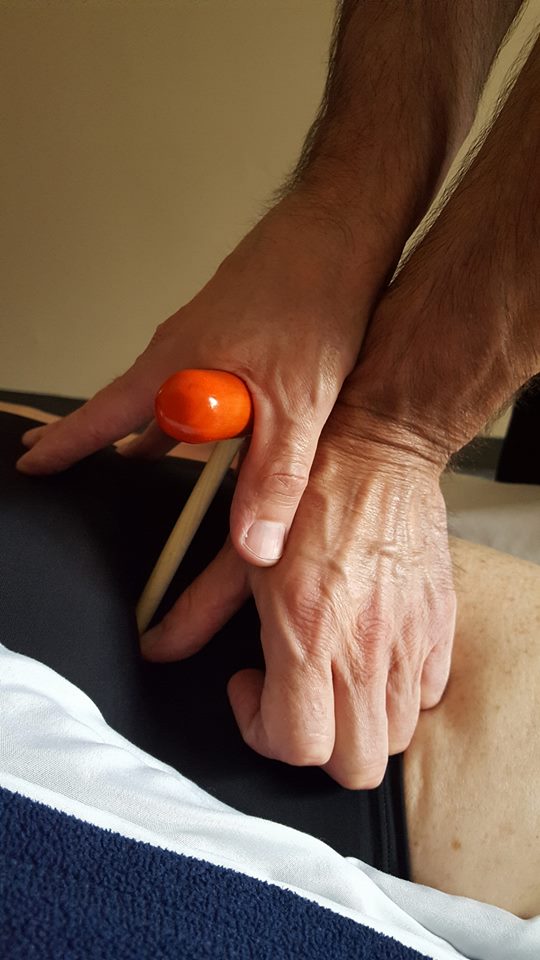
    Pictured below are my 3 favorite ways to deliver very-precise pressure.

    Stacked Fingers/Thumbs
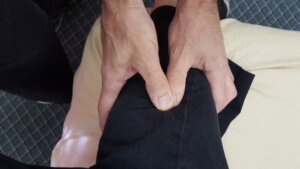
    Try not to press. Instead lean into your fingers/thumbs. The bottom finger/thumb is the primary palpation vehicle.

    Knuckle-Thumb
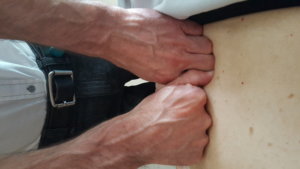
    In this picture I’m directing my pressure into the middle finger of my left hand. You’ll notice that my right thumb is bent to fit in comfortably next to my left middle knuckle. This is not a mistake. In this case, my thumb’s primary role is for palpation, not for delivering pressure. My right thumb’s companion four fingers form a loose fist. They take most of the weight that I put on that hand, not my thumb.

    Tool-Thumb
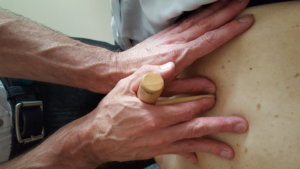
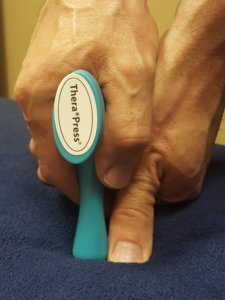
    In this picture my thumb is a support, guide and the primary sensing instrument. I’m directing most of my “leaning” pressure into the tool, not my thumb.

    How to Find the Spots

    The way I find the tight and tender spots within the area of pain  is by creating contrast. I can create contrast by the direction, length and speed of my palpating stroke.

    When I’m palpating Ali’s levator scapulae attachment, I start by going across the grain of the muscle to give me enough distance to “flip” over a potential tight spot. My stroke is going to be fast enough and long enough so that I can feel the full shape of the tight/tender area. If I’m still having trouble feeling anything, I’m going to press deeper as I do the faster, longer stroke.

    Going Very Precise   

    Once I find the tender/tight spots, I’m going to systematically investigate the areas using combined body parts, stacked/braced body parts or a massage tool and finger/thumb combination.

    Next I’m going to use very precise pressure to work hyper-tender or hyper-tight spots within the pain area.

    When applying very precise pressure I usually 1. press, 2. press and pull or 3. press and reciprocate. A massage tool combined with finger or thumb is insanely precise. In this video, I demonstrate how to press, press and pull, and press and reciprocate using a massage tool: T-Bar and L-bar: 3 Ways to Work Muscles Video.

    Also, I like to work the pain area and the “That’s it!” spot from different angles. Lots of my clients love this.

    Too Much

    When you’re doing very-precise pressure, you run the risk of overworking the area. I usually can avoid this by revisiting the area instead of spending a long period of time there.

    I also use a pain scale system approach when I’m unsure of the therapeutic pressure that I should be using. Here’s a quick video tutorial: Pain Scale System Video.

    Lastly, I check in with the client to see how she’s feeling about the area I’m working on.

    Checking in is not foolproof. The client may not have a mental gauge as to what feels like good pain and what feels like bad pain. When in doubt, move off—unless the client knows exactly what works for her.

    Making Very Precise Happen

    Here’s the short version for working with very precise pressure:

    1. Find the pain/tight area by creating contrast.

    You can create contrast by making your exploratory stroke longer and faster than you normally would. If you need more contrast, press deeper as you do your exploratory strokes.

    1. Choose a body part combination that doesn’t cause you pain when you’re pressing.

    My favorites are 1. Stacked thumbs, 2. Knuckle and thumb, 3. Massage tool and thumb.

    1. Systematically work the pain area and the “That’s it!” spot (if there is one) by pressing, pressing and pulling or pressing and reciprocating.

    Being very precise can help your client with her pain condition and doesn’t have to cause you pain.

    Massage Tools Online CEU Course

    If you want to be able to use a massage tool with every massage so that you can save your hands and deliver focused, precise pressure like nobody else can, this online course will get you there.

    I taught it live for many years and now I’ve made the online version, There are lots of videos and if you have any questions while you’re taking the course, you can always ask me (mark@makethemostofmassage.com).

    Check it our here: How to Use Massage Tools (Fearlessly and Effectively).
  • TheraPress Trigger Point Massage Tool Review

    TheraPress Trigger Point Massage Tool Review

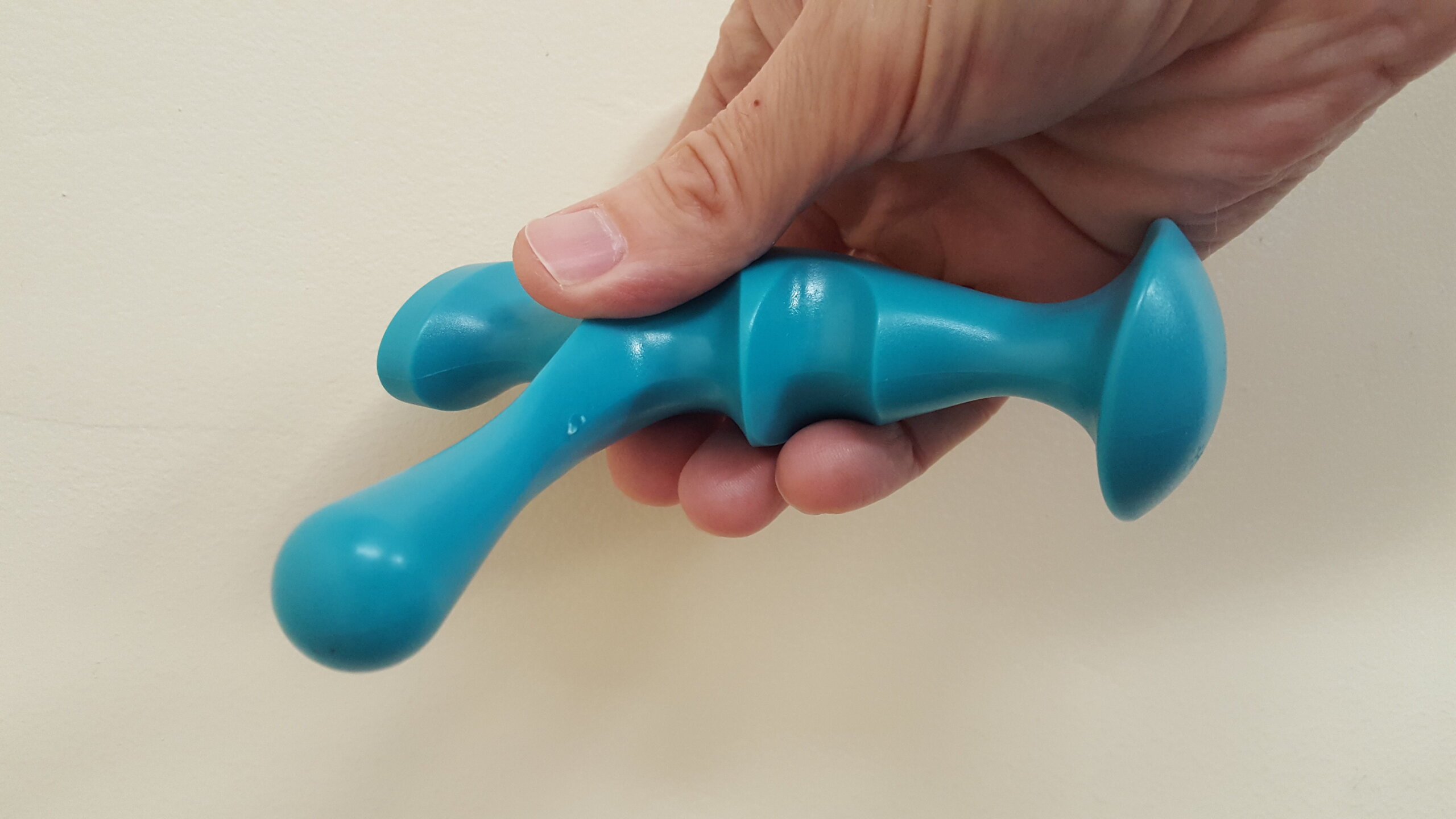
    The TheraPress Trigger Point Massage Tool (say that 10 times fast) is a massage tool that I’ve grown to like once I figured out how I could adapt to some of its design challenges.

    Challenges When Using a TheraPress Trigger Point Massage Tool

    First, it’s a heavy tool.

    Believe it or not, an ounce or two makes a big difference in terms of hand fatigue if you’re using tools often during a massage.

    Heavy also means you’re gripping harder to keep the tool from falling over.

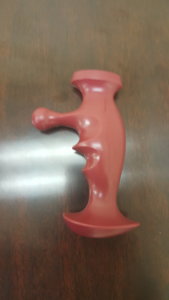
    Another challenge with the tool is that the handle is big which also means more over-gripping.

    I know, that’s a lot of complaining about a massage tool that I say I’ve grown to like.

    But the heaviness and big handle can essentially be reduced to non-factors with one simple adaptation.

    1. Use the TheraPress Trigger Point Massage Tool as a two-handed massage tool.

    Why Two Hands Are Better Than One

    When you have a two-handed hold on the TheraPress Trigger Point Massage Tool, you don’t have to grip hard. The support/guide hand provides stability so that you can relax the other hand on the handle.

    Once you get competent with two-handed holds, the TheraPress Trigger Point Massage Tool is good for pressing into big muscles, like hamstrings, quads, calves, and back muscles.

    I also use it for light to deep pressure on feet.

    Oh, and the thumb-sized knob on the end makes it a good, light-to-medium pressure glide/press massage tool when using a two-handed hold.

    I put this video together to demonstrate the press and glide-press techniques I do with the TheraPress Trigger Point Massage Tool.

    For the basics on using massage tools, check out Why You’re Not Using Your Massage Tool.

    My Bottom Line on the TheraPress Trigger Pioint Massage Tool

    Use two hands with the TheraPress Trigger Point Massage Tool and you’ve got a decent pressing tool for light to deep pressure on legs, glutes and muscles in the lamina groove.

    And it’s a solid glide-press, two-handed tool for light to medium pressure.

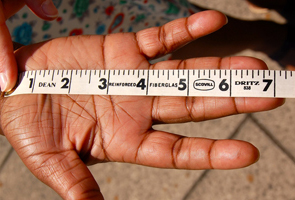
    For smaller hands (6.5 inches or less)…

    Source: choosehandsafety.com

    …you might want to try the TheraPress 2 Trigger Point Massage Tool.

    P.S. If you want to learn how to incorporate massage tools into your massage so that you can deliver precise pressure without hurting your hands, I have an online, home-study massage course for you.

    Massage Tools CE Course

    Objective: To be able to seamlessly incorporate massage tools into a relaxation/pain-relief/medical massage so that you can deliver focused pressure without hurting your hands.

    Byproduct: You’ll be able to do more massages pain-free.

    Class: How to Use Massage Tools (Fearlessly and Effectively)

    CEU; 2.5

    Type: Online, home-study (lots of videos and no fluff material)

    Guarantee: Money back if you don’t like the class.

    Final Words: Massage tools will not feel awkward in your hands once you use a guide finger and a couple of other techniques. Promise.

  • Google My Business Questions & Answers

    How do you complete Google My Business Questions & Answers when a customer hasn’t submitted a question?

    You write the questions yourself and answer them.

    Wait, that’s deceptive, Mark.

    Well, first of all, you’re not claiming that a specific client, like Terrance, asked you a specific question.

    And if you’re approaching Google My Business (GMB) Q&A with your customer in mind, then you’re doing all your potential customers a favor by answering the common questions that many will have.

    By the way, when you answer common customer-questions you’re doing yourself a favor too because it’s also good marketing.

    How so?

    For one, answering questions shows that you’re going above-and-beyond with your customer care.

    In addition, you can also address common “barrier-to-entry” themes in a way that will give your potential client/customer peace of mind.

    And icing on the cake is that Google likes it when you check all the GMB boxes.

    So, in order to squeeze every drop of marketing juice from your GMB Q&A I’ve categorized the most important questions that customers have asked me during my 25+ years as a business owner.

    Here are my categories:

    1. COVID-19 questions
    2. 1st-time client questions
    3. Barrier-to-entry questions
    4. Set-yourself-apart questions.

    Before we jump into the questions I need to show you how to add questions to your GMB page.

    You are not going to do this in your account.

    You are actually going to do a Google search for your business. When you do, your GMB page will come up on the side. Scroll down your page until you see Questions and Answers and click on Ask a Question.

    You can check out our GMB page by Googling PressurePerfect Massage.

    Okay, now to the questions.

    COVID-19 Questions

    Letting potential customers know the COVID-19 safety measures you have implemented is a must. And a Q&A format is a great way to get that information out.

    Here’s an example of how you could do Q&A around COVID-19:

    Q: Does the massage therapist wear a mask during the massage?

    Yes. The massage therapist will wear a N95, double-layer cotton mask or a 3-ply surgical mask during the massage.

    In addition, we limit the number of people in our office at a time to two, each room has a HEPA air filter unit and each room is thoroughly disinfected after each massage.

    Q: Do I need to wear a mask during the massage?

    No. Therapists are trained to dodge droplets.

    Haha. Okay, here’s my real answer:

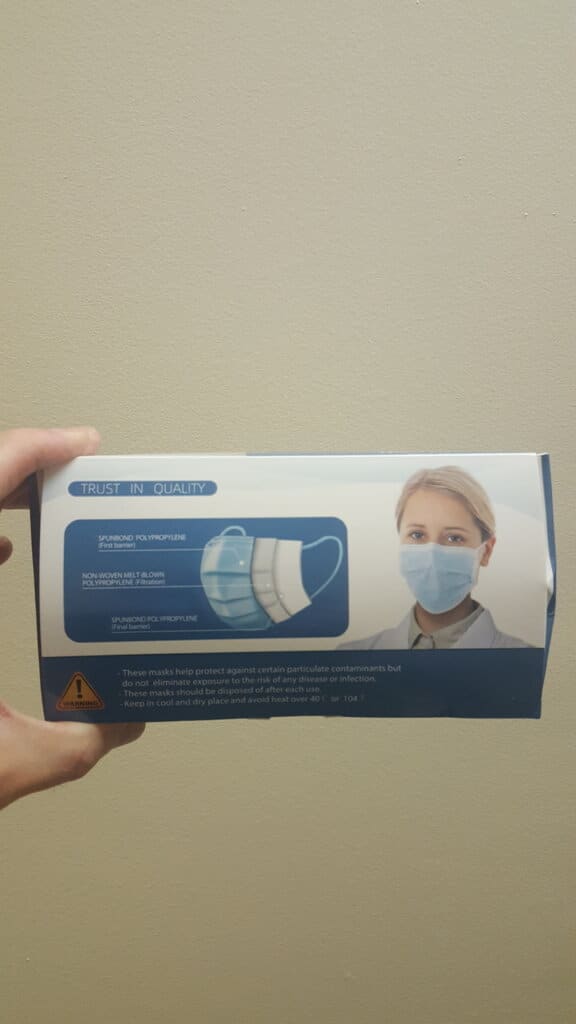
    Yes. To help protect all clients we require everyone in the office to wear a mask at all times. We offer disposable medical masks for anyone who wants one. Some clients prefer the disposable medical mask while on the table because there’s flex to the material.

    Q: What do I do when I arrive?

    In order to assure that you’re not in the office when another client is in the office, please stay in your car and the massage therapist will come out to get you or will text you when it’s okay to come in.

    Safety questions like these are the number one thing that I’d want answered if I were looking for a massage right now, especially if I were a first-time client.

    Speaking of first-time clients, here are some Q&A that we have on our GMB page.

    First-Time Client Questions

    Q: Do I need to fill out an intake?

    Yes. Please go to our website www.pressureperfectmassage.com. Scroll down and towards the bottom of the page you’ll find an intake-form link. Click on the link and you can either print out the form, fill it out and bring it in with you when you come for your appointment or you can complete the form as a Word doc and email it to  mark@pressureperfectmassage.com.

    Q: How should I pay?

    We take cash, check, credit card, Paypal or Venmo.

    Also, in case you didn’t know, we have a no tipping policy. It keeps the math easy and you don’t need to worry about running to the ATM before your massage.

    Q: Do I keep my clothes on during the massage?

    Disrobe to your comfort level. During the massage, you’ll be covered by a blanket and sheet. When the massage therapist is working a particular area, she/he will expose only the area she/he is working while keeping everything else covered.

    For example, if the massage therapist is working your back, the sheet and blanket will be covering your entire lower-body.

    At this point, you may be noticing that some first-time Q&A sound a lot like barrier-to-entry questions.

    For example, a 1st-time massage customer may want to know how much he needs to disrobe for the massage, and at the same time disrobing could be considered a barrier-to-entry because of the general uncertainty around disrobing.

    So, now I want to focus on barrier-to-entry questions that are not necessarily 1st-time client questions.

    Barrier-To-Entry Questions

    Q: Do you do charge extra for deep pressure massage?

    No. We charge the same price for relaxation, deep pressure and sports massage.

    Q: Do you accept insurance?

    We accept Workers’ Compensation. We would like to accept auto or health insurance, but they are not reimbursed in PA.

     Q: Is massage helpful when I’m going to PT?

    You’ll need to ask your PT that question as it relates to your case. That said, when we’re working with a client who is in PT, we encourage the client to allow us to coordinate care with the physical therapist.

    For example, say you strained your back and are going to PT and are now coming to see us. With your consent we would reach out to your PT so that we could all be on the same page to getting you healthy.

    The last category of questions is set-yourself-apart questions. And like 1st-time-client and barrier-to-entry, there’s cross-over. That’s okay. The point is not have sharply defined categories. The point is to make sure that your Q&A section is helpful to potential customers and puts your best foot forward.

    Set-Yourself-Apart Questions

    When you’re thinking of set-yourself-apart questions, think of your massage and massage business strong points. Here’s one we use:

    Q: Do you work with runners?

    Yes. Runners come to see us for help with plantar fasciitis, tibialis posterior tendinopathy, hamstring strains, IT band syndrome and other running issues.

    We also help runners who are training for events by being part of their recovery and monitoring process.

    In addition, we collaborate with running coaches and personal trainers to help their clients reach their running goals.

    Q: Do you work with chiropractors?

    Yes. We coordinate care with chiropractors, physical therapists, personal trainers, exercise physiologists and other medical/health professionals because being on the same page is the key to achieving health/wellness goals.

    As you work on your Q&A information you may start to notice that a narrative is emerging. In other words, each answer to a question is defining who you are as a business, and themes and sub-themes are starting to emerge.

    Your Business Narrative

    Take a look at our boiled-down version of our GMB Q&A page:

    Does the massage therapist wear a mask? Yes.

    Do I need to wear a mask? Yes

    What do I do when I arrive? Stay in your car.

    Do I fill out an intake? Yes—email it or bring it in.

    Do I take my clothes off for the massage? Disrobe to comfort level.

    How do I pay? Cash, check, credit card, Paypal, Venmo. No tipping.

    Do you charge extra for deep pressure? No.

    Do you accept insurance? Only Workers’ Compensation

    Is massage helpful when going to PT? We defer to your PT and we’ll co-ordinate care with your PT.

    Do you work with runners? Yes—and we coordinate care with running coaches and personal trainers.

    Do you work with chiropractors? Yes—and we coordinate care with chiropractors and any health/wellness professional you would like us to contact.

    Here’s the narrative that emerges in my brain from reading our short-version Q&A:

    PressurePerfect takes Covid-19 safety very seriously. They go out of their way to ensure that you are as safe as possible when getting a massage. They are health and wellness oriented and routinely coordinate care with other health professionals to help your reach your health and wellness goals.

    Guess what? That narrative is not new. It’s the same narrative that’s on our website and on our Yelp page.

    I need to mention that I chose the word “narrative” to describe what you offer to your clients over other words like “messaging” or “branding”.

    I did that for a reason. To me, “branding” and “messaging” feel more market-y, and “narrative” makes me think harder about who I am and what I have to offer.

    But don’t get hung up on the words. Whether you call it a “narrative”, “messaging” or “branding”, you’re relaying specific information—who you are and what you offer—to the customer.

    The good thing here is that once you figure out what your narrative is, you can plug it into all of your social media and free, online advertising platforms, like GMB and Yelp.

    GMB Q&A Recap

    Here’s my GMB Q&A recap:

    Create the questions for these 4 categories:

    1. COVID-19 questions
    2. 1st-time client questions
    3. Barrier-to-entry questions
    4. Set-yourself-apart questions.

    Answer how you’re keeping clients safe as possible.

    Address the fears of 1st-timers.

    Remove common barrier-to-entry concerns.

    Show how your business is different from the businesses around you.

    And as you’re creating the Q&A section on your GMB page, pay attention to the business narrative that’s emerging.

    Are you creating questions that emphasize your relaxation massage?

    Are you creating questions that sell rehab massage?

    What are the questions that your ideal customer is asking?

    That narrative should be consistent in all of your advertising.

    If you already know your narrative, plug it into your GMB Q&A.

    Need Help?

    If you want to work with me to get your business off the ground, the easiest and cheapest way is to sign up for the Accelerator Program.

    It has the GMB plan that I used to build and grow my business. It also has my referral building (word of mouth) plan as well as all of my free (or very low cost) tactics for building a business using strategic effort rather than paid-for advertising.

    Lastly it has me in it–3 months of email support. Email me with any questions have you and we’ll get it done together.

    Accelerator
  • Massage Advertising Idea on the Run

    Need a massage advertising idea that is free and easy to do?

    Put a picture with a caption on your Google My Business (GMB) page using your cell.

    When I was scraping along as a massage therapist, I used to think that if only I could get in front of potential clients I’d win a percentage over and have all the clients I could possibly want.

    And you know what, I was right (yeah, I surprised myself, haha). By the way, operating now during Covid-19 doesn’t mean you can’t acquire clients. You just need to do the best job you can screening clients. (Here’s a Covid-19 screening questionnaire.)

    Groupon seared this numbers game concept into my brain.

    Before my Groupon experiment I had an okay practice. It was enough to pay the bills, but clients weren’t coming out my ears.

    I ran the Groupon, testing the idea that more customers coming in would translate into more repeat clients because I would convert customers to clients at a specific rate.

    And I did—about 15 percent.

    I need to mention that until you see the conversion rate working, it can be discouraging.

    Why?

    Because your first conversion may be your 30th customer. Remember the conversion rate is an average.

    But here’s the upside of relying on an expected conversion rate: It can also help you to keep putting one foot in front of the other.

    How so?

    When that 10th customer doesn’t come back because she can’t actually afford your massage, you know that the 11th or the 12th or the 13th customer could be your next repeat client because statistically you know that your conversion rate will be somewhere around mine with Groupon and much higher with referrals.

    Which brings me back to putting pictures on your GMB page: It’s part of an advertising process that will bring in more customers for you to convert into clients.

    The difference between Groupon and GMB customers is that GMB customers are not necessarily looking for a deal, which could make for a higher conversion rate. (I don’t have any stats on this yet.)

    Adding a picture to your GMB page may seem like small potatoes in terms of bringing clients in, but it’s much more than that.

    An Easy Massage Advertising Idea

    1. If you add a picture to your GMB page weekly, you’re establishing a weekly marketing behavior.

    Overtime that behavior will turn into a habit.

    Not a bad thing, especially since we, massage therapists, are not marketers by nature.

    2. Adding a GMB pic is an easy entry point for marketing.

    What could be easier than putting a picture on your GMB page?

    Nothing.

    3. GMB pics are part of a bigger GMB marketing strategy.

    The big GMB marketing strategy is this: Do everything Google tells you to do with your GMB page so that you check all their boxes and make Google happy since Google is responsible for GMB ranking in a local search.

    What’s a local search?

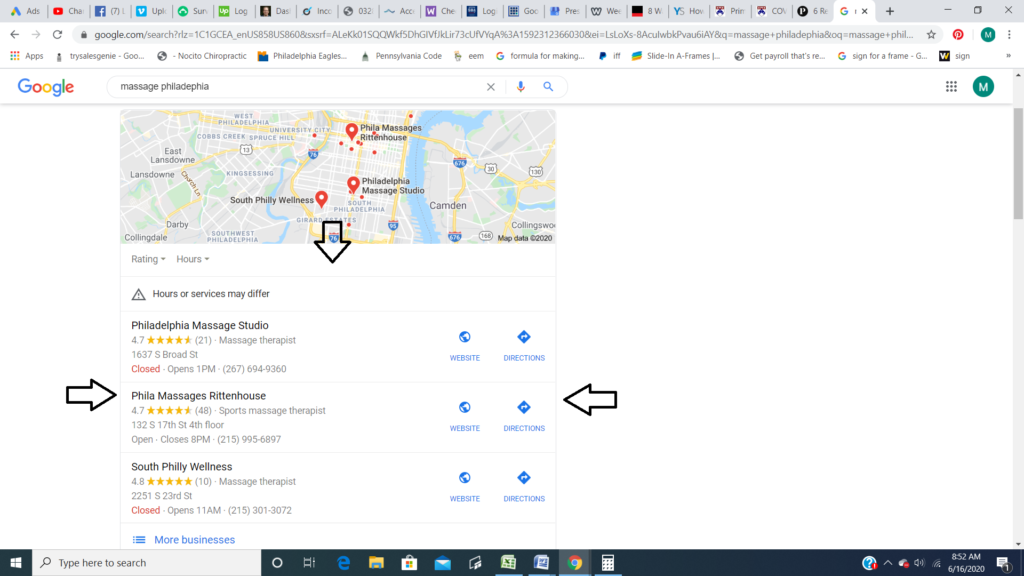
    This is a local search:

    You want to be in the top three so that no scrolling is needed.

    4. By deciding which picture to take and adding a caption to that picture you’re forcing yourself to exercise your marketing muscles.

    Besides being an easy way to exercise your marketing muscles, it’s fun, too.

    5. Adding pics will make your GMB page look better than your competitors.

    Why a potential customer calls you after looking at your GMB page and not a competitor probably can’t be boiled down to one thing.

    It’s the gestalt, the totality of experience.

    Pictures on your GMB count towards that totality.

    6. Putting a pic on your GMB page builds your marketing confidence.

    Want an instant feeling of marketing competence and satisfaction?

    Take a pic and put it on your GMB page.

    7. Pics on a GMB page are free marketing.

    Free is good, especially when you’re starting a business or trying to grow an existing business.

    Free is not good when it’s complicated.

    Adding a pic to your GMB page is not complicated, and I’m going to show you how to do that right now.

    Put A Pic On Your GMB Page

    First, if you haven’t claimed your business on GMB, go here.

    Fill out your basic information.

    Next, get the Google My Business App for your phone.

    This is where the fun starts to happen at work.

    Below is my step-by-step (there’s a video tutorial at the end of this article if you’re more of a video-kinda-person).

    1. Take a picture.

    Of what?

    Look around the office and start to think about what might be important to show a client.

    Here are some ideas: the massage room, an intake form, a client (if the client is willing to have her/his pic on your GMB page), things you are doing to ensure that your room is as Covid-19 safe as possible, front entrance of the building, your sign, or special oils you may use.

    Got your pic?

    Okay, next you are going to…

    2. Open your GMB app on your phone.

    3. Click + Post.

    4. Click “Add photos/videos”.

    5. Click in the box that says “Add photo or video”.

    6. Click “Choose from gallery”.

    7. Choose your pic.

    8. Then click in the “Add a caption” box.

    Why am I making you add a caption?

    Because it will help you exercise your marketing muscles. Yes, you have marketing muscles. They just need to be pumped up.

    A caption needs to be engaging. Being informative can be engaging. So, can being funny.

    Funny? I’m not Chris Rock, Mark.

    Not stand-up funny. Funny as in a chuckle or a smile.

    Yeah, we can squeeze the stress out of this muscle.

    This pic below is an informative pic and I’m targeting the people who accept a certain level of risk with getting a massage, but are hesitant to go to someone they haven’t worked with before. I want them to understand that we’re trying to mitigate all risks that we can affect on our end.

    Couldn’t be easier, right?

    Just add a pic to your GMB page after you’ve disinfected and are waiting for your room to air out.

    Here’s the video tutorial:

    Every week I’ve got more tell you about safety and making massage money during Covid-19. If you want to know when my next article is out, jump on my email list. It’s free:-)

    Need Help?

    If you want to work with me to get your business off the ground, the easiest and cheapest way is to sign up for the Accelerator Program.

    It has the GMB plan that I used to build and grow my business. It also has my referral building (word of mouth) plan as well as all of my free (or very low cost) tactics for building a business using strategic effort rather than paid-for advertising.

    Lastly it has me in it–3 months of email support. Email me with any questions have you and we’ll get it done together.

    Accelerator