Author: Mark Liskey

  • Build a Massage for Pain Relief Practice

    Build a Massage for Pain Relief Practice

    I built my practice on massage for pain relief. You can, too. And you don’t need to shell out thousands of dollars to learn how to do it. Why? Because on some level with every massage you do now, you’re already doing pain relief massage.

    You can make pain relief massage your signature massage by doing these 3 things: 1. Calibrate your pressure, 2. Double down on therapeutic rapport, and 3. Follow a treatment plan.

    I Thought I Had the Answer

    I became certified in neuromuscular massage therapy (NMT) in 1999 because I wanted to get people better. In my mind at the time, here’s how things would go down: I’d work on clients, they’d get better and then they’d never come back.

    But what I didn’t understand was that pain was complicated. It may have a non-musculoskeletal origin. And even if it had a musculoskeletal origin, the NMT intervention may not be effective.

    Embarrassed to Take my Client’s Money

    When some clients started coming back to see me on a regular basis, I felt like a failure because I didn’t get them better. Instead I only gave them some temporary (not forever) pain relief.

    Fortunately, even though at the time I didn’t value pain relief massage, my clients did. And in a relatively short period of time I had enough clients to open my first office. Soon after, I couldn’t deny that pain relief massage was having a huge, positive impact on my clients’ lives. And I became interested in figuring out how I could give the most effective pain relief massage possible.

    Calibrate Your Pressure

    I found that the appropriate pressure is the single most important element to pain relief massage. With acute pain, too much pressure can aggravate a condition. Conversely, for someone with recurring pain who responds well to deep pressure, not enough pressure is ineffective and a waste of her money.

    When in doubt about pressure, try this technique that I was taught in NMT training. Say to the client: “Imagine a pain scale that goes from 1 to 10. One is the lowest amount of pain and 10 is the highest. As I press on a tender or tight spot, I want you to give me a pain rating.”

    If you get a 5 or above response, lighten your pressure. In most cases if you work between a 3 and 4, you’re going to, ultimately, lessen your client’s pain, not increase it.

    Double  Down on Therapeutic Rapport

    Pain is not just a biomechanical response. How we interact (and connect) with our clients can actually lessen or increase their pain. If you’re having trouble connecting to a client, try my Elderly Grandmother technique.

    Imagine that your client is your elderly grandmother. How are you going to treat her?

    First, you’re going to slow down and take your time. Then you’re going to make sure that you understand what she’s saying and that she understands what you’re saying. Lastly, you’re going to do everything in your power not to upset Granny. And subsequently, you’ll create a calm and supportive environment.

    An abbreviated way of looking at therapeutic rapport is: It’s all about Granny for the next hour!

    [If you want specifics about developing great therapeutic rapport, check out my article in Massage & Bodywork Magazine—Four Lessons on Chronic Pain (Notes from a Mountain Guide).

    In this article, Maximizing the Placebo Effect, I explain how to increase the placebo effect (a positive response) through therapeutic rapport. In a more recent article, I explain how the placebo effect can be fine tuned. Here is an interview I did about the article.

    Follow a Massage for Pain Relief Plan

    A treatment plan is essential in order to do an effective pain relief massage. When you have a plan you’ll be on target to address the pain issues the client wants you to address. A plan also puts your client’s pain in a massage framework for current and future discussions. And a plan is something that you can go back to and adjust if your client doesn’t feel better. If he does feel better, you know what to do the next time.

    The treatment plan I follow comes from my research and experience.  It’s universal in the sense that it works with any type of massage modality.

    a. Pre-massage: identify pain areas before the client gets on the table.

    This ensures that you will always find the problem areas once the client is on the table. And it builds therapeutic rapport. For more about this read My Simple (Secret) to Better Pain Relief Massage.

    b. During the massage: commit to a course of action.

    Let’s say your plan is to work the upper-trap for a neck/shoulder condition. But once you get the client on the table you find that the levator scapulae is the tight muscle. No problem. Change your course of action–but stick with the new plan. In Get Your Client Out of Pain: Put a Stake in the Ground, I explain why having a course of action can make or break a pain relief massage.

    c. Post-massage: tell the client what you did, what you found, then provide recommendations and follow-up.

    Now it’s time to lay it on the line. Once you’ve done your work, go over the highlights of the massage (e.g., I found you’re piriformis to be tight) and then make recommendations to further lessen the pain (e.g. self massage at home). Follow up in a couple of days.

    If the massage helped, great! If not, it’s time for Plan B if you think it’s warranted.

    Your Massage for Pain Relief Practice Starts Now

    You can build a practice quickly by making pain relief massage your signature massage. And it’s not a far stretch from what you’re already doing. If you focus on

        1. calibrating your pressure
        2. doubling down on your therapeutic rapport
        3. following a treatment plan

    you’re going to see big changes with your client retention.

    Seriously, you got this! Just follow this formula to start. Over time you’ll make it your own.

    Free Course to Jumpstart Your Massage Business

    If you’re just starting a massage business and want to incorporate pain relief massage into your business model, this free course will get you to your 30K a year: Jumpstart.

    If you’re trying to take a meh massage business and make it a dream massage business, go here: Accelerator.


  • 4 Steps to the Massage Income You Want

    4 Steps to the Massage Income You Want

    Here’s a list of reasons why I never reached the massage income level I wanted in the past: some clients left, I had to move my office, my website was broken, I didn’t have money to advertise, I’m not good at selling my services, family took up more time than I thought, my shoes were too tight…and on and on. Ultimately, these reasons weren’t the problem. This was: I simply didn’t know how to push to the next level.

    Pushing to the Next Massage Income Level

    The next level is a point in your massage business where you have all the clients you want, but you’re only doing a minimal amount of effort to bring them in.

    Sounds pretty good, right?

    So how do we get there?

    The default answer is to work harder.

    But if you’re working harder doing the wrong things, you’re just wasting your hard work.

    The key to reaching the next level is to follow a plan.

    Admittedly, I had no massage income plan in place early on in my massage career. Then one slow week, I had a serious business talk with myself. In retrospect, I realize this “talk” actually led to the first step in my push to reach the next level.

    4 Steps to Increase Your Massage Income

    1. Admit to yourself that you’re only halfway there.

    Okay, you may be 2/5 or 4/7 of the way to where you want to be. It doesn’t matter. The point I’m trying to make is that you’re NOT content with your current massage income. And thinking in terms of “1/2 way there” can help move you along.

    For one, it’s encouraging.

    Congrats you’re ½ way there! You’ve already done a lot of the hard work.

    And, two, it’s a reality check.

    Sorry, you have another 1/2 to go. Time to buckle up, put that helmet back on and get serious like you did when you got through massage school and established your client base.

    Once you make that psychological and emotional commitment of doing whatever it takes, it’s time to…

    2. Go all in with marketing.

    At one point, I almost doubled my income in less than a year because I got better at massage.

    Uh-no.

    I got better at marketing.

    It’s okay…say it with me: marketing.

    It took me a long time to get comfortable with that word because I was afraid I’d turn into this:

    Source: Unbounce

    But I didn’t.

    I’m still me.

    Source: nutriciously.com

    Okay, me.

    Source: Me

    Marketing covers a big swath of territory. The easiest, cheapest and least painful way for most massage therapists to market is through word of mouth.

    And that’s exactly what I did.

    I set out to create referral sources outside of my client base with chiropractors, physical therapists, personal trainers, runners and local, sport-hobby store employees.

    I used two simple marketing tools to engage potential customers and referral sources: demo massages and free gift certificates.

    My reasoning for demo massages and free gift certificates over other marketing strategies, like free talks, was that you can yammer on about the benefits of massage at the Moose Lodge annual Toy Drive, but nothing is going to sell your massage as much as you getting your hands on a “moose”.

    The first three months of demo massage marketing were physically and mentally hard. Some places that I engaged were dead ends. I cut them and zeroed in on the most promising places. I started to get some referrals, but not enough to make me feel like I was going to hit my new income goal.

    This is when I wanted to stop—and where you’ll want to stop. But this is precisely when you need to…

    3. Keep pushing forward even though you’re not getting the complete return you want on your labor investment.

    When you push on, the needle will jump. Your average massage income will go up. Not as high as you want it to be, but enough so that you get a shot of adrenaline.

    However, at the same time you might feel even more squashed then before because you’re running really freakin’ hard now.

    Here’s what I mean. About month four I had 2 or 3 demo massage going on a week. I was asked to sponsor events where I donated on-site massage. I was answering questions from trainers and coaches about their clients and athletes. And I could barely fit in new clients because of all the promotional activities I was doing.

    Yes, I was making more money, about ¾ of the way there, but Markie didn’t want to play no more.

    Fortunately, my massage income numbers evoked another adrenaline producing event in me. I was now periodically hitting the number that I wanted to be my weekly, average income.

    And that was enough for me to do what I recommend you do…

    4. Keep your hand on the hot burner until you have clients coming out of your ears. 

    Here’s something that I discovered on the other end: The pain from being over-stretched is temporary.

    And here’s when and how it will change. Once you have no room in your schedule for new clients, back off with your marketing.

    [bctt tweet=”If you don’t have to push clients into the next week, you don’t have enough clients.” username=”Mark LiskeyMarkLiskey”]

    If you’ve been going every week to a place to do on-site massage, cut back to once a month or stop entirely if that’s a natural ending.

    Initially, I was nervous to back off working referral sources because I thought the valve would shut off.

    But it didn’t because I had built great relationships. Now I could go into maintenance mode which meant cutting way back on my demo massages.

    Massage Income Breakthrough in a Nutshell

    Pushing to the next massage income level is do-able. Forget working harder at what you’re currently doing. You need a plan and you need to persevere at that plan.

    Here’s my 4-step plan:

    1. Admit to yourself that you’re ½-way there.
    2. Go all in with marketing. I recommend promoting through demo massages. It’s by far the cheapest (almost free) way to market.
    3. Keep pushing forward even though you’re not getting a complete return on your labor investment.
    4. Keep your hand on the hot burner until you have clients coming out of your ears.

    If you’re doing referral marketing, these two articles will get you moving in the right direction:

    1. How to Get Someone Else to Sell Your Massage
    2. How to Get Massage Clients: Nurture the Connectors

    The Accelerator Course

    If you need to take a meh massage business to beyond paying the bills, then this course will finish the job for you: Accelerator.


  • Massage Body Mechanics – A New View

    Is there a bad body-mechanics position when doing massage?

    I used to think so. But the answer to me now is more nuanced.

    Instead of “good” and “bad” or “correct” and “incorrect”, I view body mechanics positions as “short term” and “long term” positions.

    A “short term” body position will cause you pain sooner than later. That means you don’t want to hang out in this position for too long. For example, if you are hunching over to work an area, you will want to change that position before it starts hurting your back.

    You probably see where I am going here: A “short term” body position is okay to do as long as you don’t stay in the position to the point of pain.

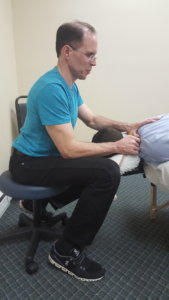
    Ultimately, you want to be in “long term” body positions. Long term body positions are supported positions where there is minimal strain to keep your body upright and minimal strain for you to do your work. Examples of support while massaging are sitting while you’re working or leaning into the massage table while you’re standing. The picture below shows a long-term body position.

    I’m sitting; so there is less strain in my back. My working arm is resting on my knee which translates into less strain in my neck, shoulders and arm.

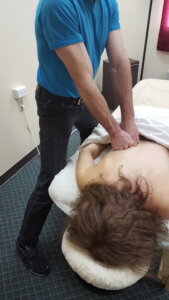
    Below I’m standing and leaning my body weight into the client and the massage table.  Notice the front of my legs which are in contact with the massage table. This position is very easy on my body.

    Are there body positions that you should never be in?

    Yes. Those are the body positions that hurt you immediately or you can feel the negative effects of being in them while you massage or after you massage.

    Time for New Thinking

    Body mechanics happen in the massage room, not in the text book.

    “Correct” and “Incorrect” body positions don’t accurately reflect what goes on in the massage room. Thinking about your body positions as non-starter (hurts you immediately), short term (can stay in the position for a short period of time) and long term (can stay in the position indefinitely) allows you to have an arsenal of body positions so that you’re not in any one position too long.

    In the video below, I show you my long term body positions (forever positions). Let me know what you think:-)

    The Pain-Free Massage Therapist

    Check out my book about how to massage pain-free  here.

    I have online classes, too:

    (1) Delivering Pressure Without Hurting Yourself

    (2) How to Use Massage Tools

    (3) Advanced Massage Tools

    And the Pain-Free Massage Therapist Package (all 3 classes).

    Ways to Save Money and Build Your Practice:

    Massage Insurance: Who has the Cheapest Massage Insurance

    Website: Cheapest Way to Build a Website.

    Rent a Massage Room: How to Rent a Massage Room for Cheap.


  • How to Glide with a Massage Pressing Tool

    How to Glide with a Massage Pressing Tool

    Relaxation massage at medium and deep pressure can beat up my hands. That’s why I use a massage pressing tool.

    Dude, that’s called acupressure.

    True, if I only pressed, but I glide, too.

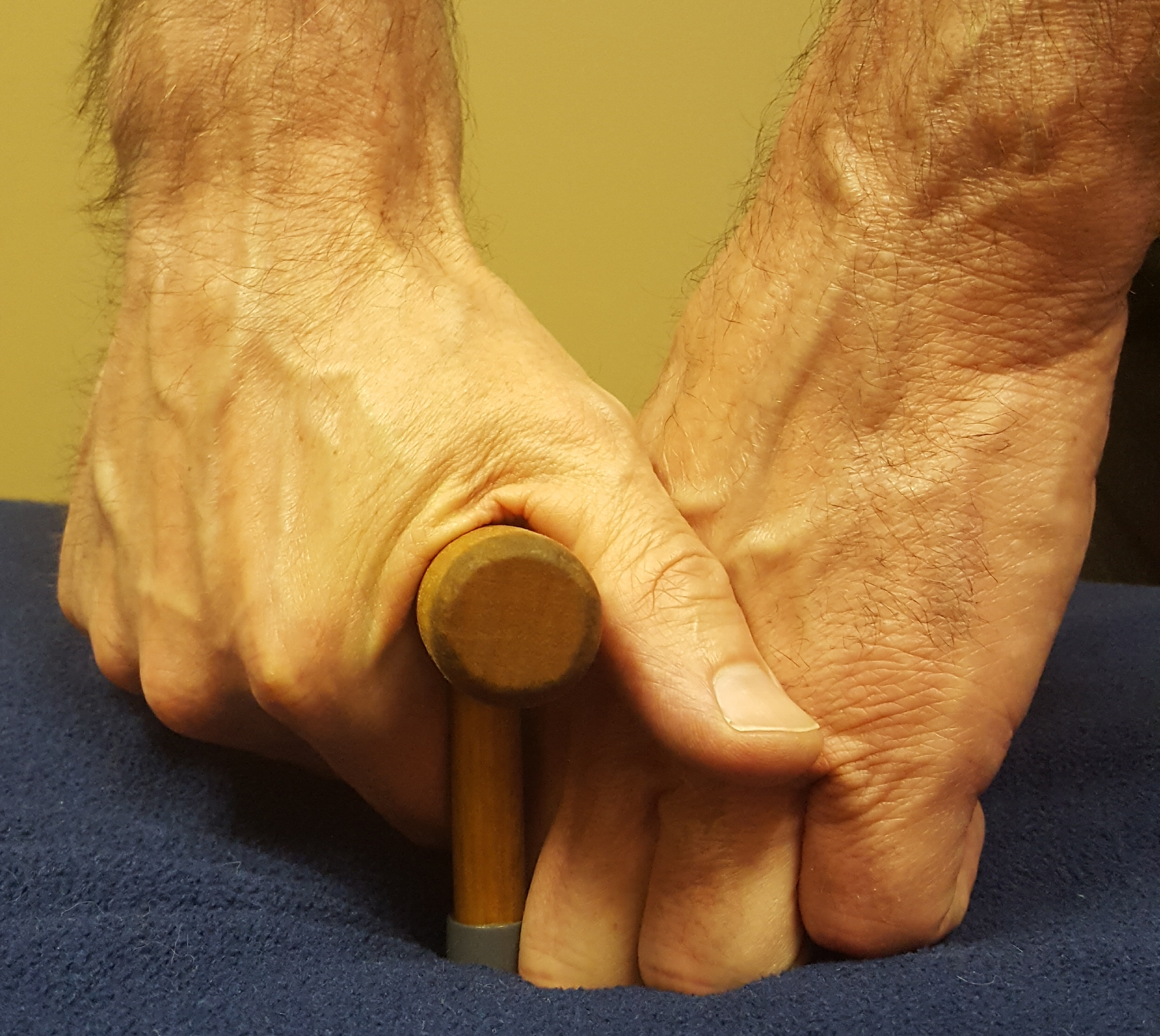
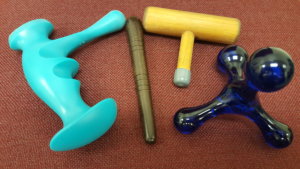
    A pressing massage tool (pictured below) not only can be used to do static or reciprocating pressure when gliding with body parts (hands, knuckles, fists, forearms), it can also be used  as the primary gliding vehicle, too.

    Using a Massage Pressing Tool for Static Pressure During a Glide Stroke

    Using a massage pressing tool for static pressure during a glide stroke is fairly straight forward.

    You glide with your favorite body parts (hands, fists, knuckles, forearms) and when you find a tight spot you pause, pick up the massage pressing tool, press, put the massage tool back down, then continue on with your glide.

    More about how to do that here:

    Gliding with a Massage Pressing Tool

    Gliding with a pressing tool requires a little more practice. But it’s worth it.

    Why?

    Because when you can glide with a pressing tool you can:

    1. Maintain consistent flow.
    2. Save your thumbs and hands.
    3. Seamlessly do static or reciprocating pressure at anytime during the glide stroke.

    Gliding with a pressing tool can be a little awkward at first, but I have 2 tricks to make it easy.

    First, do an exploratory stroke WITHOUT a massage pressing tool.

    Trick #1: Exploratory Strokes

    For an exploratory stroke glide with your favorite body parts (hands, fists, knuckles, forearms).

    As you glide note the tight and tender areas along the way. Now you have a basic mental map of the areas you may want to focus on.

    With that map in mind pick up a massage pressing tool and start to glide, which brings us to trick #2.

    Trick #2: Don’t keep the same pressure through the entirety of the initial pressing tool stroke.

    So, say you’re gliding with deep pressure in the lamina groove with a T-bar.

    If you initially do the whole stroke with deep pressure, you’re going to hit some tight spots on the map, and it’s NOT going to feel so relaxing to the client when you slam into them with that deep pressure.

    So, instead of slamming into tight spots as you glide, back of the pressure as you approach them.

    How will you know where they are?

    Use your map.

    So, this means that you’ll go over the first tight spot with the lighter pressure, then you’ll stop, back up a little and do your magic (possibly deeper static pressure) to provide pain relief to that area.

    The whole stroke looks like this: Starting stroke with a deep pressure glide using a T-bar…tight spot coming up…lighten up a little…over it…stop…back up…on it…find the pain relief pressure for that spot…make the client sigh…done…glide on with deep pressure…next tight spot coming up…lighten up just before you make contact…over it…stop…back up…on it…pain relief provided…move on and repeat this same process until the end of the stoke.

    By the way, my relaxation glide stroke is pretty damn slow. So, it’s not like I’m jamming on the brakes when I stop and pause on a tight/tender spot.

    Personally, I think that stopping and addressing tight/tender areas when doing a relaxation massage (in a relaxing way) is what separates an average relaxation massage from a good relaxation massage.

    Okay, sounding pretty good so far?

    Well, here’s the bad news. When you actually glide with a massage pressing tool for the first time this is what’s going to happen:  The massage tool is going to fall out of your hands OR you’re going to squeeze so hard your hand will hurt.

    Here’s how you fix that: Use two hands.

    In this video I demonstrate how to hold a TheraPress with two hands while gliding.

    Okay, got it, Mark, two hands…glide but not too much pressure at first…slow the stroke down…then come back to the tight spot on Thursday, but not Friday…

    Yeah, let’s simplify things for gliding with a massage pressing tool.

    1. Do an exploratory stroke WITHOUT the massage tool.
    2. Use two hands to brace the tool.
    3. Lighten up on the pressure when you first come up to tight spots.

    Boom!

    If you’re getting serious about using massage tools to save your hands, check out How to Hold a Massage Tool.

    Massage Tools Online Class

    And if you want to get really serious about saving your hands and using a massage tool to deliver focused pressure, I have an online, home-study class for you: How to Use Massage Tools (Fearlessly and Effectively).