Author: Mark Liskey

  • Pain Relief Massage: Tibialis Posterior Tendonitis

    Pain Relief Massage: Tibialis Posterior Tendonitis

    If you work with athletes or someone with flat feet, you may have already encountered tibialis posterior tendonitis (TPT). A person with TPT may feel pain in the arch of the foot, medial side of the ankle and/or deep in the calf. A tibialis posterior pain reduction massage might be in order.

    I’ve found 2 keys to helping a client walk out of my office in less pain: 1. Look for pain in 3 places 2. Give the right dose of pressure.

    Lost Arch—Almost

    My first true case of working with a tibialis posterior condition turned out to be a tendon tear. In the past, Tom had come to see me for a stiff neck and a frozen shoulder. But when he came in with extreme pain in his arch/ankle with reduced foot functionality, I knew he was waay beyond anything I could do to help him.

    He went to the orthopedist and eventually found out that his tib posterior tendon was 80% torn. Yikes! If it went completely, the surgeon said, Tom would completely lose his arch and wouldn’t be able to do the recreational activities that he loved, like running and basketball.

    Tom had his tib post surgically repaired and it was a huge success. Now I work on his tib post for minor aches and pains. Since Tom, I’ve worked on many runners with tib post tendonitis. Needless to say, I’ve gotten to know the tib post quite well.

    The Tib Post Big Picture
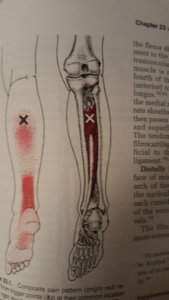
    The tibialis posterior is the deepest muscle in the posterior calf (underneath the gastrocnemius and soleus). It’s main attachments are the inner posterior borders of the medial tibia and fibula, the interroseus membrane (membrane between the tibia and fibula), the tuberosity of the navicular bone, the plantar surface of the 1st cuneiform and at the bases of the 2nd, 3rd and 4th metatarsals.


    Tib Post in 3 Sections

    I divide the tib post into 3 parts to make it easy to remember. Here they are: 1. Foot, 2. Tendon, 3. Body.

    Foot Attachments—Find the Tuberosity of the Navicular Bone

    In the foot, the tib post attaches at the base of metatarsals 2, 3, and 4, the navicular tuberosity and the middle cuneiform.
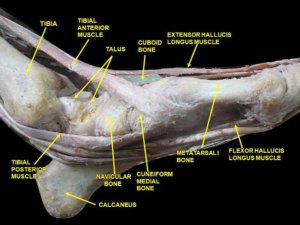
    posterior-tibialis-foot-attachments-pic

    (Picture from https://commons.wikimedia.org/wiki/File:Slide2wewe.JPG)

    Don’t sweat the attachments. If you find the navicular tuberosity, the rest is gravy. Why? Because the navicular tuberosity is an area that you’ll really want to investigate, and once you find it, you can use it as a reference point to locate the middle cuneiform and metatarsals.

    In this video, Finding the Tibialis Posterior Navicular Attachment, I show you the quick and easy way to locate tib post navicular attachment.

    Tendon Section

    To locate the tib post tendon, put your fingers on the medial malleolus. Now go slightly posterior of the malleolus and down.

    If you’re doing a parts body massage, have the person invert her foot as you resist with your hand and the tendon will become more prominent.

    Calf Section

    Now for the body of the tib post: In your brain, draw a straight line from the Achilles tendon ¾ of the way up the lower leg. At the ¾ mark up the calf is approximately the location of the interroseus membrane, one area where tib post attaches. Between the Achilles and the interroseus membrane is the body of the muscle.

    Goldilocks Pressure for the Tibialis Posterior Pain Reduction Massage

    Once you locate the tibialis posterior, your next goals are to find the areas of pain and then reduce the pain. You are going to reduce pain by applying a therapeutic (pain relief) pressure.

    Too much pressure may cause your client to tighten up and/or may add to an unwanted inflammatory response. Not enough pressure and it’s unlikely you’ll facilitate a pain relief response.

    The right amount of pressure can be easily determined by introducing a pain scale to your client. The scale is 1 to 10. One is a little bit of pain. And 10 is a whole lot of pain.

    Press on a pain area and ask your client to tell you when the pain reaches a 4 on her pain scale. Hold at that 4 pressure for less than 10 seconds. Ask the client if the pain stayed the same or went up or went down. If the pain went down, you may try applying a little more pressure when you come back to that area again during the massage. If it didn’t, lighten the pressure and try again until the pain goes down.

    Once you get your client’s “4”, you don’t need to check in with her regarding pressure except when you’re in doubt.

    In this video, I show you how to use the pain scale to find the right pressure: Pain Relief Massage–How to Find the Right Pressure.

    Some clients know which pressure is best for them because they’ve had a lot of massage. In those cases, I would, more often than not, go with the client’s request.

    Tibialis Posterior Pain Reduction Massage Combined with Relaxation Massage

    Here’s what post tib work could look like if you were incorporating it into a relaxation or body parts massage: Tibialis Posterior: How to Do Pain Relief Massage Video

    Tibialis Posterior Pain Reduction Massage Cliff’s Notes

    Here’s your quick reference guide:

    a. Navicular: Find the tuberosity of the navicular bone. Then you can find all the other foot attachments if necessary.

    b. Tendon and Body: The tendon is on the medial ankle side. The body of he muscle is in the middle of the calf and deep.

    Video: Finding the Tibialis Posterior Navicular Attachment.

    c. Keep pressure at 4 if you’re unsure.

    Video: Pain Relief Massage–How to Find the Right Pressure

    d. Integrate into relaxation.

    Video: Tibialis Posterior: How to Do Pain Relief Massage

    Tibialis Posterior Pain Reduction Massage + ?

    Lastly, a massage is not going to cure tibialis posterior tendonitis. It can help someone on the road to recover, but the cause (or perpetuating factors) for the tendonitis needs to be addressed.

    Personally, I reach out to podiatrists, orthopedists, physical therapists, coaches, and select body movement instructors (e.g. Pilates and yoga). For me, a combined efforts approach has produced great outcomes both for my clients and my business.

    Want more information about pain relief massage?

    Check out My (Simple) Secret To Pain Relief Massage.

    Just need more help with…well…everything?

    Join my email group.

    I send you my latest everything.

    It’s free:-)

    Sign up below.

    [contact-form][contact-field label=’Name’ type=’name’ required=’1’/][contact-field label=’Email’ type=’email’ required=’1’/][/contact-form]
  • How to Use Your Massage Stool

    How to Use Your Massage Stool

    In my one office I had spent 10 years without having a massage stool (or anything) to sit on when doing a massage.

    Yeah, I’m cheap, but that wasn’t the only reason I didn’t have a stool in my massage room.

    I thought that not sitting would make me stronger, tougher and a more durable massage therapist.

    Now, after 25+ years of doing massage, the massage stool is my bestie—and it’s one of the things that has helped me become more productive and durable now, at 57, than I was at 30.

    Just to be clear: On par with my male contemporaries, my testosterone is plummeting like the 2008 stock market. I don’t do Performance Enhancing Drugs. And I haven’t found the fountain of youth.

    I’m more productive now because I’m strategic when doing massage. And my massage stool plays into my scheming.

    How?

    A massage tool allows me to…

    1. Rest my legs.
    2. Rest my back.
    3. Rest my shoulders and arms.
    4. Rest my head. (Don’t tell anybody.)

    That’s a lot of resting, huh?

    Well, you may have guessed by now that my massage hardening philosophy has taken a 180 over time.

    Now it’s: Toughen your body in the gym, on a trail or in the water; preserve your body in the massage room.

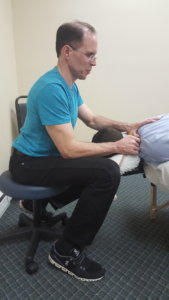
    Resting is a way to give overworked muscles a break. And using a massage stool when massaging the head, neck, tops of shoulders and feet is a great way to rest.

    Resting your legs is a no-brainer. You sit down on the stool and your legs say aah.

    But what about resting your back?

    Use a Massage Stool to Rest Your Back

    It’s easy.

    Pull up a massage stool and put your butt down.

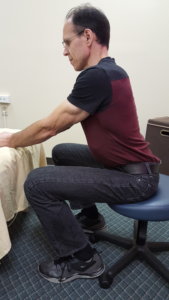
    And if you really want to rest your back, use your armrests.

    Your thighs.

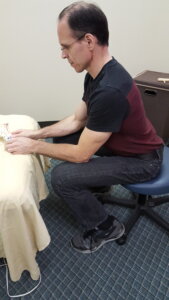
    Here my forearms are on my thighs and my back is happy to be in a different position and to have the extra support of my arms.

    To apply pressure effortlessly just lean in from the waist.

    Couldn’t be any easier.

    How about shoulders and arms?

    Use a Massage Stool to Rest Your Shoulders and Arms

    Same formula as back.

    Sit. Rest forearm(s). Lean.

    That really takes the upper trap and levator scapulae out of the contraction zone.

    What if your armrest is too low?

    Just raise your armrest by pushing up to tiptoes while staying seated.

    I’ve also found it easy to sit and lean when working the IT band, peroneus longus/brevis, and tibialis anterior.

    Here’s a quick video I put together about sitting and leaning.

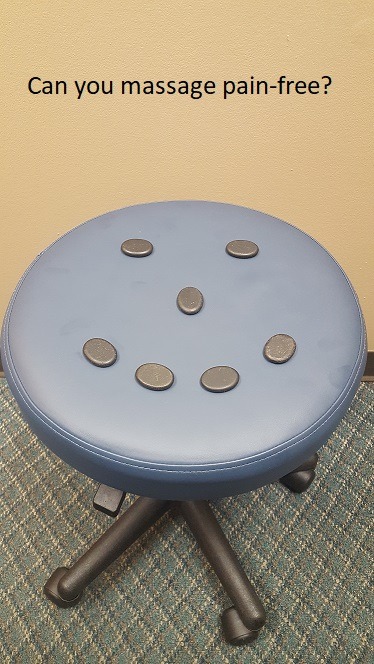
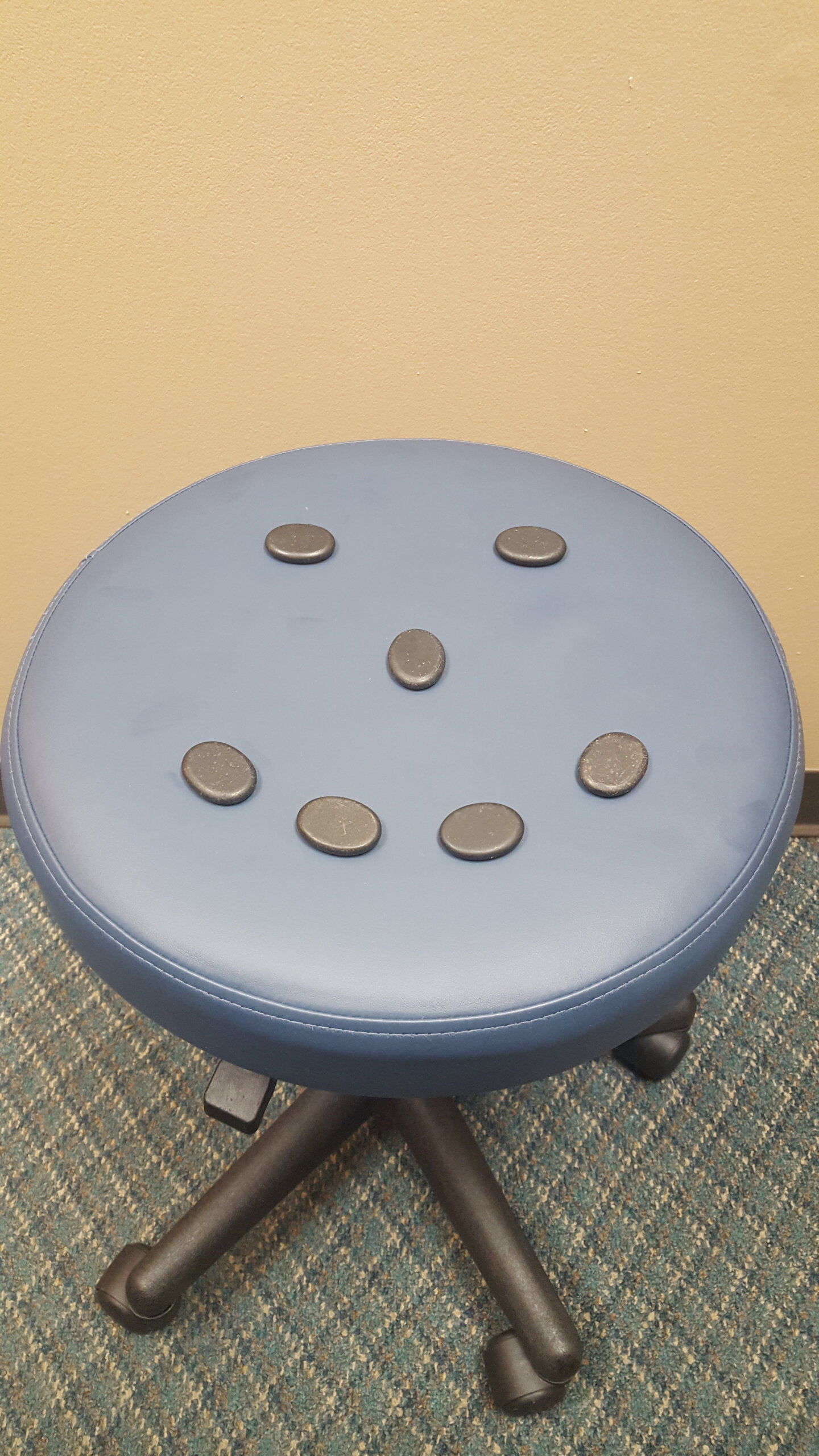
    By the way, the massage stool is the perfect moveable platform to put massage tools on.

    Okay, well that about does it….

    Aw hell naw, I wasn’t going to sneak out on you without showing you how (on rare occasions) I rest my head.

    Seriously, the massage stool (like the massage table) can save your body by giving you a chance to rest your overworked muscles.

    Find the times when sitting can work for you.

    Mine are: Head, neck, top of shoulder, IT band, tibialis anterior, peroneus longis/brevis, feet.

    Then…

    1. Sit.
    2. Forearm(s) on lap.
    3. Lean.

    Looking for a Stool?

    I got mine from Amazon. This is an affiliate link. I get a commission if you purchase a stool using my link, but you don’t pay extra for using my link. And you support my mission to help you build your dream business and never be in pain from doing massage with free articles, business classes and business coaching forever.

    Massage Body Mechanic Online Class

    If you want to stay out of pain when doing massage and increase your massage max (the number of massages you can do in a day pain-free), then I have an online class for you: How to Deliver Deep Pressure Without Hurting Yourself.

    It’s 3 CEUs and NCBTMB approved.

    It includes the strategies and techniques that saved my body and extended my massage career. Let me know what you think:-)

  • How to Fix a Marketing Mistake: Lessons for Massage Therapists and Small Business Owners

    I hit send and was happy that my blog post about marketing to massage clients on Facebook was going to be read by Make the Most of Massage readers. I waited for responses.

    Strangely, the first response I got was from one of our PressurePerfect Massage (PPM) business clients. Hmm…. It took me a few minutes, but then it hit me: I had sent the Make the Most of Massage email and blog post link to my PPM clients, not my Make the Most of Massage readers!

    Thankfully, the post wasn’t a deep dive into which posts  on Facebook work best with our PPM clients. O. M. G. It was!

    Damage Control

    Once I could think straight I went into I action. I realized that I could use the metrics on Mailchimp to see how many people opened the email and how many people clicked on the link to read the post. Eighty-five people opened the email. Five clicked on the link. I could retrieve the names of the five with one click and send them a personal apology email along with a group apology email.

    But what if more people would click on the link and read the post? Then I remembered that I could unpublish or password protect the post so no PPM clients could read the post unless they had the password. Perfect.

    Now for the group email: I didn’t want to go too deep with an apology for fear of making someone who didn’t open the email want to investigate. So I settled with this:


    Subject: Apology for Earlier Email Mix-Up

    I am so sorry! My email from earlier today was supposed to go to the massage therapists who read my massage blog – and obviously I hit the wrong button.

    I don’t want to waste any more of your time but I do want to let you know that I’m taking measures so it doesn’t happen again.

    Again, really sorry!

    Have a great rest of the day!

    Mark


    Then I went to work on the ones who read the post. For clients who I didn’t know well, I came up with this:


    Subject: Apology for Email Mix-Up

    Hi Fred,

    Sorry about the email mix-up today. You got the one that was meant for my massage business/marketing blog group.

    I was never a big fan of marketing, but I am forced to do marketing because I am a small business owner. So the only way that I could see myself succeeding with marketing was to blog about it so that I would have to learn about it.

    That said, if you found the marketing post that I accidentally sent to you in any way offensive from a client perspective, please accept my apology. My heart is and always will be with clients above all business responsibilities. I hope you have a great afternoon.

    Mark


    Two other post readers were in the business world and one was in marketing. So I apologized to them and asked them directly how offensive the errant email was so that I could gauge whether my reaction was too over-the-top.

    The Surprise Reward

    Writing the apologies helped me understand for myself that my clients are still my emotional driver. Yes, they are how I make money. But they are more than that to me. If they walk, yes, I lose their money. But I can get more clients. However, if I lose their respect that would always gnaw on me.

    That said, the responses I got from my clients with the apology email allayed my fears because they were all positive. One said that he was intrigued by how much work went into making a small business run. Another one thought it was a behind-the-scenes reveal at first, then it made her laugh once she realized it was a mistake.

    My Marketing Lesson

    The very next day, I got back on the horse and sent out an email advertising two free raffle tickets to win a massage for anyone who gets a massage with one of our therapists on two particular days. I started the email with: “Yes, this one is meant for you (LOL).”

    This is a big difference from my reaction to a factual mistake I had made in an Op-Ed I had written for the Philadelphia Inquirer fifteen years ago. After my mistake I didn’t write another Op-Ed for a year for fear of making another one.

    Moral of my marketing story to me: By addressing your mistakes head-on and with sincerity, you not only rectify the errors but also build stronger connections with your clients. Mistakes are inevitable, but how you handle them defines your business. In other words: Get up. Spit the tooth out. Make them smile again.

  • Change Work Postures: Massage Therapy Foundation Ergonomics Project

    In February of 2022, the Massage Therapy Foundation posted the 1st phase findings of its Ergonomics Project (https://massagetherapyfoundation.org/mtf-ergo-project/). Three of the recommendations are to sit more, change work postures, and have adjustable tables and stools to vary work postures.

    These findings corroborated my experience which I teach and write about. Unfortunately, implementing these recommendations without understanding key body mechanics concepts comes with potential hazards. Let’s start with sitting.

    Massage Ergonomics: Sit and Lean

    If you sit more to massage in order to rest your legs, you could be potentially stressing your upper-body more if you don’t lean to generate force. Here’s how I lean to generate forces:

    Sit and Use a Massage Tool

    Since you can only use your upper-body to lean and generate force while you sitting, you might be tempted to press harder with your arms and hands. To prevent that I recommend using massage tools while sitting and pressing. The key to using massage tools is to lean, pin, add a guide finger and relax the hand holding the tool. Here’s how I do that:

    Change Stances

    Changing work posture doesn’t only have to be from standing to sitting and vice versa. I change stances constantly throughout a massage. Why? To break static posture and give areas of my body that are more taxed than other areas of my body a break. In this rough-cut video I demonstrate how to change stances (work postures) without interrupting the massage:


    Massage is both static and dynamic. There are times you’ll be in the same position for a while as you hold a point or work an area. The dynamic part takes a little more conscious effort. As you’re in a static posture and before the taxed muscles start to figure, make the massage dynamic by changing positions, techniques or moving on to a different area.

    If you need help figuring out which body-mechanics strategies and massage ergonomics work best for you, shoot me an email (mark@makethemostofmassage.com), and I’ll be happy to help:-)

    Other help is here: book and online classes.

    If you don’t take care of you, at some point, you won’t be able to take care of them.

    Ways to Save Money and Build Your Practice:

    Massage Insurance: Who has the Cheapest Massage Insurance

    Website: Cheapest Way to Build a Website.

    Rent a Massage Room: How to Rent a Massage Room for Cheap.

    Questions?

    I am here. Email me a mark@makethemostofmassage.com! 🙂