Author: Mark Liskey

  • Scratch the Itch: Get the Multifidus and Rotatores

    Scratch the Itch: Get the Multifidus and Rotatores

    The multifidus and rotatores are in the lamina groove. Early on in my career, I shied away from anything close to the spinous processes. But neuromuscular therapy taught me that these muscles can be influenced and clients REALLY  like getting them worked.

    The Deep Back Muscles

    Here are the multifidus and rotatores:
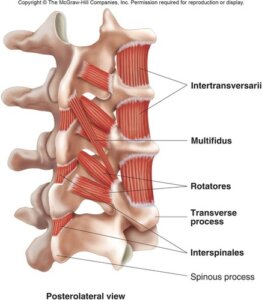
    rotatores-and-multifidi

    They multifidus stabilizes joints within the spine. The rotatores lie underneath the multifidus and are involved in postural control.

    Why Work Them?

    There are five reasons why I think that working the multifidus and rotatores improves the quality of a pain relief massage.

    1. When you’re working the multidus and rotatores, you’re also working a lot of other muscles.

    For instance, let’s say you’re massaging in the upper-thoracic lamina groove. As you’re working into the lamina groove, you’re also pressing into the trapezius, rhomboids, and other back muscles. It’s literally one stop shopping.

    1. You’re giving the client a new experience.

    I’ve found that most therapists don’t do focus work in the lamina groove. So a first-time client will probably be pleasantly surprised if you work the multifidus and rotatores.

    1. From a trigger point standpoint there could referrals.

    If you subscribe to trigger point theory, then there could be pain referral patterns stemming from these deep back muscles.
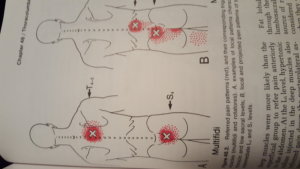
    multifidus-tp-back-pic

    (Myofascial Pain and Dysfunction The Trigger Point Manuel, Janet G. Travell, M.D., David G. Simons, M.D., Volume 1, p. 639)

    1. Allows you to really compare left to right.

    It’s fairly easy to compare left to right when it comes to the multifidus and rotatores, mainly because you can use the spinous process as a reference point.

    By comparing the left side to the right side, you can customize your massage. For instance, say I wanted to desensitize a pain area occurring around T8. If I found a higher degree of pain (not hyper-pain) in the right, T8, lamina-groove muscles, I would spend more time there than I would on left T8 side.

    1. You can scratch the client’s itch.

    My clients really like the lamina groove work. It’s not uncommon to have a new client say, You got the spot that I’ve wanted someone to get for years. I’m not special. Anyone can get this same response. You just need to get your lamina groove reps in.

    Also, when working through clothes (like when doing demo massages), targeting the multifidus and rotatores using static pressure is a very effective pain relief massage. I would argue it’s as effective as doing a regular skin-to-skin massage.

    Three Steps

    Here’s how to get comfortable working these deep muscles.

    1. Find the spinous processes.

    Once you find the spinous processes, you’ve won the battle.

    By the way, don’t be scared of the spinous processes. They are you friends (reference points).

    1. Go just lateral of the spinous processes (maybe 1/2 inch).

    For extra assurance, keep in contact with the spinous processes. You can use fingers from your pressing hand or non-pressing hand to maintain contact.

    1. Press down into the lamina groove with a thumb/finger or body parts combination.

    Here’s a video on how I use body part combinations in the lamina groove: Combining Body Parts for the Lamina Groove Video. (In the video I use the term power tools.  Now I call power tools “body part combinations”.)

    As you’re learning to calibrate your pressure in the lamina groove, you may first want to use a pain scale system.

    Here’s the pain scale system I use: tell the client to think of a pain scale from 1 to 10 where 1 is not much pain and 10 is a lot. When you press on an area, you want your pressure to feel like it’s registering in a 3 to 4 range (in acute pain areas) or a 4 to 5 (in non-acute pain areas).

    Here’s my pain-scale-system tutorial video if you want to take a deeper dive: Pain Scale Video

    Experiment With Massage Tools

    Massage tools (especially the T-bar) are ideal for the lamina groove muscles. Why? Because with massage tools you can generate pressure effortlessly. In addition, your pressure will be more precise than your thumbs or fingers.

    Here’s how I do pain relief massage in the lamina groove using massage tools: Massage Tool Work In Then Lamina Groove Video.

    Intention is 50% of Massage

    Intention plays an important part in massage. When working in the lamina groove and directing your pressure to influence the multifidus and rotatores, you’re not only affecting those muscles, you’re impacting other muscles. In essence, you are getting a big bang for your effort.

    In my experience, clients respond favorably to intentional and focused pressure in the lamina groove. For example, I can sometimes find that one spot that a client wants addressed that no one has addressed before.

    Working the rotatores and multifidus is not difficult. You just need to find the spinous processes, go lateral and press into the lamina groove. When first starting out keep a guide finger on the spinous processes until you get comfortable working in the lamina groove.

    Here are the video tutorials to get you on your way:

    Combining Body Parts for the Lamina Groove Video

    Pain Scale Video

    Massage Tool Work in the Lamina Groove Video

    Once you start getting positive feedback and results, you’re going to be glad that you ventured into the lamina groove.

    Home Study Massage Tools (2.5 CEU) Course


    Get good with massage tools and you’ll save your hands and you’ll be able to deliver precise pressure like nobody’s business. Precise pressure is not only what my clients love, it’s also what differentiates me from the massage therapist that I compete with around town.

    How to Use Massage Tools Fearlessly

    Questions? Ask away! Email m at mark@makethemostofmassage.com. 🙂

     

  • Can You Have Too Many Business Coaches? My Experience with Business Coaching

    Can you have too many business coaches? Nope—at least not for me. This year, I worked with five of them, and they moved me along faster than I’ve ever moved in business. It was like trading my roller skates for a rocket.

    So, why the coaching spree? Because I was stuck and needed more than one brain to push me to the next level.

    What is Business Coaching?

    Business coaching is like having a GPS for your entrepreneurial journey—someone who helps you chart the course, avoid potholes, and steer clear of that “Recalculating…” voice in your head. Coaches guide, mentor, and hold you accountable.

    You’ll find all kinds of business coaches: marketing gurus, financial wizards, operations masterminds, and leadership whisperers. They specialize in filling the gaps you can’t—or won’t—tackle alone. And the benefits? For me: clearer goals, stronger strategies, and the ever-terrifying but necessary accountability.

    Free Business Coaching: SCORE.org

    If you think good coaching has to cost an arm and a massage table, think again. Enter SCORE.org, the holy grail of free business coaching.

    SCORE connects small business owners with seasoned pros who volunteer their time to help people like you and me not just survive but thrive. Their coaches helped me fine-tune marketing, master SEO, and bring structure to my chaos. Plus, they’re available in-person, via Zoom, or by email. And SCORE doesn’t care if you more than one coach at a time!

    One SCORE coach, Tom, became so invested in my success he joined my wellness center as a yoga instructor. Another, Ann, gave me great ideas about marketing locally and was the perfect sounding board for me. And Danny helped get my massage business to rank #1 locally. Did I mention all this was free?

    SCORE is a lifesaver for anyone on a budget—and if you are going it on your own, you have to run lean. Love me some SCORE!

    Coaching Through Personal Connections

    Now, about my neighbor Luke: He’s a business relationships guru who creates “value experiences.” (Whatever that means, it worked. Haha.) No, for us value experience means we make the clients feel good from the moment they arrive to the moment they leave so that they are sure to tell everyone about the great experience.

    I offered Luke a massage gift certificate for his advice. He accepted. Turns out, bartering isn’t just for middle school lunch tables—it’s a great way to exchange expertise. I got Luke’s insights on creating lasting customer connections, and he got to enjoy our massage.

    This experience taught me that you don’t always have to go far to find great coaching. Look around. Maybe your hairstylist has killer branding ideas, or your mechanic knows a thing or two about small business operations. Tap into your network, and don’t be afraid to swap skills. But don’t stray from the coach’s expertise.

    Picking the Right Coach

    Here’s the thing about having multiple coaches: it’s not a free-for-all. It’s a strategy. You need to pick the right coach for each challenge.

    Take my lineup: Danny was my digital marketing coach, Ann handled traditional marketing, and Lauren optimized SEO. Each had a specific skillset I needed. If I had one generalist, at best, I probably would have ended up with mediocre results across the board. At worst, I would have been frustrated and given up on projects that I should have finished.

    Before choosing a coach, figure out your pain points. Need help with finances? Find someone with P&L expertise. Struggling with leadership? Look for a coach who’s managed teams successfully. Ask questions, check references, and be clear about your goals. Make sure you click and when you do choose a coach, constantly monitor your coaching sessions to make sure the coach is giving you what you need and is still the right person for the job.

    When Coaching Goes Wrong

    Now, a word of caution: Even the best coaching can backfire if you don’t approach it wisely. Here are three pitfalls to dodge:

    1. The Popularity Trap: Don’t pick a coach just because they’re Instagram famous or charge a lot of money. Expertise matters more than hype.
    2. Coach Overload: Currently, I have 4 coaches, but I don’t meet with them at the same time. I space things out so that I can complete the task from each coach. Four at a time may be too many for you—and at some point it might be too many for me, too. But for me now it works like a charm. If you’re just starting with coaching, my advice is to start with one so that you’re not spread too thin.
    3. Unclear Expectations: Always define goals, timelines, and deliverables. A confused coach-client relationship helps no one.

    Get a Business Coach!

    It’s not the number of coaches you have that matters. It’s having the right coach to meet your specific needs that matters—whether they’re SCORE volunteers, bartered buddies, or hired pros.

    So, if you’re hesitating about getting a coach, don’t. Start with free resources like SCORE or tap into your network. Barter, research, and, most importantly, take the leap.

    Because if there’s one thing I’ve learned, it’s this: great business coaching can transform you which in turn can transform your business.

  • Massage Insurance: What Every Therapist Needs to Know to Protect Their Business

    Massage Insurance: What Every Therapist Needs to Know to Protect Their Business

    When I first started massage, thirty-plus years ago, I rolled the dice, and I didn’t get massage insurance. I knew it was a risky move. So, after a year of worry, I purchased my first massage insurance policy. But here’s the thing, I bought massage insurance with my eyes closed. And a handful of years later my insurance provider disappeared into thin air. POOF!

    At that point, my business had grown (and risk exposure, too), so it made sense for me to do a deep dive into massage insurance. I did, and I found the perfect policy for me. That said, the policy that was perfect for me, may not be the perfect one for you.

    So, my goal here is to help you understand what massage insurance is and isn’t. At the end of this article is a link to a cheap massage insurance (and best massage insurance) guide. It will help you figure out which massage insurance is perfect for you. But first, let’s get an update on the state of massage insurance providers to make sure they are not going to POOF! on us.

    Massage Insurance Providers: How Long Have They Been Around?

    There are basically nine insurance providers, many are associations, that have long track records in the massage industry. (There are few insurance companies that have recently entered the game. I’ll get into that in a later article. But for now, let’s stick with the ones have been in the massage game the longest.) Below is a chart showing when each massage insurance provider started.

    Insurance Provider Year Established Notes
    ABMP 1987 Associated Bodywork & Massage Professionals, a national membership association for massage therapists and bodyworkers.
    AMTA 1943 American Massage Therapy Association, the largest non-profit professional association serving massage therapists.
    InsureLMT 2010 Provides liability insurance tailored for massage therapists.
    Massage Magazine Insurance Plus 2010 Offers insurance solutions for massage professionals.
    NACAMS 2010 National Association of Complementary and Alternative Medicines, offering insurance and resources for complementary and alternative medicine practitioners.
    Massage Council 2000 Provides insurance and support for massage therapists.
    Hands-On Trade 2000 Offers insurance and resources for massage professionals.
    Alternative Balance 2000 Provides insurance and support services for massage therapists.
    InsureBodywork (BBI) 2012 Operates under the name Beauty and Bodywork Insurance, offering specialized insurance for beauty and bodywork professionals.

    Pretty good, right? I am fairly confident there will be no POOF-ing. Next, let’s understand what massage insurance actually covers.

    What Does Massage Insurance Actually Cover?

    Massage insurance primarily exists to protect you from the financial fallout of lawsuits or claims that could come up in your work. But what does that really mean in practice? Here is what massage insurance is:

    1. Professional Liability Insurance

    Think of this as your main shield. Professional liability covers you in case a client claims they were harmed or injured because of your techniques or advice. Whether it’s an alleged injury or discomfort from a specific method you used (like the massage stones being too hot), this part of your policy steps in to help cover any legal costs or damages.

    2. General Liability Insurance

    This is your coverage for the “oops” moments that can happen in any workspace. Let’s say a client trips on their way into your massage room or accidentally spills something that leads to a slip. General liability is there to handle these third-party bodily injuries or property damage claims. It’s about making sure your bases are covered for accidents that could happen even outside of your hands-on work.

    3. Product Liability

    Ever wonder what would happen if a product you use on a client—like a massage oil or cream—caused a bad reaction? Product liability has you covered in these cases. If a client has an adverse reaction to a product you used or sold, this part of your insurance protects you against potential claims.

    4. Personal and Advertising Injury

    If you’re active on social media or marketing yourself, this one’s worth noting. Personal and advertising injury covers issues like libel, slander, or copyright infringement that could come up in your advertising materials. So, if there’s ever a misunderstanding in your marketing or a post that gets misconstrued, this coverage can give you some peace of mind.

    5. Property Coverage

    Not every policy includes property coverage, but it’s worth looking into. This option can cover your massage equipment, supplies, or even furniture if they get damaged or stolen. Think of it as extra protection for your business assets.

    What Massage Insurance Doesn’t Cover

    One thing to remember: massage insurance doesn’t cover your personal health. For that, you’d need a separate health insurance policy to take care of your own medical needs. Massage liability insurance is all about protecting you in the business realm—think of it as your professional safety net.

    How to Choose the Right Insurance Provider

    Choosing massage insurance for yourself comes down to weighing a few key factors. First, consider the type of policy you need: “claims-made” or “occurrence-based”.

    A claims-made policy only covers you while the policy is active, while an occurrence-based policy will cover incidents that happened during the policy period, even if the claim is filed after it ends. If you’re not sure which one is best for you, check out the linked article below where I dive deeper into this.

    Next, look at “coverage amounts”. Think about the kind of work you do and how much protection you feel comfortable with. Some providers offer higher liability limits, which can be reassuring if you want extra peace of mind.

    Also, consider whether you want “just massage insurance” or if you’re interested in additional benefits. Some providers offer insurance as part of a package with membership perks in a professional organization. This can include access to continuing education, discounts, and even networking opportunities.

    Ultimately, it’s about finding a balance between cost, coverage, and the added perks that matter most to you.

    Massage Insurance Cost Breakdown

    Massage insurance costs can feel like a maze when you’re first looking into it—and I get how tricky it can be to balance the coverage you need on a tight budget, especially if you’re just starting out.

    Generally, you’ll find that two basic policies start less than $100 per year, which is a great starting point if you’re looking for straightforward protection. On the higher end, you could pay up to $300 annually. These policies tend to include not just higher coverage limits, but also perks like access to continuing education or discounts through professional memberships.

    The sweet spot depends on your individual needs. Just starting out or working part-time? A basic plan may be all you need to feel secure. Established and seeing a high volume of clients? A policy that includes membership with additional perks may be the way for you. Now it’s time to see how cheap massage insurance policies stack up to more expensive massage insurance policies.

    How Cheap Massage Insurance Options Stack Up

    I did a deep dive analysis on massage insurance in a guide I wrote 9 years ago about cheap massage insurance. (Don’t worry: The guide is updated and revised every week!) The guide compares cheap and the more expensive massage insurances options. It’s an easy read and a straightforward guide. Once you read it, I think you will be able to make a clear and easy decision for yourself.

    Also, if you have a massage insurance questions, email me anytime (mark@makethemostofmassage.com). I’d also be happy to answer questions you may have about my business articles. 🙂

    Last, if you find this information helpful and want to continue to hear a perspective outside the usual industry voices, please share this page and the cheap massage insurance guide. It’s the only way this kind of independent insight gets out there—and it helps more therapists like us stay informed.

    About Mark

    Mark is not a bot. He is a business owner, neuromuscular massage therapist of 30+ years, teacher, writer and blogger. In this blog, he shares best practices for inexpensively growing a business. You can also find Mark’s articles here: Massage Magazine and Massage & Bodywork Journal. Mark loves working in his massage businesses – PressurePerfect Massage and Pain-Free Massage Therapist.

  • How Much Do I Charge for a Massage?

    How Much Do I Charge for a Massage?

    Every massage therapist has asked: How much do I charge for a massage? The short answer is you probably can’t go wrong if you stay close to the price of your top 2 to 3 competitors.  But there are variables and pricing strategies you should consider before making a final decision.

    Before we start talking about strategies, let’s address the emotional  battle that may be going on inside your head. On a bad day you might be thinking that you’re not worth as much as other massage therapists are charging, and on a good day you might be thinking you’re worth a lot more than everyone else. 

    The Emotional Side of Setting Your Massage Rate

    In addition to the emotional battle, there’s also the reality piece: How much is someone actually going to pay for a massage?

    These feelings and thoughts are normal. But don’t let them stymie you and settle on a price by default. Here are some suggestions that I think can help you out.

    Self-Evaluation: Understanding Your Value

    First, how would you rate your massage? This is a loaded question because it’s difficult to do a self-evaluation without bringing in emotional baggage, like “my massage is never good enough.”

    Here’s a way to evaluate your massage and leave the baggage at the door. Ask yourself: Do clients come back to me? Do they compliment me?

    Client Feedback: A Guide to Self-Confidence

    If you’re working in a place with other massage therapists, are you holding your own in terms of getting clients?

    My guess is that your massage is good to go, but that you have normal self-doubt. However, if you think your massage needs tweaking, check out New Therapist Can Be Good Therapists.

    Research Your Local Market for Comparable Rates

    Next you need comparables. What are other MTs in a 5-ish mile radius from you (the place where you’re going to see clients) charging for massage?

    To answer this question, find 2 or 3 MTs or massage businesses as comparables—but be selective. You want to compare apples to apples.

    How to Choose Relevant Competitors

    For instance, if you’re currently working in a spa setting and are going to see clients in a room in your house, then you shouldn’t use a spa in your 5 mile radius as a comparable. People coming to a spa are not only paying for the massage, they’re also paying for the spa atmosphere and wouldn’t pay that price to get a massage in a room in your house.

    However, a franchise massage spa, such as Massage Envy or Hand & Stone, might be a fair comparison. Why? Because a franchise massage spa makes money in volume which means they charge lower prices than non-franchise spas in order to drive more people through the door.

    Pricing Strategies for Massage Therapists

    Undercut Strategy: Pros and Cons of Starting Low

    Once you’ve got your comparables, you’ll have a price range. Let’s say MT 1 charges $70 , MT 2 $80 and MT3 $70. The price range is $70 – $80. Where should you fall in?

    This is the challenging part.

    Instinct may tell you to price low, maybe even below the lowest price in the range. For instance, with the $70 – $80 comparables price range, you might think that $60 would be a good price point to get people in the door. Then over time you would raise the price.

    If you’re going to try this strategy, only do it for a short period of time and only for clients who will follow you from your current job to your practice.

    I say this because I used this strategy when I started my first practice. Yes, it did help me establish a core client base so that I could make it on my own. However, some of those original clients are still not up to my current massage rate.

    If you know that you’ll have a hard time raising the price over time, just avoid this strategy completely.

    High Price Strategy: When to Set Higher Rates

    The opposite approach to undercutting would be to price your massage off the high-end of price range scale. For example, if the comparables price range is between $70 and $80, a high price strategy would be to price your massage at $85.

    This strategy is more often employed by established MTs who know their market. If you’re just starting out, I wouldn’t recommend this strategy unless you have access to people who can pay that price.

    Here’s what I mean: Let’s say you’ve worked at local spa for a year and you’ve developed a following. One of the clients, Nefri, who loves you is also your biggest promoter. Nefri has talked you up to her friends and some come to see you at the spa.

    Your plan is to rent a studio and start your own massage practice. You do your research and find that your competitors are charging $75 – $80 for a 60 minute massage. The spa charges $100 for a 60 minute massage.

    When you tell Nefri that you’ll be leaving the spa to do massages in a studio, she wants to follow you. You suspect that most of her friends who see you at the spa will follow you, too.

    Banking on Nefri and her friends following you (they are used to paying a higher price) and counting on them as referral sources (they can provide an on-going source of people who can afford the higher price), this would be a time where you could price your massage higher than your competitors.

    Putting it in numbers, it might looks like this: at the spa, Nefri pays $100 for a 60 minute massage and gives you a $20 tip. Her out-the-door cost is $120.

    The top end of your comparables price range is $80. If you charge Nefri $85 and she still gives you a $20 tip, her out-the-door cost will be $105.

    You would be making $5 more per massage than your highest priced competitor and Nefri would be paying $15 less than if she went to the spa, which makes up for the fact that you can’t provide the total spa atmosphere.

    In-The-Range Pricing: Staying Competitive

    Personally, I prefer to stay within the comparables price range. Here’s why: Let’s say I work at chiropractor’s office. She charges $75 for an hour massage and my comparables price range if I were to go out on my own is $70 – $80.

    I have a few clients on the side, but I’m nervous that I’m not going to have enough clients when I start to rent space. I know that if undercut and charge $55, I’m in a position of never getting paid enough going forward.

    Solution: I price my massage at $75, right in the middle of the price range, and offer an intro massage price at $45.

    This strategy has worked well in our most recent massage business for 3 reasons:

    1. The intro pricing is a nice way to say thank you to the people who are going to follow you.
    2. The intro pricing is hard to resist for people who are on the bubble about following you.
    3. It’s a great way to get your hands on (literally) future clients and sell your massage through your hands.

    Cheat Sheet: Choosing the Right Massage Pricing Strategy

    Here are the Cliff’s Notes for pricing your massage.

    1. Only price your massage under the low end of the comparable range for a short time (e.g., until you have a base that pays for your massage expenses) and only with clients who are going to follow you.
    2. Only price your massage above the high end of the comparable range when you have access to clients who will pay that rate.
    3. You probably can’t go wrong with pricing your massage within the comparable price range and offering a one-time, intro discount price.

    Setting Your Massage Rate with Confidence

    Cheat Sheet: Choosing the Right Massage Pricing Strategy

    Here’s a quick summary of massage pricing tips:

    • Undercut Strategy: Use sparingly for new clients only. Look for ways to save money on massage insurance, a website and renting a room until you can get to your ideal price.
    • High Price Strategy: Ideal if you have clients willing to pay premium prices.
    • In-The-Range Pricing: Safe choice that aligns with competitor rates. Don’t let pricing your massage stop you from growing your business. Start within a comfortable range, then adjust as you build confidence and experience.


    Need more help starting and/or growing your massage business?

    Get my free course–Jumpstart.

    It has everything you need to get your business moving in the right direction.

    Save Money!

    If you are looking to save money on massage insurance, check out my most recent article: Who has the Cheapest Massage Insurance. By the way, website don’t have to be expensive. In fact, if you build it yourself, you can save a lot of money and make changes immediately. Go here for that article: Cheap Website. Last, you can land a room to rent for cheap if you find the right person to rent from. Here’s how you do that: How to Rent a Massage Room for Cheap.

    Questions? Email me at mark@makethemostofmassage.com. 🙂