Category: Accelerate Massage Business (30K – 60K+)

  • Get Your Client Out of Pain: Put a Stake in the Ground

    Get Your Client Out of Pain: Put a Stake in the Ground

    What makes or breaks a massage treatment plan?

    Whether or not you commit to a course of action.

    In other words, you may have hundreds of ideas about why someone is in pain and a hundred more ideas about how to treat that pain, but until you commit to a course of action, you can’t determine if what you’re doing is working.

    This may seem straightforward, but committing to a course of action is not necessarily easy to do.

    Life and Death

    A couple of years ago, my wife, Lisa, and I were in a should-we-commit-or-shouldn’t-we-commit situation.

    Her sister, Patty, an avid horse rider, was dying of emphysema and she had one last request. She wanted to pet rescue horses.

    The problem was that Patty was extremely weak. A trip to the horse rescue farm could hasten her demise if not do her in right there on the farm.

    The easy way out was to do nothing and let nature take its course.

    After a lot of back-and-forth, the family decided to put a stake in the ground. We, and the nursing home staff, took Patty to the farm.

    In the massage room, as in life, fully committing to a course of action without knowing the outcome can be scary, but when you do, you really start helping clients get out of pain.

    Create a Massage Treatment Plan

    Committing to a course of action usually involves having a massage treatment plan.

    Right about now, you’re thinking, crap, SOAP notes and Latin names for muscles.

    No need to whip out your muscle chart.

    I’m talking about a much more on-the-spot, happening in your brain as you talk to the client, massage treatment plan.

    For example, Moyor comes in with pain in his trap area. You palpate his neck and shoulders and find his traps and levator scapulae to be tight, but it doesn’t seem like his cervical erectors are as tight.

    So, you plan to work all neck and shoulder muscles, but the majority of your focus will be on traps and levator scapulae. 

    As you start the massage you find out that your initial pre-massage palpation is accurate regarding the tight traps and levator scapulae. But then you also discover that his scalenes are tender.

    So, at this point during the massage you commit to a course of action of working his traps and levator scapulae with static pressure and firm effleurage. You also commit to static pressure work on the scalenes.

    Now comes the scary part with having committed to a course of action: The results.

    Managing Your Reaction to the Results

    There will be immediate results. Does Moyor feel better after the massage?

    And there’ll be down-the-road results. Does Moyor feel better 3 days after the massage?

    If Moyor feels better after the massage and/or 3 days later, you’re golden.

    But what if he doesn’t?

    What if he feels worse?

    This is what happens.

    That little voice awakens in your head.

    And it says: Dude, you suck.

    You start doubting if you can help people in pain because you’ve committed to a course of action and it didn’t work out.

    After all, you’re not Dalton, Myers or DeLany. 

    You’re just you with a simple treatment plan.

    Simple Can Be Effective

    Okay, little voice, time for a reality check.

    First, a treatment plan doesn’t have to be complex to be effective.

    In fact, overly complex treatment plans have a drawback.

    If you have a complex plan and it doesn’t work, you’re going to have a lot more question marks about what you should adjust for the next time.

    Whereas, with a simple plan it will be easier to figure out what you want to do next.

    Complex Doesn’t Mean Better

    Also, there can be a tendency to put too much stock in complexity.

    We think that the more complex a system of analysis/treatment is, the more successful it will be.

    But is that true?

    Has one discipline or modality cornered the market with providing pain relief?

    That last time I checked, my pain-relief massage business is doing just fine.

    Still feeling a little iffy?

    Check out: How to Get Good at Pain Relief Massage.

    So, okay, even if you accept that what you have to offer in pain relief massage is legitimate, that still doesn’t completely shut up that little voice berating you for committing to a course of action that didn’t help your client.

    And at this point I’m going to say something that sounds so ridiculously rah-rah that your gonna rupture a capillary from your eyeballs rolling back in your head. 

    Ready?

    There is no failure when you commit.

    If the client has no response or the pain worsens after your treatment, you now have the opportunity to adjust your massage treatment plan or try a plan B (if you have one).

    Or maybe it’s time to collaborate with another health professional.

    Or maybe it’s time to refer your client to someone else (e.g., orthopedist, physical therapist, chiropractor, etc).

    Some of my best work happens when I refer a client to the right person (usually a doctor for a diagnosis), and I’m part of a team effort.

    Failure is “NOT Committing”

    I used to think that firmly committing to a course of action was cocky.

    But I was wrong.

    Committing simply means that you’ve weighed the options as best as you can and you’re not going to let indecision make the decision for you.

    And once you commit you now have something to work with.

    After the massage you can answer important questions, like…

    Did what I do work?

    Do I need more time to work my massage treatment plan?

    Do I just need to tweak the current plan?

    Do I want to try something different next time?

    Should I punt to someone else?

    Our Commitment to a Course of Action

    Fortunately, when committing to a course of action in massage there are no life and death results to deal with.

    But outside the massage room there are.

    Within 36 hours of the trip of petting her favorite horse, Tom Thumb, Patty was dead.

    Did we make the right decision for Patty?

    I’m not sure.

    There was that faint smile on Patty’s face as Tom Thumb chomped on a carrot from her hand.

    Patty Feeding A Carrot to a Horse

    But I’m almost certain that the trip sapped the last vestiges of life from her body.

    I can only say this: Putting a stake in the ground, and not letting indecision determine her fate, was the only thing that we could live with.

    And I’m okay with that.

    R.I.P. Patty.

    Commit to a Course of Action

    It’s 2020 and it’s time to commit to a course of action.

    Do it in the massage room.

    Do it in your business.

    If you’re starting out with your business, this is a free course that can take you to 30K: Jumpstart.

    If you can pay the bills, but need to take your massage business to the next level, go here: Accelerator.

  • Massage Marketing Tips: How to Pick Winners

    Massage Marketing Tips: How to Pick Winners

    Which are the best massage marketing tips?

    The ones that you can effectively apply to your situation, which is precisely what we’re going to do now–figure out the best massage marketing tips for you.

    Listening to someone talk about massage marketing tips is like being handed free, lottery scratch-offs. You can’t wait to score!

    Scrape, scrape, scrape…no match…scrape, scrape, scrape…damn…scrape, scrape, scrape…seriously?!…scrape, scrape, scrape…maybe I should switch dimes…

    This scenario of trying-and-hoping-but-things-not-working-out was my experience with massage marketing tips in the past.

    I got a little sour on the process because I didn’t think the tips worked. But in retrospect, the tips actually weren’t bad. The problem was that I was picking the wrong tip to implement.

    How to Pick the Wrong Massage Marketing Tips

    Here’s a prime example. When I had an office in a fitness center, I wanted more clients and I knew that I hadn’t remotely tapped the full potential of the fitness center’s membership.

    So what did I do?

    Naturally I spent money on an outside-the-fitness-center advertising deal that was completely not my target audience. Not surprisingly, the ad netted zero clients.

    Eventually, I got up, dusted myself off, made more mistakes, but eventually figured out how to grow my practice. I never hired a marketing expert. I simply learned how to pick the right marketing tips to implement for my current situation.

    Here’s a recent example. I wanted to climb the Google, organic-search rankings for for massage in my area. I added a blog to our PressurePerfect website and made some SEO and website adjustments and guess who’s breathing down Massage Envy’s back for the number one slot?
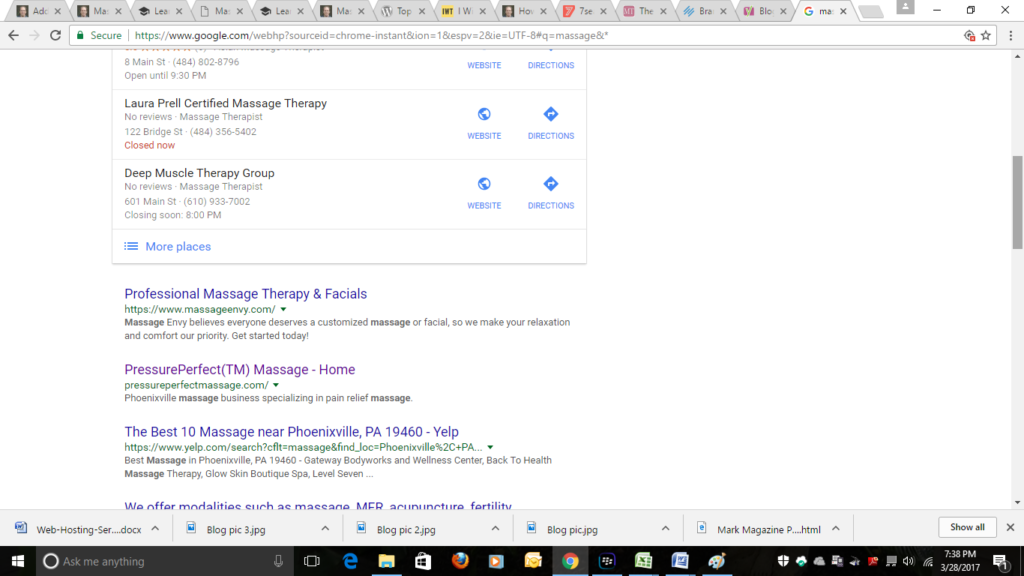
    Comin’ to getcha ME! It’s payback time:-)

    My regret is that it took me a long time to get to this point in my marketing. And I now realize if I would’ve taken the time to address a couple of beliefs that were holding me back, I would’ve had a handle on marketing much sooner.

    Belief# 1: You have to know everything.

    If you believe you have to know everything about something to be good at that something AND you’re near a wall, start banging your head against it. Cuz that’s what’s it’s going to feel like when you start trying to implement marketing tips.

    Okay, don’t do that…but seriously, if you think like that (like I once did), you’re going to waste a lot of time and be very frustrated because you’ll never feel like you’ve mastered the medium.

    A Trick

    Maybe this can help you break free: Think of something that you’re really competent at, and then ask yourself: Do I know everything about this subject?

    Probably not. But you know enough, right?

    I’m not saying grab a margarita and call it a day when it comes to marketing task.

    I’m just saying chill.

    To be competent doesn’t mean you need to be a master.

    Here’s another crippling belief.

    Belief #2: You need to spend a lot of money when marketing.

    Sure, if you’ve got a cash reserve and have a process that can convert advertising leads into clients, then paid advertising is the way to go.

    But if you don’t, then you need to focus on low or no cost massage marketing tips.

    By the way, I have some low-cost marketing tips that took my business to the next level. I’ll talk about them a little later, and you can decide if they’re right for you.

    Okay, crippling beliefs vanquished. Time to pick the right massage marketing tip for what you need.

    How to Pick the Right Massage Marketing Tips

    First, we need to start with a general marketing goal. Most everyone wants to bring in more clients. So, we’re going to say that’s our goal.

    Next, let’s create two broad categories to dump all massage marketing tips into: Traditional Marketing and eMarketing (anything marketed electronically).
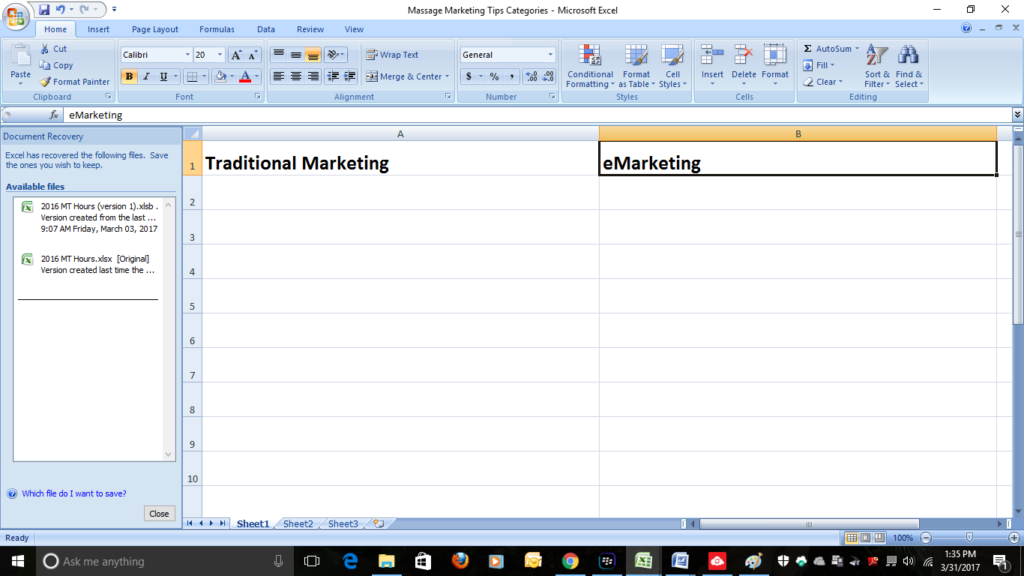
    Now dump.
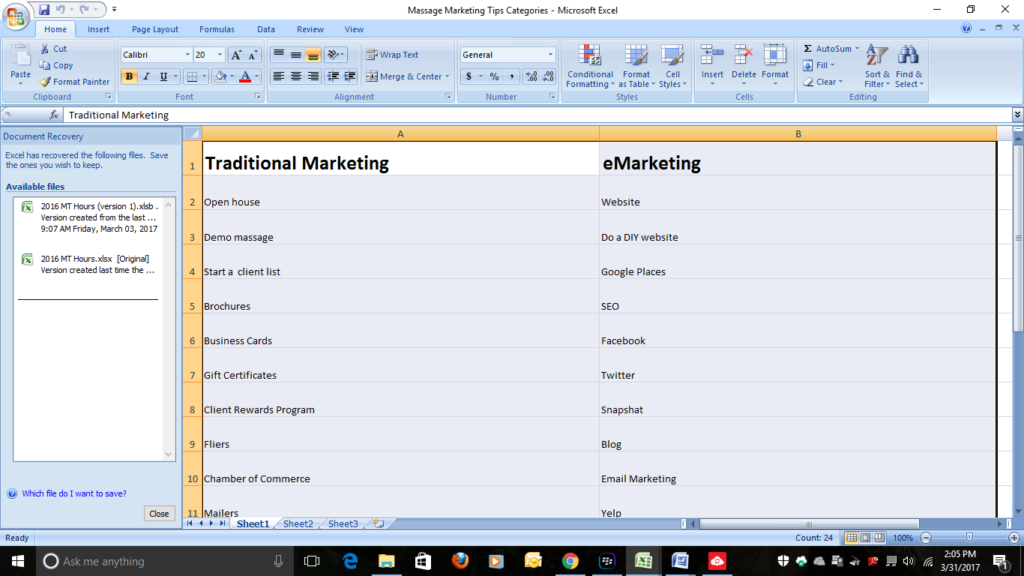
    OMG, un-dump! The list goes on and on, right? And within each topic are sub-topics.

    In SEO, there’s optimize your home page, optimize your About Page, reduce your webpage load time, blah, blah, blah, blah…

    Here’s how you’re going to cut through the list. When you’re looking through your massage marketing tips list, you’re going to ask yourself three questions. Then you’re going to pick the best answer.

    Massage Marketing Tips: Questions to Ask

    1. Which tip is going to give me the biggest bang for my time investment right now?

    To me, this another way of saying don’t get caught up in the small stuff. The big stuff brings in most of the clients. The little stuff produces small results and you can tweak that stuff once your business is rolling.

    I’ll give you my big stuff recommendations in a minute.

    1. Can I see myself doing this marketing tip?

    Is this marketing tip something that I have a shot at sticking with? For instance, the idea of doing SEO for my website so that I get a higher search ranking makes we want to run and hide. But I also know that becoming more visible in a Google search can improve my chances of landing a client.

    For me, I can put up with the learning curve, knowing there’s a potential payoff on the other side.

    However, if I really hated monkeying around with Internet stuff, then I’d pass on the SEO idea.

    1. Does this marketing tip make the most sense in my current situation?

    Here’s why I think I went with the outside-the-gym ad when I had an office in the fitness center: I didn’t want to rely on the fitness center for clients.

    The gym owner came from corporate America and was a tough cookie. When he bought the gym as an investment, he beat me up some when it came to renegotiating the lease.

    So I thought getting clients from outside the gym would give me some security if things went south. But this actually didn’t make the most sense in my current situation.

    A client who was a gym member (and liked my work) was as likely to follow me as a person who wasn’t a gym member and liked my work.

    If I’d spent the money to do some advertising in the gym, I would’ve certainly netted more clients since I already had a presence in the gym and had great relationships with the personal trainers.

    Okay, so once you pick a massage marketing tip, here are some pointers to help you accomplish the task without taking forever to do it.

    Implementing Massage Marketing Tips 101

    1. Study enough to understand.

    Remember you don’t need to be an expert, so don’t waste time trying to be one. You just need to know why you’re doing the tip and how to get it done.

    1. Find the person who has the shortcut.

    This is huge. More than likely, someone has already done what you’re trying to do. It’s worth spending the time to find the person who can point out the hazards and give you the shortcuts. This pointer can save you gobs of time.

    1. Use tools.

    It’s also worth looking around to see if there are tools to help you with the marketing tip. This mainly applies to online marketing work, like website design, SEO, blogging and social media.

    So, now were coming to my favorite part. Here’s where I get to tell you which tips have worked for me. Let’s start with traditional marketing. But first, I want you to think about something.

    My Traditional Marketing Tip

    Think about your current massage clients. How many were referrals? Probably a lot, right? A client refers her sister to you…a chiropractor refers her patient…a friend refers his mom…and the beat goes on.

    The benefits of referrals are that there free (for the most part) and usually there are no advertising costs involved.

    But referrals don’t just grow on trees. You have to get them. The best way that I know to get them is not to hope that a client refers his wife to you. The best to get referrals is to build a referral base. This means you are strategically aligning yourself with people who will consistently refer clients to you.

    Here’s a massage marketing tips list for building a referral base.
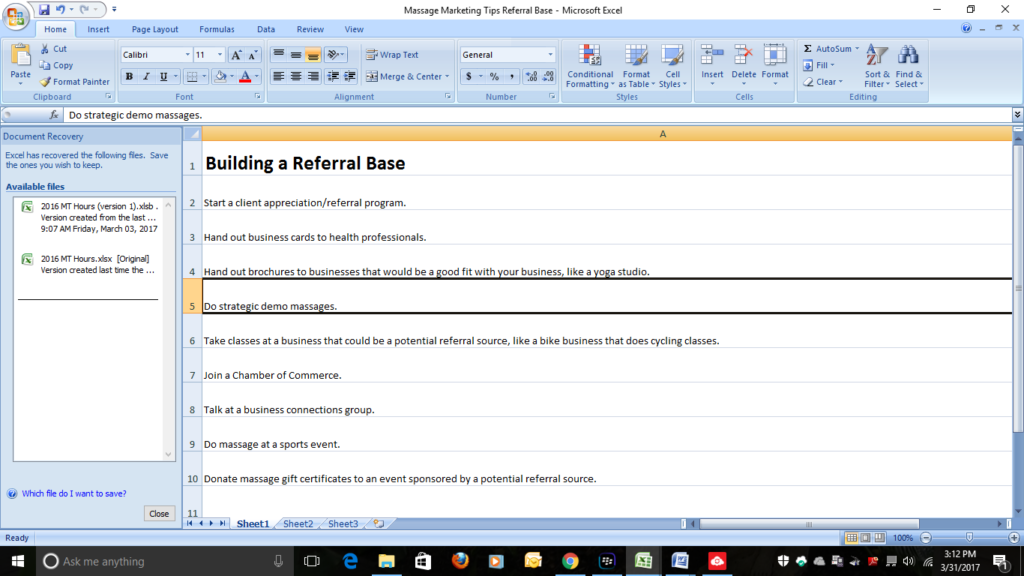
    Within this list is one action item that increased the size of my business by 1/3 in 4 to 6 months. This action item has produced 3 new referral bases. And one is a consistent, ongoing referral machine. Here’s the action item:
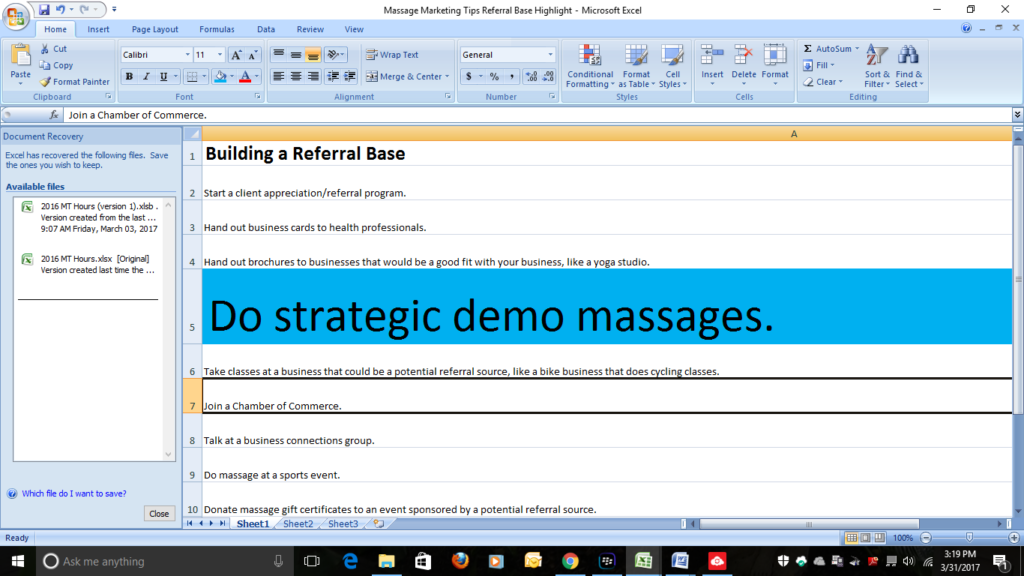
    Here’s why demo massages work. No matter if it’s Facebook or your neighborhood, information spreads when people are compelled to share something good, bad or shocking. (I’m hoping my massage wasn’t bad or shocking.)

    It really only takes one key person within a group to like your massage, and the word will spread like wildfire.

    Niche Market

    If you want to create a referral base that is a referral machine, you’re first going to want to think about a niche market. A niche market is a group of potential customers who have specific characteristics and a common need.

    Anybody who wants a relaxation massage is not a niche market. But moms with kids, ranging from 1 to 12 years old, who want a relaxation massage but can’t find the time to drive to an office is a niche market.

    Here’s how you find a niche market: A Niche Market = More Clients ($)

    How to Start Demo Massages

    Once you settle on a niche market, then it’s time to roll out the demo massages. In this short piece I explain how to do a massage demo program: How to Grow Your Business for Zero $

    WARNING

    If you’re targeting a potential referral source in the health field, save yourself from a time-eating misstep and read this: How to Get Massage Clients: Referrals.

    Also, for those of you who are agoraphobic (yeah, I had to look that one up), you don’t need to do demo massages on-site. I talked to a MT who didn’t like doing demo massages in public. She lived in the city, was a foodie and was targeting the waiting staffs, chefs and owners who would refer restaurant patrons to her.

    So instead of doing demo massages on the premises, she offered to work on them back at her massage studio.

    Okay, before I talk about my eMarketing suggestions, I have to tell you that I’m not techy at all. And if I can do this stuff, you can, too. So, let’s have a look at my eMarketing Tips lists.

    My Top eMarketing Suggestions
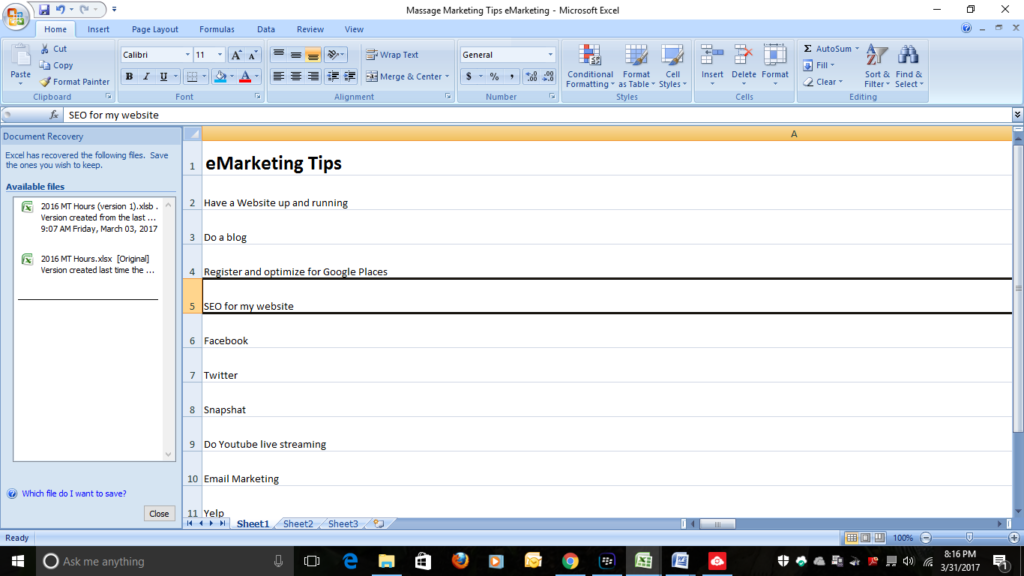
    Again, there’s a ton of massage marketing tips that you could be doing. But there’s one that really stands out. What’s the one thing a massage therapist can do in cyberspace to make her business legit?
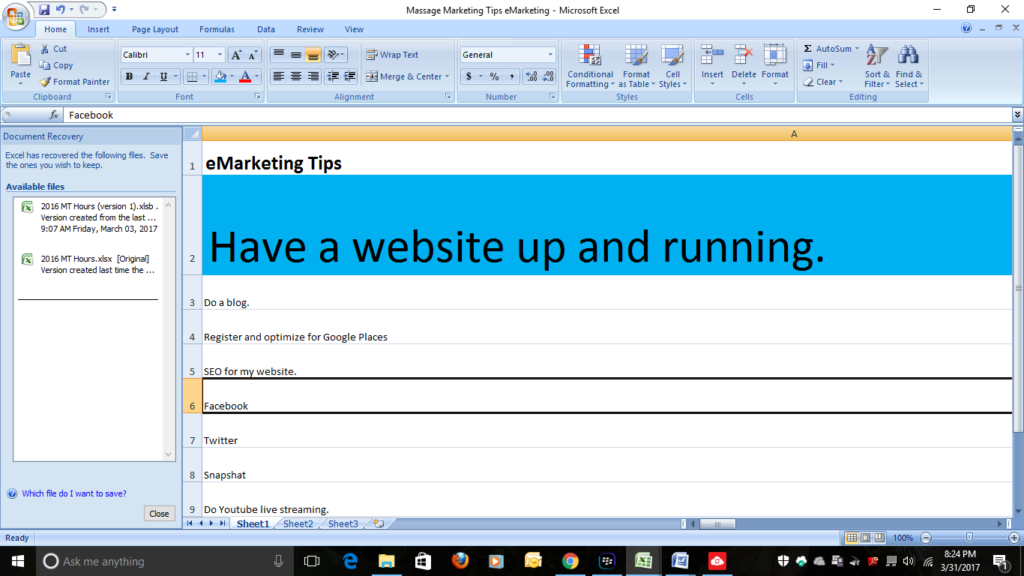
    If you don’t have a website, please, please, please take control of the process and do it yourself.

    Here’s why:

    1. You can make changes on the fly.

    Imagine having to wait for a designer to add the gift certificate message that you wanted up on your website in time for the winter holidays, but you can’t get a hold of her because she actually has a full-time job and finally she does respond and does what you ask her a week later but made a spelling mistake and it looks embarrassing and you email her about it and she doesn’t get back to you until a week later and asks you what you emailed her about because she lost the email, and OMG you would’ve fired her but she’s a friend and she’s doing it for cheap and then eventually she makes the change but decided that she didn’t like the way you’d phrased the original gift certificate message and rewrote the whole paragraph for you but she’s a horrible writer and by this time no one wants your stupid gift certificates because it’s spring… True story:-(

    1. You can optimize the website yourself.

    SEO is not a selling point, I know. But if you do a few simple things, you’ll be good to go and ahead of a lot of the massage websites out there. Go here for that.

    1. You can add video.

    Video is in. With drag and drop website builders, it’s a breeze.

    But you want a website builder that’s massage therapist friendly (easy to use, not expensive and has good designs for massage therapists).

    I built websites on HostGator, Wix and Weebly then I compared them in this article.

    Once you have your website builder you’ll need engaging content. This will help you out:How to Build a Massage Website guide.

    eMarketing  Tip #2
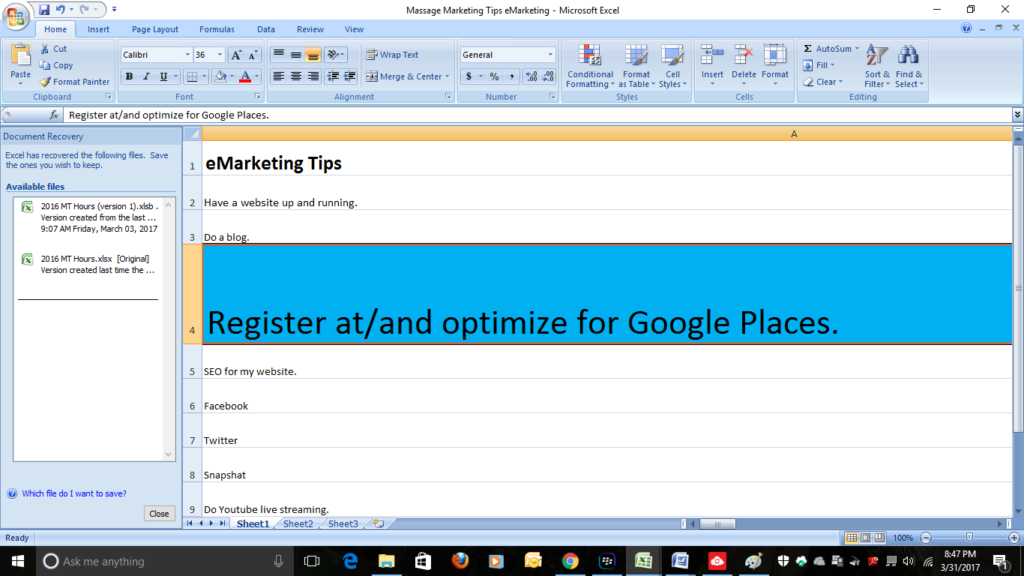
    If you have a place to do massage, you’ll want to claim your business on Google Places. Google Places, a list of local businesses, appears at the top of the screen when someone searches for a term, like “massage”.

    So, first, you want to be on that list.

    Second, you want to rank as high as you can on that list. Google has some suggestions. Definitely a must read.

    If you still got some gas in the tank after you’ve done your website and Google Places, here’s my my last eMarketing “getting started” suggestion.

    eMarketing Tip #3
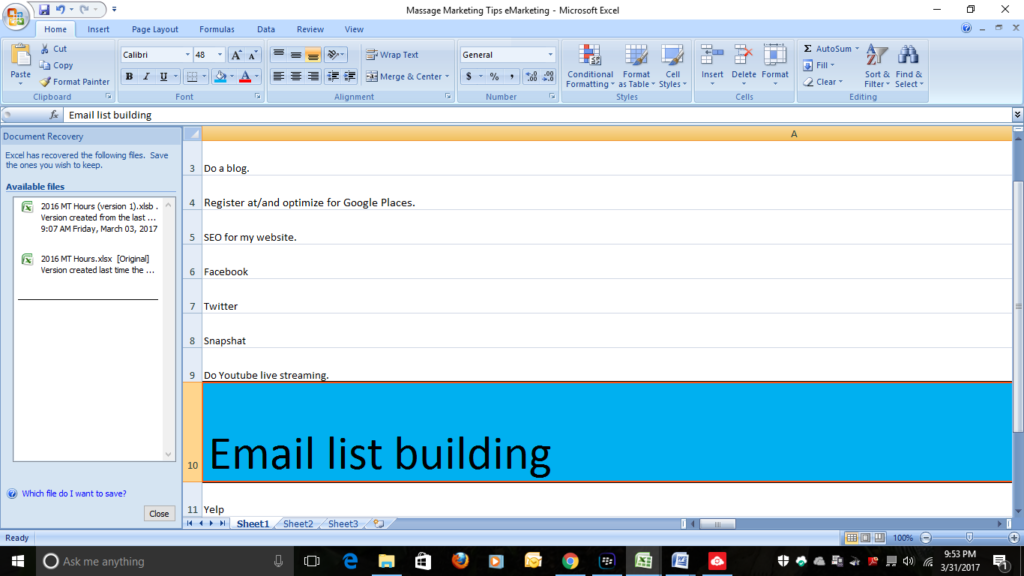
    If you haven’t started to collect clients’ email addresses, then start. Having email addresses will allow you to email your clients about massage specials, important information and personal recommendations. It also just reminds them that you’re there.

    There’s an easy way to collect email addresses. We have a line for an email address on our intake form. And 90%-ish of our new clients provide an email address on the intake.

    After the massage, I let the client know that we periodically email specials out. And then I ask the client if she wants to be on the email list.

    I also go through my cell contacts of existing clients. If I don’t have an email address for one, I will call or text her. Here’s what I say/write: “Hi, _______, I’m going to start sending out emails when I’m running a special. Just wanted to know if you’d be interested in receiving that information?”

    Here’s a quick primer on getting started with creating and working an email list: How to Email In More Clients.

    If you’re getting overwhelmed right about now, back up.

    Getting Clear with Massage Marketing Tips

    Pick one tip in either category, Traditional Marketing or eMarketing. Then run it through this line of questioning.

    1. Which tip is going to give me the biggest bang for my time investment right now?
    2. Can I see myself doing this marketing tip?
    3. Does this marketing tip make the most sense in my current situation?

    Once you find the massage marketing tip that you think will work best for you, apply these strategies to implement it:

    1. Study enough to understand.
    2. Find the person who has the shortcut.
    3. Use tools to help you whenever you can.

    Remember that you don’t have to be an expert to have success in marketing. You just need to be competent.

    P.S. I have free Massage Business Jumpstart Course.

    It will help you stay on track.

    Get access to it here

  • How NOT Doing Massage Makes Money

    How NOT Doing Massage Makes Money

    If you’re not doing massage then you’re not working.

    What do you think about that statement?

    It makes sense, right?

    If you’re not actually doing massage then you’re not bringing in money.

    But there’s another layer here.

    That statement doesn’t say anything about how to get people on your table so that you can be  doing massage (making money).

    In fact, if that’s your mindset–I’m not working unless I’m being paid to massage–you’ve hit a roadblock to bringing in clients and building a massage business.

    So what am I supposed to do, Mark, work for free?

    Actually, yes (but that’s a qualified yes).

    You work for free now as an investment for a return later.

    I know that unpaid work for future dinero is a hard concept to swallow. It took me a long time to accept. Here’s why I think we (MTs) struggle with this concept.

    Always Doing Massage Brain Explained

    We’re in a business of instant $.

    If you work for yourself you get paid every time you work on a client.

    But I don’t work for myself, Mark.

    You get tips, right?

    When the massage is over the client hands you some cash. Boom. Instant $.

    Massage work = instant money.

    Believe me, I love instant money as much as you.

    But instant money reinforces the idea that “if you’re not getting paid right away, you’re not working”.

    This is a problem because if you want more clients and/or want to build a massage practice, you’ll need to put in some work time even though there will be no instant payoff.

    But, Mark, I’m good at my massage. My work will speak for itself and my business will grow.

    If you have a mortgage, kids in school, or debt from massage school then you better hope that your work speaks really, really fast.

    The reality is massage is competitive. And you’re not going to make the money you need to make until you start putting in some “free” time.

    Our Phoenixville office is in massage row. And within massage row are a lot of talented MTs.

    Who gets the clients?

    The person who works for “free”.

    But remember you’re not really working for free.

    You’re working for future money.

    You’re investing your time now for a financial reward in the immediate, near and distant futures.

    By the way, I’m still a work in progress when it comes to thinking I DON’T have to be doing massage in order to be working.

    Last month we opened up our third office. And being an introvert means I’ll do anything I can to NOT  meet people.

    So, one day this week, I had found a lot of things I could do on the computer for our new office.

    I thought to myself: Yeah, I’m doing unpaid work here for the future growth of our business.

    And I was ready to give myself a pat on the back when something didn’t feel right.

    Here’s what didn’t feel right: Our business didn’t need me to do computer stuff right now. It needed me to get my butt out there and let people know that we we’re open.

    So, I forced myself to visit other businesses within walking distance of our office.

    The first place I went to was a local fitness center. To my surprise, the owner, Bill, wanted to talk and talk and talk…

    About 15 minutes into the conversation I reverted back to the “MT must rub” mentality.

    I thought: We have new bills to pay. I need to be doing massage. What a waste of time!

    But then I remembered how building relationships at our Phoenixville office netted clients.

    There we consistently get referrals from chiropractors, personal trainers, and the local running store.

    All of these relationships were built through “free” work.

    So, cool your jets, Marky. You ARE working.

    I ended up talking to Bill for an hour.

    Was that a good “free” work investment?

    I honestly don’t know.

    But I do know that Bill and I connected and I will continue to explore ways we can partner on some things in the future.

    And if nothing else, I’m learning how to get better at making “free” work payoff.

    Ready to invest your time now for future business?

    Here’s a good place to start: Build referral bases.

    Need more help?

    Join my email group.

    I’ll send you my latest info weekly.

    Sign up below:-)


  • How to Get A Client Out of Pain: A Key Question

    How to Get A Client Out of Pain: A Key Question

    There’s a massage skill that has nothing to do with your hands, but is really important when treating a client in pain. The skill is to ask the right massage intake question.

    Of all the questions (excluding medical history and contraindications), there’s one question that could vastly improve your chances of helping someone in pain.

    No more suspense.

    It is: What has worked to relieve your pain before?

    Oxycontin and vodka.

    Okay, I’m not talking about drugs and booze.

    I’m talking about what kinds of musculoskeletal treatments (physical therapy, chiropractic, massage therapy, yoga therapy, Pilates, etc) have helped with the pain in the past.

    Once you have that information, drill down and find out what specifically about the treatments worked.

    Then, if possible, incorporate the things that worked into your massage.

    Here’s an example of how you might ask this important massage intake question.

    Asha came in with neck and shoulder pain. She was a medevac nurse and speculated that having to carry heavy equipment and wear night vision goggles was the cause of cervical condition.

    To relieve the pain she had tried lots of treatments. The cortisone route didn’t really help. Chiropractic had helped some. Bill helped the most.

    Who was Bill?

    He was a physical therapist who did hands on work with her.

    Hmm…I asked her what he did.

    She explained that he did some massage and stretching.

    Then I asked her if he did manual traction on her neck as part of the stretching? And, if so, did that help?

    The answers were yes and yes.

    Next I asked if Bill ever tested her neck flexion, extension and rotation.

    He had. Flexion and extension–no pain. Some pain in rotation.

    Lastly, I asked about Bill’s massage pressure.

    Firm pressure relieved the pain.

    So, at that point I knew my treatment starting point would include specific work in the cervical erectors with firm pressure. I would also stretch her neck and do manual traction.

    At the end of the session, Asha was a happy camper.

    A companion massage-intake question to what makes a pain condition better is: What makes a pain condition worse or simply doesn’t help?

    Maria came in with sciatica. The pain was in her right buttock and down her leg, but not below her  knee.

    She had been dealing with the condition for a month and half, but it had improved. And she rated herself as being 60% better.

    Here’s how my questioning went with her.

    Have you had massage before?

    Yes, I get shiatsu from time to time. I really like it. I feel so much better afterwards.

    (Maria had won a GC to see me. That’s why she wasn’t going to her Shiatsu person.)

    Oh, did you ever get shiatsu when you had sciatica?

    Yes. It was very helpful.

    Now I had an idea of how I was going to treat Maria’s back problem—using a lot of static pressure.

    Next the companion question: What makes it worse?

    Maria told me that sitting makes her sciatica worse.

    Okay, how about lying face down?

    I’m good, she said.

    I worked on Maria supine, fairly confident that I wasn’t going to aggravate her back condition.

    I used static pressure on tight/tender areas in her spinal erectors. That was very relaxing and pain relieving for her.

    When I got to her glutes, I knew I was going to back off on my pressure because sitting bothered here which could mean that the nerves in her gluteal area were fired up.

    And they were.

    I used oblique angles of approach when working the glutes and piriformis so that I wouldn’t be pressing down onto angry nerves, and used a pain scale technique to make sure that the pain was lessening as we worked.

    Maria had significant pain reduction when we were done.

    Here’s the key massage intake question and companion question recap:

    “What has helped?” led me to using static pressure.

    “What made it worse?” led me to using a pain scale, oblique angles of approach and lighter pressure in the gluteal area.

    Why I’m So Adamant About This Massage Intake Question

    Asking the right questions was hammered home with me after sitting in on many intakes with a PT friend.

    I noticed that he was always coming back to identifying what is making a condition worse and what is making it better or, at the very least, not making it worse.

    Once he had an idea of the parameters he should initially work within he then had an idea of how he could address the pain without making it worse. Once he got the pain down, he could start to test the parameters.

    It takes time to ask the right questions.

    I give and an extra 30 minutes for new clients. (You can download our intake here: [download id=”618″]).

    During that time, I ask the important massage intake question: What treatments/techniques have lessened the pain in the past.

    Then I incorporate the techniques that had worked (and I’m competent with) into my massage.

    And I avoid the techniques that had been a bust or had made things worse.

    Need more help? 

    Join my email group.

    I send you my latest everything weekly.

    It’s free.

    Sign up below:-)