Category: Massage Pain-Free

  • Why Pain-Free Massage is Possible


    I used to think pain was part of the job.

    I’d finish a day of deep tissue work with my wrists barking, my shoulders stiff, and my thumbs barely able to hold a pen. I told myself it was just the price of helping people.

    The problem is, that price adds up.

    Pain isn’t a badge of honor. It’s a warning sign. If your hands hurt, your body’s telling you something. And if you ignore it long enough, it’ll make sure you listen—by cutting your career short.


    You can do excellent massage work—deep, effective, therapeutic work—without hurting yourself. But you’ve got to unlearn some things first.


    1. You have to stop muscling through sessions.

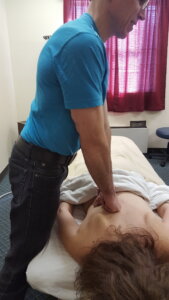
    This is the big one. Most therapists rely too much on their hands, arms, and shoulders to generate pressure. That leads to burnout fast. Muscling through every stroke might get you through the session—but it won’t get you through a long career. You shouldn’t be using your strength to deliver massage. You should be using your structure.

    2. You have to rethink what “deep” really means.

    Clients say they want deep tissue, but what they really want is results. You can create depth through slower pacing, better body mechanics, and focused attention—not just by pressing harder. Real depth isn’t about pressure. It’s about intention, engagement, and staying connected to the tissue without overloading your own.

    3. You have to start using your body the way it was built to move—by leaning, not pushing.

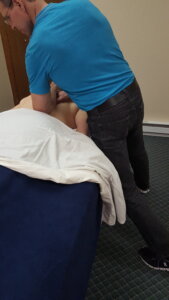
    Leaning lets your body weight and gravity do the work. It protects your wrists, thumbs, shoulders, and neck.

    When you lean in from your core—not just from your arms—you create pressure with less effort. You stay relaxed. Your strokes become smoother and more sustainable. Over time, you’ll be shocked by how much you can get done with less strain.


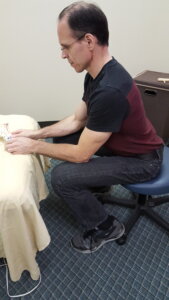
    These days, I do most of my work seated. I’m not exaggerating—my colleagues joke that I sit for 80% of every massage. And they’re not wrong. I lean, I work close, I let my body weight do the job instead of my hands.

    In essence, I’m efficient and effective—and I’m not in pain at the end of the day.


    Pain-free massage is possible because pressure doesn’t have to come from shear muscular force. It can come from smart mechanics. From gravity, body weight and alignment.

    When you stop pushing and start leaning, when you stop working against your body and start working with it—you protect your hands and your career.

    And that’s what we’re going to build together here.

    More body mechanics information at www.painfreemassagetherapist.com


  • Table Height is EVERYTHING!

    Table Height is EVERYTHING!

    What is the right massage table height for you? It is the table height that allows you to effectively deliver force without hurting your body. You’ll need to experiment to figure out what table height setting works best for you. In a few minutes I’ll give you my recommendations. But first, I have a question for you: What’s your table height set at now? Twenty-five years ago I was taught to set my table height this way: my distal knuckles should touch the top of the table when my arms were at my sides. Look on the Internet and you’ll find a range of table height advice, like: the height of your table should be your height divided by two. Though well intended, a standardized table height setting should not be your gold standard for setting your table height. Why?
    1. Different sizes.
    2. Different body part requests.
    3. Different pressure request.
    4. Different massage styles.
    5. Different chronic conditions and injuries.

    1. Different Sizes

    When I say different sizes I’m not just talking about massage clients–I’m talking about massage therapists, too. Let’s start with massage therapists.

    MTs Come in Different Limb Lengths

    Two people at the same height don’t necessarily share the same limb length.  Jennifer and Shanice are 64 inches tall. When they stand against the same massage table, Jennifer’s fingertips are 1 inch farther away from the table than Shanice’s. Imagine Jennifer and Shanice are leaning to apply pressure. Depending on the massage style of Jennifer and Shanice, a 1 inch differential in arm length could make a difference in how high or low each sets her table.

    Clients Come in Different Thicknesses

    Clients come in all sizes. Ricardo, who weighs 305 lbs, is “thicker” than Jamar who weighs 150. That means if Ricardo and Jamar were lying on a table side-by-side, the top of Ricardo’s body would be an inch or two higher off the table than Jamar’s. If you set your table height at the Jamar level for each massage, you’d be giving up an inch or two of leaning leverage when working on someone big, like Ricardo.

    2. Different Body Part Requests

    When a client is lying on the table, body parts stick up at varying heights. For instance, glutes will stick up off the table higher than calves. If you’re focusing on glutes and your table height is too high, you won’t be able to generate enough pressure from leaning.

    3. Different Pressure Requests

    Light pressure is less important in terms of dialing in on table height. A high table can help keep the flexion out of your back and a low table is workable if you know how to use the massage table for support. However, a request for medium or deep pressure should make your ears prick up. In general, when talking about leaning to generate pressure, medium and deep pressure require you to apply more force. You safely do that by leveraging more of your body weight onto the client and/or driving from your legs. Whether you are more of a using-your-body- weight leaner or a driving-from-your-legs leaner depends on your massage style.

    4. Different Massage Styles

    Which body part would you pick to work on hamstrings using medium to deep pressure? Are you an elbow/forearm or a fist/knuckles or a palms/fingers massage therapist? Knowing which body parts you’ll use the most during a massage is a key for setting your table height at the beginning of the massage. If you’re a forearm/elbow MT you’ll need less leaning leverage than you would if you’re a fist/knuckle MT. So your table will probably be higher. What about your techniques? Are you more of an ischemic compression/trigger point therapist or gliding/relaxing therapist? My massage emphasis is ischemic compression/trigger point so I look more like a chiropractor when I massage, meaning I’m taking full advantage of my body weight to generate pressure by working on a low table. A forearm massage therapist who doesn’t need to be over the table may prefer a higher table to lean into. In a lunge stance she doesn’t need to use all of her body weight to generate force because she can drive from her back leg.

    5. Different Chronic Conditions and Injuries

    The last thing you’ll need to consider when setting your table height are any chronic conditions and injuries you have. I started out my massage career as a forearm/elbow massage therapist. Twenty years into massage the forearm/elbow technique hurt my neck and shoulders. So, I switched to fists/knuckles. In order to be able to transfer all of my body weight onto the client if I needed to, I lowered my table, much lower than when I was a forearm/elbow massage therapist.

    Set Your Table to Save Your Body

    At this point you may be thinking that setting your massage table height to save your body is crazy complicated. It’s not. It just requires asking yourself some basic questions and then doing some experimenting

    Table Height Experiment

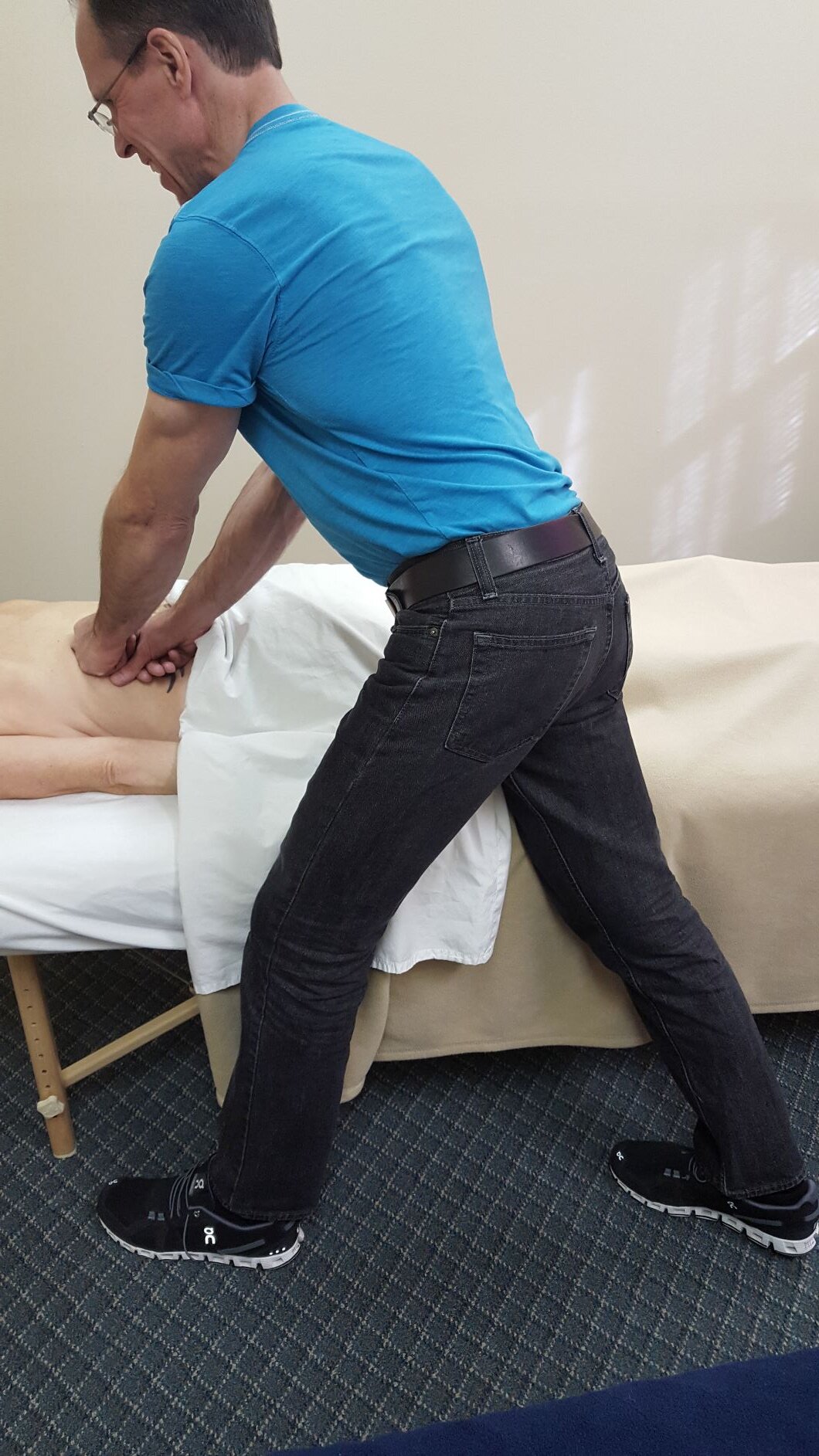
    Step #1: To get your general go-to setting pick the body part that you use the most to massage with (e.g., forearm, fists, knuckles, palms, massage tools) and start leaning at your normal table height setting. This will be your baseline to compare higher table and lower table leaning. If you’re already using your body weight to generate pressure, then skip to the next step. Step #2: Try leaning at a table height higher, one notch, than your normal table height. Step #3: Try leaning at a table height lower than your normal table height. For a lower table I recommend experimenting with one notch if you’re a forearm person and no more than three, until you get used to low table leaning, if you’re a fist person. If you’re new to low-table leaning, you’ll want to read this article before you start experimenting—How to Use the Massage Table for Support. As you experiment with leaning keep these things in mind: If you’re leaning in an asymmetrical (lunge) stance, lock your back leg and drive from your back foot to generate extra force. If you’re leaning on a low table make sure that your using the table for support. Once you have your go-to table height nailed down, you can then make situational adjustments as they come up.

    Making Adjustments on the Fly

    For instance, let’s say your normal table height was 30 inches but your new go-to table height is 31 inches. Thomas is your next client and he’s really thick. So, you decide to lower your table to 30 inches so that you can lean more effectively. Or your normal table height was 30 inches and your new go-to table height is 24 inches. Tara is you next client and she is thin and likes light pressure. So, you decide to raise your table up to 26 inches so that you can be more upright without having to use the table for support. Personally, I set my table height as low as possible (with the lower table legs off) so that I am always prepared for deep pressure. The challenges with using the lowest table setting for each client means that I’m not at an ideal table height for light pressure requests and thin clients. I get around the body mechanic challenges by adapting to a low table. Specifically, I use the massage table to support my body weight and help me regulate pressure. And I break static posture when I want to stretch my back or get vertical. .

    Set Your Massage Table Height Recap

    Set your table height so that you can lean effectively and pain-free. Leaning allows you to take your upper-body out of the massage and can reduce neck, shoulders and arm strain. Your go-to table height may be your current table height or it may be lower or higher than your current table height. You won’t know until you experiment. Start your experiment by leaning at your current table height. Then try leaning at a lower and higher setting. When you’re in a lunge stance (asymmetrical stance) lock your back leg and drive from your back foot to generate more force. When you’re in a parallel foot stance on a low table use the table for support and shift your body weight to the balls of your feet so that you can leverage all your body weight onto the client if you need to.

    Learn my approach:

    If you want to learn my approach and body-saving techniques when doing medium to firm pressure, I have an online CE course that will help you out: How to Deliver Deep Pressure Without Hurting Yourself (3 CEU).

    Questions?

    I am here. Email me a mark@makethemostofmassage.com! 🙂  
  • Scratch the Itch: Get the Multifidus and Rotatores

    Scratch the Itch: Get the Multifidus and Rotatores

    The multifidus and rotatores are in the lamina groove. Early on in my career, I shied away from anything close to the spinous processes. But neuromuscular therapy taught me that these muscles can be influenced and clients REALLY  like getting them worked.

    The Deep Back Muscles

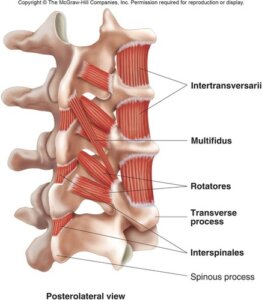
    Here are the multifidus and rotatores:
    rotatores-and-multifidi

    They multifidus stabilizes joints within the spine. The rotatores lie underneath the multifidus and are involved in postural control.

    Why Work Them?

    There are five reasons why I think that working the multifidus and rotatores improves the quality of a pain relief massage.

    1. When you’re working the multidus and rotatores, you’re also working a lot of other muscles.

    For instance, let’s say you’re massaging in the upper-thoracic lamina groove. As you’re working into the lamina groove, you’re also pressing into the trapezius, rhomboids, and other back muscles. It’s literally one stop shopping.

    1. You’re giving the client a new experience.

    I’ve found that most therapists don’t do focus work in the lamina groove. So a first-time client will probably be pleasantly surprised if you work the multifidus and rotatores.

    1. From a trigger point standpoint there could referrals.

    If you subscribe to trigger point theory, then there could be pain referral patterns stemming from these deep back muscles.
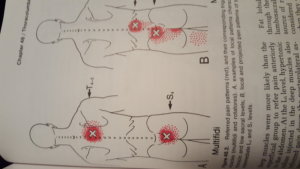
    multifidus-tp-back-pic

    (Myofascial Pain and Dysfunction The Trigger Point Manuel, Janet G. Travell, M.D., David G. Simons, M.D., Volume 1, p. 639)

    1. Allows you to really compare left to right.

    It’s fairly easy to compare left to right when it comes to the multifidus and rotatores, mainly because you can use the spinous process as a reference point.

    By comparing the left side to the right side, you can customize your massage. For instance, say I wanted to desensitize a pain area occurring around T8. If I found a higher degree of pain (not hyper-pain) in the right, T8, lamina-groove muscles, I would spend more time there than I would on left T8 side.

    1. You can scratch the client’s itch.

    My clients really like the lamina groove work. It’s not uncommon to have a new client say, You got the spot that I’ve wanted someone to get for years. I’m not special. Anyone can get this same response. You just need to get your lamina groove reps in.

    Also, when working through clothes (like when doing demo massages), targeting the multifidus and rotatores using static pressure is a very effective pain relief massage. I would argue it’s as effective as doing a regular skin-to-skin massage.

    Three Steps

    Here’s how to get comfortable working these deep muscles.

    1. Find the spinous processes.

    Once you find the spinous processes, you’ve won the battle.

    By the way, don’t be scared of the spinous processes. They are you friends (reference points).

    1. Go just lateral of the spinous processes (maybe 1/2 inch).

    For extra assurance, keep in contact with the spinous processes. You can use fingers from your pressing hand or non-pressing hand to maintain contact.

    1. Press down into the lamina groove with a thumb/finger or body parts combination.

    Here’s a video on how I use body part combinations in the lamina groove: Combining Body Parts for the Lamina Groove Video. (In the video I use the term power tools.  Now I call power tools “body part combinations”.)

    As you’re learning to calibrate your pressure in the lamina groove, you may first want to use a pain scale system.

    Here’s the pain scale system I use: tell the client to think of a pain scale from 1 to 10 where 1 is not much pain and 10 is a lot. When you press on an area, you want your pressure to feel like it’s registering in a 3 to 4 range (in acute pain areas) or a 4 to 5 (in non-acute pain areas).

    Here’s my pain-scale-system tutorial video if you want to take a deeper dive: Pain Scale Video

    Experiment With Massage Tools

    Massage tools (especially the T-bar) are ideal for the lamina groove muscles. Why? Because with massage tools you can generate pressure effortlessly. In addition, your pressure will be more precise than your thumbs or fingers.

    Here’s how I do pain relief massage in the lamina groove using massage tools: Massage Tool Work In Then Lamina Groove Video.

    Intention is 50% of Massage

    Intention plays an important part in massage. When working in the lamina groove and directing your pressure to influence the multifidus and rotatores, you’re not only affecting those muscles, you’re impacting other muscles. In essence, you are getting a big bang for your effort.

    In my experience, clients respond favorably to intentional and focused pressure in the lamina groove. For example, I can sometimes find that one spot that a client wants addressed that no one has addressed before.

    Working the rotatores and multifidus is not difficult. You just need to find the spinous processes, go lateral and press into the lamina groove. When first starting out keep a guide finger on the spinous processes until you get comfortable working in the lamina groove.

    Here are the video tutorials to get you on your way:

    Combining Body Parts for the Lamina Groove Video

    Pain Scale Video

    Massage Tool Work in the Lamina Groove Video

    Once you start getting positive feedback and results, you’re going to be glad that you ventured into the lamina groove.

    Home Study Massage Tools (2.5 CEU) Course


    Get good with massage tools and you’ll save your hands and you’ll be able to deliver precise pressure like nobody’s business. Precise pressure is not only what my clients love, it’s also what differentiates me from the massage therapist that I compete with around town.

    How to Use Massage Tools Fearlessly

    Questions? Ask away! Email m at mark@makethemostofmassage.com. 🙂
     

  • How to Use Your Massage Stool

    How to Use Your Massage Stool

    In my one office I had spent 10 years without having a massage stool (or anything) to sit on when doing a massage.

    Yeah, I’m cheap, but that wasn’t the only reason I didn’t have a stool in my massage room.

    I thought that not sitting would make me stronger, tougher and a more durable massage therapist.

    Now, after 25+ years of doing massage, the massage stool is my bestie—and it’s one of the things that has helped me become more productive and durable now, at 57, than I was at 30.

    Just to be clear: On par with my male contemporaries, my testosterone is plummeting like the 2008 stock market. I don’t do Performance Enhancing Drugs. And I haven’t found the fountain of youth.

    I’m more productive now because I’m strategic when doing massage. And my massage stool plays into my scheming.

    How?

    A massage tool allows me to…

    1. Rest my legs.
    2. Rest my back.
    3. Rest my shoulders and arms.
    4. Rest my head. (Don’t tell anybody.)

    That’s a lot of resting, huh?

    Well, you may have guessed by now that my massage hardening philosophy has taken a 180 over time.

    Now it’s: Toughen your body in the gym, on a trail or in the water; preserve your body in the massage room.

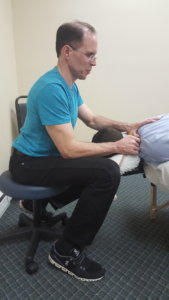
    Resting is a way to give overworked muscles a break. And using a massage stool when massaging the head, neck, tops of shoulders and feet is a great way to rest.

    Resting your legs is a no-brainer. You sit down on the stool and your legs say aah.

    But what about resting your back?

    Use a Massage Stool to Rest Your Back

    It’s easy.

    Pull up a massage stool and put your butt down.

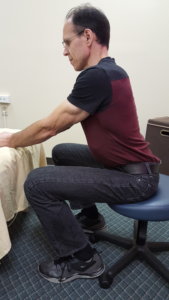
    And if you really want to rest your back, use your armrests.

    Your thighs.

    Here my forearms are on my thighs and my back is happy to be in a different position and to have the extra support of my arms.

    To apply pressure effortlessly just lean in from the waist.

    Couldn’t be any easier.

    How about shoulders and arms?

    Use a Massage Stool to Rest Your Shoulders and Arms

    Same formula as back.

    Sit. Rest forearm(s). Lean.

    That really takes the upper trap and levator scapulae out of the contraction zone.

    What if your armrest is too low?

    Just raise your armrest by pushing up to tiptoes while staying seated.

    I’ve also found it easy to sit and lean when working the IT band, peroneus longus/brevis, and tibialis anterior.

    Here’s a quick video I put together about sitting and leaning.

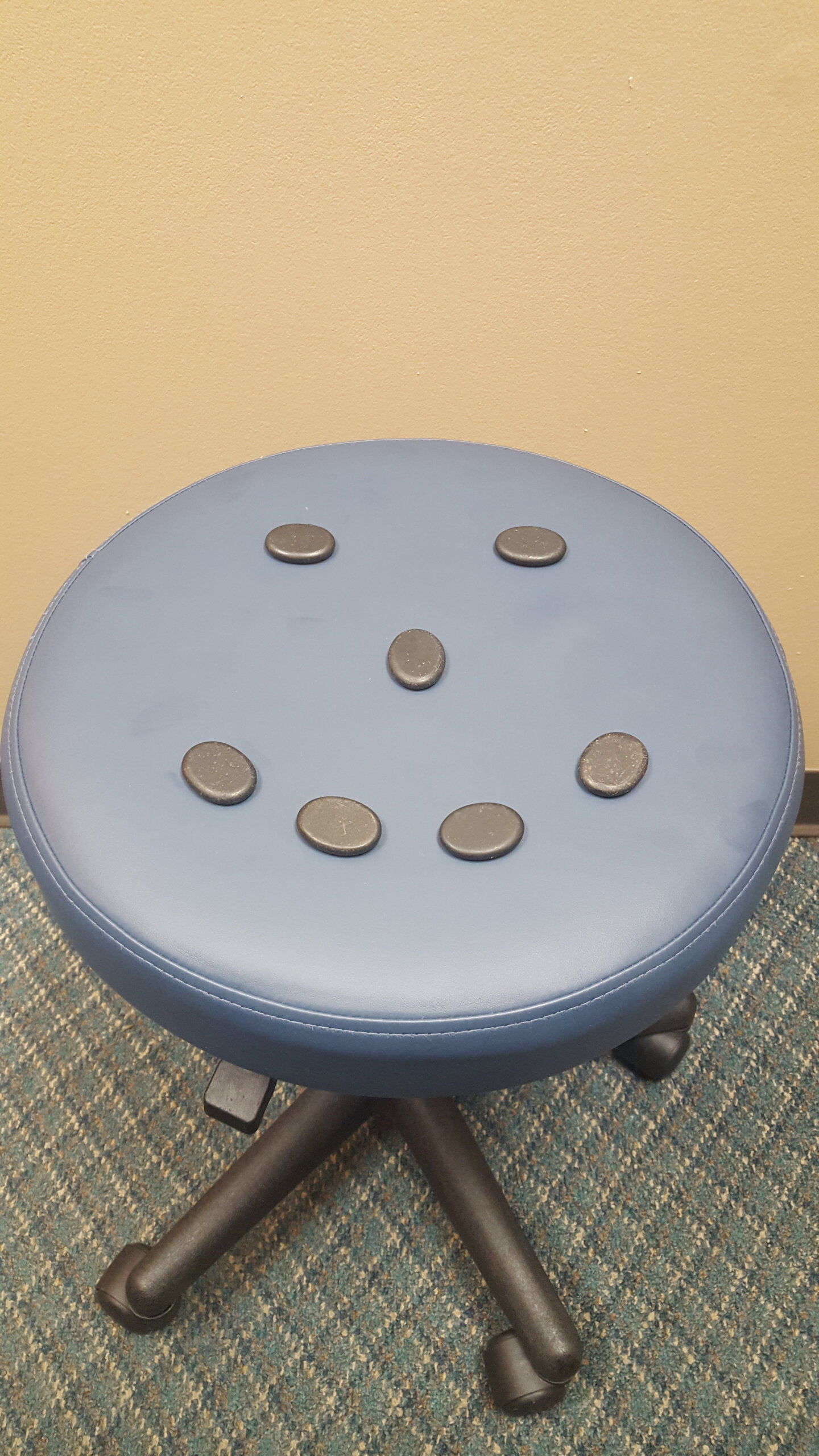
    By the way, the massage stool is the perfect moveable platform to put massage tools on.

    Okay, well that about does it….

    Aw hell naw, I wasn’t going to sneak out on you without showing you how (on rare occasions) I rest my head.

    Seriously, the massage stool (like the massage table) can save your body by giving you a chance to rest your overworked muscles.

    Find the times when sitting can work for you.

    Mine are: Head, neck, top of shoulder, IT band, tibialis anterior, peroneus longis/brevis, feet.

    Then…

    1. Sit.
    2. Forearm(s) on lap.
    3. Lean.

    Looking for a Stool?

    I got mine from Amazon. This is an affiliate link. I get a commission if you purchase a stool using my link, but you don’t pay extra for using my link. And you support my mission to help you build your dream business and never be in pain from doing massage with free articles, business classes and business coaching forever.

    Massage Body Mechanic Online Class

    If you want to stay out of pain when doing massage and increase your massage max (the number of massages you can do in a day pain-free), then I have an online class for you: How to Deliver Deep Pressure Without Hurting Yourself.

    It’s 3 CEUs and NCBTMB approved.

    It includes the strategies and techniques that saved my body and extended my massage career. Let me know what you think:-)