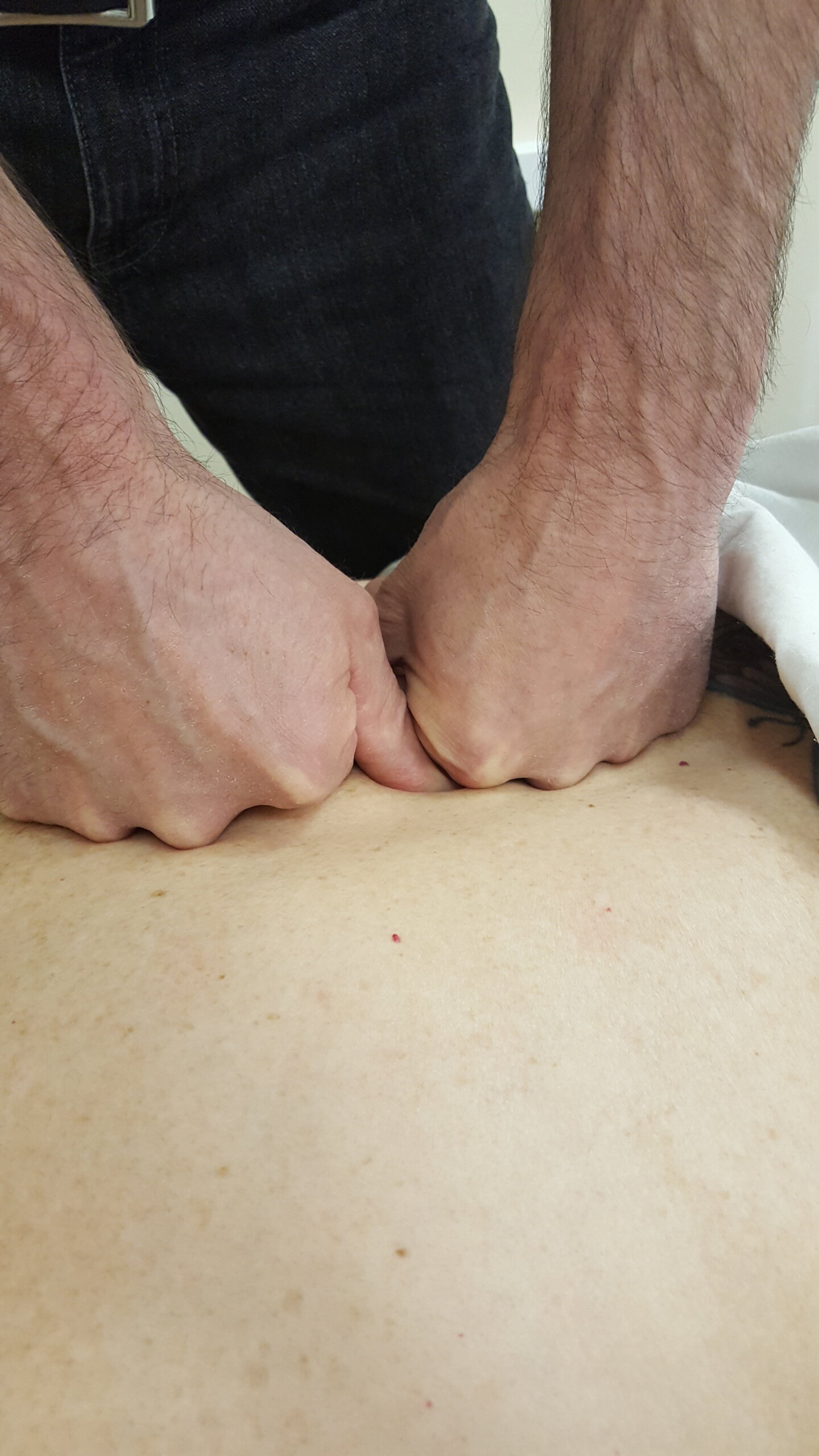
Category: Advanced Massage Techniques/Information

  • How to Combine Body Parts (Save Your Hands)

    How to Combine Body Parts (Save Your Hands)

    Sometimes you just can’t change a situation. You have to suck it up and move on. Hand pain when doing massage isn’t one of those times–if you learn how to combine body parts to press and glide.

    How can I be so confident?

    Well, I’m a wimp.

    And being wimpy has pushed me to discover new ways (for me) to do massage that don’t cause hand pain.

    Here’s how it works. Basically when my hands start to bother me when I’m massaging I look for a way to make them feel better.

    I’m not talking about stretching or doing exercises after the massage.

    I look for ways to reduce or eliminate the pain while I’m working.

    This is true not just for massage but for any physical work I do.

    Let’s say I’m cutting a plastic light cover with with a utility knife and my holding hand is cramping.

    Wimpy me wants to end the pain so I hold the plastic cover a different way.

    If my right arm gets tired turning the screwdriver, I switch to using my left arm.

    Is my non-dominant arm as good with the screwdriver as my dominant arm?

    Nope.

    But after some practice, my non-dominant arm gets the job done.

    Massage is no different.

    We can change how our hands feel by making adjustments and trying out new ways to do massage.

    At this point, if you’ve read my articles before, you’re probably guessing that next words I’m going to type are going to be something about massage tools.

    No tools this time.

    Today I’m talking about how to combine body parts.

    Like a knee and an elbow?

    Not quite.

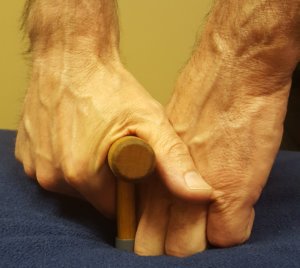
    More like a thumb and a knuckle.

    Or overlapping fingers.
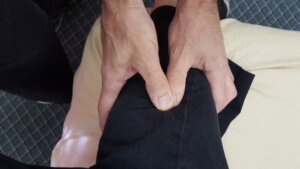
    When you combine body parts to press or glide you distribute the workload so that one body part (e.g., finger) isn’t doing all the work.

    And the primary pressing/gliding body part is getting some bracing action to boot.

    Okay, enough talk. Let’s combine body parts.

    How to Combine Body Parts

    In this video I give you examples of my favorite body part combinations. Once you start experimenting, you’ll probably come up with some of your own.

    This video is about transitioning between body part combinations. The idea is that the more fluid you are at using body part combinations, the more likely you’ll make an adjustment when a finger or thumb or elbow starts hurting.

    Want to know how to massage pain-free?

    Take this pain quiz.

    You’ll get an instant video that will help you with your particular issue.

    Pain Quiz


  • Why Aren’t You Using Your Fists?

    Why Aren’t You Using Your Fists?

    Need a deep pressure substitute for a forearm?

    Try fists.

    I did, Mark, but fists didn’t work for me.

    Yeah, at first that was my experience, too.

    Then I did this: Set my table height for fists not forearms. (In other words, I lowered my table.)

    When I set my table for fists instead of forearms I was able to transfer my body weight into the client for deep pressure—and it was smooth sailing.

    Well, almost smooth sailing. I still needed to get good at transitions between forearms and fists.

    This was accomplished by taking a wider stance for forearms and a narrower stance for fists.

    So, to use fists as a deep pressure substitute for forearms, I just needed to 1. set my table height for fists (lower) and 2. get competent at transitioning between forearms and fists by using a wide stance for forearms and a narrow stance for fists.

    Sounds like a lot of work, Mark, maybe I’ll just stick with forearms.

    Hey, you might be able to get away with using only forearms for the rest of your massage career, BUT if…

    1. Your shoulder(s) hurts.
    2. You have cubital tunnel syndrome.
    3. Your forearm is too big to get the job done.
    4. The person getting the massage doesn’t like the feeling of a forearm.
    5. You don’t feel comfortable using a forearm.

    …you’re going to want a deep pressure substitute for forearms.

    Think fists.

    Deep Pressure Substitute Mini-Tutorial

    Enough talk about fists as a deep pressure substitute for forearms. Let’s make this happen.

    In this video, I first show why I think most MTs struggle with fists.

    (You guessed it: The massage table is set too high.)

    After I go over table height I show how to transition back and forth between forearms and fists using wide and narrow stances.

    P.S. Moving between wide and narrow stances is easy when you shuffle your feet.

    Want to massage pain-free using your fists and other cool techniques?

    Take this pain quiz.

    You will get an instant video that will help you with your issue.

    Pain Quiz
  • Don’t Do Static Posture Massage

    Don’t Do Static Posture Massage

    Want to trash your back? Do massage in the same body position (static posture massage) day in day out.

    It’s easy to get stuck doing that. You come out of massage school green.

    You start cutting your teeth at a spa or chiro’s office. As you gain confidence you develop your way of doing massage.

    Massage life is good–until one day when your back hurts. A month later it still hurts.

    Now what? Change the way you do massage?

    No way. Quality of work would suffer, right?

    There’s another way to approach this. Instead of changing your way of doing massage, tweak it.

    To explain what I mean I need to circle back to static posture.

    What is it?

    Static Posture

    It’s a fixed body position.

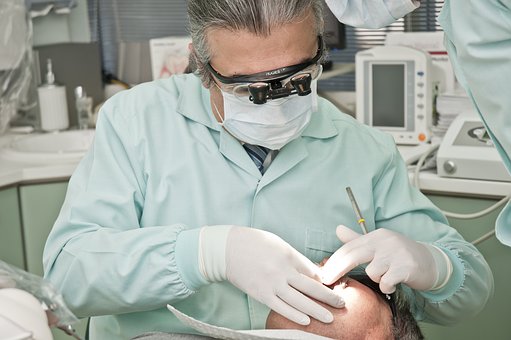
    Think hairstylists, dentists, mechanics, data entry workers, and us, massage therapists.

    The problem occurs when you’re in a fixed position for extended periods of time while you’re physically exerting yourself.

    Why is that bad?

    Because protracted  static posture increases loads or forces on muscles and tendons in specific areas. When this happens fatigue occurs in these areas because blood flow is impeded. When blood flow is impeded there’s less replenishing of nutrients and elimination of metabolic waste. In other words, tissue recovery is not good.

    It’s a perfect set up for back pain.

    Now think about your way of doing massage. Seeing some static posture moments?

    Time to make some adjustments.

    The Tweaks

    For office workers, adjustments are fairly easy. You get up from your desk and walk around every hour or so to give your desk muscles a break.

    But you can’t exactly do that in a massage, right?

    Hey, be back in 5. Why don’t you finish up your feet for me while I’m gone. Cream’s on the stool.

    But you can change positions so that you’re not in the static posture massage cycle throughout most of the massage.

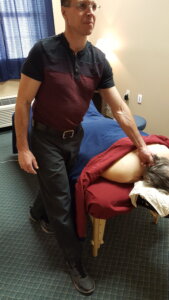
    Here’s a common static posture in massage.

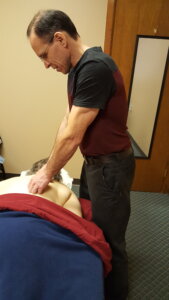
    Hunching with head down.

    So how I can I interrupt this static posture massage cycle without rewriting how I do massage?

    One way is to find times during the massage when you can change your back position. Here are some examples:

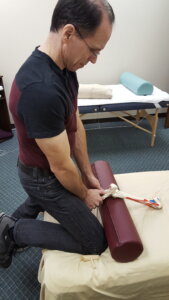
    1. Take a knee on the table when standing and working on feet.

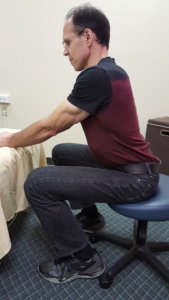
    2. Sit and lean whenever possible.

    3. Massage with one hand so that you can straighten up.

    And stretch if you want to.

    One-handed massage is one to challenge your old habit of hunching. Try other ways to…

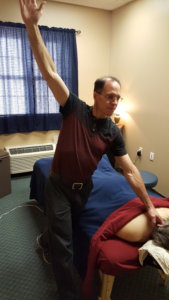
    4. Get vertical during the massage.

    Here’s how I do that: Advanced Massage Body Mechanics: Get Vertical.

    We Got It Good

    Can you imagine a dentist experimenting with different ways of standing or sitting while working?

    That’s called a lawsuit.

    A dentist can’t avoid static postures if she wants to get the job done safely and effectively.

    But for a MT, static posture is a habit.

    Break the habit.

    Save your back by looking for times when you can get out of your normal massage position and still do your job effectively.

    Can you massage pain-free?

    Yes.

    And you can get CEU credits.

    Take the pain quiz.

    Get an instant video to help you with your pain issue and a recommended CEU class.

    Pain Quiz


  • Advanced Body Mechanics: Massage Adjustments

    Advanced Body Mechanics: Massage Adjustments

    What makes a massage therapist durable? It’s whether or not the MT makes massage adjustments.

    Wait. What about the things you bring with you into massage, like old injuries, dysfunctions, etc., that affect how you work?

    Yep, they’re important.

    And how about: Do you do massage in way that is hard on your body?

    Absolutely. Can’t overlook that.

    But most of us get these points.

    What’s less obvious is: Do you make massage adjustments?

    What are Massage Adjustments?

    When I say massage adjustment I’m talking about a change you make regarding how you approach or do massage that keeps you out of pain.

    An adjustment can be part of a plan.

    Or it could be something you do right before the massage.

    Or it could be something you do on the fly (while you’re doing the massage).

    Let’s get specific.

    1. Planned adjustment: This is an adjustment that is scheduled in advance.

    For example, let’s say that you usually use your fists for your primary glide stroke, but recently you strained your left wrist working out. So for the next week you decide that you’re going to use your forearms instead of your fists as your primary glide stroke.

    2. Before the massage adjustment is something you do before the massage to avoid potential pain.

    Joe, a big person, wants deep pressure massage, so you lower your table more than normal so that you have more leaning leverage which makes the work easier on your upper-body.

    3. During the massage adjustment happens on the fly.

    Your right thumb is bothering you as you’re pressing into a trigger point in a calf muscle, so you switch to a T-bar or you switch to your left thumb supported by your right fist.

    Keys for Making a Massage Adjustment

    To get good at making massage adjustments you need to:

    1. Pay attention.

    Basically, you’ll need to tune into your body while you’re doing the massage. The goal is not become hyper-vigilant. The goal is to become aware of when you’re overstressing areas of your body. Once you become aware, you’ll need to…

    2. Connect the dots.

    In other words, you’ll need to recognize patterns that lead to pain. For example, let’s say that you mainly press with your right hand. After a long day of pressing with your right hand, you notice that the right side of your neck bothers you. Once you make the connection, you’ll need to…

    3. Experiment with making massage adjustments.

    Sticking with the example of neck pain, you could experiment with using your other hand to balance out the work load.

    Make Massage Adjustments Work for You

    This is how making adjustments might look like in real life.

    You did a day’s work of detailed work and your hands are aching. So for your last massage, you make an on the fly adjustment by using massage tools to give your fingers a break.

    The next day you work outside in the yard, which gets your hands fired up again. So you decide to use massage tools as much as you can for the rest of the week (planned adjustment).

    As the week goes on you notice that some deep pressure clients are still hard on your hands even with massage tools. So you decide to lower the table more than normal before each deep pressure client (before the massage adjustment). This will allow you to use your body weight to your advantage.

    Adjustments For The Rest of Your Massage Life

    Sounds like a lot of work, Mark.

    A little in the beginning, but after you develop the habit of making adjustments, it’s a cake walk.

    Here’s how to develop the habit of making massage adjustments: (1) Note when pain occurs when you’re working, (2) make a connection to what may be causing it, and (3) then make an adjustment.

    The adjustment can be part of a plan or it can happen right before the massage or during the massage.

    Boom.

    This article will help you with more ways to adapt: How to Eliminate Pain When Massaging: Adaptation.

    Can you be durable and massage pain-free for the rest of your massage career?

    Here’s the online, home-study (3 CEU) massage class that I’ve designed to make sure that you can: How to Deliver Deep Pressure Without Hurting Yourself.