Author: Mark Liskey

  • Your Injury Can Be An Opportunity

    Your Injury Can Be An Opportunity

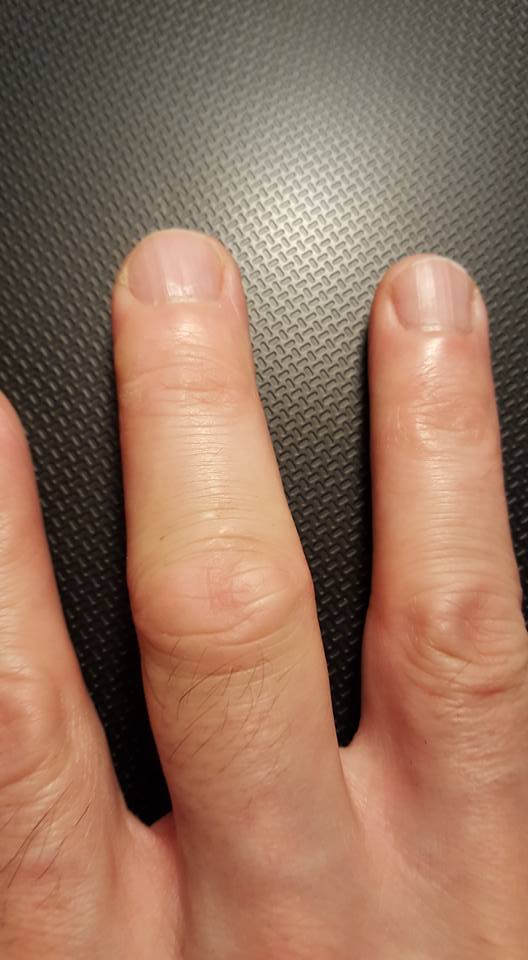
    A few winters ago I had dry-skin challenges of winter and I developed a significant skin crack on the knuckle of my right middle finger. This knuckle is a tool that I use when I need to deliver precise, deep pressure.

    At first, I thought about cancelling some deep pressure clients, but I didn’t. Instead I worked around the injury—and I’m glad I did. For one, I got better at using my left (non-dominant), middle-finger knuckle to deliver deep pressure. I also “created” and got efficient at using new power tools (two or more tools—fingers, thumbs, knuckles, fists, elbows-forearms—that are used together). In essence, my injury helped me become a more durable and balanced therapist. Here’s my process for working around a hand injury:

    Think “Work Around” Not “Work Through”

    We’ve all done it–repeat the same mistake over and over. My injury was a perfect example. At first I taped my knuckle and tried to work through the discomfort, like I’ve done in the past, but my knuckle just got angrier. Finally, after my knuckle became sore to the touch, I decided to work around the injury instead of through it. In other words, I would not use, or minimally use, my right, middle-finger knuckle. Instead I would figure out other ways to deliver precise, deep pressure. When I gave that knuckle a rest, it finally had time to heal and within a week, it was good to go again. This time I think (hope) the lesson has stuck.

    Think: Opposite Side

    Since I wasn’t going to use my right, middle-finger knuckle during a massage and I wasn’t cancelling any clients, the pressure was on. I needed to immediately figure out new ways to deliver precise, deep pressure during the upcoming scheduled massages. The good news was that I was familiar with using my left, middle-finger knuckle to deliver deep pressure, but I just wasn’t good at it. So with my right knuckle out of commission, I put my left knuckle to work. It took some work but to my surprise, within 10 massages I felt competent with my left knuckle. Which begs the question: If my right knuckle wasn’t injured, would I have ever gotten better with my left? My guess is probably not.

    Think: T-Bar

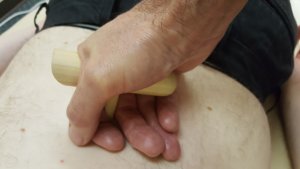
    I also tried substituting my thumbs and fingers for my right knuckle, but this wasn’t sustainable because I used my thumbs and fingers a lot throughout a massage already. So I started experimenting with my T-bar. The fact is that I also used my T-bar a lot throughout a massage, but the T-bar didn’t overtax my hand muscles and finger joints because I could hold it in a variety of ways. Substituting the T-bar for a knuckle was new to me, but I found it to be an excellent substitute when doing precise, deep pressure in the arches of the feet, on the levator scapulae attachment and in the upper cervical areas.
    Think: New Power Tools

    Though I had temporarily stopped massaging with my right, middle-finger knuckle, I habitually kept placing my hands down as if I were going to use my injured knuckle. When that happened I found myself experimenting with using other knuckles on my right hand. Because I never experimented with these knuckles individually, it felt comfortable to support them with another tool. Soon I had more power tools (two or more tools—fingers, thumbs, knuckles, fists, elbows-forearms—that are used together) at my disposal. My new power tools were right, pinky-knuckle braced with left thumb and right, index-finger knuckle braced with left thumb. These combinations were great for detail work in the back and upper shoulders.

    In this video I demonstrate some combinations:

    The Rewards

    There’s no doubt that it can be scary when you get injured. But if you can work around an injury there’s potential for multiple payoffs. For one, you’ll become more versatile with under-used tools. You’ll also begin to “create” and use new power tools in ways you never imagined before. Lastly, you’ll feel more confident in your ability to succeed in massage because despite being injured you will have gotten the job done without compromising the quality of your work.

    Can you massage pain-free?

    Take the pain quiz and get an instant video that will help you with your pain problem.

    PAIN QUIZ
  • How to Palpate without Palpating

    How to Palpate without Palpating

    I stunk at palpation in massage school. All my classmates found the tight spot on the massage model right away. When it was my turn, if I didn’t find the tight spot by the third pass, I would pretend that I did.

    My palpation skills did improve over time (hallelujah!), but they could have improved IMMEDIATELY if someone had explained to me the key to finding the most important tight and/or pain spots (the ones your client wants you to address).

    The key is to pay attention with your eyes and ears.

    The MT Measure

    It makes sense that we, MTs, measure how skillful we are by what we pick up through our hands. But what we pick up through our eyes and ears will allow us to zero in on the tight/pain spots that our clients wants us to address quickly and ensures that we’ll never miss them.

    In My (Simple) Secret to Pain Relief Massage I talked about how to find the client’s pain spots before the client is on the table. Now I want to share a detailed example of putting “palpating without palpating” into  action.

    Ian the Ex-Runner

    I didn’t know what to expect when I walked into Ian’s running store. We had made an appointment to talk, but that didn’t mean he was a proponent of massage. It could be that he was just looking for some freebie massages to help keep his customers happy. Fortunately, that wasn’t the case. Ian was waaay into massage.

    He asked me questions about the kind of massage I did and he talked about the times he got massaged. Not surprisingly, he had a strong opinion on what made a good MT. To him, a good MT should be able to find problem areas and tight spots by just using her fingers.

    I Got This

    Immediately I offered to do a free massage on Ian, knowing our future business connection rested entirely on whether I could find his pain spots.

    When I went home, I told Lisa, my wife, that I’m going to hit a home run with Ian.

    Why was I so confident?

    Because, unknowingly, Ian told me the exact location of his pain spot.

    Bad Hammy

    Ian was once was a competitive runner but at one point he tore his hammy really bad and it took him about a year to get better. After that, anytime he’d try to run a marathon, his hammy would seize up midway through the race.

    “It’s like a rock,” he said when I had met him. “You’ll find it.” But he didn’t tell me which leg he had injured.

    Hmm…I wanted to make sure that I’d find it. Normally, I would ask the client to show me exactly where the injury is, but if I had asked Ian, I would have lost cred in his eyes. So I began to ask open-ended questions, like “What happens when it seizes up?”

    At least two times when Ian was talking about his hammy, he reached down and grabbed his right hammy, midway between his knee and buttock.  Now I knew the side and location of his old injury.

    Wait…There’s More

    I was in a time crunch that day and had to leave his store before we could finish our conversation. But I wrote down important points regarding our conversation in my cell. Then before I was scheduled to work on Ian, I went back to his store to drop off my cards. Ian and I had another conversation.

    This time Ian talked about his bad knee, probably compensation from his hammy injury he thought. Again, I probed with open-ended questions, like: When does it bother you the most?

    It turns out that the combination of injuries (hammy and knee) made Ian switch from running to cycling. And now his neck and lower back bothered him more than his hammy. As he talked about his current pain spots, he grabbed his neck, the C1 – C3 area.

    I updated my notes when I left his store. Unless he had a new issue the day I was going to work on him, my game plan was to work his : 1. Neck, 2. Lower back, 3. Right hamstring.

    Batter Up!

    With all that information, it was nearly impossible for me to screw up. And on massage day, Ian was amazed that I knew exactly where to go.  It wasn’t just a home run. It was an out of the park home run because I had asked open-ended questions, listened and watched.

    Palpation Without Palpating Checklist

    Most people are not going to test your palpation skills. However, that doesn’t mean a client is going to volunteer all the information that you’ll need in order to find her pain spots. Here’s my checklist for Advanced Palpation Without Palpating:

    1. Before you drill down with specific questions, ask open-ended questions.

    If you ask too specific questions in the very beginning, you may be narrowing your search too soon. That was the case with Ian. After the first meeting I drilled down too fast because I was in a rush and I had assumed that his right hammy was his number one priority. But during the second meeting when I had more time to ask open-ended questions, I found out that his neck and lower back were higher priorities.

    1. Watch for clues.

    Recently a client talked about general shoulder pain, but for whatever reasons, wouldn’t tell me where it was. However, she did reach back to her right levator scapulae attachment and upper rhomboid area. That was the clue I needed and once on the table, I found her pain spot immediately.

    1. Write things down.

    It’s not disingenuous to write down information that a client tells you so that you can incorporate it into your conversations and game plan. In fact, it makes for great therapeutic rapport. If you struggle with therapeutic rapport, check out A Quick Way to Connect with a Client.

    1. Review notes before you see the person again.

    If I hadn’t reviewed my notes before I saw Ian the 2nd time, I wouldn’t have been able to facilitate the conversation to the point where I actually got the order of his pain issues correct.

    Tell Me Your Success Stories

    There’s no getting around that at some point you’ll need to find the pain spot with your fingers. But through asking open-ended questions (before you drill down with specific questions), listening and watching, you can make it a heck of a lot easier on yourself and be confident that you will find your client’s pain spots.

    Need  More Help?

    Sign up for my email group and get my latest info. It’s free and you can unsubscribe whenever you want:-)

  • How to do One Hand Massage

    How to do One Hand Massage

    I give my mom credit for helping me embrace one hand massage.

    When I was a kid I’d sometimes give her the sass face, and she’d say: Your face is going to get stuck like that!

    Yikes!

    I stopped.

    For a while. Then I decided to check in the mirror after I made the sass face. Hmm…nothing seemed to be stuck.

    Many years later in massage school I was taught to keep two hands on the client all the tiime.

    Why?

    I’m not entirely sure…maybe because the client was paying for two hands, not one.

    Anyway, I did two hand massage forever. Then one day my shoulder hurt and my subconscious must have remembered my mom’s horrible, life scarring lie to me about my facing freezing as I sassed her, and I lifted one hand off my client and continued the massage.

    Interestingly, my pain went away. And when it was time for my client to pay, he didn’t demand a 50% refund.

    Thanks to my mom, one hand massage has made me a durable MT and kept me out of pain.

    One Hand Massage Is Not Complicated

    One hand massage is not a massage modality.

    It’s a strategy.

    Here’s the strategy: at select times when doing static pressure use one hand.

    Here are two things you’ll need to do:

    One Hand Massage Basics

    (1) Lean to generate pressure.

    That means you’ll need to have your table height set so  you can effectively  leverage your body weight. onto the client. More about that here: Table Height is Everything.

    (2) Press with a with a thumb, knuckle(s), fist, fist-thumb (same hand), or massage tool.

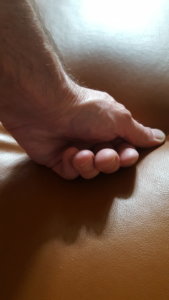
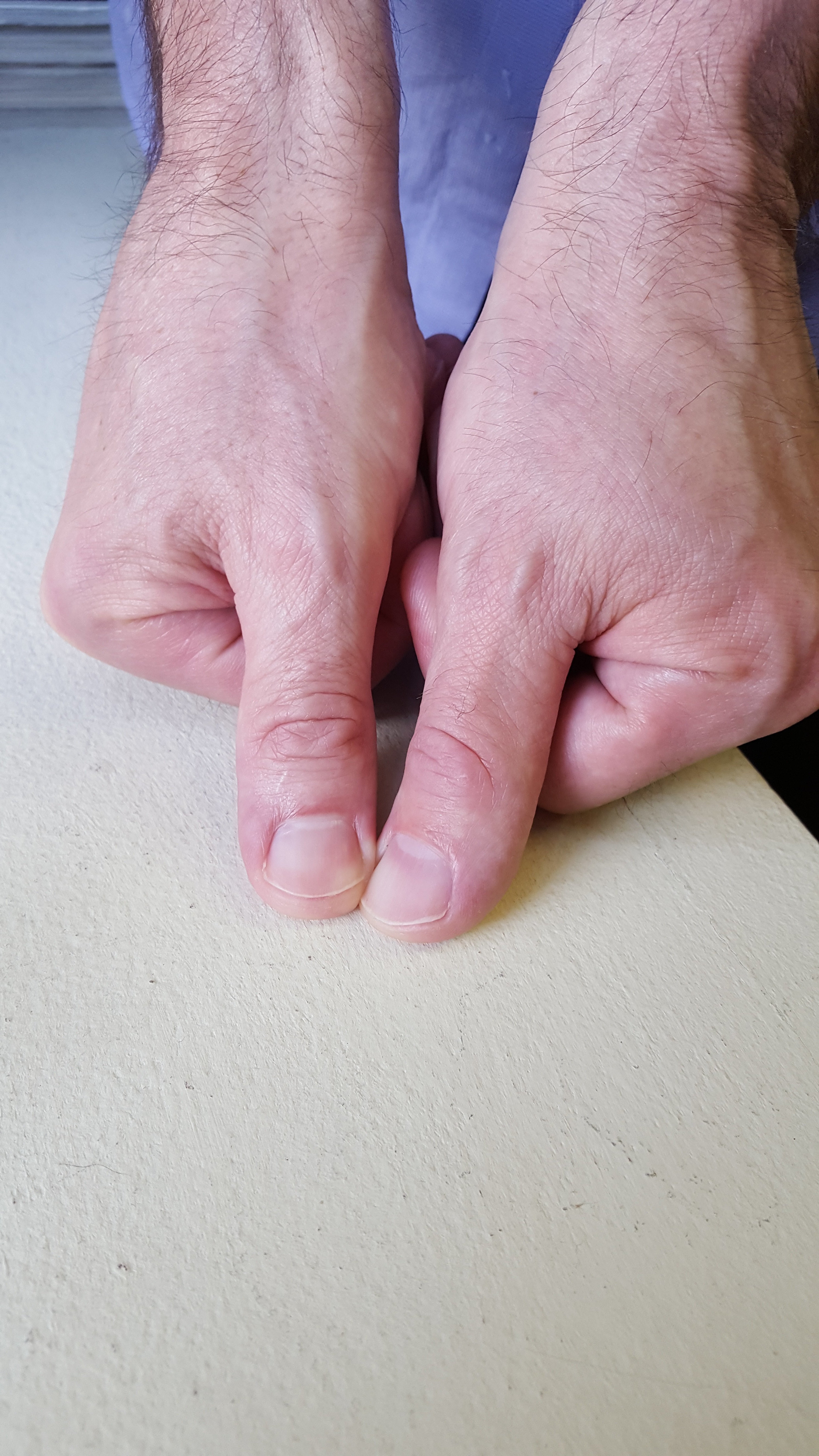
    We all know what knuckles and thumbs look like, but a fist-thumb may be new for some. Here it is:

    A have a very relaxed hand when using a fist-thumb. Notice that my fingers are not balled tight.

    With a fist-thumb you can adjust where the focus of the pressure goes by simply directing more pressure into the fist or thumb.

    Okay, Mark, we’re getting a little deep here. Before I invest anymore eyeball time into this article, how’s this going to save my body?

    Fair enough.

    One Hand Massage Saves Your Body

    The first way it will help save your body is pretty obvious.

    1. You can rest the hand that’s not working.

    A 15 or 30 second break is sometimes all your fingers need to feel less taxed. And if you become ambidextrous with one arm massage, you’ll get to rest both hands during the course of a massage.

    2. You can change positions.

    When doing a massage stroke, you either face the direction of the stroke.

    Back stroke from lumbar to cervical.

    Or you don’t face the direction of the stroke.

    Back stroke from lumbar to cervical.

    Either way, both hands are down and you’re locked into one position.

    This means that you glide in that one position.

    You press in that position.

    You sort of become that position, right?

    But look what happens when you switch to one hand.

    You can put your body in a different position and get a break from having two hands down. And here’s the bonus.

    3. You can make postural adjustments and stretch.

    Think of one hand massage as an office workstation break. It’s time to get up from your desk and stretch.

    For us, MTs, it’s a time to be less hunch-y and more vertical.

    If you breath in and lift your rib cage up while doing one hand massage, you can reset your posture.

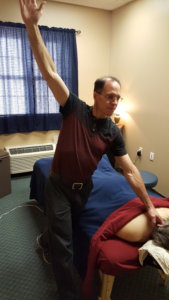
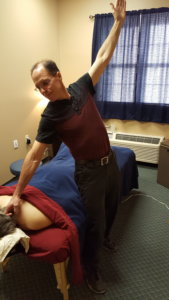
    And if you raise the other hand, you can reach up, extend your back and counter chronic, back flexion.

    Whoa, Mark! You’re getting a little carried away here. Remember, you’re actually doing a massage.

    Hey, I’m not slacking.

    My pressure is precise. And I’m leveraging my body weight with which allows me to sustain any pressure with minimal effort.

    One Hand Massage Example

    Here’s an example of one hand massage in action.

    Your gliding with deep pressure on Maria’s back. You hit a tender spot and she wants you to hold that deep pressure.

    You do. But your body has been in that one massage position too long and things are starting to cramp up.

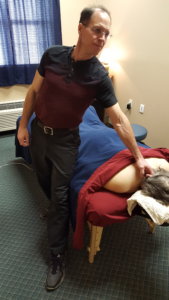
    So you switch to a one-handed position and lean into the tender spot.

    She asks for a little more pressure. You move your body so that you’re in the best position to transfer your body weight. Then you lean in.

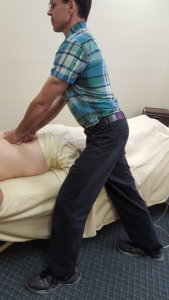
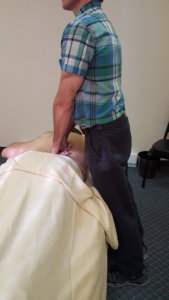
    In this picture I’ve maneuvered so that I can effortlessly lean in with all my body weight if need be.

    Now I’m adding the stretch.

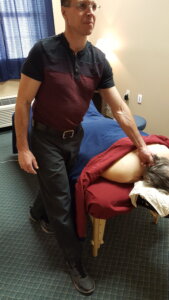
    Oh, one more thing. You can even throw in a tool.

    One Hand Massage Quick Start

    If you want to add one hand massage into your work, start with areas that are easy for you to access with one hand.

    For me, these areas are neck, back, and hammies.

    1. Find a tight/tender spot.
    2. Lean in with one thumb, knuckle(s), fist, fist-thumb or massage tool.
    3. Adjust your body position so that it feels comfortable.
    4. Make postural correction and/or add a stretch.

    To transition out of one hand massage, simply move your feet so that you can comfortably put the other hand back down. Then continue on with two hands until you need another break.

    If you need a little more motivation to keep you going, jump in my email group. I’ll send you links to updates, tutorials, workshops, downloads, everything! It’s free and you can opt out whenever you want:-)

    Massage Pain-Free

    It took me a while (like 20 years, ugh) to figure out how I could massage efficiently and effectively without being in pain. But now in my 50s I can comfortably do more massages than I could in my early 30s.

    The trick?

    Steroids.

    Haha,

    The trick is not a trick; it’s actually a series of strategies and techniques that allow you to maximize your work effort while minimizing stress and strain on your body which I write about in my upcoming book, The Pain-Free Massage Therapist, due out July 10.   .

    You can read about that here.

    Have a question? Email me at mark@makethemostofmassage.com.


  • How to Stop Your Traps From Aching

    How to Stop Your Traps From Aching

    If you struggle with pain around the neck and upper traps when doing massage, here’s one simple massage strategy that could help you out: sit down when you can.

    Pain in the Trap Area

    When the orthopedist diagnosed me with an unstable shoulder and cervical radiculopathy a while back, I knew I needed to change some things around or I would have to find a new career. At the time, pain symptoms kicked up in trap/levator scapulae area when I was doing detailed work and having to stand in one position for a long time.

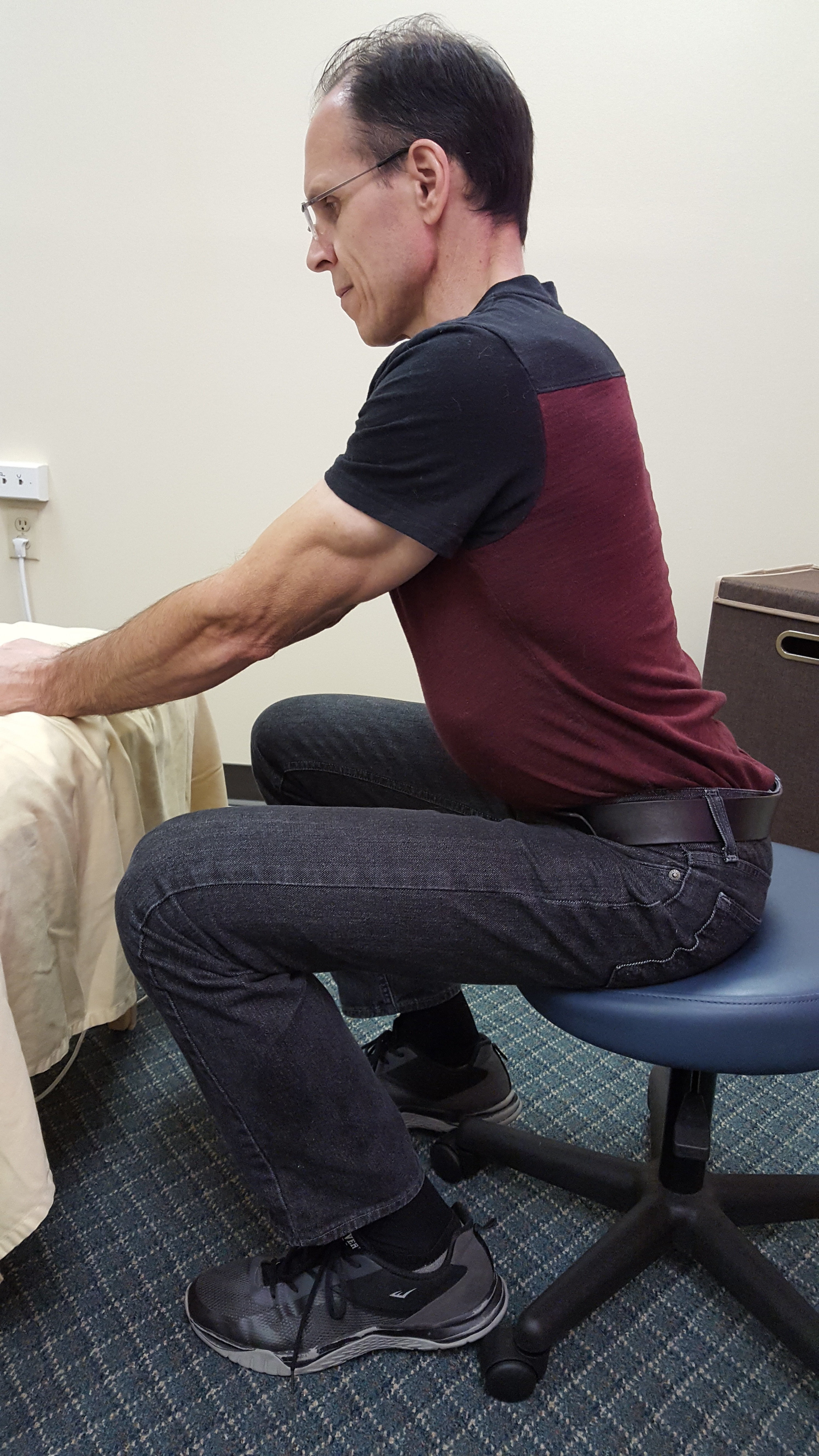
    Then one day I sat down to work the neck of a client who was prone. I rested my forearms on my knees and the pain in the trap/levator scapulae area practically went away. But as I pressed, the pain returned.

    To me, this pain could be associated with muscular contraction of my neck and upper shoulders and/or a change in my shoulder/neck positioning. I wondered how I could take “contracting my shoulder and neck muscles” out of the equation when doing seated massage.

    Over the course of the next year, I discovered the other piece of the puzzle: leaning.

    Seated Leaning

    I had become efficient with leaning to generate pressure when standing, but it didn’t cross my mind to lean when I was sitting and working. When I eventually did, the trap/levator scapulae area stopped acting up.

    The hinge for leaning when seated is the waist. When you’re leaning from the waist, the weight of your torso will sustain the pressure. If you’re not leaning, your shoulder and arm muscles will be working hard to sustain the pressure.

    seated-leaning-pic

    Seated massage is ideal for doing prone cervical work. In this video, I break down the process into 3 steps: sit, support arms, and lean: Seated Massage Body Mechanics Video.

    Sit and Work Using a Massage Tool

    I would strongly recommend experimenting with a massage tool in the seated position. Specifically, I would choose to work with an L-bar because it has a longer shaft than the T-bar. The longer shaft will allow you to get into the cervical erectors easier.

    When you use a massage tool like the L-bar while seated, you’ll be able to really focus your pressure because the end of the L-bar has a small surface area. This means that you’ll barely have to lean to generate appropriate pressure. I hardly feel like I’m working when I’m seated and leaning with my L-bar.

    In this video–L-Bar Seated Massage Body Mechanics Video–I show how to sit, support, and lean when working the neck with an L-bar.

    Create Your Own

    There are many other ways that you could incorporate seated massage into your massage routine. Here I’m working the plantar side of the foot with my arms supported on my legs. From this position, I can easily get my pressure up to medium.

    seated-lean-supported-with-legs-pic

    If I need deeper pressure, I would stand and support my arm and hand with my leg.

    standing-supported-pic

    If you want to give your hands a break, try the same standing supported-arm technique with a T-bar.

    tbar-one-hand-foot

    It’s Not Hard

    There is only one way to change how your body feels when doing massage and that is to experiment. If you’re having trap area problems, try doing some of your work seated.

    In my book, the three most important steps for seated massage are:

    1. Sit
    2. Support
    3. Lean

    Once you get those down, think about adding “looking straight ahead”and you’ll put even less strain on your traps/neck.

    Watch a Video Before You Start Your Next Client

    For quick reference, here are the videos. They are short so that you can watch them during the time you allot for your client to get on the table.

    Seated Massage Body Mechanics Video

    L-Bar Seated Body Mechanics Video

    Massage doesn’t have to hurt you. Keep experimenting. And if you need some help, let me know.

    Can You Massage Pain-Free?

    Yes.

    Start by taking this pain quiz and you’ll get an instant video solution to your pain problem.

    PAIN QUIZ