Author: Mark Liskey

  • How to Do Deep Tissue Pressure Massage (Without Hurting Yourself)

    How to Do Deep Tissue Pressure Massage (Without Hurting Yourself)

    How do you do deep tissue pressure massage—without hurting yourself? Lean to generate force. In this article, I’m going to show you how to deliver deep-tissue pressure on a low table.

    Step #1: Lean to generate force.

    Let’s get into the nuts and bolts of leaning. When teaching I refer to leaning as “fall” and “catch” massage. You let your body “fall” and the client (and/or table) “catches” your body.

    Your body weight provides the pressure. And with good body mechanics there’s minimal strain to your neck and shoulders.

    I should mention that we’re talking about controlled falling. No black and blue clients.

    Here’s what I mean by controlled falling.

    You’re going to…

    Initiate the fall with your feet.

    By simply shifting your weight from your heels to the balls of your feet you begin the fall.

    In this pic I’m positioned to fall with my fists. My weight is towards my heels.
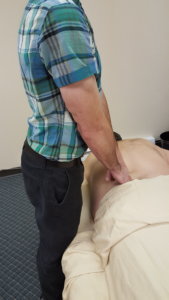
    Here I’ve fallen by shifting my weight to the balls of my feet.

    .
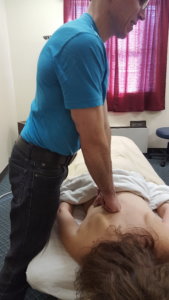
    Catch your weight on the table and/or client.

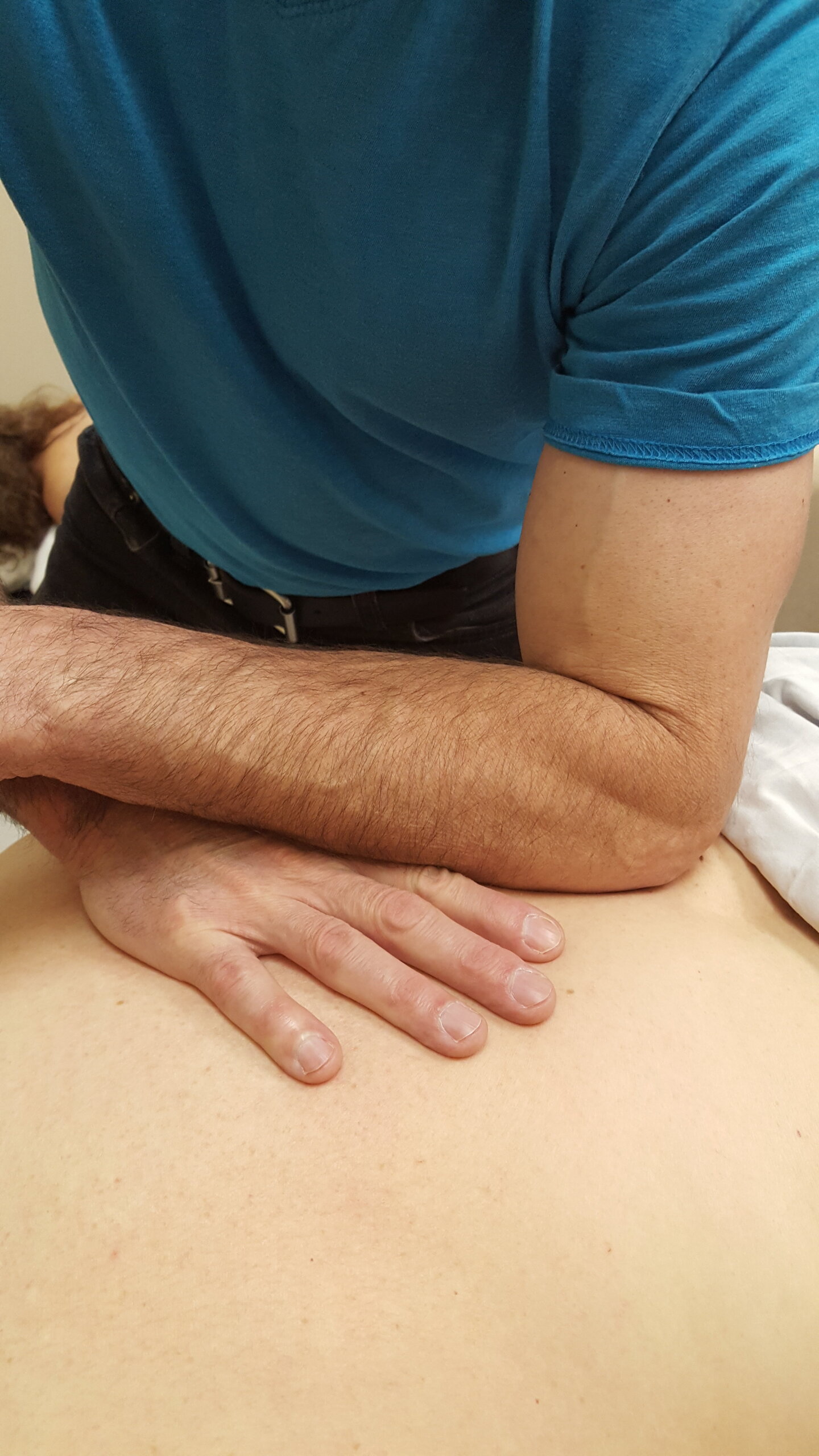
    The catching part is practically imperceptible because the body parts you’re massaging with (palms, fists, forearms, thumbs, or knuckles), should be in contact with the person.

    You’re simply transferring your body weight forward by shifting your weight from your heels to the balls of your feet.

    By the way, look at my shoulders, elbows and wrists in the picture above. Notice how those 3 joints are stacked one over the other. Stacking joints puts less adverse stress in the joints than not having them stacked. It’s a strategy that’s important to execute throughout the entirety of a deep pressure massage.

    Okay, to do light to medium pressure, direct some of your body weight into the table as well as the client.
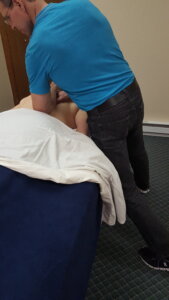
    See my leg leaning against the table in this pic? I’m primarily leaning into the table and exerting light pressure through my forearm. (80% into the table; 20% into the client).

    For deep pressure direct all of your body weight into the client.
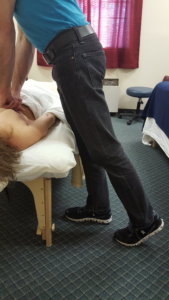
    If you “fell” too deep, shift some of your weight back off the balls of your feet.

    If you’re having trouble figuring out how much falling (transferring your body weight onto the client and/or table) you should do, keep this in mind: If you are leaning and someone suddenly moves the massage table, you should fall.

    Remember that you if you want to put less pressure into the client, lean more into the table than the client.

    Okay, here’s the next thing that’s going to save your body when doing deep pressure:

    Step #2: Do short strokes.

    It’s time to rethink what a makes a stroke relaxing especially when working at a really deep pressure. My opinion in the past was that a relaxing stoke is done at a slow pace and covers a long distance. But over time I realized that it’s difficult, if not impossible, to maintain consistent deep pressure during a long stroke and maintain alignment between your shoulders, elbows and wrists.

    On the other hand, if you segment a long stroke, do short strokes instead of long ones, you can maintain consistent deep pressure while staying in good alignment.

    I tested this idea out on clients and fellow MTs and no one complained. In fact, they loved it.

    The reason why a short stroke allows you to maintain consistent deep pressure is because you’ll never be out of position to lean into the client.

    Here’s how I’d segment a long back stroke. Divide the back stroke up into 3 parts—upper, mid and lower. Stand at the side of the table and lean into the area in front of you.

    You can position your body so that you are facing the direction of the stroke.
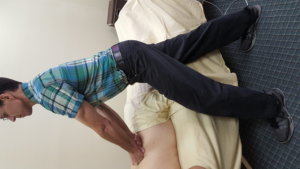
    Or you can position yourself so that you aren’t facing the direction of the stroke.
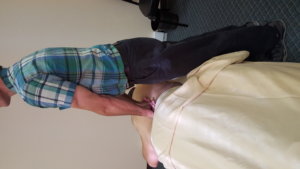
    Glide just in the segment area.

    Okay, so you did a short stroke, so now how do you get in position to do the next short stroke while remaining in alignment.

    Step #3: Move your feet.

    Moving your feet is important because that puts you in position to do your next stroke.

    Here’s how moving your feet looks: You’re at the end of your short stroke and ready to start your next short stroke. Keep your hands/forearm on the client as you move your feet to get in position to do your next short stroke. This may seem choppy, but it’s not. By having your hands/forearm on the client as you re-position yourself, you’ll maintain contact and consistent pressure. Also, you will keep the same relaxing stroke speed during the next short stroke.

    Here’s a video of what moving your feet to get in position for the next short stroke looks like:

    Now there is one more key thing you need to know to be able to do deep pressure without hurting yourself.

    Step #4: Use the table for support.

    When you lean onto your client with all your body weight to deliver deep pressures there should be no strain in your upper-body because your body weight is doing the work.

    However, not all my body parts may be happy.

    Your back could start talking to you because you’re working on a low table, especially when the client requires less pressure (light to medium).

    Less pressure means that you can’t lean all your body weight onto the client so your back and legs have to do more work.

    There’s a solution to potential more strain in your back. It’s lean into the table.

    How?

    Look at the picture below. Do you see how my one leg is pressing into the table?

    The leg against the table provides extra support.

    That means less work for my back to do and, ultimately, it allows me to change positions so that I won’t be in the  massage-hunchback position all the time.

    Leaning into the massage table has become a central feature to my body mechanics, so much so that if you randomly pulled the massage table away from me when I was standing during a massage, I would fall on my face 90% of the time.

    Here’s what you need to know to experiment with leaning into the massage table.

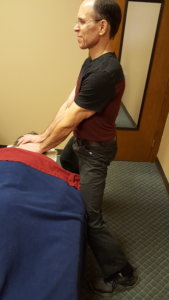
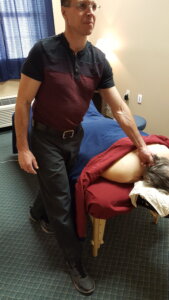
    (1) You can lean into the massage table for support with all sides of your legs (front, back, side, inside).

    It doesn’t take much leaning to provide enough support to be able to get you out of massage hunchback.

    Here I’m leaning into the table using the inside of my left leg.
    In this next picture I’m leaning into the table with the side of my leg.
    Here’s classic leaning into the front of a leg.
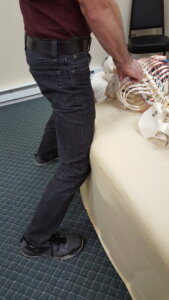
    And here’s what you’ve been waiting for: Leaning into the back of a leg(s).
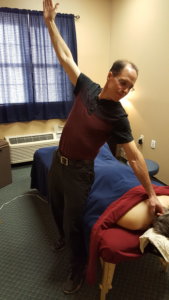
    This back of legs leaning position is also a what I call a get vertical position.

    Anytime you can lean into the table to support your body weight so that you can straighten your torso is a vertical position.

    Here’s another example of getting vertical:

    Getting vertical during a massage helps with breaking up static postures, the postures a massage therapist tends to get stuck in during a massage, like hunchback posture.
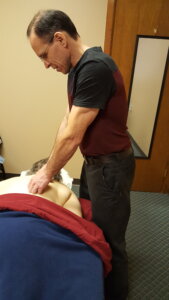
    I’ll go into that in more detail below. Here’s the next tip you need to know about leaning into the table:

    (2) Think plank when leaning into the table for deeper pressure.

    Deeper pressure is going to require more weight onto the client rather than onto the table.

    So you’re contact leg that’s leaning into the table is going to help stabilize your “planking”.

    Don’t worry about getting more vertical when leaning and doing deep pressure.

    Here’s what leaning into the table delivering deep pressure looks like:
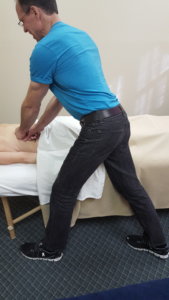
    That’s about a 90% lean into the client and 10% lean into the table. The table is helping to stabilize me and the client’s body is supporting most of my weight.

    Last leaning into the table tip:

    (3) Straighten up and change back positions with light to medium pressure and/or when using one hand to massage.

    For light to medium pressure my stances widen because I don’t want to transfer all of my body weight onto the client.

    The combination of not needing to exert a lot of pressure and having the support of the table is the perfect opportunity for me to unbend my back.
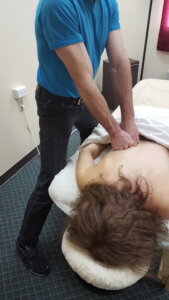
    Here’s a one-hand massage example where I’m applying light to medium ischemic compression while taking the opportunity to unbend.
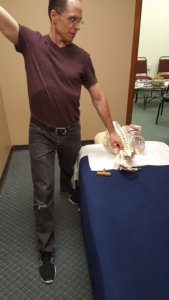
    You can also give your legs and back a break by sitting and leaning.
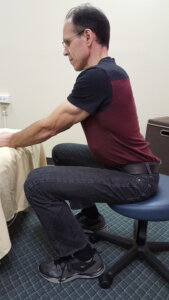
    If you want to also give your upper-back and traps a rest, rest your forearms on your quads and lean:
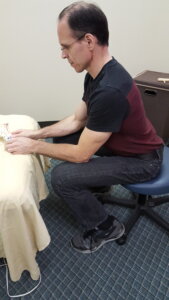
    Now that you got the get the basics of leaning, moving and using the table for support, here’s something else that will help you deliver deep pressure effortlessly.

    Lean with a Massage Tool

    Ever think about using massage tools when doing deep pressure?

    If not, you should.

    A massage tool can save your hands and elbows, especially if you’re doing deep and focused pressure.

    But you can’t be gripping the massage tool like a screwdriver if you want to make deep pressure massage easy on your body. Instead you need to relax your hand(s) and lean.

    Lean with a massage tool?

    Yep. Just like when you’re using body parts (hands, forearms and fists) to deliver deep pressure, leaning is how you make using a massage tool for deep pressure effortless.

    Here are the basics for using a massage tool to deep-pressure focused massage work (aka, saving your thumbs):

    (1) Lean into the massage tool to generate pressure.

    (2) Use a guide finger to maintain sensitivity.

    (3) Use a non-holding hand to stabilize the massage tool.

    Take a look at this video. I want you how having two hands on the massage tool makes for some easy going:

    Not as scary looking as you thought it might be, right?

    My advice for perfecting your deep pressure massage would be to get the leaning down first so that you know how to leverage your body weight. Then it will be easy for you to lean into the massage tool and get comfortable with massage tools.

    Massage Mindsets and Physics

    Working deep without being in pain comes down to mindsets and physics. We often get locked into beliefs, like “I have to do long back strokes with every relaxation massage”. But that belief can be harmful to your body especially when doing deep-tissue pressure massage.

    A better approach to long strokes when doing deep-tissue pressure is short strokes. For example, divide a back stroke up into upper, middle and lower, and only work one segment at a time. By doing so you can effectively lean into the client using your body weight to generate the force. Make sure to stack your arm joints (shoulder, elbow and wrists). Move your feet when you want to start the next short stroke and pivot when you’re out of position to effectively lean. Lean into the table to support your back, adjust your pressure and/or straighten up to get out of hunch-back posture.

    Deep-Tissue Pressure Online CEU Course

    I have an online, home study How to Deliver Pressure Without Hurting Yourself class.

    There are lots of videos and if you have any questions while you’re taking the course, you can always ask me (mark@makethemostofmassage.com).

    Check it our here: How to Deliver Deep Pressure Without Hurting Yourself.

  • Massage Therapist: Act as if Your Client Has COVID-19

    Wave 2 is here in the US.

    If you’re going to continue doing massage during possibly the worst phase of COVID-19, you need to step up your safety plan to keep your client and YOU as safe as possible.

    In this post, I want to specifically talk about protecting yourself so that you don’t get sick, spread the virus and/or have to shut down.

    How do you protect yourself from a client giving you COVID-19?

    Implement mitigation strategies for contact transmission and airborne transmission.

    Contact Transmission and Airborne Transmission

    I’m assuming that you have the contact transmission of COVID-19 in check through cleaning and disinfecting protocols you follow.

    I’m going to focus on airborne transmission of COVID-19 because we (massage therapists) break so many of the COVID-19 airborne transmission safety rules.

    For one, we have to do our work inside, not outside (unless you live in the tropics).

    We can’t social distance to do our job. In fact, we are in close contact.

    And if you’re in close contact, less than 6 feet, with someone who has COVID-19 for 15 minutes or longer, then the CDC wants you to quarantine for 14 days. (https://www.cdc.gov/coronavirus/2019-ncov/php/public-health-recommendations.html)

    But, Mark, my clients don’t have COVID-19.

    Actually, how do you know?

    40% of COVID-19 cases are asymptomatic.

    And a temperature check is just one data point that will only catch a potentially COVID-19 infected client if she/he has a high fever.

    To be as safe as possible while you continue to do massage from here on out, you need to act is if every client that walks into your massage office has COVID-19.

    By acting as if the client has COVID-19 you can potentially reduce the risk of you getting COVID-19 should the client actually have it.

    I’m seriously not trying to scare you to the point of quitting massage. I’m simply providing a mental framework to keep you vigilant and on your toes so that you keep yourself as safe as possible while doing massage during the 2nd wave of this pandemic.

    Here’s how I mitigate risks of getting COVID-19 in the massage room through airborne transmission.

    I create an environment that is more like outside than inside and I wear medical grade PPE.

    PPE in the Massage Room

    Let’s start with PPE.

    I wear an N95 respirator.

    Why?

    Because it filters out at least 95% of airborne particles. It’s what healthcare professionals who are on the frontline wear. It’s what medical professional clients tell me to wear.

    My advice is to not skimp here. Bite the bullet. An N95 is about $4 a piece, but you can re-use them by rotating them throughout the week. A box of 20 got me through 3 months. Read more about N95s and other masks here.

    I put a fresh disposable mask over the N95 for each massage to keep the outer side of N95 cleaner. By cleaner I mean less likely to be contaminated with the virus if it is airborne.

    I wear a face shield to protect from COVID-19 entering my eyes. I think there is enough evidence to warrant a face shield. You can decide for yourself: Massage Therapist—Wear A Face Shield During COVID-19.

    Air Exchange in Your Massage Room

    That’s PPE, now let’s talk about air exchange in the massage room: You want lots of it.

    Why?

    If a client has COVID-19, you ultimately don’t want to breathe in any virus.

    Assume you’re wearing an N95. That’s good, but it’s an N95, not an N100, right? So, some particles are getting in and at some point you might be breathing in COVID-19 air.

    Fresh air coming into the room and stale air going out helps with diluting the room air or getting the potential virus out of the room.

    How do you get good air exchange in your massage room?

    Simple. Just open a window and if you’re space allows it and your client is comfortable with it, open the massage room door, too.

    Now, let’s talk about airborne transmission and viral load. If a client comes into your office and has COVID-19 but is asymptomatic and you have an N95 on and a window and a door open, you’re still probably not going to be able to dodge every COVID-19 particle in the room.

    BUT if you reduce the amount of exposure time to COVID-19, you could be reducing the viral load, the amount of virus that gets into your bloodstream, and that could just be the ticket to getting a low-grade infection instead of a severe infection.

    So, how do you minimize potential viral load?

    By minimizing how much potential COVID-19 air you breathe in.

    Masks help with that.

    So does opening a window and a door by “diluting” the air.

    An air purifier may reduce viral load by killing the virus, but they are expensive.

    The good news is that there’s something super-inexpensive, in fact free, that you can do to potentially reduce viral load.

    It’s work COVID-19 smart.

    Work COVID-19 Smart

    Did you ever see demonstrations of someone talking or sneezing with a standard cotton mask on? The area of droplet spray is around the edges of the mask, especially around the nose where there tends to be bigger gaps between the material and the face.

    Think about that when your client is face up or even face down on the table. Where do you want to be in relation to droplet flow? Not above the nose, right?

    This is a challenge for me because I love doing supine neck and face work. But since COVID-19 mask demonstrations I realized that the above-the-head position not only puts me close to the clients face, but also aligns me with where the biggest gaps in the face mask are.

    So here’s how I’ve adapted to spend less time in the potential COVID-19 exposure zone. I…

    (1) do less work at the head of the table by working from the shoulders.

    (2) spend less time working at the head of the table in general, 1 – 3 minutes at time.

    (3) have the client not talk when working at the head of the table.

    (4) use a fan to blow client exhalation away when I’m at the head of the table (yet to try).

    (5) turn off any heating or cooling device that is blowing the clients exhalation towards me while I’m at the head of the table working.

    (6) work up and down a body instead of side to side so that I can break up the amount of time that I’m close to the client’s face.

    (7) let my room air-out after the massage.

    (8) rotate between two massage rooms.

    (9) wear all PPE, N95 and face shield, when cleaning the room in case there still may be aerosolized COVID-19 particles in the room.

    The idea here is to not to drive yourself crazy; it’s to give yourself ways to reduce your potential exposure time to the virus so that you don’t get sick (or die), become a long-hauler or spread the virus and subject others to the virus’s wrath.

    We Got This

    When my mom was in her last months and I was wearing thin between trying to take care of her and doing my work and not sucking as a husband, I remember hearing myself say, This is not forever.

    The severity of COVID-19 will end. Yes, it’s going to be around for a while, and the 2nd wave is here in the US, but it won’t be forever.

    So, keep yourself as safe as possible during Wave #2 by acting as if your client has COVID-19.

    Think about the strategies I just talked about.

    Try them. Use the ones that seem to have merit to you.

    You’ll think of more.

    And we’ll get through this:-)

    P.S. Get my latest info for free. Sign up below.

  • Massage Therapist Mask – Protection for the Massage Therapist

    A mask can help protect you from getting COVID-19.

    How?

    Not only is a mask blocking your droplets from going out, it’s blocking droplets from coming in.

    This is big news—really big.

    Until recently the COVID-19 jury was out as to whether the wearer of the mask was getting any airborne transmission protection, but now that’s changing.

    This is an excerpt from a CNN report:

    Dr. Monica Gandhi, an infectious disease specialist at University of California, San Francisco, has been working with a team of researchers to understand how more people could go through their infections with minimal or no symptoms. About 40% of people infected with the virus don’t have symptoms, according to an estimate last month by the US Centers for Disease Control and Prevention.”

    Gandhi’s team found masks make a difference.

    “What the mask does is really reduce the amount of virus that you get in, if you do get infected,” she said. “And by reducing that … you have a lower dose, you’re able to manage it, you’re able to have a calm response and you have mild symptoms or no symptoms at all.”

    How many masks can I strap around my ears before I can’t breathe, right?

    Don’t laugh, I’ve tried. Three cotton layers and a face shield before I turn blue.

    Massage Therapist Mask – The Best Ones

    But I digress, this is exactly the news that can be a game-changer for us—in the massage room—regarding our safety and our sanity, knowing that if Dr. Ghandi is right, we can reduce potential viral load by wearing mask to the point that if we do get COVID-19 it will more than likely be a mild case.

    Which is the best for preventing droplet transmission?

    According to a Duke study, the N95.

    The N95 is a “respiratory protective device designed to achieve a very close facial fit and very efficient filtration of airborne particles.” (Source: FDA).

    Also, effective for blocking droplet transmission are 3-ply surgical masks (“a loose-fitting, disposable device that creates a physical barrier between the mouth and nose of the wearer and potential contaminants in the immediate environment”, Source: FDA) and cotton masks.

    Not effective and possibly worse than wearing no mask were thin, polyester neck gaiters. You can read more about that here.

    Here are some suggestions to test see if your current mask is up to snuff: If you hold the mask up to the light and can see through it, get another mask. Or if you can easily blow threw it, turn the mask into a finger puppet.

    My N95 Mask Procedure To Avoid COVID

    Personally, in the massage room, I wear a N95 with a disposable medical mask on the outside of the N95. After each massage I change out the disposable medical mask, but keep the same N95 on through the course of the day.

    And I don’t throw out the N95 after one use. Instead, I reuse it by rotating it back into my PPE gear after a three day air-out period.

    So, that means I have three to four N95s I rotate out throughout the week, depending on how many days I’m working.

    I air-out each N95 that I’m going to reuse in a paper bag instead of a plastic bag to cut down on moisture which could be a breeding ground for bacteria.

    The N95 is going to be less effective keeping potential COVID out if you don’t have a good seal around your face. So, let’s get that seal right.

    I asked one of my clients, Charley Herbick, trained in N95 fitting, to show us how to get a good seal with the N95.

    You can see how he does it in the video below (and if you want to see new videos, please subscribe to the Make the Most of Massage YouTube channel):

    Where to Find Massage Therapist Masks

    N95

    So, where can you get N95s?

    My advice is do NOT buy them off Amazon.

    Why?

    Because there are counterfeits circulating on the Amazon website–and, personally, I don’t want to risk having a N95 that is faulty.

    So, to find a N95 that is  National Institute for Occupational Safety and Health (NIOSH) certified as a N95 respirator (filters at least 95% of airborne particles) and/or is FDA cleared as surgical mask (liquid resistant) takes a little  research.

    Start your research here: NIOSH – Approved N95 Particulate Filtering Facepiece Respirators.

    In this list you’ll find approved manufacturers and their products.

    After you choose a manufacturer/product, you’ll contact them to get in touch with one of their official distributors.

    My N95 Search

    My research turned up the FDA-approved Makrite 9500-N95 Pre-Formed Cone Particulate Cone Particulate Respirator Mask. It’s both NIOSH certified and FDA cleared as surgical mask (the surgical mask liquid-resistant-clearance is less important for us because we usually don’t slip in a little open heart surgery during our relaxation massage).

    Once I found the approved manufacturer I wanted to go with, I googled them and then contacted them through their contact form.

    From there, they put me in touch with an official distributor of their products.

    Yes, this is more complicated than simply clicking on an Amazon link, but, again, that easy click yields a world of unnecessary risk in my book–and I don’t want that extra worry that comes with that risk with the 2nd wave coming.

    By the way, the price I paid for N95s through an official distributor of an FDA-approved manufacturer was within the price range of the unofficial distributors on Amazon, which was about $4/mask. (Remember, that a box of 20 for $80-ish will last you a two to three months if you reuse them on a rotating basis.)

    I’m going to tell you the N95 manufacturer I went with, but before I do that I want to let you know that I am NOT an affiliate marketer of their products and or receive any compenstation from them.

    So, after searching for a NIOSH certified and FDA-approved N95 mask, I went with the  9500-N95 made by Makerite. The manufacturing company, Makerite, was very responsive.

    They put me in touch with this distributor: SPH Medical Supplies.

    Tony from SPH got back to me and was very informative and helpful. Ultimately, I purchased the Makerite 9500 N95 and the Sekura N95 also made by Makerite.

    The 9500 N95 is both a surgical mask (resistant to fluids) and a respirator.

    The Sekura N95 is not a surgical mask, but is a respirator. Again, respirator meets our working requirements–surgical mask is above and beyond.

    I ordered the Sekura N95 because it’s supposed to be more comfortable than the 9500 N95.

    I’ll let you know what I think about the two when I have a chance to use them.

    One more thing to say about getting your N95s: If you hate dealing with the research and have a client or know someone in the medical field, contact that person. She/he may let you order PPE through her/his organization.

    Onto surgical masks.

    * Below are Amazon affiliate links. As an Amazon Associate I earn from qualifying purchases.

    3 Layer Surgical  and Cloth Masks

    If you don’t have the budget for N95s, you still have options. Three-ply surgical masks and certain cloth masks did well in the Duke Study.

    3-Layer Surgical Face Masks

    Cloth Masks

    Here are plain, old standard 2-ply cotton masks:

    This is the top 6 on the Duke Study list if you wanted to do a search for each type:

    1. Fitted N95, no valve
    2. 3-layer surgical mask
    3. Cotton-polypropylene-cotton mask
    4. 2-layer polypropylene apron mask
    5. 2-layer cotton, pleated style mask
    6. 2-layer cotton, pleated style mask

    Lastly, I can’t talk about masks and not talk about my favorite TV doctor, Dr. Sanjay Gupta.

    All through this pandemic he has said to stop the spread of the virus, act as if you have the virus and don’t want to transmit it.

    I have something to add to that: With this new information about masks protecting the wearer, we (massage therapists) should also act as if our clients have the virus and we don’t want to get it.

    We have an important tool to help protect us from a client who is unknowingly COVID-19 positive.

    It’s a mask.

    Wear it during the massage.

    Wear it when you’re disinfecting the room after the massage.

    And take it off like a surgeon so that you don’t contaminate yourself with any potential virus on the mask by using the straps to remove the mask without touching the mask itself. By the way, wearing a disposable mask over the N95 should protect the N95 from getting contaminated with the virus.

    Now that you’re masked up, it’s time to talk about face shields: Wear a Face Shield.

    If you want to continue to stay safe as possible while making money doing massage, sign up below and I’ll let you know when my next post is out.

  • Massage Therapist Goggles versus Face Shield COVID-19

    Massage Therapist Goggles versus Face Shield COVID-19

    Which is better to wear for COVID-19 eye protection when doing a massage, a face shield or goggles?

    According to the CDC, both are adequate forms of eye protection for infection control.

    The face shield offers the advantage of protecting more areas of the face, and it’s a physical barrier between the wearer’s  hands and face, which can help protect against contact transmission, e.g. rubbing eyes.

    (Go here to learn more about face shields and why massage therapists need eye protection during the COVID-19 era.)

    The disadvantage with wearing a face shield is that it can make your head hot, especially if you’re double-masking when working, like I do.

    Face shields can also look a little HAZMAT-y and not so massage-y.

    So, I’ve been researching goggles as an alternative to face shields, and I found that all goggles are not equal for keeping the potential bad stuff out.

    Before we get started with the CDC goggle recommendations for keeping the bad stuff out, let’s define what goggles are by saying what they’re not: They’re not safety glasses.

    Goggles Versus Safety Glasses

    Safety glasses provide impact protection and don’t provide the same level of splash/droplet protection as goggles do, according to this 3M technical bulletin. I also confirmed this when I talked to a 3M rep on the phone. So, from a pure being-as-safe-as-possible-in-the-massage-room perspective, we’re going to stick with goggles exclusively for this article.

    Okay, we know what goggles are not, now we need to know which goggles can be used for PPE.

    What to Look for When Buying Goggles for Infection Control

    The CDC stated that goggles for infection control should be indirectly ventilated.

    What’s indirect ventilation?

    According to Albany County Fasteners, it is “the venting system that does not allow for direct contact of particles to the interior of the goggles. This is achieved by adding angled vents which face away from the front lens that the wearer looks through.”

    Basically, indirect ventilation makes it harder for bad stuff to make it to the eyes.

    The downside to a pair of indirect-vented goggles is that indirect-vented goggles won’t be as well ventilated as direct-vented goggles.

    Hmm…a little warmer around the eyes versus less potential COVID…that’s a tough decision—not.

    The CDC also recommends that the goggles should have an anti-fog coating, and that the goggles should “fit snugly, particularly from the corners of the eye across the brow.”

    Fitting snugly doesn’t necessarily mean the goggles need to seal around the wearer’s eyes, according to 3M.

    If in doubt as to whether the goggles you’re thinking about purchasing are resistant to liquid droplets/splash, look for or ask if the goggles have “3” marked on the frame. (EN 166:2001 Personal eye protection. Specifications. European Committee for Standardization, Brussels.).

    So, let’s summarize what you want in a pair of massage goggles (eye protection for infection control).

    Requirements for Goggles for Infection Control

    1. Indirect ventilation
    2. Anti-fog coating
    3. Snug fit especially from the corners of the eyes across the brow.
    4. When in doubt, look for “3” on the frame.

    Seems pretty straightforward so far, right?

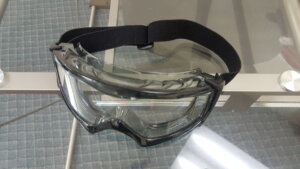
    But here’s the twist: Have you ever tried a pair of standard goggles like the ones pictured below while you’re also wearing a N95 mask?

    The N95 Challenge

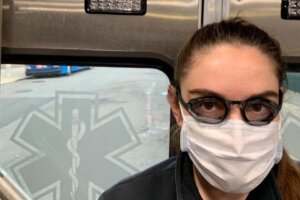
    Besides looking like I should be doing a science experiment instead of a massage, let me share my experience of wearing a N95 with the goggles pictured above.

    Picture Mike Tyson. Now, imagine Iron Mike has one hand on the back of your head and his other hand is balled up in a fist and he’s pressing it into the bridge of your nose for 60 minutes.

    In case you wanted to run the experiment yourself I’m just going to warn you that minute one of Mike Tyson pressing his fist into the bridge of your nose is bearable. It’s around minute 23 when you want to rip the goggles off your head.

    The problem with wearing goggles, like the ones pictured above, with a N95 is that they both press on the bridge of the nose at about the same place.

    Are there alternatives to the goggles pictured above?

    Potentially.

    We’ll circle back to that in a minute. First, we’re going to find goggle solutions for (1) cotton and 3-ply medical masks, then (2) N95s and, finally, (3) people with glasses.

    Goggles When Wearing Cotton and 3-Ply Medical Masks

    Cotton masks and 3-ply medical masks are typically easy on the bridge of the nose. So, there is built-in leeway with goggle style because you don’t need to be overly concerned about too much pressure on the bridge of your nose.

    Here are 3M goggles that comply with the requirements of the European standard EN166.2001. By the way, the good thing about goggles is that they aren’t expensive and you can experiment with them without going broke.

    Fahrenheit

    Goggle Gear (GG) 500

    2890 Series

    4800 Series

    Goggle Gear (GG) 6000

    You can check these  models out here.

    You can also do your own Google search to find more goggles. Just keep in my mind indirect venting, anti-fog coating and a snug fit.

    Okay, now if you’re like me and wear a N95 when doing a massage, let’s look at eye protection that won’t break our noses.

    Goggles When Wearing a N95

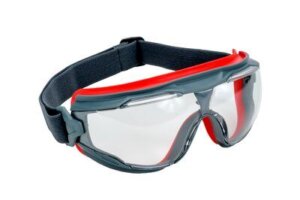
    First, it’s hard to determine which goggles might work well with a N95 from pictures and descriptions alone. So, I called the 3M tech department for a recommendation and the advisor suggested the Goggle Gear 500 series.

    From the picture it looks like the GG 500 nose piece contacts the wearer’s nose higher up on the bridge of the nose when compared to the Fahrenheit, 2890, 4800, and 6000 models. That could mean that the wearer is not getting double pressure from the goggles and the N95 at the same place on the bridge of the nose. I’ve ordered the GG 500 to run the experiment and will update this article soon.

    Here’s another potential option that looks really intriguing to me—the Magic5 swimming goggles converted into PPE.

    When COVID hit, and there was a shortage of PPE, the Magic5 company started turning their swim goggles into protective goggles.

    From what I could discern on their website, they’re not claiming to meet CDC goggle criteria for infection control eye protection; however, the custom-fit Magic5 goggles seem to satisfy what I would argue to be the most important criterion: snug fit. In fact, their gasket fit is so snug, that it’s water-leak-proof (which you would hope to be the case with swimming goggles).

    The Magic5 goggles also has a custom-fit nose bridge, and look at the picture above—see how high the nose bridge is? That could totally go above the N95 nose piece.

    And call me vain, but after looking like a lab tech with my current goggles, I’m up for the Phelps look.

    But before I place my order, I’m going to do a little more digging to see how compliant the Magic5 goggles are with CDC recommendations. I’ll update this article after I get more information.

    UPDATE: I contacted Magic5 and they responded very quickly via email:

    Mark,

    Thanks for your voicemail.

    In regards to your question about using goggles as PPE:

    This is a tricky question to answer, and it kind of depends on the form of PPE you are looking for. In an impact protection eyewear setting, our goggles would not do very much. I am assuming you’re talking about using them in a medical setting in place of the large clear face shields. 

    Our goggles are not certified in any way to be considered medical grade PPE, however earlier this year when New York was dealing with a nationwide shortage of proper PPE, since our supply chain was not affected by the COVID-19 Pandemic at the time we were able to send a number of pairs of our goggles as a sort of “best case alternative”.

    I am not sure if there are any particular guidelines about what constitutes proper PPE where you are, but if you are just looking for something other than a cloth face mask then they might be an ok solution for you. However, they do only cover the eyes.

    Hope this helps! Please let me know if you have any other questions. 

    Best Regards,
    Garen
    THEMAGIC5

    Yes, I was hoping for a slam-dunk yes answer, too, but, instead we have this: Not impact grade goggles. That’s fine. There should be no flying debris in a massage.

    But they also are not certified medical grade goggles even though they were considered a “best case alternative” to eye protective PPE in New York during the 1st wave of the pandemic.

    Personally, as the 2nd wave is coming on us, I’m sticking with the face shield.

    Okay, we have goggles for cotton and disposable surgical  masks. We have a potential goggle alternative (not medical grade) when wearing a N95. What if you wear glasses? How do you wear goggles and glasses at the same time?

    Goggles with Glasses

    You have two options here. You can get goggles with prescriptive inserts. Go here.

    Or you can do what I do: Jettison your glasses and be a little blind in the massage room, which, I feel, adds to my palpation sensitivity.

    Cleaning Your Goggles

    No matter which option you choose or which goggles you get, you’ll need to know how to clean them. Here’s a more official recommendation from 3M: Go to page 4 of their Technical Bulletin in August, 2020.

    I use soap and water or if I need to move with greater urgency, I use disinfectant wipes.

    That’s it.

    You’ve got goggle options for cotton masks and disposable 3-ply surgical masks: Fahrenheit, Goggle Gear (GG) 500, 2890 Series, 4800 Series, Goggle Gear (GG) 6000

    You have this goggle recommendation for a N95 mask: 3M’s GG 5000. And the Magic5’s PPE conversion goggles are not medical grade, but were used during the pandemic as a best alternative.

    And you have two options if you wear glasses: (1) get prescriptive inserts for your goggles or (2) jettison your glasses and just wear goggles in the massage room.

    Work safe. Be healthy.

    Join my email group and get my latest how to safe and keep your clients safe during Covid-19.