Author: Mark Liskey

  • Injury Prevention for Massage Therapy – This Worked For Me

    Here are seven “injury prevention for massage therapy” strategies that keep me out of pain and allow me to increase my massage max.

    1. Stop doing techniques that hurt you.
    2. Find replacements for techniques that hurt you.
    3. Use as many body parts as possible.
    4. Use your body weight to apply pressure.
    5. Interrupt static postures.
    6. Use a massage tool.
    7. Become ambidextrous.

    You may have laughed at the first strategy—stop doing the techniques that hurt you—but here’s the reality, it’s easier said than done.

    1. Stop doing techniques that hurt you.

    You learn a great scapula release technique at a CE class and your clients love it. Problem is, it hurts your hands. What do you do? Well, if you’re like me you keep doing it until it becomes a problem. I know I’m not the only one that does this.

    Once I was training Susan, a massage therapist who was working for us.

    She complained about that her right shoulder was really bothering her as the number of massages in a day increased.

    So, we went into the massage lab to investigate. As she was working on me (tough experiment for me, haha) she said, Now…it hurts now.

    Okay, what are you doing right now?, I asked.

    When I got off the table she showed me what she was doing. Her right hand was under my back and she was doing a supine subscapularis release technique.

    That’s it, she said, that’s exactly when my shoulder hurts.

    I then asked her, Have you tried a different release technique?

    She looked at me puzzled, and then said, I never thought about trying something different.

    I showed her a side posture subscapularis release technique and it didn’t cause pain in her shoulder.

    There was a flash of embarrassment on Susan’s face when she realized that she never thought about NOT doing the move that was hurting her shoulder.

    I told her that we’ve all been there. In fact, you still might be there.

    You might be thinking: This killer move is what my client wants, it’s my signature move, it’s the best move out there and/or I’ve done this move forever (in varying degrees of pain) so it’s my body that’s the problem, not the move.

    Okay, let’s get rid of this “if I’m in pain doing massage, it’s okay” out of our heads right now because there’s a cumulative effect with this mindset. And it can set you up for more pain and potentially an injury.

    No technique is worth an injury (or pain). If certain techniques bother your body, stop those techniques and…

    2. Find replacements for techniques that hurt your body.

    Here comes that voice again: “Nothing can replace my patented supine rhomboid move.”

    I’m here to tell that voice, Yes, that move can be replaced.

    And it can be replaced by a move that doesn’t hurt your body.

    You just need to start experimenting.

    For example, are you into squeezing traps?

    If so, how do your hands and forearms feel after a 6 hour day of squeezing.

    Mine didn’t feel so good. That’s why I started to experiment with different ways to release traps. In this video I use a massage tool to press instead of squeeze with my hands.

    Now that you’ve agreed to stop doing the techniques that hurt your body and are starting to think about replacement techniques that don’t hurt your body, it’s time to…

    3. Use as many body parts as possible.

    When I say body parts I’m talking about fingers, thumbs, knuckles, fists, palms, forearms and elbows.

    Why use as many body parts as possible?

    So that you don’t burn out one body part.

    Think about it—if you can alternate between fingers, thumbs, knuckles and elbows (in large muscles areas) for detail work, you can spread out the workload over multiple joints and body parts.

    Spreading out the workload amongst body parts may look like this for detail work: 20% thumb, 20% fingers, 20% knuckles, 20% elbow, and 20% massage tool (we’ll talk about massage tools in a minute).

    Hmm…100% using thumbs to do detail work versus 20% using thumbs…I’m going to say my thumbs will be a lot happier carrying only 20% of the workload for detail work.

    We covered some injury prevention strategies for detail work and general massage, but what about for deep pressure massage?

    4. Use your body weight to generate pressure.

    When you use your body weight to generate pressure you take the strain out of your upper body. In fact, applying pressure pretty much becomes effortless. But in order use your body to the point that you can transfer your body weight onto the client, you’ll need to lower your table.

    Twenty-five years ago I was taught that to set my table height, my distal knuckles should touch the top of the table when my arms were at my sides. Look on the Internet and you’ll find a range of table height advice, like: The height of your table should be your height divided by two.

    Though well intended, there are some serious flaws with standardizing a table height setting that result in a loss of leaning leverage for medium and deep pressure. With no leverage, backs, hands, arms and necks get trashed because you need to overuse your upper-body when doing deep pressure.

    But a lower than “normal” table is the set up to allow you to transfer all of your body weight (lean) onto the client.

    If you don’t believe me try leaning onto your client at your normal table height. Then lower your table to the lowest setting, better yet, take off the extender legs so that the table is even lower than the lowest setting. Now lean.
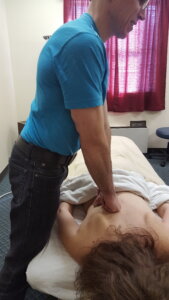
    Do you see how you can now transfer all of your body weight onto your client if you wanted to?

    It will take you some experimentation to figure out which lower table height setting works best for you when doing deep pressure. My suggestion is this: Whichever setting you’re thinking about lowering your table to, go one if not two settings lower than that.

    To learn more about working on a low table so that you can lean effectively, go here.

    Leveraging your body weight to deliver pressure is going to take the strain out of your upper-body, but we have something else to consider that can lead to fatigue and cause us pain and potentially contribute to injury—static posture. Here’s what we’re going to do:

    5. Interrupt static posture.

    First, what is static posture?

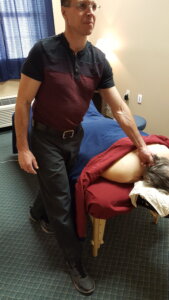
    Static pressure is being in a position for a long time without moving. It often looks like this during a massage:
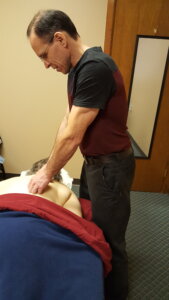
    Static posture is bad because protracted  static posture increases loads or forces on muscles and tendons in specific areas. When this happens fatigue occurs in these areas because blood flow is impeded. When blood flow is impeded there’s less replenishing of nutrients and elimination of metabolic waste. In other words, tissue recovery is not good.

    Here’s an example of how you can disrupt static posture during a massage.

    Look at the picture above. I’m hunching with my head down, a common static posture position.

    So how I can I interrupt this static posture massage cycle without rewriting how I do massage?

    One way is to find times during the massage when you can change your back position. Here are some examples:

    1. Take a knee on the table when standing and working on feet.
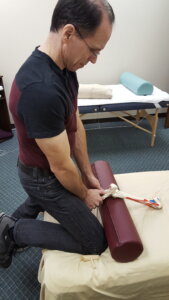
     

    2. Sit and lean whenever possible.
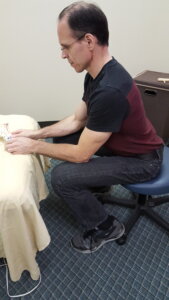
    3. Massage with one hand so that you can straighten up.
    This article will give you a more in-depth understanding of how to break static posture during a massage: Don’t Do Static Posture Massage.

    Breaking static posture will become the norm once you start experiencing the huge benefits of not being in the same position all the time.

    Speaking of big rewards, I now want to show you how massage tools can save your hands.

    6. Use massage tools.

    I’m not talking about any massage tool. I’m specifically talking about massage tools that have a handle and a stem.

    Why?

    Because a handle makes the tool easy to hold, and a stem does a fantastic job of simulating a thumb.

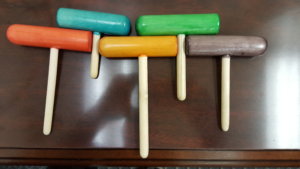
    Here what tools with handles look like:

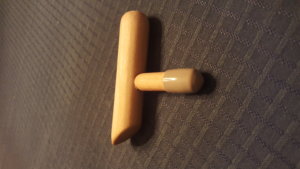
    Here’s a T-bar:
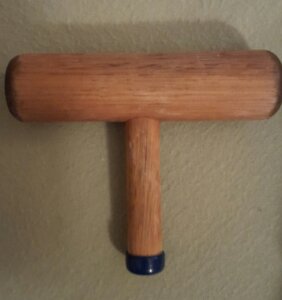
    And here’s a long stem T-bar:

    (Thank you Matt Johnson for designing and making my wooden tools!)

    Massage tools with handles come in a lot of different flavors, but I really want to emphasize the importance of the handle.

    The Importance of a Handle

    The handle allows you to easily hold the massage tool BUT I’m not talking about holding a handle in the traditional sense–wrapping your hand around the handle and gripping.

    I’m talking about using the handle to support your body weight. Think of parallel bars or push-up stands where you’re simply supporting your body weight on an apparatus.

    Holding a Massage Tool

    With a massage tool you are directing some of your body weight onto the handle of the tool.

    If the massage tool is pinned between your hand and the tissue you’re working on, you can loosen your grip.

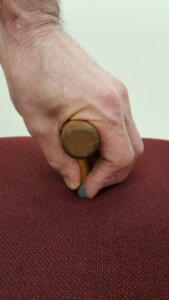
    And if you add a guide finger/thumb next to the end of the stem of the massage tool, you can actually relax your “holding” hand.

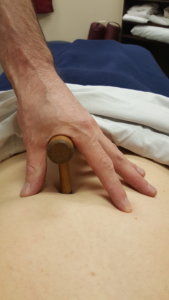
    Here’s what that looks like:
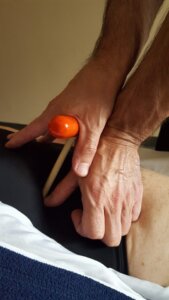
    See how relaxed my hands are?

    My guide fingers is helping to stabilize the tool. I’m also sensing how much pressure I am applying with my guide finger.

    This all looks great, right? But when you actually go and try to hold a T-bar or L-bar without gripping you’re going to say–Mark, you’re a freakin’ liar–because it’s not going to work.

    Why isn’t it going to work?

    Because your table won’t be low enough. And that means you’re not going to be able to lean onto the massage tool handle with enough pressure to keep the tool upright without gripping.

    Leaning into a massage tool, like leaning into the client with your hands, is not rocket science. It just takes practice.

    The last injury prevention recommendation I have is to…

    7. Become ambidextrous.

    Raise your hand if you’re severely one-sided!

    I was. It felt unnatural and inefficient to use my non-dominant side.

    Why?

    Because it WAS unnatural and inefficient to use my non-dominant side.

    But with a little practice I got a little better and soon the idea of becoming competent with my non-dominant side didn’t seem that farfetched.

    This isn’t exactly what I did, but I think it will get you to where you want to be. For the next 50 massages, every time you use a dominant-side body part for detailed work (e.g. right thumb), use a non-dominant-side body part (left thumb), too.

    Make it easy when you first start by only placing a non-dominant-side body part down for 1 or 2 seconds. Gradually add more time.

    As you add time, explore with the non-dominant-side body part.

    Why not? We have the perfect work situation to explore.

    Seriously.

    For one, we can eye the client for reactions.

    Get a squirmy reaction, then stop and try again in a different place or on a different client.

    We also know what it feels like to get a massage. We know when pressing on a spot too long starts to feel uncomfortable.

    And that on-the-table sense is always running as we’re doing the massage. To build that sense up, get more massages. I’m always amazed how much I learn when I’m actually the one getting the massage.

    Injury Prevention for Massage Therapy in a Nutshell

    If you’re feeling like injury prevention is a little daunting, step away from my specific recommendations for a minute and think in broader terms.

    To prevent repetitive stress injuries you don’t want to keep racking up the massage hours with a particular body part, like your thumbs.

    So what do you do?

    You can become ambidextrous, use many body parts (and combination body parts) and massage tools.

    To prevent injuries that are caused from overstraining, use your body weight to generate pressure, stop doing the techniques that hurt you and find replacement techniques.

    To avoid injuries due to muscle fatigue from being in one position too long, find other positions to do your work.

    It took me a while to get this about massage injuries: Avoiding injuries (and pain) when doing massage is an active process. It’s not an off and on thing. In fact, it always needs to be on. When it is, it becomes part of your massage style and what makes you unique and keeps you injury free.

    Have a pain/injury issue?

    Take my pain quiz and get an instant video solution.

    PAIN QUIZ

    For more about staying injury and pain free, sign up for my email group. It’s free:-)
     

  • How to Get Repeat Massage Clients

    How do you get repeat massage clients?

    (1) Do a massage that sets you apart from the competition.

    (2) Have solid therapeutic rapport.

    (3) Have referral sources that send you new clients.

    (4) Create a COVID-19 safe environment.

    (5) Coordinate care.

    (6) Follow up after the first massage.

    Notice that none of the recommendations to get repeat massage clients had to do with discounting your price.

    Why?

    Because if you follow these recommendations, you’ll never need to entice clients to come back by shaving dollars off your price.

    By the way, the recommendations above helped take my meh business to my Yay! business. You can read more about me here.

    Okay, let’s get you some repeat clients by starting with:

    (1) Do a massage that separates you from the competition.

    Wait, don’t get your credit card out to sign up for the latest specialty massage class. When I’m talking about separating yourself from the massage therapists in your neighborhood, I’m talking about finding and highlighting what makes your massage unique.

    That doesn’t mean you have to be a myofascial expert or have a firm understanding of reflexology. It means you have to find what people like about your massage and then take it to the next level.

    If you want a shortcut to standing out from the crowd, try this: Get competent with pressure.

    If your pressure is spot on (is appropriate and feels good to the client), clients will love your massage. Surprisingly, not all massage therapists get this. That is why nailing the pressure during a massage can be your differentiating factor.

    And that’s the case for me. I’m competent with pressure and I’ve taken pressure to the next level by become competent with precise pressure, too.

    Becoming competent with precise pressure gives me a leg up on my competition.

    For one, I can specifically treat a tight/tender area with very precise pressure.

    Also, precise pressure is sometimes the only way I can find the “That’s it!” spot. And precise pressure feels like more of complete and comprehensive treatment to clients as opposed to general pressure especially when working on specific tight and/or tender areas.

    If you’ve backed off very precise pressure because it hurts your body or it feels intimidating, here’s how to change that.

    Precise Versus VERY Precise

    In general, I use general pressure to find areas of tender/tightness. To do this, I use a variety of body parts, from big (forearms and fists) to small (thumbs and fingers).

    However, if I want to examine the tender/tight area in detail I use very precise pressure. And that’s often when I find the “That’s it!” spot. For precise pressure I use smaller body parts (thumbs, fingers, massage tools).

    Here’s an example. Ali comes in with neck and shoulder pain. Using my knuckles around the scapula I find the locus of his pain area in his levator scapulae attachment (general pressure).

    Next I start examining the area of pain in the levator scapulae attachment with my middle knuckle, looking for that exquisitely tender or tight spot (precise pressure).

    What to Use to Find the “That’s It!” Spot

    If it hurts your hands to work with precise pressure, I have three suggestions:

    1. Combine body parts.
    2. Stack and/or brace (support) body parts.
    3. Combine a massage tool with a body part.

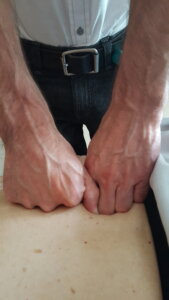
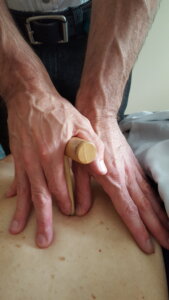
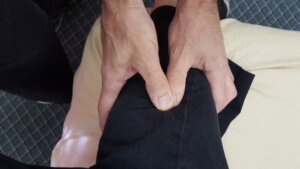
    Pictured below are my 3 favorite ways to deliver precise pressure.

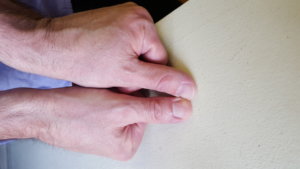
    Stacked Fingers/Thumbs

    Try not to press. Instead lean into your fingers/thumbs. The bottom finger/thumb is the primary palpation vehicle.

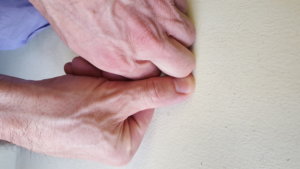
    Knuckle-Thumb

    In this picture I’m directing my pressure into the middle finger of my left hand. You’ll notice that my right thumb is bent to fit in comfortably next to my left middle knuckle. This is not a mistake. In this case, my thumb’s primary role is for palpation, not for delivering pressure. My right thumb’s companion four fingers form a loose fist. They take most of the weight that I put on that hand, not my thumb.

    Tool-Thumb

    In this picture my thumb is a support, guide and the primary sensing instrument. I’m directing most of my “leaning” pressure into the tool, not my thumb.

    That’s a taste of precise pressure which helps to differentiate me from my competition.

    More about how to use massage tools to deliver precise pressure here.

    But as I said in the beginning, what uniquely makes you “you”, doesn’t have to be what makes me “me”.

    Finding Your Uniqueness

    So, does your uniqueness have to be precise pressure?

    No.

    But your pressure has to be spot on to make clients happy—and right there you have the beginning of a uniqueness formula. Adding precise pressure is an easy next step.

    That said, you don’t have to go the precise pressure route. Your uniqueness could be specializing in a modality or combining modalities or your specific take on a modality or something as basic as doing a fantastic relaxation massage.

    The point is to find your uniqueness and make sure that it’s connected to happy clients. Once you know the two are connected you can hone that skill.

    Next, let’s talk about therapeutic rapport.

    (2) Have solid therapeutic rapport.

    Have you had the experience of being referred to an expert in a field and that expert turns out to be a complete a-hole?

    Bye-bye, right?

    In massage you don’t need to be an a-hole for someone not to come back. It could be that you didn’t show enough care towards the client.

    For instance, if you’re having a bad day, thinking about yourself and not the person on the table, that could just be enough for your client to pass over you next time for Kiesha who is good at massage AND is present during the session.

    Being a good listener and a good conversationalist (when the client wants to talk) are also ways that allow you to really connect with a client.

    In fact, my wife, Lisa (also a massage therapist) and I agree that a big reason why our clients keep coming back is due to how we interact and connect with them.

    If you’re just starting out and having trouble connecting with a client, try this: A Quick Way to Connect to a Client.

    Making your massage unique and having solid therapeutic rapport are two things that you must have to get a good flow of repeat clients, but if you want to make converting clients into repeat clients a whole lot easier, do this: Get referral sources to refer clients to you.

    (3) Have referral sources that send you new clients.

    A client who is referred to you from a referral source (a business/person who recommends your massage to her/his clients/customers/patrons) is primed to become a repeat client.

    Why?

    Because the referral source is endorsing you.

    Don’t believe me?

    Do a thought experiment. Margo does a Google search and you show up third in the local search. She goes down the list and calls the first two massage therapists but they don’t pick up. However, when she calls you, you do pick up. Do you expect that Margo will feel confident that she’ll get a good massage from you?

    Maybe…I mean she only has your website to go on.

    Okay, now imagine Tara the PT referred Margo to you because Tara personally knows you and respects your work—can you say potential client has been primed to come back to you?

    It just makes sense that the more a referral source likes you and your work, the more she is going to talk you up to the person she’s sending your way, which makes that person a prime candidate to be a repeat client.

    For more about creating referral source machines, go here: Stalking Bernie for Referrals.

    So, I talked about how to get repeat clients during normal times, but how about during abnormal times, like during a pandemic.

    Specifically, what can you do get repeat clients during COVID-19?

    Simple.

    Do this:

    (4) Create a COVID-19 work-safe environment.

    Creating a COVID-19-safe-as-possible work environment is not only the right thing to do, it’s a way to expand upon care and further deepen your connection with the client.

    Oh, by the way, this care connection starts before the client even walks though our door.

    Think about when a potential client hits your website. With our website I want the client to know that we’re taking her safety more seriously than any other outfit in town.

    I’m not going to overwhelm website visitors with policy. I’m going to point out key safety features we’re employing, like forehead temperature checks, masks, disinfecting and limiting the number of people we have in the office at one time.

    And I’m going to give potential clients clear direction on how the appointment will go down so that there is no confusion or ambiguity in their minds.

    This is the COVID-19 safety video that I made for our website:

    So, with the video and the verbiage on our website I’m addressing safety barriers that may be preventing that person from calling:

    (1) Is massage safe?

    (2) Is this place safe?

    (3) How safe is this place compared to other places?

    This is the start of our care connection that will continue to  build once the client arrives at our office.

    Does above-and-beyond safety and care during COVID-19 guarantee a repeat client?

    Not necessarily, but it makes the checkmark in the therapeutic rapport box a big one.

    I have two more recommendations that have helped my repeat client average. The first is…

    (5) Coordinate care.

    By coordinating care I mean if the client comes to you for a specific pain issue, ask the client if it would be okay if you reach out to the other health professionals who are helping her with that specific issue.

    That means you could be contacting orthopedists, podiatrists, PTs, PTAs, personal trainers, exercise physiologists and chiropractors.

    The majority of health professionals that I coordinate care with are PTs, PTAs, chiropractors and personal trainers.

    I get a huge positive response when I ask the client if I can coordinate care with the health professional on his pain issue case, and I often get referrals from that health professional.

    Lastly, I need to mention…

    (6) Follow up after the first massage.

    By following up after the first massage (2 to 3 days after) you open the door for a dialogue about the massage session the client just had with you.

    It’s at this point that you are more likely to get a candid reaction about the massage.

    Nine out of ten times you will get a positive response. And the fact that you called after the massage shows the client that you care.

    Again, think cumulative not specific. In other words, lots of caring actions add up. Keep heaping on the caring and the choice of where the client wants to go for a massage becomes a no-brainer.

    How to Get Repeat Clients in a Nutshell

    Getting repeat clients is not rocket science, but it does take some targeted actions.

    First, you need to know what separates you from your competition. It doesn’t have to be a technique or modality. It can simply be that you deliver great pressure during a relaxation massage.

    Also, throw in some good ole therapeutic rapport. Listen. Be a good conversationalist when appropriate. Coordinate care and follow up after the first massage session.

    Find referral sources that consistently send you clients.

    And during COVID-19 create a safe as possible environment and let clients know this on your website and in your advertising.

    Getting repeat clients does not happen because you did one thing right. You get repeat clients by doing key things (what I mentioned above) competently.

    Extra Help

    If you’re just starting out and/or making less than 30K as a massage therapist, check out this free course to get your repeat clients rolling: Jumpstart.

    If you’re trying to take your meh business to a Yay! business, go here: Accelerator Program.

    If you want to get my latest info for free, sign up below:-)

  • Massage Therapist PPE – Protecting Yourself From COVID-19

    The PPE you must have when doing massage during COVID-19 are (1) a good mask and (2) a face shield to reduce your risk of getting COVID-19 and/or infecting others.

    If you’re only doing one, it’s time to up your game.

    Last week, two clients cancelled because of sickness and a third cancelled because a family member tested positive for COVID. This week another client cancelled because of a fever.

    I’m not claiming to be the bellwether of the COVID 2nd wave, but this cluster of data points in my work-life makes complete sense in the context of a country (US) whose infection rate and positivity rates are soaring.

    It’s decision making time: Are you going to shutter your office for a few months or are you going to work through this COVID 2nd wave (as long as you can)?

    If you choose to do massage as long as you can through the 2nd wave, it’s imperative that you keep yourself as safe as possible by not straying from protocol.

    “Straying from protocol” was said for my benefit.

    Why?

    Because as this pandemic drags on, fatigue has set in and I find myself wanting to cut corners.

    The client was only in the waiting room for 30 seconds, do I really need to wipe the coffee table down again?

    Do I really need to get another disinfectant wipe to do that massage stool because this one is drying out?

    Do I really need to wash my cloth mask that I use in between clients for tomorrow?

    Yes.

    Yes.

    And YES!

    This is not just the time to be vigilant. It’s the time to be HYPER-vigilant.

    I have extra incentive to be hyper-vigilant. My wife, Lisa, had COVID in April. If you thought there were only two options with COVID—living or dying—there’s actually one more option: living with COVID after-effects that may or may not go away. They call this group of people who have not fully recovered from COVID-19 long haulers.

    Lisa is a long hauler. Her long-hauler issues have improved, but they haven’t disappeared and she is starting month seven post-COVID diagnosis. In addition, there are cases of COVID-19 re-infection. In other words, once you have COVID, immunity is not guaranteed.

    So, I desperately don’t want her to get COVID-19 again.

    And that’s the extra reason why I’m going out of my way to protect myself in the massage room.

    By the way, the measures I take to protect myself, act as protection for my clients, too.

    If you don’t get COVID-19, you can’t give it (through airborne transmission).

    So, looking out for yourself is a 100% win/win for you and your client.

    Before we get into the exact details of protecting yourself, I want to give you a mental framework to work within so that you can make the best decisions regarding your safety and your clients’ safety.

    The framework is this: Act as if your client has COVID-19.

    The Mental Framework for Staying Safe

    This is what happens in my brain when I start with that premise.

    If my client has COVID-19 would I walk back into the massage room she just came out of without a face shield on?

    No.

    If my client has COVID-19 would I take my mask off in the office after the he has left?

    No.

    If my client has COVID-19 would I work in a room with poor air exchange?

    No.

    Raising your level of vigilance may be raising your blood pressure, too, but if you take action and follow strict safety protocols, your brain should feel some sense of relief, knowing that you’re doing everything humanly possible to stay safe, and subsequently keeping your client safe, during a massage.

    Alright, now let’s talk about essential PPE and two PPE related items that protect me and my clients at the same time.

    Massage Therapy PPE

    Here’s the PPE:

    1. Masks
    2. Face shields

    Here are the PPE-related items:

    1. Air exchange
    2. Viral load

    Masks

    I’m starting with masks because it makes the most sense when I talk about protecting myself from getting infected.

    COVID-19 is an airborne illness. The first place to stop COVID-19 from enter my lungs and going into my bloodstream are at the holes where air comes in, nostrils and mouth.

    A mask keeps the COVID -19 virus out and if you have it, it can help keep the COVID-19 virus in.

    A good mask does a better job at keeping COVID in or out than an average mask.

    Recently the CDC stated the importance of a mask in protecting the wearer.  And there has been compelling examples from the beginning of this pandemic that masks protect the wearers like this one: In July of 2020 two hair stylists in Sprinfield, Missouri tested positive for Covid-19 after interacting with 139 clients and 6 coworkers.

    Here’s the important thing: No one they interacted with was known to get Covid-19.

    How did that happen?

    Most experts think it was because both the hair stylists, fellow employees and customers wore masks.

    Studies bolstered this conclusion.

    Can you say mask up?

    And that means everybody—no client exceptions.

    At our office we have disposable medical masks that we offer the client who have forgotten to bring a mask or whose mask is too uncomfortable to wear face down.

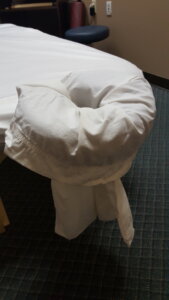
    For the one or two clients who can’t breathe through any mask face down, we do the open pillow case over the face cradle so that the client is breathing into the open pillow case.

    So, we agree that universal mask wearing in the massage room is a must, right?

    Now the question is which type of mask should you use?

    Pick Your Mask Using The Best Information

    Which is the best mask for preventing droplet transmission?

    According to a Duke study, the N95.

    The N95 is a “respiratory protective device designed to achieve a very close facial fit and very efficient filtration of airborne particles.” (Source: FDA).

    Also, effective for blocking droplet transmission are 3-ply surgical masks (“a loose-fitting, disposable device that creates a physical barrier between the mouth and nose of the wearer and potential contaminants in the immediate environment”, Source: FDA) and cotton masks.

    Not effective and possibly worse than wearing no mask were thin, polyester neck gaiters. You can read more about that here.

    Here are some suggestions to test see if your current mask is up to snuff: If you hold the mask up to the light and can see through it, get another mask. Or if you can easily blow threw it, turn the mask into a finger puppet.

    Personally, in the massage room, I wear a N95 with a disposable medical mask on the outside of the N95. After each massage I change out the disposable medical mask, but keep the same N95 on through the course of the day.

    And I don’t throw out the N95 after one use. Instead, I reuse it by rotating it back into my PPE gear after a three day air-out period.

    So, that means I have three to four N95s I rotate out throughout the week, depending on how many days I’m working.

    I air-out each N95 that I’m going to reuse in a paper bag instead of a plastic bag to cut down on moisture which could be a breeding ground for bacteria.

    Where do you get N95s?

    So, where can you get N95s?

    My advice is do NOT buy them off Amazon.

    Why?

    Because there are counterfeits circulating on the Amazon website–and, personally, I don’t want to risk having a N95 that is faulty.

    So, to find a N95 that is  National Institute for Occupational Safety and Health (NIOSH) certified as a N95 respirator (filters at least 95% of airborne particles) and/or is FDA cleared as surgical mask (liquid resistant) takes a little  research.

    Start your research here: NIOSH – Approved N95 Particulate Filtering Facepiece Respirators.

    In this list you’ll find approved manufacturers and their products.

    After you choose a manufacturer/product, you’ll contact them to get in touch with one of their official distributors.

    My N95 Search

    My research turned up the FDA-approved Makrite 9500-N95 Pre-Formed Cone Particulate Cone Particulate Respirator Mask. It’s both NIOSH certified and FDA cleared as surgical mask (the surgical mask liquid-resistant-clearance is less important for us because we usually don’t slip in a little open heart surgery during our relaxation massage).

    Once I found the approved manufacturer I wanted to go with, I Googled them and then contacted them through their contact form.

    From there, they put me in touch with an official distributor of their products.

    Yes, this is more complicated than simply clicking on an Amazon link, but, again, that easy click yields a world of unnecessary risk in my book–and I don’t want that extra worry that comes with that risk during this 2nd wave.

    By the way, the price I paid for N95s through an official distributor of an FDA-approved manufacturer was within the price range of the unofficial distributors on Amazon, which was about $4/mask. (Remember, that a box of 20 for $80-ish will last you a two to three months if you reuse them on a rotating basis.)

    I’m going to tell you the N95 manufacturer I went with, but before I do that I want to let you know that I am NOT an affiliate marketer of their products and or receive any compensation from them.

    So, after searching for a NIOSH certified and FDA-approved N95 mask, I went with the  9500-N95 made by Makerite. The manufacturing company, Makerite, was very responsive.

    They put me in touch with this distributor: SPH Medical Supplies.

    Tony from SPH got back to me and was very informative and helpful. Ultimately, I purchased the Makerite 9500 N95 and the Sekura N95 also made by Makerite.

    The 9500 N95 is both a surgical mask (resistant to fluids) and a respirator.

    The Sekura N95 is not a surgical mask, but is a respirator. Again, respirator meets our working requirements–surgical mask is above and beyond.

    I ordered the Sekura N95 because it’s supposed to be more comfortable than the 9500 N95.

    One more thing to say about getting your N95s: If you hate dealing with the research and have a client or know someone in the medical field, contact that person. She/he may let you order PPE through her/his organization.

    * Below are Amazon affiliate links. As an Amazon Associate I earn from qualifying purchases.

    3 Layer Surgical and Cloth Masks

    If you don’t have the budget for N95s, you still have options. Three-ply surgical masks and certain cloth masks did well in the Duke Study.

    3-Layer Surgical Face Masks

    Cloth Masks

    Here are plain, old standard 2-ply cotton masks:

    Okay, time to talk about face shields.

    Face Shields

    Wait, we already covered the mouth and nose to reduce the possible transmission of COVID-19 through droplets via coughing or sneezing. Why the eyes now?

    From an article in Managed Healthcare Executive:

    “The eyes are an important part of the body to protect because, like the nose and mouth, they are mucous membranes where germs can infect the body,” Ruchman says. “The virus spreads when infected droplets from a sick person’s mouth or nose come in contact with another person’s face, often when they cough, sneeze or talk. Although it’s more likely to be infected by inhaling these droplets through your mouth or nose, they can also enter through your eyes, especially if you touch something that has viral particles on it and then rub your eyes.”

    Still not ready to look like a chem lab tech or a HAZMAT 1st responder?

    According to an NPR article, Dr. Joseph Fair, virologist and epidemiologist, believes that he caught coronavirus through the eyes. On a crowded flight he wore a mask and gloves, but no eye protection. Two weeks later he had COVID-19.

    The CDC also acknowledges that transmission could happen through the eyes.

    Dr. Abraar Karan at Harvard Medical School says, “it’s hard to quantify exactly what the risk is in terms [of] through the eye specifically.” (NPR article.)

    And even though Karan and other experts feel that eye transmission is less likely than nose or mouth, Karan goes on to say in the article that “…in health care settings, eye coverings are immensely important. ‘We definitely don’t go into [coronavirus patients’] rooms without eye coverings.’ He says other jobs that require people to work face-to-face, like a barber, might also choose to wear a full-face clear plastic shield.”

    More Reasons To Wear a Face Shield

    And let’s add this to our particular mix: In order to do our job, we break almost every COVID-19 no-no.

    We are in a enclosed area with a person for a protracted period of time where we can’t social distance.

    In fact, even though the client is wearing a mask (if you still have reservations of insisting clients wear masks during a massage, go here now), we are often within feet of the client’s nose or mouth.

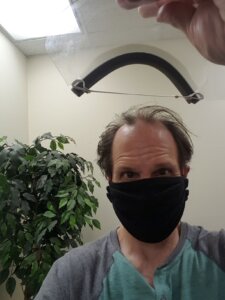
    Guess what? I’m wearing a face shield.

    What You Need to Know About Face Shields

    According to the CDC, a face shield should cover your forehead, go below your chin and wrap around the sides of your face.

    Here’s the good news about face shields: They are inexpensive and easy to clean.

    I purchased my face shield on Amazon.

    Experts recommend soapy warm water so that you don’t destroy the anti-fogging coating if it has one. I use disinfectant wipes because my shield is cheap and it’s more convenient for me to clean that way.

    At this point, you may be ready to ditch your mask in lieu of a shield. But that is not what the experts want you to do.

    They are saying add the shield as a supplement to the mask.

    Why?

    There is not enough research to determine if shields alone are as effective as masks for protecting against COVID-19 transmission.

    Eyes, nose and mouth protected? Check.

    One more thing: air exchange.

    Air Exchange in the Massage Room

    Wait, that’s not PPE, Mark.

    You’re right, but it’s part of the protecting yourself from the airborne transmission of COVID-19.

    Plain and simple: You want lots of air exchange in your massage room.

    Why?

    If a client has COVID-19, you ultimately don’t want to breathe in any virus particles.

    Assume you’re wearing an N95. That’s good, but it’s an N95, not an N100, right? So, some particles are getting in and at some point you might be breathing in COVID-19 air.

    Fresh air coming into the room and stale air going out helps with diluting the room air or getting the potential virus out of the room.

    How do you get good air exchange in your massage room?

    Just open a window and if you’re space allows it and your client is comfortable with it, open the massage room door, too.

    Since we now space our clients out, I can confidently assure the client that no one will be coming into the office while she is on the table. And I haven’t had a client object to the massage room door being open or partially open. In fact, most seem to think it is a good idea. I’m guessing they don’t want to be breathing in “stale” (COVID) air either.

    Remember when I said one more thing? I lied. I have one more thing regarding my one more thing.

    It’s viral load.

    Viral Load

    If a client comes into your office and has COVID-19 but is asymptomatic and you have an N95 on and a window and a door open, you’re still probably not going to be able to dodge each COVID-19 particle in the room.

    BUT if you reduce the amount of exposure time to COVID-19, you could be reducing the viral load, the amount of virus that gets into your bloodstream, and that could just be the ticket to getting a low-grade infection instead of a severe infection.

    So, how do you minimize potential viral load?

    By minimizing how much potential COVID-19 air you breathe in.

    Masks help with that.

    So does opening a window and a door by “diluting” the air.

    An air purifier may reduce viral load by killing the virus, but they are expensive.

    The good news is that there’s something super-inexpensive, in fact free, that you can do to potentially reduce viral load.

    It’s work COVID-19 smart.

    Work COVID-19 Smart

    Did you ever see demonstrations of someone talking or sneezing with a standard cotton mask on? The area of droplet spray is around the edges of the mask, especially around the nose where there tends to be bigger gaps between the material and the face.

    Think about that when your client is face up or even face down on the table. Where do you want to be in relation to droplet flow? Not above the nose, right?

    This is a challenge for me because I love doing supine neck and face work. But since COVID-19 mask demonstrations I realized that the above-the-head position not only puts me close to the clients face, but also aligns me with where the biggest gaps in the face mask are.

    So here’s how I’ve adapted to spend less time in the potential COVID-19 exposure zone. I…

    (1) do less work at the head of the table by working from the shoulders.

    (2) spend less time working at the head of the table in general, 1 – 3 minutes at time.

    (3) have the client not talk when working at the head of the table.

    (4) use a fan to blow client exhalation away when I’m at the head of the table (yet to try).

    (5) turn off any heating or cooling device that is blowing the clients exhalation towards me while I’m at the head of the table working.

    (6) work up and down a body instead of side to side so that I can break up the amount of time that I’m close to the client’s face.

    (7) let my room air-out after the massage.

    (8) rotate between two massage rooms.

    (9) wear all PPE, N95 and face shield, when cleaning the room in case there still may be aerosolized COVID-19 particles in the room.

    The idea here is to not to drive yourself crazy; it’s to give yourself ways to reduce your potential exposure time to the virus so that you don’t get sick (or die), become a long-hauler or spread the virus and subject others to the virus’s wrath.

    Vow to Be Hyper-Vigilant Until COVID-19 Is Under Control

    Who would have thought that being self-centered, protecting yourself to the hilt, turns out to be best thing you can do to protect your client, too.

    But it is.

    Now that the pandemic is raging again, we need to shake off the battle fatigue and double-down on protecting ourselves.

    And don’t cheap it.

    That was inner-dialogue that got out because right now I’m thinking about my PPE and cleaning/disinfecting costs and wondering how I can save money.

    Forget it, Mark.

    Get the N95 that will keep the COVID out.

    Use as many wipes as you need to disinfect the face cradle to reduce contact transmission.

    Go ahead and use a disposable medical mask over top your N95 for each massage.

    This is not forever and letting your guard down could cause a whole lot of hurt for you, your loved ones, your clients and people you don’t even know.

    Mask up.

    Face shield up.

    Create decent air exchange in your room.

    Reduce potential viral load.

    Clean and disinfect like you’ve never cleaned and disinfected before.

    We’ll get through this by protecting ourselves and never taking our eye off the ball until it’s safe to do so.

    My Email Group

    Want to get my latest info? Sign up for my email group. It’s free.

  • Massage Therapy Hand Pain – NOPE

    Massage Therapy Hand Pain – NOPE

    How do you eliminate hand pain when doing massage?

    1. Incorporate your non-dominant hand. 
    2. Add in bracing/combination techniques.
    3. Use hand-held tools.

    I bet you thought I was going to say use your elbows/forearms as substitutes for your hands.

    Elbows can be good substitutes for hands, but if you start to rely on your elbow too much you could develop overuse problems, like cubital tunnel syndrome. 

    In addition, an elbow is great for a back, but how about if you’re doing detail work, like in the neck? For most of us massage therapists, using an elbow to do detail work in cervical erectors is not going to work.

    Enter your non-dominant-hand, bracing and combination techniques and massage tools.

    1. Massage Therapist Hand Pain – Be Ambidextrous 

    About 10 years ago, my right thumb started to bother me.

    When I think back it makes perfect sense that it would. I used it a lot—especially when doing deep, detail work. For a long time, I simply accepted thumb pain as the price to pay for doing massage.

    But as the pain increased I realized that if I didn’t change something soon I was going to be in trouble.

    One day during a massage my right thumb was really aching and I had to give it a break. So I stuck my left thumb in the cervical erectors.

    It was awkward BUT my left thumb didn’t ache. (Hey, I could get used to this!)

    Then I experimented with my left thumb so often that it started to hurt, too.

    Eventually, I found that if I followed a thumb workload formula of 60/40 (60% dominant thumb/40% NON-dominant thumb) my thumbs felt great.

    2. Massages Therapist Hand Pain – Combine and Brace

    Splitting the workload to 60/40 between my thumbs was a big improvement for reducing pain in my right thumb. However, it didn’t solve my problem of achy and stiff fingers.

    There was one move in particular that really made my hand ache. The move involved squeezing and rolling the upper trap edge between my thumb and fingers.

    One day I was doing that move and my hand ached. Without thinking I reached over with my other hand to help with the squeezing.

    Hmm…it sure was a lot easier squeezing with two hands.

    And that is when I really started to experiment with combining and bracing.

    What happens if I put a thumb over top a thumb and pressed down with both thumbs?

    Well, I’ll be damned if that didn’t make the work for my dominant thumb easier.

    There are no right or wrong bracing techniques. It depends on the individual and is influenced by anatomy (e.g., big knuckles versus small knuckles) and preexisting conditions.

    My favorite hand-saving, bracing combinations are

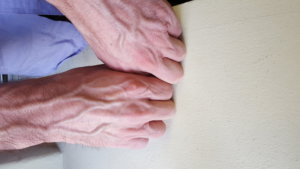
    Braced thumbs:Braced Thumbs pic
    Third knuckle and thumb:Braced Thumb and Third Knuckle pic
    Braced knuckle and fist:Braced Knuckle with Fist pic

    Check out this video for more in-depth bracing and combination techniques: 

    Here’s my favorite eliminating hand pain solution—massage tools.

    3. Massage Therapist Hand Pain – Massage Tools

    Becoming ambidextrous and bracing my fingers, thumbs, knuckles and fists together made my hands feel better. But adding in hand-held tools allowed me to increase my massage volume big-time without injuring my hands.

    Here are 2 basic types of wooden hand-held tools that I use:T-bar and L-Bar pic
    These tools were designed by my massage colleague and friend, Matt Johnson.

    Let’s take a closer  look.

    This is a T-bar.

    And this is an L-bar.

    A little intimidating looking, right?

    But if you start with baby-steps you’ll get used to them, and then you’ll never want to do another massage without them!

    Here’s what you need to do to get competent with massage tools.

    Adjustment #1: Relax Your Hand

    This is how we were taught to grip a T-bar in NMT class.

    Take note of my fingers gripping the stem and tip to control the T-bar.

    This hold allowed you to have fine-tuned control of the T-bar when working a tight/tender spot, but it also encouraged you to grip the T-bar tightly, even when applying light pressure.

    Hmm, I wondered, what would happen if I just loosened my grip some?

    Actually, nothing happened. The T-bar didn’t slip out of my hand, and I was still able to control the tip with a lighter grip.

    This begged the question: How loose can I hold the T-bar without it actually falling out of my hand? I started experimenting and found that my hands were very happy when I simply steadied the T-bar with the minimal amount of pressure required to keep the T-bar from dropping  or slipping from my hand.

    This is a loose-hand hold: 

    My fingers are relaxed and I’m using just enough of a grip so that T-bar doesn’t slip out of my hand.

    At the end of a month or so, I got pretty good with light and medium pressure, but when I ratcheted up to deep, I had to tighten the grip to keep the tool steady.

    I wish I could say that I figured out the pain-free method of holding a T-bar for deep pressure within a month or so, but I can’t.

    In fact, I went in a different direction altogether. I started experimenting with other massage tools for deep and precise pressure. And it wasn’t until 15 years later that I figured out how to use the T-bar for deep pressure without hurting my hands.

    At that time, shoulder and neck conditions forced me to radically change my massage body mechanics. One of the big changes that I made was to set my table lower than I normally had it. And when I did, the T-bar missing puzzle piece fell into place.

    Adjustment #2: Pin the T-bar

    With a lower table, my work was below me. This meant that I could take full advantage of leaning my body weight into the client to generate pressure.

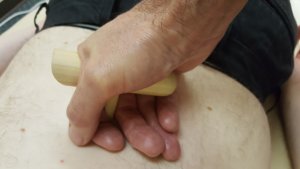
    When I leaned in with a T-bar to do deep pressure, I could pin the T-bar between my hand and the client’s body. There was no need to grip hard to hold the T-bar in place. In fact, I really didn’t have to grip at all. This is an open-hand hold.

    Open hand hold.

    To execute this hold the table has to be low enough so that you can lean in to generate pressure and pin the T-bar. Here’s what it looks like when the camera steps back.

    The pin technique made it easy to hold the T-bar, but there were times when a one-handed pin wasn’t possible and/or my pinning hand needed a break. This leads us to the third adjustment.

    Adjustment #3: Use A Guide Hand Next to the T-bar

    Using a guide hand next to a T-bar is my preferred way to hold a T-bar.

    For one, I’m contacting the client with more surface area than I would with the T-bar alone. This gives the massage more of a relaxation feel.

    Two, it’s really easy to stabilize the T-bar with a guide hand, maintain sensitivity and regulate pressure.

    Three, I can shift the emphasis of pressure from tool to guide hand (hand not holding the T-bar) without having to pull my hands off the client.

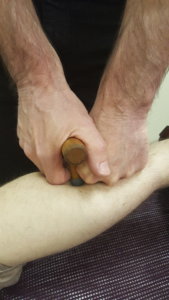
    In this picture my guide hand is a relaxed fist. 

    The relaxed-fist, guide hand that’s next to the T-bar serves as a stabilizer. For broader pressure, I would direct more of my body weight into my fist. For precise pressure, I’d lean more into the T-bar. This hold is great for calves and forearms.

    This next example is a double-handed hold.

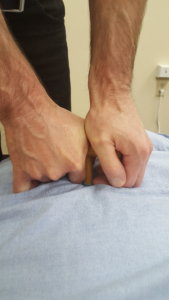
    Two hands on the handle hold.

    Note that both hands are contacting the handle. Having two hands on the handle allows me to lean in with my body weight. I use this hold when I need to deliver more pressure to influence deep muscles.

    The double-handed hold is good for when you’re working thick areas, like back, hamstrings and quads.

    Also, can you see that my hands are relaxed? That’s really important because you’ll instinctively want to tighten your grip to steady the T-bar as you lean in to deliver deeper pressure.

    But that’ll be completely unnecessary. Look at all the points of contact my fingers and knuckles make with my client’s back. That T-bar is not going anywhere!

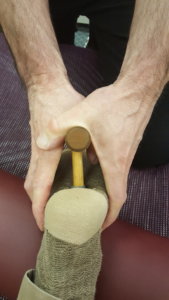
    This last hold is a wrap-around technique that works well feet.

    The great thing about the wrap-around hold is that it’s easy to control your pressure. You simply lean in. 

    The guide-hand and two-handed holds worked great for me, but I had a tendency to get really comfortable with one or two holds and I then I’d feel the overuse pain again. This tendency led to me to adjustment #4.

    Adjustment 4: Vary Your Holds

    There are countless ways to hold a T-bar. Here’s how I recommend you experiment. First, pin the T-bar between your hand and the client’s body. Then place your other hand next to the T-bar and allow that hand do whatever it wants to in order to support the T-bar.

    Just remember to keep your hands relaxed and you’ll be amazed at how many different holds you’ll come up with.

    Easier than You Think

    There’s a potential irony in massage that we all desperately try to avoid. It goes like this: We put ourselves in pain to get someone else out of pain.

    Thumb pain is not a byproduct of doing massage.

    Kick thumb pain to the curb by using a T-bar when doing deep and precise work. But first you have to learn how to hold the T-bar without gripping it.

    Here are the keys for holding a T-bar:

    1. Hold the T-bar with a relaxed hand.
    2. Pin the T-bar between your hand and the muscle by leaning in. You may have to lower your table. You can lean when you’re sitting, too.
    3. Use a guide hand, thumb, finger next to the T-bar for stability, sensitivity and as a pressure gauge.
    4. Use two-handed holds to spread the workload.
    5. Vary your holds so that you don’t overuse a body part.

    Once you get these basic things down, you’ll never have to worry about developing chronic thumb pain again.

    This video will help you, too:

    Eliminate Hand Pain Recap

    The great thing about massage is that you can get paid for on-the-job training.

    With a paying customer you can experiment with your non-dominant hand.

    Once you do that add in a bracing combination, like thumb on thumb.

    With hand-held massage tools take it a little slower.

    First,  practice on friends, colleagues and family.

    Once you get positive feedback with your tool work test out a massage tool  on a client. 

    Slowly increase the time you use a massage tool with that client on subsequent sessions.

    Online, Save-Your-Body CEU Course

    Need more help saving your hands?

    I have an online course that can help you eliminate hand pain (and shoulder, neck and back pain, too).

    A while back I almost quit massage because of pain and injuries.

    Then I spent a year revamping my massage to see if I could massage pain-free. That’s where incorporating the lower half of my body into the massage came in along with a bunch of other strategies that ultimately saved my massage career.

    I pulled all that first-hand experience together and made a live CEU class which I taught for about 5 years. During those 5 years I listened to the massage therapists taking the course and worked out the learning kinks. 

    Check out the kink-free, massage-pain-free course here

    Online, Massage Tools CEU Class

    Massage tools help saved my hands and upper-body.

    Most massage therapists shy away from using massage tools because, less face it, it’s hard to be sensitive with a piece of plastic or a hunk of wood–that is unless you have work-arounds.

    I use massage tools in every massage from focused pressure work to total relaxation. I can do this because the work-arounds work and are easy to implement.

    So, if you’re ready to take the plunge and delve into massage tools, I have an online, home-study course that will make your learning life easier.

    Here it is: How to Use Massage Tools (Fearlessly and Effectively).