Author: Mark Liskey

  • Massage Therapist Face Shield – Wear One During COVID-19

    Do you need a face shield when doing massage during COVID-19?

    To be as safe as possible, yes.

    Wait, we already covered the mouth and nose to reduce the possible transmission of COVID-19 through droplets via coughing or sneezing. Why the eyes now?

    From an article in Managed Healthcare Executive:

    “The eyes are an important part of the body to protect because, like the nose and mouth, they are mucous membranes where germs can infect the body,” Ruchman says. “The virus spreads when infected droplets from a sick person’s mouth or nose come in contact with another person’s face, often when they cough, sneeze or talk. Although it’s more likely to be infected by inhaling these droplets through your mouth or nose, they can also enter through your eyes, especially if you touch something that has viral particles on it and then rub your eyes.”

    Still not ready to look like a chem lab tech or a HAZMAT 1st responder?

    According to an NPR article, Dr. Joseph Fair, virologist and epidemiologist, believes that he caught coronavirus through the eyes. On a crowded flight he wore a mask and gloves, but no eye protection. Two weeks later he had COVID-19.

    The CDC also acknowledges that transmission could happen through the eyes.

    Dr. Abraar Karan at Harvard Medical School says, “it’s hard to quantify exactly what the risk is in terms [of] through the eye specifically.” (NPR article.)

    And even though Karan and other experts feel that eye transmission is less likely than nose or mouth, Karan goes on to say in the article that “…in health care settings, eye coverings are immensely important. ‘We definitely don’t go into [coronavirus patients’] rooms without eye coverings.’ He says other jobs that require people to work face-to-face, like a barber, might also choose to wear a full-face clear plastic shield.”

    More Reasons To Wear a Face Shield

    And let’s add this to our particular mix: In order to do our job, we break almost every COVID-19 no-no.

    We are in a enclosed area with a person for a protracted period of time where we can’t social distance.

    In fact, even though the client is wearing a mask (if you client is not wearing a mask, go here now), we are often within feet of the client’s nose or mouth.

    Guess what? I’m wearing a face shield.

    Massage Therapist Face Shield Challenges

    If you choose to wear a face shield, I’m not going to lie, it comes with some challenges.

    1. Mask + face shield can equal hot IF your room is not cool enough.

    If you have limited or no control over the temperature in your room, strategically adjust how far the shield comes down.

    Normal wear means your face shield bottom should be in line with your chin or lower.

    If you’re getting hot behind your face shield you can flip up the face shield a little to allow for more air exchange.

    If I need more air exchange I do this when I’m working away from the client’s head, like on her legs or feet. Then when I go back to the upper-body, I pull the shield down all the way.

    Talking will also heat up the face shield. With high-talk clients I keep the room a touch cooler and that does the trick.

    If you can’t control your climate and your room is warm and you have a high-talk client, try goggles instead of a shield. (I’m still looking for the goggles that will work best on the bridge of my nose when I’m wearing a N95.)

    I want to take a moment now and talk about air flow. Specifically, I want to focus on air conditioning and air flow. Remember the Chinese study with the restaurant patrons? It concluded that the AC air-current spread COVID-19 from the infected patron to other patrons.

    In our office, we have wall-unit, blower ACs. So, the way our tables are laid out, the AC air-flow goes from the client’s feet to his face.

    If I’m doing neck and head work on the client and the AC is on, then I’m in the direct flow of the AC, and the client’s exhalation is coming my way.

    I don’t want that. So, if it’s getting too warm in the room, I turn on the AC when I’m working on the client’s legs and turn it off when I’m around the client’s face.

    Am I being overly paranoid?

    Probably.

    In the restaurant case study the patrons weren’t wearing masks. On my table, clients are—and that should reduce droplet airborne activity.

    In a restaurant, patrons are projecting their voices and talking loud to be heard over the competing conversations—so that means droplets with more velocity than during a normal conversation.

    On my table, most of my clients are quiet.

    There’s another big difference between my massage room and a restaurant room. I can facilitate better air exchange in my room.

    We know that being outside is better than being inside for reducing the transmission of COVID-19. So, I want my “inside” to be like “outside” as much as I can. In other words, I want lots of non-room air in my room to dissipate any droplet or aerosolized COVID-19.

    How do I do this?

    I now have all windows in the massage room open.

    I also work with the massage door open (it opens into our waiting room which we don’t use anymore). Our office door, which leads to a hallway, is open, too. Since I schedule clients with plenty of in-between time, I know that no one is going to walk in on a client.

    Lastly, we have a HEPA air filtering unit in each massage room.

    It’s not “outside”,  but it’s closer to being outside than if I were to do nothing to promote air exchange.

    On to challenge #2 with wearing a face shield.

    2. Mask and face shield look more like intubation than relaxation.

    Yes, you can turn off a massage client by looking like you’re geared up for brain surgery.

    This one is an easy fix.

    Put your massage mask and shield on while the client’s getting on the table.

    When I first see the client I have a happy cotton mask on.

    As she’s getting on the table, I switch out to a N95 with a surgical mask over-top that. I put my face shield on, but keep it up because I will need to talk to the client for the first minute or two of the massage, especially if it’s a new client.

    When the mask is all the way down, it can sound like you’re talking into a can. When the shield is down and you’re talking, you just need to project your voice or lift the shield up slightly.

    After the massage is over and I’m getting ready to leave the room, I flip the face shield up to let the client know that the massage is over.

    The last challenge with a face shield has to do with scaring the client again.

    3. Face shield hair.

    I’m just going to say look in the mirror after you take your face shield off.
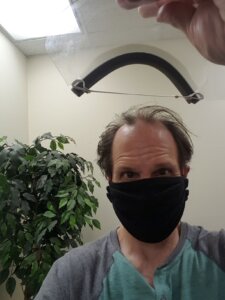
    I haven’t scared off a client with face-shield-hair yet, but I’ve gotten some looks.

    Pretty easy stuff to handle, right?

    And face shields are inexpensive.

    Mine is cheap and easy to clean. Experts recommend soapy warm water so that you don’t destroy the anti-fogging coating if it has one. I use disinfectant wipes because my shield is cheap and it’s more convenient for me to clean that way.

    At this point, you may be ready to ditch your mask in lieu of a   shield. But that is not what the experts want you to do.

    They are saying add the shield as a supplement to the mask.

    Why?

    There is not enough research to determine if shields alone are as effective as masks for protecting against COVID-19 transmission.

    Wear A Massage Therapist Face Shield

    To me, wearing a face shield along with a mask is a no-brainer.

    Protect all entry points: mouth, nose and eyes.

    Face-shield hair is fixable.

    Heating up behind a face shield can be eliminated.

    And you don’t have to scare the client if you wait to put your face shield on after the client gets on the table.

    Remember that when using a face shield to make sure the bottom of the face shield is at your chin line or below.

    Also, the face shield should wrap around to almost touching your ears.

    And there should be no space between your forehead and the shield.

    That’s it—mouth, nose and ear protected. You’re doing everything you can to protect yourself and your client.

    For more about staying safe as possible (and making money)  doing massage during COVID-19 and beyond, sign up for my email group. I’ll send you my weekly articles. It’s free:-)

  • How to Find Covid-19-Recession-Proof Clients

    Can you find recession-proof massage clients during a pandemic?

    Yes, and I’m going to show you how to in a minute, but first I want to talk explain what a recession-proof client looks like.

    I used to think that recession-proof clients were scarce because they were only the super-wealthy, like Warren Buffet. But I was wrong.

    Recession-proof clients are simply people who will still have disposable income during a recession; specifically, now, I’m talking about the Covid-19 recession to come.

    So, what’s the difference between your plain old recession and a Covid-19 recession?

    Recession-Proof Versus Covid-19- Recession-Proof

    Well, not all recessions/depressions affect industries in the same way. Sure, there are a group of typical industries that in general may tend to do well during any recession/depression, like food and sanitation.

    But then there are some that will be up or down depending on what’s causing the economic crisis.

    So, for us now, we want to know which industries are stable or are up during this specific crisis of Covid-19 so that we can find the people who have secure jobs.

    And who would that be right now?

    One industry that’s doing just fine is Pharma, especially the companies directly or indirectly involved with a Covid-19 vaccine or therapeutic treatments for Covid-19.

    But before you start spamming Merck or J&J employees to find the Covid-19-recession-proof clients I have a more practical way of ferreting them out.

    Ready?

    Tyshea, a new client, walks in your door.

    You tell her your price.

    She says okay.

    You work on her.

    She likes your work.

    Her credit card is accepted.

    She asks if she can schedule the next week.

    You say yes and schedule.

    She comes in next week, likes your massage, pays and reschedules.

    Do you want to punch me now or later?

    But here’s the thing, I’m not being facetious. This is a true way to see if a person can afford and/or is willing to pay for your massage during a pandemic.

    You don’t need to pull up Tyshea’s intake to see if she works in Pharma or sneak out to the parking lot to see if she’s drives away in a Mercedes or a Tesla.

    She already proved that she qualifies as recession-proof by paying for your massage twice and by setting up a third appointment.

    I’ll admit that proof is the easy part of getting Covid-19-recession-proof clients.

    The more challenging work is actually getting one of them to walk through your door during the middle of a pandemic.

    How to Find Recession-Proof Massage Clients

    So here’s what you’re going to do: You’re going to run a Google ad.

    Get a pencil out, I’ve got the copy. Ready?  

    Wanted people who can afford massage as the economy goes into the sh**ter?

    Okay, this time I was joking. Skip the Google ad and get your marketing message out there through free advertising.

    Here are some free marketing platforms: Your website, Facebook page, Google My Business page and Yelp page.

    What you say, how you present yourself (and your massage) on these platforms is what pulls the client in. By the way, safety sells massage for me now (and by emphasizing that in my messaging it raises my safety bar, which is only a good thing).

    The potential client will see your price on these platforms and that will act to some extent as a self-selecting process. People who can’t afford your massage will move on.

    I need to mention one thing here about free marketing, you need to respond quickly if someone contacts you. The person who found your website is not going to wait around for you to get back to her, whereas a referral will.

    Speaking of referrals, referral sources are another great way to find Covid-19-recession-proof clients.

    Referral Sources Sending Recession-Proof Massage Clients

    Here’s how it works for me. A running store is one of my referral sources and will continue to be during this pandemic.

    How do I know that?

    Running does require some money. You need good shoes, as you increase your mileage you may need some coaching, travelling to run marathons is not cheap, and conditions and injuries can come with added out-of-the-pocket expenses. Of course that doesn’t mean that all runners will have disposable income during a pandemic.

    However, an avid runner is like an AFOL (Adult Fan Of Lego), and they will spend money on the thing they love—even during an economic downturn.

    Another ongoing referral source for me during this pandemic is a local personal training business. If their clients can still afford personal training, their clients can still afford me. I don’t need another litmus test.

    Here’s a referral source that still produces for me and should continue to produce for me even if the economic situation gets dire: physical therapists.

    Now, I know this seems wrong. PTs see people who are paying through insurance. However, the PTs and PTAs who send me referrals understand that massage is an out-of-pocket expense, and they take that into consideration when they recommend massage to their patients. In essence, they screen out the ones who can’t afford me.

    Okay, that’s some of what I have going on with current referral sources. How about new referral sources on my radar?

    Here’s one. I’m looking in the boutique wellness realm for a concierge doctor, a wholistic doctor, a wellness coach, or a chiropractor whose price point is higher than most in the area.

    How will I find this referral source?

    Easy, a recession-proof client will tell me.

    Leslie, a new client, came back to see me. She had passed the recession-proof test by scheduling multiple weeks in a row.

    As we were talking about her massage treatment she mentioned how she was going to get platelet-rich plasma therapy (PRP) for her knee.

    Hmm… that might be a doctor that I’d want to introduce myself to for coordinating care and as a potential referral source.

    Leslie was also starting up with a naturopath for nutritional challenges she was having. I’m thinking the naturopath is covered by insurance, like me, and that within her practice are Covid-19-recession-proof clients. I will reach out to her in the near future, too.

    If you don’t have an intro via a client, do the cold-call email.

    It’s a number’s game. Here’s the generic email that I sent out to build referral sources in our Phoenixville office.

    Hi Lou,

    My name is Mark Liskey. My wife and I own PressurePerfect(TM) Massage (www.pressureperfectmassage.com) in Phoenixville. A good chunk of our work is with athletes and people trying to get in shape who have all sorts of preexisting conditions. 

    Recently, we’ve done free demo massages at Stellar Chiropractic (Dr. Bernard Stern) in Phoenixville. It’s working out really well. Dr. Stern’s patients get a nice perk after their adjustments and we get the opportunity to demonstrate our massage.

    I was wondering if you’d be interested in talking about setting up free demo massages for your clients? We could do it right there on the premises like we do at Stellar Chiropractic. Also, I would like to offer you and your trainers a free 30 min massage. 

    Lastly, I would love to know more about your personal training business and how we might be able to help you. Thanks for your time, Lou.

    All the best,

    Mark Liskey, BS, LMT, CNMT

    www.pressureperfectmassage.com

    www.themassageinstitute.net

    Now Is The Time

    Am I sounding very business-y?

    There’s a good reason.

    We don’t know what the economy is going to be like in a month, 6 months or a year. We need to be business-y.

    Don’t wait for things to get better.

    There are Covid-19-recession-proof clients out there. Make them your clients.

    Some are wealthy. Most are not wealthy, but will have disposable income during and after this pandemic because they have jobs that are untouched or their industries are benefitting from the pandemic.  

    Find them directly through your free marketing platforms (website, Facebook, GMB page, Yelp page), and find them indirectly through referral sources.

    Clients can lead you to good referral sources like a wellness center or a concierge doctor.

    Don’t be above cold calling or emailing potential referral sources with a special so that you can build a relationship with them.  

    You can do this.

    In fact, you’re doing it.

    Just dig a little deeper and land those Covid-19-recession-proof clients.

    By the way, if you like what you’re reading you can get my latest weekly post by signing up for my email group. It’s free:’)

  • Cutting Operating Costs During Covid-19: Bye-Bye Waiting Room

    Do you need a waiting room for your massage clients now?

    Nope.

    Will you need one post-Covid-19?

    I don’t think so.

    However, my wife wants waiting rooms when things clear out with Covid. So we’ll have to fight that one out. Hmm…I wonder who’ll win?

    If you’re still guessing, I’ll give you a clue: Not me (haha).

    Anti-Waiting Room Mark

    Why am I anti-waiting room now?

    Well, I got to experience firsthand the pluses after we closed our waiting rooms down when we returned back to work.

    Positive number one: I know who is in my office at all times.

    Along with that I can control when a client comes in by having her wait in her car until I text her that it’s safe to come in. Psychologically that does wonders for me. I feel less rushed not having someone sitting and waiting for me.

    Another benefit of not having a waiting room is that it makes the process of client check-in and check-out go faster because all of that is now done in the massage room instead of the comfy waiting room where the client is tempted to hang out.

    And here’s the new bonus of not being able to use a waiting room: I can potentially recoup shutdown/reopening losses and higher operating expenses due to Covid.

    In other words, I can move OR renegotiate my rent.

    Yes, moving requires a lot of work and renegotiating your current rent agreement requires you putting yourself out there.

    But here’s the thing, if you’re doing the same strategies you did pre-pandemic, like paying for a waiting room, you’re not going to go from surviving to thriving fast enough. In fact, you’re in for a long haul.

    How do I know this?

    Because my business limped through two crisises: 911 and the 2008 market crash.

    Working Through a Crisis

    Yes, eventually, my businesses did come back full-force after both events, but it happened at a snail’s pace because I didn’t adapt quickly enough to the new massage order.

    After the crash in 2008 my massage clients who weren’t wealthy stopped coming in, leaving me with about a 30% income deficit.

    You know what my response was? It was to hang in there until things got better.

    And, sure enough, as the economy got better, so did my business. Bubble clients, people who could afford my massage when the economy was good, started coming in again.

    But that business plan is like purchasing bonds when you’re young and can afford to be more aggressive. Low risk and low yield is what retired people do.

    Survive to thrive growth is stocks. It’s what working people do.

    Yes, I’m saying run your massage business as if you’re buying stocks, not bonds, but the analogy breaks down here because you don’t have to risk any money to accelerate your business growth during this Covid-19 time. You just have to invest some of your time and adjust how you think.

    Ask yourself right now: Where are the opportunities in this new massage landscape?

    I’ll tell you one. Back to 2008, like I had said, the crash knocked out a chunk of potential massage clients BUT it also knocked out a chunk of massage therapists. Less competition and people looking for a massage therapist because a lot of massage therapist dropped out of the game meant I had an opportunity to actually pick up clients.

    Back then I got that bubble clients couldn’t afford massage. I also understood recession-proof clients still could afford massage. What I didn’t get was that there were still recession-proof clients looking for massage therapists.

    By the way, if I had gone after recession-proof clients I wouldn’t have needed to spend any money on advertising.

    I would have just needed to focus my energy on nurturing my current referrals sources and adding a couple of new referral sources whose clients/patients/customers were recession-proof.

    During this pandemic, thinking differently than pre-pandemic is the key for not only bringing in clients, but is also the key for surviving the higher operating costs you’re incurring, and you know exactly what I’m talking about—masks, wipes, air purifiers, more sheets, more blankets and the list goes on, which brings us back to waiting rooms.

    Waiting Room Bargaining Chip

    We haven’t used our waiting rooms since reopening. In fact, in one office we took all the chairs out so that no one is tempted to sit down.

    No one blinks an eye or objects when I say please wait in your car when you arrive until I text you to come in.

    Why?

    Because takeout is delivered to car windows.

    Groceries are put in car trunks.

    Patients sit in driver’s seats until they are texted that it’s okay to come in.

    Cars are safe and guess what?

    They are the new waiting rooms.

    If you have a waiting room in your office space and aren’t going to use it in the foreseeable future, why are you paying for it?

    Okay, you may have signed a contract pre-Covid, but here’s the thing, the world has changed. Commercial real estate is available—lots of it—and there’s wiggle room for renegotiating.

    So, if you’re paying for waiting room space that you don’t use, approach your landlord about a new deal. I’m fairly sure that she doesn’t want to have another non-rented space.

    If you’re on a month-to-month you have even more leverage because there’s a lot of office space on the market now.

    I’m not saying Montgomery Burns this rent situation. I’m saying if you want to go from survive to thrive faster, look at every place where you can save money and accelerate your business.

    Rent is one of them.

    Strike a new deal.

    How to Strike a New Deal

    “Kisha, since re-opening my operating expenses have gone up, some clients aren’t coming in until it’s safer to do so, I can’t see my more normal client-load because of the extra time I need to put in between clients, and, frankly, I’m not sure if I’m going to be shut down again.

    I’m looking to cut costs anywhere I can until we get out of the throes of this pandemic. And I’m asking for $200/month reduction through the rest of the year so that I can sustain my business?”

    What if Kisha says no.

    Well, you can always go back and ask for a smaller reduction in rent, AND you can always start looking for cheaper rent.

    At this point, unless you already have a super-great deal, you’ll probably find something cheaper now.

    Is it worth it to relocate during a pandemic?

    To me, the answer depends on how much money you need to recoup. Reducing your rent by $500 a year may not be worth it. But reducing your rent by $5000 a year might be.

    What if you’re just starting out or are restarting and looking for space?

    Remember: It’s a renter’s market in commercial real estate.

    I’m not claiming the area that I operate my business in is a microcosm of office space for massage therapists globally, but my poking around has found landlords willing to make deals. And I’ve come across very competitive square footage pricing from the get-go.

    Speaking of square footage, no waiting room means less square footage to pay for.

    Yes, your office could be a 10 x 10 room.

    Your waiting room—the client’s car.

    The bathroom—a shared bathroom between offices.

    And guess what the cost of your office space is? Not much.

    You can always upgrade later when the economy gets better.

    Don’t Buy Bonds

    So, don’t miss the opportunities that come with bad times.

    It’s a renter’s market.

    Think about renegotiating your current rent or relocating your office because survive-to-thrive is an active process. You need to recoup losses and build at the same time.

    Recouping means you may shrink your business in some areas, like the size of your office, but absolutely does NOT mean that you’re shrinking your client list. In fact, you’re client list should be growing.

    If you take a passive approach and wait for the economy to recover you’re going to really struggle. Don’t. I did in 2001 and 2008. Not this time.

    Want to know when my latest Covid-19 Survive to Thrive articles are out? Sign up for my email list below. It’s free:-)

  • Raise Your Massage Rate During a Pandemic, Duh

    Who the hell is stupid enough to raise massage prices during the middle of a pandemic?

    Yep, that would be me.

    Why am I raising my rate?

    The obvious answer is that operating costs have gone up. There’s PPE, HEPA air systems, more laundry, more electricity, and more time to disinfect in between clients.

    The less obvious answer is that we don’t know how long we’re going to be carrying on with higher operating costs. It may even be the new norm.

    But you know all that already. The part you’re concerned about is what happens when I do raise my price?

    In other words, will clients start walking?

    Here’s my guess: If you’re raising your rate by $5/hour, your clients are not going to walk—even during the middle of a pandemic.

    How Not To Fear the Price Raise

    By the way, a $5 increase doesn’t have to apply to everyone. If some of your clients are struggling now because of a work stoppage or work loss, you can always make an exception to the rule and keep those clients at your pre-pandemic rate.

    And if there is someone who is completely outraged that you’re raising the price of your massage to cover increased operating costs, he can always go somewhere else, which brings me to another good reason to raise your price now: Who are they going to go to?

    There’s less competition. Not only is there less competition, but from what I’ve observed there’s less availability of massage therapists in general.

    Many massage therapists that I’ve talked to are not carrying a full load because they’re trying to figure out their new work rhythm.

    To me, that means it’s NOT a buyer’s market in massage. It’s a seller’s market, specifically for the massage therapist who owns her own business.

    But what if you’re just starting out, should you raise your price now?

    Raise Your Price Advice For New Therapists

    Well, do you have confidence in your work?

    If not, then no. Instead of raising your price you should gain confidence by getting really consistent with nailing the appropriate pressure with each massage.

    Once you do, your clients will love your massage and your confidence will soar.

    If you’re just starting out and have confidence in your work, go ahead and raise your price, but you may want to offer a discount intro massage just to get the person through the door.

    Here’s the strange thing about raising prices, in some ways I think it’s easier for new massage therapists to raise prices than it is for seasoned massage therapists.

    How’s that?

    Well, if you’ve only been with Helen for a year, she may have never told you how she scrapes together every extra penny she has to be able to afford one massage a month.

    But if you’ve been with Helen for ten years, you know exactly what she does. She uses her tax refund money, cuts coupons and never goes out to eat so that she can see you for 60 minutes of feel good every first Tuesday of the month at 5 pm.

    And that’s why you haven’t raised your price on Helen in ten years, right seasoned MTs?

    But again, you don’t have to raise the price on Helen if you don’t want to. You make the price rule and you decide on the exceptions to rule.

    Raising your price can also be cathartic if you use it to prune out your less than ideal clients.

    But there’s a caveat here: If part of your objective is to prune your current base with a price raise, you need new clients coming in—the clients who are willing to pay your price.

    You Must Have New Clients Coming In

    Always having new clients coming in is the key to schedule control and client security.

    Three weeks ago when we re-opened, I didn’t book my week solid with all the people banging at my door to get in. Like many other massage therapists I wanted to see how I was going to manage flow and operations with all the extra stuff that now needed to be done.

    So, I had the instant problem of too many clients and not enough spaces open. Besides my regulars I had several new clients waiting in line to come in.

    Normally, I would keep the new clients waiting, but this time I didn’t. I booked my A-list regulars (consistent repeats paying full price who I really like working with) and I put my B-list regulars (clients who change appointment times, are not fun to work with and/or pay a discounted rate) on the backburner. I then inserted new clients in the schedule gaps.

    And guess what, just like before the pandemic some of the new clients are becoming regulars; however, these new clients are now at my new rate ($5/hour higher).

    This gives me a good problem—less space for my B-list regulars. And when I hit the B-list regulars with the price increase, I won’t be worried if some of them walk because the new clients who I want to work with will be taking their place.

    By the way, if you don’t have enough clients because you’re starting your business or have gotten used to a massage practice that is barely making it, I have a thought experiment that can help you move in the right direction to bringing in more clients.

    Thought Experiment: What If I Had To Move…

    Imagine that you suddenly had to move and you had no choice where you were going to move to. At this new location, you have a massage room that you rent for cheap. You are not allowed to work for anyone else as a massage therapist and you have one month to figure out how to pay rent and pay your bills doing massage in your massage room.

    What would you do to bring in clients?

    Here’s what I do.

    I’d run a special, like a Groupon, to get fast income.

    If the space came with an opportunity to put up outside signage, I would have that sign up immediately.

    I’d aggressively target 2 to 3 health professionals to be primary referral sources.

    I’d put up a website.

    I’d claim my business on Google and build out my Google My Business page.

    I’d claim my business on Yelp and build out my Yelp page.

    What I like about this thought experiment is that it has built-in uncertainty, just like our current situation of working during a pandemic. And the point of it is not to cause you more stress. It’s to give you a sense of how prepared you are at bringing in new clients right now during Covid-19.

    If you don’t have a punch list like I do, then you’re probably not prepared to bring in more clients now.

    If you need to start thinking in a bringing-in-clients way, so that raising your price is a secure move, check out Covid -19 Massage Reopening: Rebuild with Online Reviews.

    Here’s the last thing I want to say about raising your price: It won’t be psychologically uncomfortable for long.

    The psychological discomfort of raising your price happens when you imagine telling your clients that you’re going from $60 to $65 OR $65 to $70 OR $75 to $80 OR $85 to $90.  

    But what happens when you play out that thought?

    Thought Experiment: Raise Your Price By $5/hr

    See yourself doing a $5-more-an-hour-massage. Are you doing a worse job than when you were at a cheaper price?

    No.

    In fact, you’re probably unconsciously upping your game because you’re, well, making more money and feeling more valued. I’m not saying that you were underserving your client before the price hike. I’m saying that, in general, happier massage therapists produce better work than unhappy massage therapists who feel undervalued.

    Now, let’s take this a step further.

    Take that extra $5/hour and multiple that out for the week. If you do 20 massages a week that’s an extra $100 a year. If you work 50 weeks a year that’s an extra $5,000 a year.

    Do you see your quality of work going down in your head?

    Or is your focus on your client getting even sharper because your hourly rate is an exchange, and you’re making sure that you’re holding up your end of that exchange?

    Thought Experiment: Raise Your Price Even More

    For fun, imagine increasing your rate by $15/hour.

    What happens in your brain now?

    Sit with it.

    Is your mind automatically figuring out ways to balance out the exchange. For instance, currently you may balance out the exchange by never shorting clients’ table time but as you raise your price by $15 an hour you may now see yourself responding faster to appointment requests.

    There’s no right reaction to this thought experiment. It’s just a way to get you beyond the negative kneejerk reaction of raising your price so that you can potentially see how you might balance the exchange equation in your mind.

    Oh, I lied. I said that I only had one more thing to say, but I have something else to say and it has to do with raising your price and attracting the client who can afford that price before something bad happens.

    When we, humans, have control over the Covid-19 situation what are national economies going to look like?

    If you’re in the US with me, I think it’s prudent to plan for a worst-case-scenario, like a market crash.

    Who can afford massage during a crash?

    Not people who can barely afford your massage now.

    Again, they can be your charity cases during tough times.

    Now is the time to line your schedule book with Recession/Depression proof clients. Raising your price will help you find them.

    Okay, now I’m done…for now.

    If you want to raise your price with me during the Covid-19 pandemic, here’s my recipe.

    Raising Your Price In a Nutshell

    1. Don’t focus on all current clients.

    2. Prioritize your A-list clients and new clients coming in.

    3. Have mechanisms in place that bring in new clients so that you can feel secure about pruning B-List clients.

    Here’s my experience with raising my price:

    4. If you’re not in my email group to get my weekly information that is currently focusing on “how to not die or kill anyone and make more money during Covid-19”, then join. It’s free:-) and  you can unsubscribe anytime.