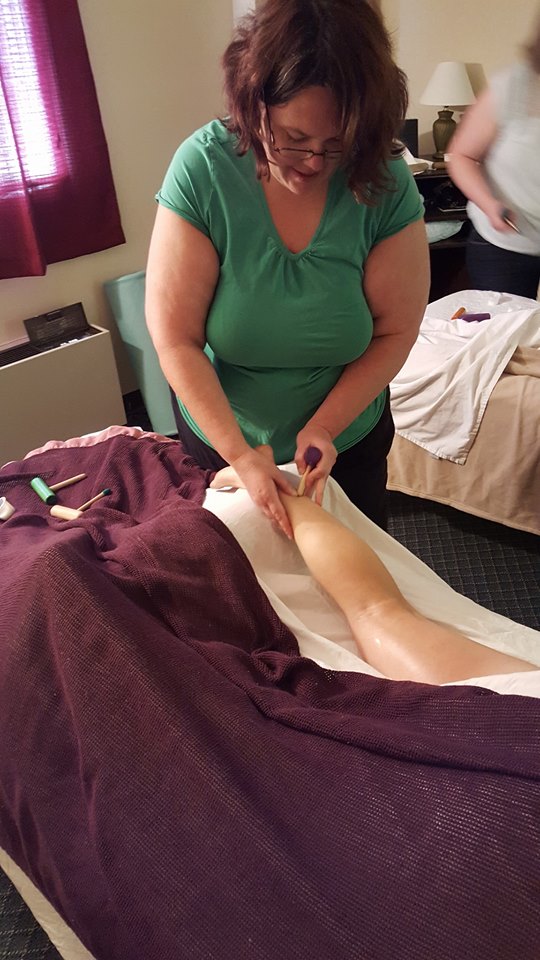
Author: Mark Liskey

  • How to Reciprocate with a Massage Tool

    How to Reciprocate with a Massage Tool

    Massage tools aren’t just about saving hands. They can also enhance your massage. One of my favorite pain-relief/relaxation techniques is to reciprocate with a massage tool.

    Reciprocate with a Massage Tool

    When I say reciprocate with a massage tool, I mean to go back and forth over a focus area (tight/tender spot or if you subscribe to trigger point theory, a trigger point).

    My clients tell me that reciprocating with a massage tool is relaxing and helps to relieve pain.

    And there’s a bonus: That back-and-forth (side-to-side) motion is a great way to palpate because you can sense differences between tissues as you glide across an area.

    Reciprocating with a massage tool is easy. Here’s what I do:

    1. Pin the massage tool between one hand and the area to be massaged.
    2. Put finger(s), knuckle(s) or thumb from the other hand down next to the massage tool tip to brace the tool.
    3. Move the massage tool back-and-forth over the focus area.
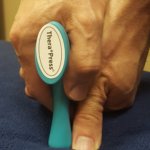
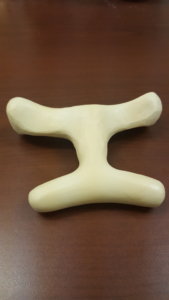
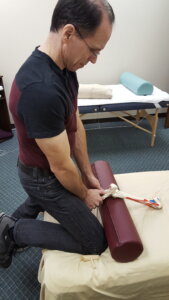
    Here’s one way it could be done with the TheraPress. The brace hand is the one with the thumb down next to the tip of the TheraPress.

    When you go back-and-forth with the TheraPress keep your hands and the massage tool together, and move as one unit.

    So why not just use one hand to reciprocate?

    Pin and Reciprocate with a Massage Tool Q & A

    Well, you could use just one hand.

    But with two hands you have better control over the massage tool.

    Here’s why: When using two hands, the hand that’s holding the massage tool basically has one job to do–pin the massage tool against the tissue–while the bracing hand does a good chunk of the tool stabilization.

    Since the holding hand is doing minimal stabilization it’s easy to move that hand to direct and angle the massage tool.

    Also, the two-handed hold means you can relax your hold on the tool because the brace hand is stabilizing the tool.

    If you’re using one hand, that hand has to both stabilize and press which means you’re grip will automatically tighten.

    Reciprocate with a Massage Tool Test Drive

    Test out different tools and two-handed holds.
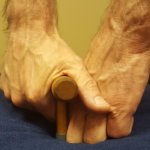
    This is a T-bar. I’m doing the exact same thing that I did in the TheraPress picture above, but instead of bracing with a thumb/fist, I’m using knuckles this time.

    If I want more pressure on the tender/tight spot, I simply lean more of my weight into the T-bar, but not into my bracing hand.
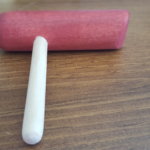
    This is an L-bar.

    To reciprocate with an L-bar I do things  a little different.

    First, notice how small the tip of the L-bar is. It’s much smaller than the TheraPress and T-bar tips.

    Reciprocate with the Bracing Hand

    Since the L-bar is designed for precise pressure, using two hands to reciprocate the L-bar is overkill, and I’m in danger of ramping up the pressure too much. So here’s what I do.
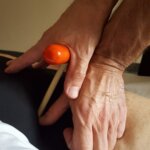
    I still do a two-handed hold, but instead of moving both hands as one unit to reciprocate, I reciprocate with the bracing hand.

    In the picture, I’m reciprocating with the thumb of the bracing hand.

    The hand holding the L-bar is not moving the L-bar back-and-forth. It is simply stabilizing the tool as I lean into it.

    When my bracing hand/thumb moves the tissue back-and-forth, the tip of the L-bar moves, too.

    Pressure is really easy to regulate this way since the hand that’s holding the tool doesn’t have to help move the tool back-and-forth.

    I also reciprocate with the bracing hand when using the T-bar and TheraPress. It just depends on the situation and which technique is easier to do at the time.

    If you looked at all the time I reciprocate with a massage tool during a week, this would be my massage tool usage breakdown:

    T-bar: 60% of the time.

    L-bar: 30%

    TheraPress: 10%

    I use the massage tool reciprocating techniques on tendons, too (especially biceps and hamstrings tendons).

    Ready To Try It?

    1. Pin the massage tool with one hand.
    2. Brace it with the other.
    3. Reciprocate keeping the massage tool and hands as one unit OR reciprocate with the bracing hand.

    Want to get good with massage tools?

    This online, home-study course (2.5 CEU) will get you comfortable with using a massage tool in any massage that you do: How to Use Massage Tools (Fearlessly and Effectively).

    This online, home-study course (2.5 CEU) will help you brand yourself as an expert with focused pressure: Advanced Massage Tools.

    Where to Get Massage Tools

    If you think that you’re ready to experiment with some massage tools, here’s where you can get the TheraPress, T-bar and L-bar.

    TheraPress: Ebay or Amazon would be my choice.

    T-bars (standard): Neuromuscular Solutions

    T-bars and L-bar (customized): Matt Johnson.
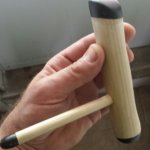
    Matt makes all my wooden massage tools. When I teach Massage Tools classes I use his massage tools because I can have tools made for all sizes of hands.

    His prices range from $15 – $30 for a massage tool depending on what you want. Just email him for more information.

    T-bar (plastic): Career Extenders


  • Effleurage T-bar Review

    Effleurage T-bar Review

    When I asked Merrill Lund about which of his massage tools to try, I was a bit surprised when one of the tools that he sent me was the Effleurage T-Bar.

    For one, I already had a lot of effleurage tools on me, like my hands, knuckles, fists and forearms.

    So, why would I need another?

    Secondly, here’s what the Effleurage T-Bar looks like:

    Not the friendliest looking massage tool you’ve ever seen, right?

    But from a functional design standpoint, this tool is balanced and feels good in my hands. (Hands is not a typo. The Effleurage T-Bar is a two-handed tool in my book. More about that later.)

    The Pluses

    Here’s what else I like about the Effleurage T-Bar:

    (1) It’s a great alternative to using palms, fists and forearms when doing effleurage strokes.

    I believe in changing things up whenever possible in order to spread out the workload. This tool gives my fists (my main effleurage body part) a break.

    (2) It’s a solid massage tool when working the lower back, hamstrings, quadriceps and IT band.

    If you hold the tool with two hands and use your body weight to generate pressure, the Effleurage T-bar is really easy to use on back and leg muscles.

    (3) It can be a broad and precise effleurage tool at the same time.

    By pressing with more pressure on one edge of the tool you can focus your effleurage stroke on a particular area of the body with ease, which makes this tool effective and easy to use on feet, too.

    The Challenges

    Here are some challenges with the tool (but didn’t prevent me from buying it).

    (1)  The tool can look intimidating to clients.

    Solution: I don’t keep the Effleurage T-Bar in a place where clients can see it.

    (2) It’s heavy.

    Solution: Use two hands to hold the tool and that will offset the heaviness.

    I show you how I do that in the video below.

    Here are the types of clients I use the Effluerage T-Bar on:

    (1) Body part clients, like runners, cyclists and triathletes.

    I especially like this tool when I’m working lower quads and along the IT band/vastus lateralis overlap.

    (2) Full body massage clients who have leg issues and/or lower back issues.

    This tool works well when effleuraging the lower back of average to large sized clients. When working in the lower back of thin clients, I’d rather glide with my hands or a small massage tool.

    Bottom line for me: The Effleurage T-Bar is one of the tools that I use in my effleurage rotation (hands, knuckles, fists and a variety of other hand-held massage tools) for body-parts work and/or focus work (especially back and legs) during a general massage.

    Below I demo how I use The Effleurage T-Bar on quads. You can purchase the Effleurage T-Bar from Career Extenders here.

    Massage Tools Online Class

    If you want to save your hands by being able to use massage tools in your massage, then this is the class for you: How to Use Massage Tools (Fearlessly and Effectively), 2.5 CEU (NCBTMB-approved), online, home-study course.

    If you know something about massage tools and want to brand yourself as a focused pressure massage therapist, then check out this course: Advanced Massage Tools, 2.5 CES (NCBTMB-approved), online, home-study course.


    Ad

  • Massage Technique Course Versus Massage Business Course

    Massage Technique Course Versus Massage Business Course

    When’s the last time you took a massage business course?

    Hey, I get it. I once avoided them like the plague.

    For one, I wasn’t so interested in being business-y, especially when I thought being business-y meant that I had to be a jerk.

    Two, my brain just didn’t think in terms of “business”. It thought in terms of “massage”. Sorry world, deal with it.

    Three, I always needed to improve my massage skills and knowledge. After all, the better I got doing massage, the more clients I would have.

    My massage brain ran the show. But guess what?

    It didn’t work out so well for me.

    Why not?

    Money.

    As in, I didn’t make enough.

    The Case for Taking a Massage Business Course

    At some point in massage we all face the money thing. We love massage, but where’s the money?

    Believe it or not, it’s out there.

    And if you’re not making the money you want to make it’s because you’re not approaching massage from a business perspective.

    This is soooo fixable.

    Let’s start by examining the massage brain we all possess.

    Changing Our Massage Brains

    1. First, you don’t have to be a jerk to be business-y.

    Uh, remember Enron and Lehman Brothers, Mark?

    They were jerks. But you’re not. I’m not. Millions of other businesses aren’t. Jerk-y is a choice. We’ll never be that and no one will ever make us that. Period. End of story.

    2. Next, massage brain says I can’t learn this business stuff.

    And besides, experts say to focus on what you’re good at—that’s why I stick to massaging clients.

    That’s easy to say if you’re not a one person show. But when your livelihood depends on just you, you better learn how to bring in clients.

    By the way, learning the business stuff won’t be as bad as you think it will be for this reason: You just need to be competent at the business stuff, not great at it.

    I manage our one office in Phoenixville.

    Is it my strong suit?

    Absolutely not.

    Did I learn enough to make it work?

    Yes.

    Will I hand that managing baton to someone else as we grow so that I can focus on what I’m good at?

    Can’t wait for that day:-)

    The point is that you may not like a business job, but you can learn to be competent at that job with a little work.

    Last massage brain hurdle and it’s a biggie.

    3. Massage brain says you have to prioritize improving your skills over everything else.

    Staying on your game is really important, BUT it’s a big, fat mistake if improving your skill is your only plan to bring in more clients.

    I know this firsthand. When I became certified in neuromuscular massage I thought my office at the gym was going to explode with clients.

    Not even a little bang.

    The fact is that more knowledge may help you to do a better massage, but it isn’t the key to bringing in clients.

    What is?

    Marketing.

    Time to Get Business-y

    I think this article is a really good place to get your feet wet with marketing. Though it’s not a  massage business course, it has very practical advice about marketing for us massage brain people.

    Oh, you’re sad.

    Don’t be.

    We’re not trying to turn you into Warren Buffet here. You just have to get competent with doing business-y things, like bringing in clients.

    You can take a massage business course.

    You can read my article.

    You can read other peoples’ articles.

    Just take a step in the business direction. And at some point more clients will start coming in.

    Once that happens you’ll never want massage brain running the whole show again because you’ll have more money AND you’ll have the security of knowing that you can bring in clients consistently and forever:-)

    Free Getting Your Business Off The Ground Course

    If you want a jump start with the business stuff, check out my free Jumpstart course.

    And if you want need to take your business to the next level, go here: Accelerator.


  • Don’t Do Static Posture Massage

    Don’t Do Static Posture Massage

    Want to trash your back? Do massage in the same body position (static posture massage) day in day out.

    It’s easy to get stuck doing that. You come out of massage school green.

    You start cutting your teeth at a spa or chiro’s office. As you gain confidence you develop your way of doing massage.

    Massage life is good–until one day when your back hurts. A month later it still hurts.

    Now what? Change the way you do massage?

    No way. Quality of work would suffer, right?

    There’s another way to approach this. Instead of changing your way of doing massage, tweak it.

    To explain what I mean I need to circle back to static posture.

    What is it?

    Static Posture

    It’s a fixed body position.

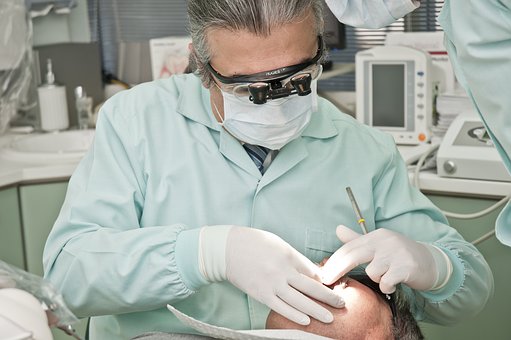
    Think hairstylists, dentists, mechanics, data entry workers, and us, massage therapists.

    The problem occurs when you’re in a fixed position for extended periods of time while you’re physically exerting yourself.

    Why is that bad?

    Because protracted  static posture increases loads or forces on muscles and tendons in specific areas. When this happens fatigue occurs in these areas because blood flow is impeded. When blood flow is impeded there’s less replenishing of nutrients and elimination of metabolic waste. In other words, tissue recovery is not good.

    It’s a perfect set up for back pain.

    Now think about your way of doing massage. Seeing some static posture moments?

    Time to make some adjustments.

    The Tweaks

    For office workers, adjustments are fairly easy. You get up from your desk and walk around every hour or so to give your desk muscles a break.

    But you can’t exactly do that in a massage, right?

    Hey, be back in 5. Why don’t you finish up your feet for me while I’m gone. Cream’s on the stool.

    But you can change positions so that you’re not in the static posture massage cycle throughout most of the massage.

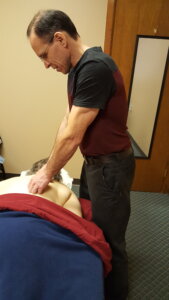
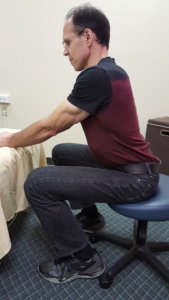
    Here’s a common static posture in massage.

    Hunching with head down.

    So how I can I interrupt this static posture massage cycle without rewriting how I do massage?

    One way is to find times during the massage when you can change your back position. Here are some examples:

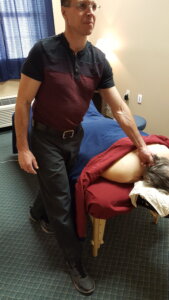
    1. Take a knee on the table when standing and working on feet.

    2. Sit and lean whenever possible.

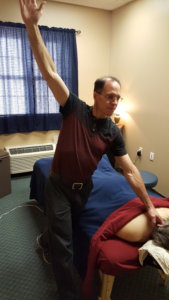
    3. Massage with one hand so that you can straighten up.

    And stretch if you want to.

    One-handed massage is one to challenge your old habit of hunching. Try other ways to…

    4. Get vertical during the massage.

    Here’s how I do that: Advanced Massage Body Mechanics: Get Vertical.

    We Got It Good

    Can you imagine a dentist experimenting with different ways of standing or sitting while working?

    That’s called a lawsuit.

    A dentist can’t avoid static postures if she wants to get the job done safely and effectively.

    But for a MT, static posture is a habit.

    Break the habit.

    Save your back by looking for times when you can get out of your normal massage position and still do your job effectively.

    Can you massage pain-free?

    Yes.

    And you can get CEU credits.

    Take the pain quiz.

    Get an instant video to help you with your pain issue and a recommended CEU class.

    Pain Quiz