Author: Mark Liskey

  • How to Do a Great Massage at the End of the Day

    How to Do a Great Massage at the End of the Day

    You have 8 hours of massage to do. And your last 3 are deep tissue. How do you make the last massage as good as the first? You get hyper-efficient with how you do your work (hyper-efficient massage).

    But before you can do hyper-efficient massage, we need to talk about just doing massage efficiently.

    I use two categories to explain massage efficiency: (1) work and (2) rest/recovery.

    And you’re probably thinking resting while doing massage is called napping, Mark.

    Well, resting while doing massage is close to napping, but not quite. We’ll get into that in a minute.

    Let’s start with working efficiently.

    Working Efficiently

    Working efficiently means that you’re maximizing your productivity with minimum wasted effort.

    Here’s how I do the work part of massage effortlessly:

    1. Lean for medium to deep pressure.

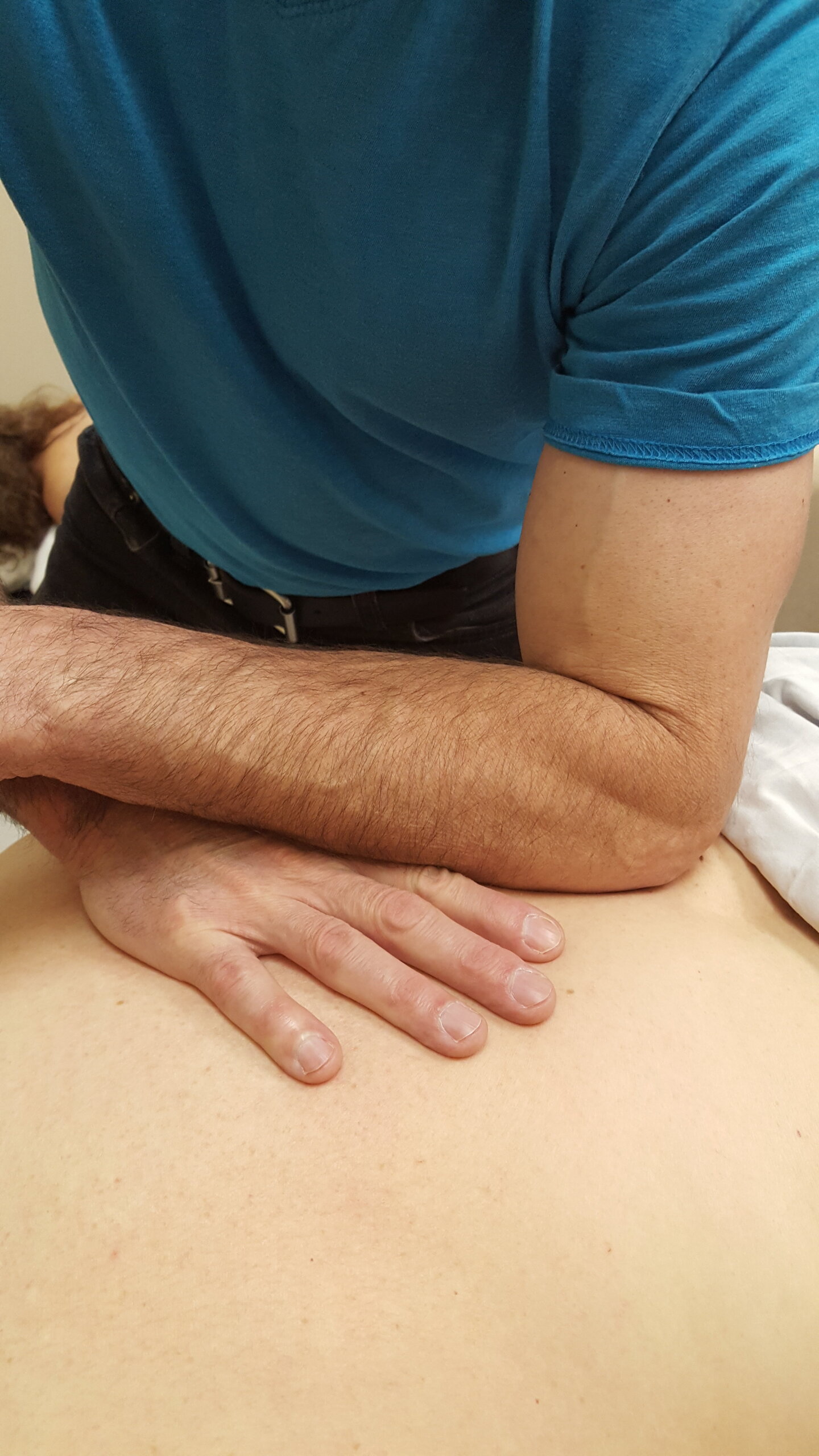
    I use a lock, stack and lean technique for medium to deep pressure. You can read more about that here.

    1. Keep the feet moving.

    If you’re not moving your feet to get into the proper position to lean, your work will become harder because you won’t be able to efficiently transfer your body weight onto the client. Here’s how I move my feet:

    [embedyt] https://www.youtube.com/watch?v=omwk-NyVjZU[/embedyt]

    There’s more, but if you do these 2 things–lean and move your feet–you’re gonna be pretty efficient.

    And that will get you through the first 5 massages of your 8-hour massage day.

    Then walks in Hour 6, and Hour 6 wants a deep tissue massage.

    What usually happens next?

    Your brain hurts and your body is tired and your form starts slipping, right?

    But this is precisely the time that you can’t give into fatigue. You must get hyper-efficient (be even more efficient than you were for the first 5 hours).

    Working Hyper-Efficiently

    How’s that going to happen when I’m ready to fall on my face, Mark?

    You’re going to talk yourself into hyper-efficiency.

    “Move your feet, buddy.”

    “Come on now, stop reaching.”

    “You got this…fifteen more minutes to go…relax your shoulders….”

    As you talk to yourself you start to become acutely aware of every move you make. With this  new, laser focus on form you can correct any sloppiness that has occurred because of fatigue and you can take it a step further by removing all inefficiencies that were getting past your radar when you were less tired (massages 1 – 5 of the day).

    Now the work gets easier again and you can fight off the droopy feeling.

    But that’s only half of what you’ll need to know to be 100% hyper-efficient.

    Here’s the first step of the other half: You need to be efficient at resting/recovering while doing a massage.

    Resting Efficiently

    How do you rest during a massage?

    1. Take a seat.
    2. Rest your arms on your legs when sitting.
    3. Relax (instead of tightening up) into the lean.

    And you can give your overworked postural muscles a break by doing this;

    1. Get upright.
    2. Lean against the table.

    Do these things to get through the first 5 massages.

    Then become hyper-efficient with relaxing to conquer hours 6, 7 and 8.

    Resting Hyper-Efficiently

    How?

    Turn “resting” up a notch.

    Look for every opportunity where you can sit, lean into the table and get vertical. 

    When you do, you’ll find more opportunities than you had thought were available. Jump on these opportunities and you’re body and brain will thank you.

    Here’s the short version.

    Hyper-Efficient Massage in a Nutshell

    Massage hours 1 -5:  Be efficient with work and rest.

    Hours 6 – 8: Be hyper-efficient with work and rest.

    When fatigue moves in, talk yourself into hyper-efficiency.

    Then you’ll start to see when body mechanic errors are creeping in and when you’re missing resting opportunities.

    Make the corrections and rest like you’ve never rested before.

    Being hyper-efficient will not only make your last massage as good as your first, it will also make you realize that you can handle much more than you had thought:-)

    Want to make sure that you can do a lot of massage and not be in pain?

    Check out Delivering Deep Pressure Without Hurting Yourself.

    It’s a 3 CEU, online, home-study course. It has all the strategies and techniques that allow me to work 6 to 8 hour days.
     

  • Advanced Deep Pressure: How to Bring Just Enough Pressure

    Advanced Deep Pressure: How to Bring Just Enough Pressure

    Are you getting a name for yourself because of your deep pressure massage?

    Or do your clients come to you because you’re the only one who can get that tight spot?

    Yeah, well, how ya feeling?

    Shoulder a little iffy?

    Neck tight?

    Fingers numb?

    Thumb aching?

    If so, there’s a good chance that you’re doing more work than you need to be doing.

    A while back my elbow hurt. My fingers tingled. My neck burned. And my shoulder was major crunchy.

    It was a rough time for me. I needed to figure out a new way to do deep pressure massage or find a new career.

    As I experimented with new ways (for me) to do deep pressure, like lowering my table and shortening my stroke, I discovered something else that was contributing to my pain: I was working a lot harder than I needed to be working.

    If you pride yourself on bringing it, then you probably don’t think twice about fully exerting yourself with each deep pressure client.

    The question is: Do you need to be bringing it 100% of the time with each deep pressure massage client?

    No.

    There’s wiggle room with deep pressure.

    In other words, at times during a deep pressure massage you may only need to bring 80%.

    Have a few deep pressure back-to-backs and that 20% means a lot.

    Deep Pressure Wiggle Room

    I discovered the deep pressure wiggle room when using massage tools.

    Massage tools made delivering precise deep pressure really easy. So much so that I could relax my body.

    In such a relaxed state I started to wonder how much pressure did I

    actually need to deliver to keep my deep pressure client happy?

    So I started to back off my pressure at times.

    Guess what happened?

    Nothing.

    Huh…I had thought that deep pressure was an all or nothing phenomenon, but my clients’ reactions (satisfaction with the pressure) when I did NOT bring it all the time told a different story.

    Deep pressure wasn’t and on/off light switch. It was more like a dial.

    Between a certain range, like 80% exertion (application of force) and 100% exertion, I could play.

    By the way, I don’t work hard even at 100% application of force. Here’s how I deliver pressure with minimal effort.

    So how do you experiment with the deep pressure dial and not lose clients?

    1. Take time to accurately figure out the deep pressure requirement of the client.

    Some clients don’t actually want your 100% deep. They may actually want your 75% deep or 85% deep.

    This is easy to figure out with new clients. First, talk to the new client about pressure.

    Then on the table figure out what pressure feels best to him.

    This is when you can really start to dial in your deep pressure. Let’s say Wil is on your table.

    Using your “I’m giving it all she’s got, Captain” (100% deep) pressure as a mental reference point, dial your pressure down to 80% to start the massage.

    How does that feel, Wil?

    You can go deeper.

    You turn the pressure dial up t0 90%.

    A little too much, Wil says.

    You dial it down to 85%.

    Perfect.

    But that’s a new client. What about old clients who want deep pressure massage?

    Can you dial back your pressure on them?

    Why yes you can.

    You just need to…

    2. Test “less pressure” in areas where expectations aren’t 100% deep.

    Linda, a client of 20-ish years, liked deep pressure in her upper thoracic and lumbar erectors.

    For the nearly 1000 massages I had done 100% deep over her entire back–but then when I got injured I needed to try something different.

    Here’s what I did. In the areas that Linda loved deep pressure (upper and lower back), I gave her my 100% deep.

    But in the areas that were not on her radar, like mid- and lower thoracic back, I backed off my pressure to 75 – 80% .

    And it worked.

    My body was happy and Linda never asked for deeper pressure in the non-primary areas.

    At this point I have to tell you that I’m a little nervous for my long-term, deep pressure MTs who are reading this article.

    Because even if what I say resonates with you, here’s what’s going to happen next: You’re going to do your next deep pressure massage at 100%.

    Why do I know this?

    Because that’s who you are.

    You’ve identified yourself with deep pressure (100% all in). And you don’t want to lose that identity–even for a couple of seconds–by going to light and having someone ask you go to deeper.

    Let me save you a case of cervical radiculopathy.

    You can still be Helen-The-Great-Deep-Pressure-Massage-Therapist without going 100% deep all the time.

    1. At the beginning of the massage figure out the kind of deep pressure the client actually wants.
    2. Then experiment in non-primary, deep pressure areas to see if you can dial back the pressure some.

    Can you be an expert with deep pressure fast and for cheap and get CEU credits for it?

    Yes.

    Go here.

  • How NOT Doing Massage Makes Money

    How NOT Doing Massage Makes Money

    If you’re not doing massage then you’re not working.

    What do you think about that statement?

    It makes sense, right?

    If you’re not actually doing massage then you’re not bringing in money.

    But there’s another layer here.

    That statement doesn’t say anything about how to get people on your table so that you can be  doing massage (making money).

    In fact, if that’s your mindset–I’m not working unless I’m being paid to massage–you’ve hit a roadblock to bringing in clients and building a massage business.

    So what am I supposed to do, Mark, work for free?

    Actually, yes (but that’s a qualified yes).

    You work for free now as an investment for a return later.

    I know that unpaid work for future dinero is a hard concept to swallow. It took me a long time to accept. Here’s why I think we (MTs) struggle with this concept.

    Always Doing Massage Brain Explained

    We’re in a business of instant $.

    If you work for yourself you get paid every time you work on a client.

    But I don’t work for myself, Mark.

    You get tips, right?

    When the massage is over the client hands you some cash. Boom. Instant $.

    Massage work = instant money.

    Believe me, I love instant money as much as you.

    But instant money reinforces the idea that “if you’re not getting paid right away, you’re not working”.

    This is a problem because if you want more clients and/or want to build a massage practice, you’ll need to put in some work time even though there will be no instant payoff.

    But, Mark, I’m good at my massage. My work will speak for itself and my business will grow.

    If you have a mortgage, kids in school, or debt from massage school then you better hope that your work speaks really, really fast.

    The reality is massage is competitive. And you’re not going to make the money you need to make until you start putting in some “free” time.

    Our Phoenixville office is in massage row. And within massage row are a lot of talented MTs.

    Who gets the clients?

    The person who works for “free”.

    But remember you’re not really working for free.

    You’re working for future money.

    You’re investing your time now for a financial reward in the immediate, near and distant futures.

    By the way, I’m still a work in progress when it comes to thinking I DON’T have to be doing massage in order to be working.

    Last month we opened up our third office. And being an introvert means I’ll do anything I can to NOT  meet people.

    So, one day this week, I had found a lot of things I could do on the computer for our new office.

    I thought to myself: Yeah, I’m doing unpaid work here for the future growth of our business.

    And I was ready to give myself a pat on the back when something didn’t feel right.

    Here’s what didn’t feel right: Our business didn’t need me to do computer stuff right now. It needed me to get my butt out there and let people know that we we’re open.

    So, I forced myself to visit other businesses within walking distance of our office.

    The first place I went to was a local fitness center. To my surprise, the owner, Bill, wanted to talk and talk and talk…

    About 15 minutes into the conversation I reverted back to the “MT must rub” mentality.

    I thought: We have new bills to pay. I need to be doing massage. What a waste of time!

    But then I remembered how building relationships at our Phoenixville office netted clients.

    There we consistently get referrals from chiropractors, personal trainers, and the local running store.

    All of these relationships were built through “free” work.

    So, cool your jets, Marky. You ARE working.

    I ended up talking to Bill for an hour.

    Was that a good “free” work investment?

    I honestly don’t know.

    But I do know that Bill and I connected and I will continue to explore ways we can partner on some things in the future.

    And if nothing else, I’m learning how to get better at making “free” work payoff.

    Ready to invest your time now for future business?

    Here’s a good place to start: Build referral bases.

    Need more help?

    Join my email group.

    I’ll send you my latest info weekly.

    Sign up below:-)


  • How to Combine Body Parts (Save Your Hands)

    How to Combine Body Parts (Save Your Hands)

    Sometimes you just can’t change a situation. You have to suck it up and move on. Hand pain when doing massage isn’t one of those times–if you learn how to combine body parts to press and glide.

    How can I be so confident?

    Well, I’m a wimp.

    And being wimpy has pushed me to discover new ways (for me) to do massage that don’t cause hand pain.

    Here’s how it works. Basically when my hands start to bother me when I’m massaging I look for a way to make them feel better.

    I’m not talking about stretching or doing exercises after the massage.

    I look for ways to reduce or eliminate the pain while I’m working.

    This is true not just for massage but for any physical work I do.

    Let’s say I’m cutting a plastic light cover with with a utility knife and my holding hand is cramping.

    Wimpy me wants to end the pain so I hold the plastic cover a different way.

    If my right arm gets tired turning the screwdriver, I switch to using my left arm.

    Is my non-dominant arm as good with the screwdriver as my dominant arm?

    Nope.

    But after some practice, my non-dominant arm gets the job done.

    Massage is no different.

    We can change how our hands feel by making adjustments and trying out new ways to do massage.

    At this point, if you’ve read my articles before, you’re probably guessing that next words I’m going to type are going to be something about massage tools.

    No tools this time.

    Today I’m talking about how to combine body parts.

    Like a knee and an elbow?

    Not quite.

    More like a thumb and a knuckle.

    Or overlapping fingers.

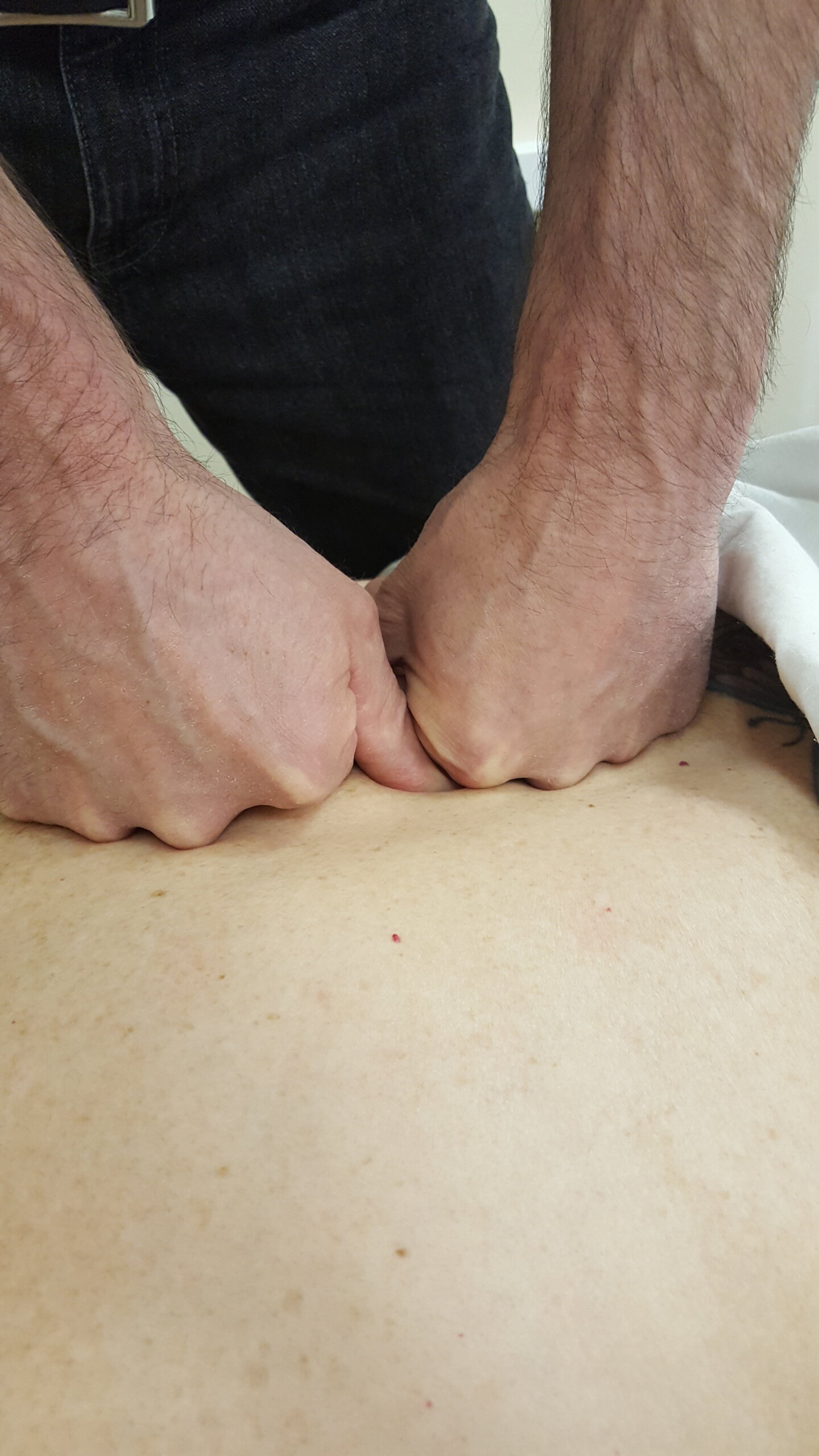
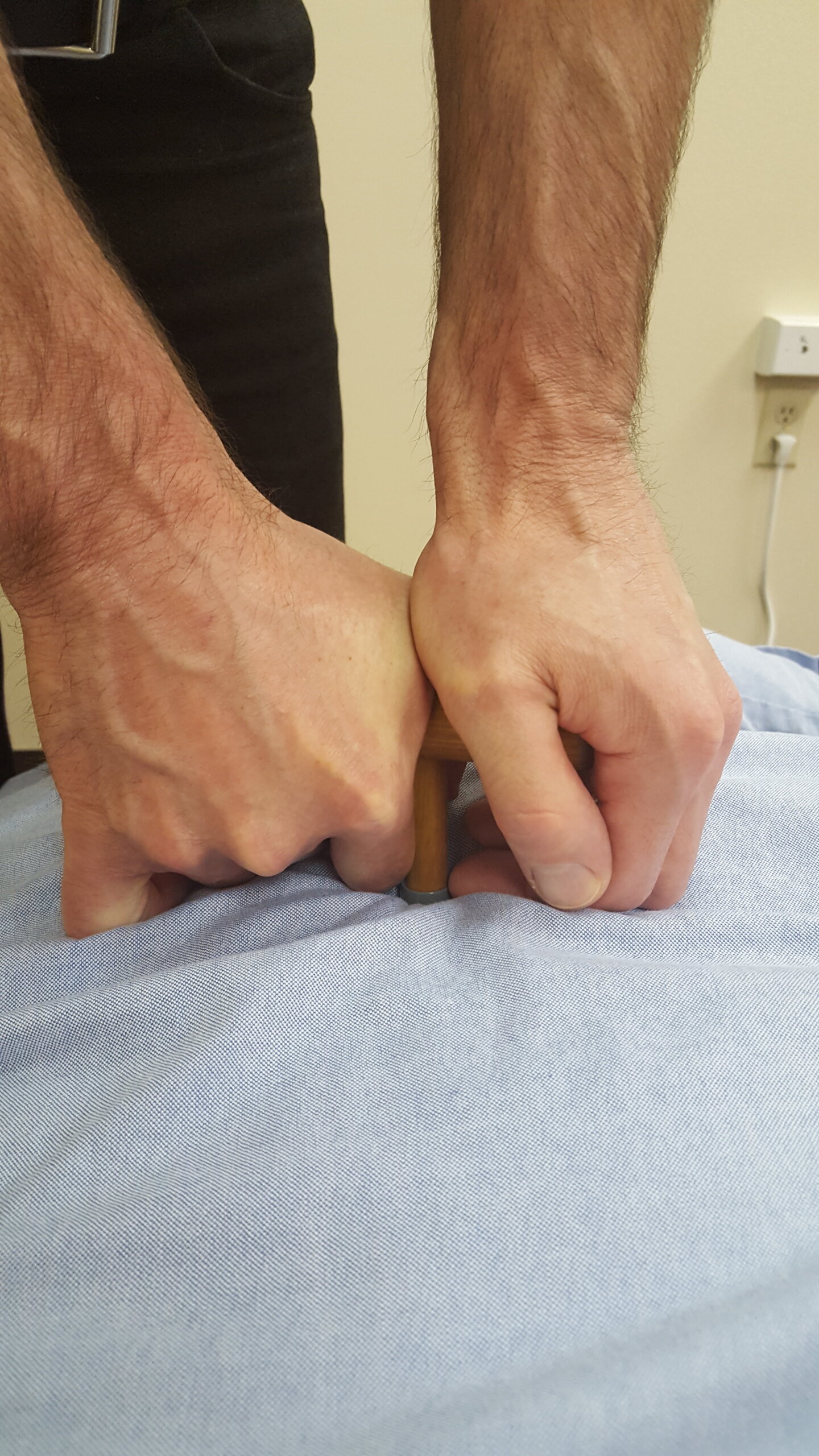
    When you combine body parts to press or glide you distribute the workload so that one body part (e.g., finger) isn’t doing all the work.

    And the primary pressing/gliding body part is getting some bracing action to boot.

    Okay, enough talk. Let’s combine body parts.

    How to Combine Body Parts

    In this video I give you examples of my favorite body part combinations. Once you start experimenting, you’ll probably come up with some of your own.

    This video is about transitioning between body part combinations. The idea is that the more fluid you are at using body part combinations, the more likely you’ll make an adjustment when a finger or thumb or elbow starts hurting.

    Want to know how to massage pain-free?

    Take this pain quiz.

    You’ll get an instant video that will help you with your particular issue.

    Pain Quiz