Category: Building a Pain Relief Massage Practice

  • Pain Relief Massage: Tibialis Posterior Tendonitis

    Pain Relief Massage: Tibialis Posterior Tendonitis

    If you work with athletes or someone with flat feet, you may have already encountered tibialis posterior tendonitis (TPT). A person with TPT may feel pain in the arch of the foot, medial side of the ankle and/or deep in the calf. A tibialis posterior pain reduction massage might be in order.

    I’ve found 2 keys to helping a client walk out of my office in less pain: 1. Look for pain in 3 places 2. Give the right dose of pressure.

    Lost Arch—Almost

    My first true case of working with a tibialis posterior condition turned out to be a tendon tear. In the past, Tom had come to see me for a stiff neck and a frozen shoulder. But when he came in with extreme pain in his arch/ankle with reduced foot functionality, I knew he was waay beyond anything I could do to help him.

    He went to the orthopedist and eventually found out that his tib posterior tendon was 80% torn. Yikes! If it went completely, the surgeon said, Tom would completely lose his arch and wouldn’t be able to do the recreational activities that he loved, like running and basketball.

    Tom had his tib post surgically repaired and it was a huge success. Now I work on his tib post for minor aches and pains. Since Tom, I’ve worked on many runners with tib post tendonitis. Needless to say, I’ve gotten to know the tib post quite well.

    The Tib Post Big Picture
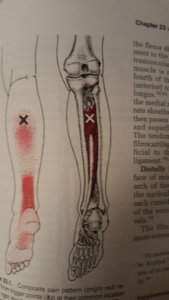
    The tibialis posterior is the deepest muscle in the posterior calf (underneath the gastrocnemius and soleus). It’s main attachments are the inner posterior borders of the medial tibia and fibula, the interroseus membrane (membrane between the tibia and fibula), the tuberosity of the navicular bone, the plantar surface of the 1st cuneiform and at the bases of the 2nd, 3rd and 4th metatarsals.


    Tib Post in 3 Sections

    I divide the tib post into 3 parts to make it easy to remember. Here they are: 1. Foot, 2. Tendon, 3. Body.

    Foot Attachments—Find the Tuberosity of the Navicular Bone

    In the foot, the tib post attaches at the base of metatarsals 2, 3, and 4, the navicular tuberosity and the middle cuneiform.
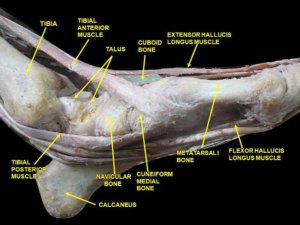
    posterior-tibialis-foot-attachments-pic

    (Picture from https://commons.wikimedia.org/wiki/File:Slide2wewe.JPG)

    Don’t sweat the attachments. If you find the navicular tuberosity, the rest is gravy. Why? Because the navicular tuberosity is an area that you’ll really want to investigate, and once you find it, you can use it as a reference point to locate the middle cuneiform and metatarsals.

    In this video, Finding the Tibialis Posterior Navicular Attachment, I show you the quick and easy way to locate tib post navicular attachment.

    Tendon Section

    To locate the tib post tendon, put your fingers on the medial malleolus. Now go slightly posterior of the malleolus and down.

    If you’re doing a parts body massage, have the person invert her foot as you resist with your hand and the tendon will become more prominent.

    Calf Section

    Now for the body of the tib post: In your brain, draw a straight line from the Achilles tendon ¾ of the way up the lower leg. At the ¾ mark up the calf is approximately the location of the interroseus membrane, one area where tib post attaches. Between the Achilles and the interroseus membrane is the body of the muscle.

    Goldilocks Pressure for the Tibialis Posterior Pain Reduction Massage

    Once you locate the tibialis posterior, your next goals are to find the areas of pain and then reduce the pain. You are going to reduce pain by applying a therapeutic (pain relief) pressure.

    Too much pressure may cause your client to tighten up and/or may add to an unwanted inflammatory response. Not enough pressure and it’s unlikely you’ll facilitate a pain relief response.

    The right amount of pressure can be easily determined by introducing a pain scale to your client. The scale is 1 to 10. One is a little bit of pain. And 10 is a whole lot of pain.

    Press on a pain area and ask your client to tell you when the pain reaches a 4 on her pain scale. Hold at that 4 pressure for less than 10 seconds. Ask the client if the pain stayed the same or went up or went down. If the pain went down, you may try applying a little more pressure when you come back to that area again during the massage. If it didn’t, lighten the pressure and try again until the pain goes down.

    Once you get your client’s “4”, you don’t need to check in with her regarding pressure except when you’re in doubt.

    In this video, I show you how to use the pain scale to find the right pressure: Pain Relief Massage–How to Find the Right Pressure.

    Some clients know which pressure is best for them because they’ve had a lot of massage. In those cases, I would, more often than not, go with the client’s request.

    Tibialis Posterior Pain Reduction Massage Combined with Relaxation Massage

    Here’s what post tib work could look like if you were incorporating it into a relaxation or body parts massage: Tibialis Posterior: How to Do Pain Relief Massage Video

    Tibialis Posterior Pain Reduction Massage Cliff’s Notes

    Here’s your quick reference guide:

    a. Navicular: Find the tuberosity of the navicular bone. Then you can find all the other foot attachments if necessary.

    b. Tendon and Body: The tendon is on the medial ankle side. The body of he muscle is in the middle of the calf and deep.

    Video: Finding the Tibialis Posterior Navicular Attachment.

    c. Keep pressure at 4 if you’re unsure.

    Video: Pain Relief Massage–How to Find the Right Pressure

    d. Integrate into relaxation.

    Video: Tibialis Posterior: How to Do Pain Relief Massage

    Tibialis Posterior Pain Reduction Massage + ?

    Lastly, a massage is not going to cure tibialis posterior tendonitis. It can help someone on the road to recover, but the cause (or perpetuating factors) for the tendonitis needs to be addressed.

    Personally, I reach out to podiatrists, orthopedists, physical therapists, coaches, and select body movement instructors (e.g. Pilates and yoga). For me, a combined efforts approach has produced great outcomes both for my clients and my business.

    Want more information about pain relief massage?

    Check out My (Simple) Secret To Pain Relief Massage.

    Just need more help with…well…everything?

    Join my email group.

    I send you my latest everything.

    It’s free:-)

    Sign up below.

    [contact-form][contact-field label=’Name’ type=’name’ required=’1’/][contact-field label=’Email’ type=’email’ required=’1’/][/contact-form]

  • Build a Massage for Pain Relief Practice

    Build a Massage for Pain Relief Practice

    I built my practice on massage for pain relief. You can, too. And you don’t need to shell out thousands of dollars to learn how to do it. Why? Because on some level with every massage you do now, you’re already doing pain relief massage.

    You can make pain relief massage your signature massage by doing these 3 things: 1. Calibrate your pressure, 2. Double down on therapeutic rapport, and 3. Follow a treatment plan.

    I Thought I Had the Answer

    I became certified in neuromuscular massage therapy (NMT) in 1999 because I wanted to get people better. In my mind at the time, here’s how things would go down: I’d work on clients, they’d get better and then they’d never come back.

    But what I didn’t understand was that pain was complicated. It may have a non-musculoskeletal origin. And even if it had a musculoskeletal origin, the NMT intervention may not be effective.

    Embarrassed to Take my Client’s Money

    When some clients started coming back to see me on a regular basis, I felt like a failure because I didn’t get them better. Instead I only gave them some temporary (not forever) pain relief.

    Fortunately, even though at the time I didn’t value pain relief massage, my clients did. And in a relatively short period of time I had enough clients to open my first office. Soon after, I couldn’t deny that pain relief massage was having a huge, positive impact on my clients’ lives. And I became interested in figuring out how I could give the most effective pain relief massage possible.

    Calibrate Your Pressure

    I found that the appropriate pressure is the single most important element to pain relief massage. With acute pain, too much pressure can aggravate a condition. Conversely, for someone with recurring pain who responds well to deep pressure, not enough pressure is ineffective and a waste of her money.

    When in doubt about pressure, try this technique that I was taught in NMT training. Say to the client: “Imagine a pain scale that goes from 1 to 10. One is the lowest amount of pain and 10 is the highest. As I press on a tender or tight spot, I want you to give me a pain rating.”

    If you get a 5 or above response, lighten your pressure. In most cases if you work between a 3 and 4, you’re going to, ultimately, lessen your client’s pain, not increase it.

    Double  Down on Therapeutic Rapport

    Pain is not just a biomechanical response. How we interact (and connect) with our clients can actually lessen or increase their pain. If you’re having trouble connecting to a client, try my Elderly Grandmother technique.

    Imagine that your client is your elderly grandmother. How are you going to treat her?

    First, you’re going to slow down and take your time. Then you’re going to make sure that you understand what she’s saying and that she understands what you’re saying. Lastly, you’re going to do everything in your power not to upset Granny. And subsequently, you’ll create a calm and supportive environment.

    An abbreviated way of looking at therapeutic rapport is: It’s all about Granny for the next hour!

    [If you want specifics about developing great therapeutic rapport, check out my article in Massage & Bodywork Magazine—Four Lessons on Chronic Pain (Notes from a Mountain Guide).

    In this article, Maximizing the Placebo Effect, I explain how to increase the placebo effect (a positive response) through therapeutic rapport. In a more recent article, I explain how the placebo effect can be fine tuned. Here is an interview I did about the article.

    Follow a Massage for Pain Relief Plan

    A treatment plan is essential in order to do an effective pain relief massage. When you have a plan you’ll be on target to address the pain issues the client wants you to address. A plan also puts your client’s pain in a massage framework for current and future discussions. And a plan is something that you can go back to and adjust if your client doesn’t feel better. If he does feel better, you know what to do the next time.

    The treatment plan I follow comes from my research and experience.  It’s universal in the sense that it works with any type of massage modality.

    a. Pre-massage: identify pain areas before the client gets on the table.

    This ensures that you will always find the problem areas once the client is on the table. And it builds therapeutic rapport. For more about this read My Simple (Secret) to Better Pain Relief Massage.

    b. During the massage: commit to a course of action.

    Let’s say your plan is to work the upper-trap for a neck/shoulder condition. But once you get the client on the table you find that the levator scapulae is the tight muscle. No problem. Change your course of action–but stick with the new plan. In Get Your Client Out of Pain: Put a Stake in the Ground, I explain why having a course of action can make or break a pain relief massage.

    c. Post-massage: tell the client what you did, what you found, then provide recommendations and follow-up.

    Now it’s time to lay it on the line. Once you’ve done your work, go over the highlights of the massage (e.g., I found you’re piriformis to be tight) and then make recommendations to further lessen the pain (e.g. self massage at home). Follow up in a couple of days.

    If the massage helped, great! If not, it’s time for Plan B if you think it’s warranted.

    Your Massage for Pain Relief Practice Starts Now

    You can build a practice quickly by making pain relief massage your signature massage. And it’s not a far stretch from what you’re already doing. If you focus on

        1. calibrating your pressure
        2. doubling down on your therapeutic rapport
        3. following a treatment plan

    you’re going to see big changes with your client retention.

    Seriously, you got this! Just follow this formula to start. Over time you’ll make it your own.

    Free Course to Jumpstart Your Massage Business

    If you’re just starting a massage business and want to incorporate pain relief massage into your business model, this free course will get you to your 30K a year: Jumpstart.

    If you’re trying to take a meh massage business and make it a dream massage business, go here: Accelerator.

  • Massage Practice 101: How to “Just Do It”

    Massage Practice 101: How to “Just Do It”

    What do you really need to do to build a massage business?

    Before you invest in branding and more advanced massage certifications, invest in understanding what: 1. motivates you, 2. keeps you focused, 3. scares you to death and, 4. compels you to finish a task.

    The Problem With Not Knowing Yourself

    Here’s a question that I still ask myself: Why did it take me so long to build a cranking massage business?

    The answer?

    I didn’t understand me.

    More specifically, I didn’t understand what prevented me from accomplishing my goals.

    For example, once when my wife, Lisa, and I opened up a new office, it took me a year to get the sign up. We lost hundreds if not thousands of dollars because I had moved so slowly.

    It was failures to act, like my sign fiasco, that added up and netted me a massage business that was so-so.

    Time to Build a Massage Business

    The story of change started about 5 years ago.

    At the time, I was on the verge of quitting my so-so massage business because in addition to making just okay money, my elbow ached, my hand was numb and my shoulder felt like it was going to snap off.

    I didn’t quit because my dad had driven home how important it was to work efficiently and effectively both physically and mentally.

    Maybe there was a way I could do massage with less effort and less pain to my body.

    So, I started to experiment and over the course of a year, I was good.

    How good?

    Damn good.

    In fact, I could do more massages without being in pain at 49 than I could do at 29.

    Talk about a shot in the arm. My body was ready to go. Now I just needed more clients.

    So, I really started to think about why I had accomplished some goals while I completely struck out with others.

    And I found 4 things that were holding me back from building a massage business that exceeded my expectations.

    Going After a Goal Must Do(s)

    1. Find the right motivation to get started.

    Not all motivation is equal. For me, effective motivation has a sense of urgency, like: If I don’t bring in more clients, I won’t be able to pay for _______ or do _______.

    Urgency doesn’t have to come out of a dire situation. It can come from the realization that everything has a shelf life.

    At 54 I’m less likely to stop everything and travel the world than I was at 24. If you don’t start your massage practice now, chances are that you won’t start it later.

    Feel the adrenaline kicking in?

    2. Focus on the goal, not the details.

    Once you’re motivated (got the adrenaline going), it’s time to fight off everything that’s going to derail you. Your punch list could be one of them.

    For example, if you want to open a massage practice, but your To-Do list to open your practice is the length of your arm—you’re set up for failure.

    Instead of trying to get every detail done, just pick the key ones that are essential to opening your practice.

    3. Acknowledge Fears

    There will be times when you find yourself dragging your feet about a key task you need to do to accomplish a goal. These are the times when you need to ask yourself some serious questions, like “Why am I dragging my feet?”

    Look closely. Nine times out of ten, I’m dragging my feet because of fear.

    Remember the sign that took me a year to put up? Here’s why. The person that I hired to do our signs was a disaster. It took him 3 months to get our banner sign done.

    He was supposed to do our marquee signs, but after the banner debacle I couldn’t trust him. The other sign companies that gave us proposals for our marquee signs were too expensive. So I decided to make the signs myself.

    But I was so nervous that I was going to mess them up and have to redo them (costing us money) that I kept putting the job off.

    Eventually, I made the signs and got them right the first time. However, at the end of the day, my feet dragging probably cost us more money (lost revenue because the signs weren’t up) than if I had paid a sign company who would have gotten the job done in a timely manner.

    pressureperfect-sign-pic

    The project that took me a year, ugh.

    Here’s a common fear for MTs striking out on their own: fear of being exposed as a fraud. I can’t tell you how many times in the beginning of my career that I waited for the client to get off my table and say, “Well, that really sucked.”

    When you’re in this fear-based mindset you may find yourself not following through with advertising. That way your name doesn’t get out there (just in case you really do suck).

    This should help you with some of that pesky fear: How to Succeed When You’re Afraid.

    4. Stay connected to what compels you to accomplish a goal.

    To resolve the feet dragging, reconnect with what is compelling for you to complete your goal. It could be a stick or a carrot.

    A stick would be: if I don’t accomplish this goal, I will never have a house. A carrot would be: if I accomplish this goal, then I will have my dream job.

    One more thing about the compelling part, it is the emotional fodder that will get you through the tough times. This is where knowing what moves you is important.

    When I started this website, I had no idea of the challenges that I would face, like learning WordPress. And when my due date for my website revamp was rapidly approaching, I balked at the thought of only getting a few hours of sleep for the next couple of nights to get the job done.

    But I had trained my brain to go back to the most emotionally compelling reason for me to do the website.

    Here’s my compelling reason: I had written for magazines and developed CE courses for quite a few years. And I loved having my work out there through these businesses and professional organizations. However, the final product was always filtered through their screens.

    I wanted the freedom to say what I thought needed to be said without their filters. Hence, the website. This was waaaay compelling to me.

    Build a Massage Business Recap

    Okay, are you ready to get this party started?

    Let’s build a massage business.

    First, grab that goal by its ears. Look it in the eye and find the strongest, biggest and baddest motivation for getting the job done. The motivation could be a dream or it could be a negative consequence that results from not following through. Lock it in your brain.

    Then don’t get bogged down in the details. Focus on what is essential.

    You’ll have to face your fears. And if you find yourself in mission creep, latch onto the motivation that is so compelling you have to stay on track.

    Need more help?

    Email (mark@makethemostofmassage.com) me or sign up for my email group.

    Email Group Sign-Up

    Get my latest info for free. Sign up below.

  • How to NOT Discount Your Massage Rate

    How to NOT Discount Your Massage Rate

    Early in my massage career some customers worked me over, and I dropped my massage rate for them.

    My guess is that a big part of me discounting my massage rate came from a lack of confidence.

    You may feel the same way if you’re a compulsive massage rate discounter, too.

    But I’m going to sidestep the lack of confidence thing right now.

    Why?

    Well, for one you’ll get the bends taking that deep of a dive into the recesses of your psychology without some professional help.

    And we’ve only got another 1,000 words or so to get you to toughen up on your price.

    So, here’s how I’m going to sidestep self-confidence: We’re going to look at confidence as a situational phenomenon.

    Sometimes you have it and sometimes you don’t.

    You have a great day at work. You rock as an MT, right?

    Have a bad day and you’re thinking about a career change.

    You can’t count on confidence to get you through being firm with your price.

    So let’s attach our thinking to something more permanent, like a plan you refer to when you start to feel yourself giving in.

    My plan has these layers:

    1. Truth
    2. Lies
    3. More lies

    First, before I get into the truth layer, I’m not saying don’t ever slide on your price.

    Little old men and ladies, people who you feel compassion for because they’re in pain and you want to help them, family and business connections—these are ones you may want to slide on.

    I’m saying create a strong, firm-price habit so that your default position is “firm price” which will allow you to fight off the bargain shoppers and pushy people.

    Believe me, it’s waaay harder (if not impossible) to start with a wishy washy price-mindset and move to a firm price-mindset during the course of a conversation.

    Onto the truth layer of sticking to your massage rate.

    Layer #1: Truth

    Start creating a firm price habit by making sure that viewers can see your prices on your website.

    No writing prices in 8pt font at the bottom of your Services page.

    By making your price very visible on your website, you’re doing all the firm-price work upfront. If a customer has been to your website, he should know exactly what he’s going to pay before he walks into your office.

    If a customer calls to book, make sure she knows your massage rate before you end the phone conversation.

    We have an intro rate. I let the customer know our intro price and then I let her know what she’d pay for her next visit.

    So being clear about your prices on your website and when booking will silence the person who is not an overly aggressive discount shopper.

    But what about the let’s-make-a-deal person who simply thinks he can work you over?

    Layer #2: Lies

    Joe owned his own company and had 30-ish employees. After the massage he asked me: “Hey, Mark, do you offer package deals?”

    I knew that Joe had read our website thoroughly because my wife had a conversation with him where he had said to her that the content on our website was what drew him in.

    He straight up knew that we didn’t offer a package deal. And that our discount was already built into our pricing because we had a no tipping policy.

    Joe was trying to work me, and didn’t want to hear about what we were already doing for him.

    My first response was a truth: “We can’t afford to offer another discount”.

    That didn’t throw Joe off stride for one second.

    It was time to unpack the lies.

    Here are some of my go-to lies:

    1. My ____ (fill in with wife, husband, spouse, boyfriend, girlfriend, fiancé…) would kill me if I ______ (offered a discount, gave a package deal…).

    By the way, Joe used this one on me to start the conversation. He said that his wife wouldn’t let him get a massage every week if he had to pay $X.

    1. Our expenses have really shot up.
    2. Our business is on a super-tight budget.

    Truthfully, I forget what I told Joe. But whatever I said was good enough to make Joe regroup and work a different angle.

    He then said, “I’d like to send my employees to you maybe as a reward kind of thing or have you come out to my office.”

    Okay, so that kind of nebulous promise of employee gifts and special events rarely works out.

    Show me the money, Joe.

    I said something like, “We do things like that with a lot of companies in the areas.” (And they don’t ask for discounts.)

    Joe wasn’t done with me.

    “We have a great website team. I’m sure one of my guys could make yours really look like a big business,” he said.

    “But, Joe, you said our website content drew you in.”

    “It did.”

    “Well, then it’s sorta working without being super fancy…”

    Confused dog look, then he said: “Yeah, but we could get you good, professional pictures…[wheels turning as he thought]…and we could get it so that you rank high and get more traffic.”

    “But we’re first in the organic search already and rank in the top 5 in the local search.”

    Crickets.

    It was apparent that Joe had no idea what the difference was between local and organic searches.

    Joe backed off (and is now a bi-weekly client).

    But I was ready for more “working me down” with more lies.

    Layer#3: More Lies

    He could have said: “I have a lot of people I’d like to refer to you.”

    Response: “I appreciate that, but we’re really swamped.” (We don’t need clients.)

    Which brings me to the ultimate answer to staying firm on your price: You need to have new clients coming in all the time.

    When that happens you won’t fear losing the customer who is trying to work you because you know that another client will be ringing your phone soon.

    If you don’t have new customers coming in check out my Build a Massage Business Mini Crash Course.

    And if you need a website so that you can create your first layer of  Firm Price Defense this is my Webiste DIY guide.

    Sticking to Your Massage Rate

    My bottom line with customers who want me to lower my massage rate is this: Some are true bargain shoppers.

    And if I’m not the cheapest, they’ll go elsewhere.

    Fine.

    I don’t want them. Let them find someone else.

    But for the ones like Joe whose DNA says “get the best deal possible all the time”, you just need to back them off.

    Try the truth first.

    If that doesn’t work: Lie.

    Then more lies.

    Practice that a few times and I’m pretty sure that you won’t crack.

    Need more help?

    This is a free course that will lift your massage business off the ground: Jumpstart.

    While you’re at it, join my email group.

    I’ll send you my latest everything weekly.

    It’s free:-)

    Sign up below.