Category: Building a Pain Relief Massage Practice

  • I Saved My Client $5000 (By Using My Most Important Neuromuscular Tool)

    I Saved My Client $5000 (By Using My Most Important Neuromuscular Tool)

    You may be surprised when I tell you that the most important tool in my neuromuscular toolkit is not a T-bar. My most important tool is actually a strategy. And it has helped my clients get out of pain (and save money) far greater than any other tool I use. It’s called Perpetuating Factors.

    What is a Perpetuating Factor?

    A perpetuating factor can be defined as anything one does (bad work posture to bad decision making) or has (a structural imbalance) that aggravates or prolongs a pain condition.

    When I learned St. John’s neuromuscular therapy (NMT), the emphasis was on finding the structural perpetuating factor (e.g., short leg, hemipelvis). And that’s what I did in my practice—but then I injured my back.

    My Worst Perpetuating Factor Ever

    When I injured my back, I searched hard for the structural perpetuating factor. I stood on two scales to see if I had a weight distribution imbalance, but that checked out okay. My friend who was a chiropractor found no structural issues when looking at my X-rays. I didn’t have a leg length differential and my arches were fine. I was baffled.

    At the same time, I rehabbed with deep muscle massage, chiropractic adjustments and PT. But I wasn’t getting better. In fact, I was getting worse. A lot.

    Finally, in desperation, I stopped everything, both searching for structural perpetuating factors and all treatments. And within a couple weeks I was better.

    Who? Little Ole Me?

    Over the next year, I began to understand what had happened. Initially, I had tweaked my back working out. Then I made things worse by trying to fix it with aggressive treatments. I was the perpetuating factor.

    There are 3 gigantic reasons why I pay close attention to non-structural (lifestyle) perpetuating factors: 1. To get a client out of pain, 2. To help her avoid pain in the future, 3. To save her money.

    The Miracle Cure

    Scott would come to see me when his lower-back acted up, maybe 2 – 3 times a year. Recently he came in with extreme pain in an area by his upper right scapula and the front of his shoulder. It was a completely new pain.

    He said that there was no event that caused it and nothing had changed in his activities at home, work and play.

    His guess was the he reinjured the rotator cuff that he had surgically repaired a couple of years ago. But that didn’t make sense to me because his range of motion was fine in that shoulder and there was no strength loss.

    There had to be a perpetuating factor somewhere.

    Scott Lied (Well…Sort of Lied)

    In the massage room, Scott yelped when I pressed the pain area. That area didn’t feel tight to me. And it felt and looked the same as on the opposite side (the side that didn’t bother him). I went back to asking questions and I got the same response: nothing changed. But then he paused. “Well,” he said, “I did change my desk.”

    Pay dirt!

    Scott’s new desk was a standing desk. The standing desk fit on top of his current desk. He adjusted it up when he stood to work. He lowered it when he sat down.

    As we continued to talk, his new pain made sense to me. When he stood to work, his arms were completely unsupported. This meant that his shoulder and upper back had to do more work now. Under the added muscular stress, his right shoulder/scapula area (compromised from being injured before) rebelled. In addition, the pain occurred at the same time as when he changed to the standing desk.

    He got rid of the standing desk and the pain went away.

    I Saved Scott $5000

    If we hadn’t uncovered Scott’s lifestyle perpetuating factor, his trajectory could have been this: doctors’ visits, muscle relaxants, anti-inflammatory pills/injections, PT, X-rays and possibly an MRI—easily $5000 plus in bills.

    In addition, Scott was out of pain and knew how to avoid pain in the future. To me, that is a powerful tool.

    Perpetuating Factors Crash Course

    I find if you keep these 3 questions in mind when looking for a lifestyle perpetuating factor, you have an excellent chance to figure things out:

    1. Has anything changed in your work, home or recreational life?
    2. If so, when did the change occur?
    3. If just before or soon after the pain occurred, could this change be connected to the pain?

    And remember that a client may have filtered out something that she thinks is unimportant, like Scott did with his standing desk (after all, standing desks are supposed to be good for you, right?). So, stay on the trail.

    You Got This!

    If you’re new to the idea of Perpetuating Factors and/or are struggling with it, leave a comment here.

    Need  More Help?

    Sign up for my email group and get my latest info. It’s free and you can unsubscribe whenever you want:-)

  • Massage for Lower Back Pain 101: The Brain

    Massage for Lower Back Pain 101: The Brain

    This is a story of massage for lower back pain not working (but there’s a lesson).

    Casey was crippled because of his lower-back pain. And nothing worked.

    In fact, after 4 injections his pain got a lot worse. He went from lying face down on my table to lying on his side to sitting up to not coming in.

    The last time he came in, we used a wheelchair to get him in and out of the office.

    I was 99% sure that Casey was heading for the knife.

    A few weeks after Casey stopped coming in to see me, I met Dr. Charlie Johnson, a PT who specialized in back pain. I thought Charlie might be able to help Casey, and Casey agreed to see him if I came along.

    When I went to pick Casey up for the appointment, I expected to see a slumped over, broken man. But what I saw was Casey close to how he used to be pre-back pain.

    What the hell?!

    Did the nerve compression ease up?

    Did the inflammation go down?

    Wait…I’ve been down this road before…these questions imply that pain is only a product of tissue damage.

    But research shows that pain is not simply a tissue damage event.

    Pain is an experience.

    I Can Heal You (NOT)

    When I opened my neuromuscular massage (NMT) practice in early 2000, I thought I had the playbook for correcting things like lower-back pain.

    I’d go through the NMT evaluation protocol, identify the eccentric and concentric muscle issues, add in trigger point therapy, and BAM!–pain get ready to get your butt kicked.

    But massage for lower back pain and other issues produced inconsistent results.

    I soon became frustrated and started to look for answers elsewhere.

    So for the next ten or so years, I studied and wrote about back pain.

    At this time, a new view of pain and how it should be treated was just starting to emerge.

    The old way for understanding pain was that pain is strictly a matter of tissue damage. The new way for understanding pain was that pain is complex and is influenced by social, emotional and conditional factors.

    When I think about Casey’s back-pain story, it makes more sense to view it through the new lens.

    Here’s what I mean.

    Casey’s Lower-Back Pain

    When Casey hurt his back, he stopped working. And as it got worse, his world got smaller, so small that he wouldn’t even leave his house.

    By five months, he was basically incapacitated.

    But then things started to improve as he approached the 6 month mark.

    Interestingly, 6 months marked the time short-term disability would be cut off and Casey would have to go back to work. If he didn’t go back to work, they’d fire him.

    I’m not at all suggesting that Casey was faking his back pain. I was there and it was real—to the point where he lost leg functionality.

    I’m saying other factors played into Casey’s experience of back pain.

    The Other Parts of Back Pain

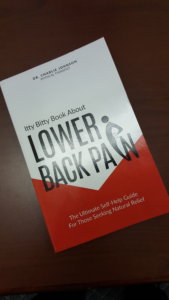
    In his book, Itty Bitty Book About Lower Back Pain, Charlie the PT explains that “pain does not equal damage or injury…it is simply an experience created by the brain when it thinks your body is in danger.”


    He goes on to say that it takes 3 – 6 months for ligaments, muscles, nerves and discs to heal in your back. After that if pain persists it could be that your sensing system is revved up and you’re brain “is still sensing danger.”

    Now, let’s back up to when Casey hurt his back. A physical event happened in his back, like a tear or strain or rupture or impingement or something.

    About a month post injury, he was doing better. Then things suddenly got worse. At the time, he was still seeing a personal trainer and my hunch is that the personal trainer was having Casey do something that aggravated his back condition.

    Then Casey started injections. Each injection helped for a very short period of time, but then the pain returned and eventually got worse. During this time he had some falls and could’ve re-injured his back.

    But eventually, the potential back-pain, perpetuating factors were eliminated–no more falls and he stopped seeing the personal trainer. So he was healing and feeling better, right? Actually, no. The pain now was the worst it had ever been!

    Why?

    Maybe because there were things revving up his sensing system, like:

    Casey HATED his job because his boss stressed him out!

    According to the research Charlie sites in his book, if you hate your job, you’re likely to experience more pain than someone who likes her job.

    In addition, it’s been shown that memories can impact pain. Casey constantly talked about his boss as being psychotic.

    Memory of Psychotic Boss + Thought of Going Back to Work = Stress Hormones Shooting Up.

    Okay, but you could argue that Casey’s stress level should’ve gone down because he was away from the hostile work environment while on disability.

    True, but Casey also knew he’d be fired if he didn’t return to work after 6 months of disability.

    That worried him A LOT. By the way, if you’re sad or worried you’re likely to feel more pain than someone who’s happy and relaxed.

    OMG, no wonder the poor man couldn’t sleep! And, yes, bad sleep habits equal more pain.

    Can you feel the pain intensifying?

    Casey (Massage for Lower Back Pain) Revisited

    “Pain is an experience” makes complete sense to me. Casey’s lower-back pain fits this view to a T.

    If I could have a do-over, here’s how I’d try to help Casey now.

    First, I’d let him know that the injury to his back will heal in 3 to 6 months. This should ease some immediate anxiety regarding his back pain.

    Next, I would jump into action once I heard Casey repeating things.

    For instance, each time I massaged Casey while he was in back pain, he told me (and I could see) how stressed out he was. But I didn’t appreciate the significance of what stress can do to the experience of pain.

    If I had really gotten this, I would’ve pestered Casey endlessly to get counseling or find a professional who could teach him how to meditate.

    Lastly, it doesn’t matter how well I listen to a client and recognize a need if I don’t have someone good to refer her to.

    With Casey, I learned that my referral list had holes in it.

    This became apparent when Casey filled me in about the back doctor he was seeing. I was not impressed. For one, the doctor gave Casey more injections than most other doctors would and he never used imagery when injecting.

    But I didn’t have an alternative for Casey to see at the time. If I had known about Charlie, I would have sent Casey to him.

    Old Dog, New Trick

    Here’s how I’m gonna fix my referral list. I’ll talk to people in the health and wellness industry who I trust. I’ll get their recommendations, then I’ll vet their recommendations. Here’s how I vet.

    Also, going forward, this is big, I promise to NOT take stress or any other factor that influences the experience of pain, for granted—ever, ever again.

    And, if things are looking bad because the pain won’t go away, I’m going to remember that in 3 to 6 months most back issues have healed.

    Maybe there’s something revving up the pain system.

    Time to look with a magnifying glass.

    P.S. When Casey went back to work, he had a new (and nice) boss:-)

    Need more help with your back pain clients?

    Check out Common Sense Ways to Treat Sciatica.

    And join my email group to get my latest info. Sign up below. It’s free:-)


  • Massage Business Success Story: Fear Works

    Massage Business Success Story: Fear Works

    You’re not good at all the things needed to sustain and grow your massage business.

    Okay, that was a little rude…but it’s true, right?

    When I opened my practice I stunk at marketing and a whole lot more.

    We’re not talking character flaws here. We’re talking too many hats to wear as a business owner.

    And if you’re like me, you’re going to find ways to avoid the things you’re not good at until something really bad happens.

    Massage Business Options

    The easy fix to all of this is to hire people to do the jobs you’re under-qualified to do. But that comes with a price. Literally. Great if you can pay it. But for most, subbing out all the jobs except for actually doing the massage itself is not an option.

    But I have another solution for you. Just a warning: It’s more Judge Judy than Judge Joe Brown.

    Ready?

    Here it is:

    I’m going to scare the crap out of you.

    That way you’ll stay on track and get better at the jobs you’ve been avoiding.

    If you’re more of a carrot person than a stick person, check out this post by Michael Hyatt. It will help to keep that carrot in front of your face. (Then come back here and get a shot of fear for good measure:-)

    Let’s start with some light scaring.

    Contracting Massage Business

    The problem with being your own boss is that the consequences of your actions or inactions are not always seen right away.

    For example, imagine your massage business has slowly been contracting for the past six months. You know you should do something, but you’re not sure what to do.

    Instead of taking action you’re able to push the situation out of your mind because it’s not an emergency.

    A few more months go by and things have drastically changed for the worse. Your best client has lost his job and isn’t coming in. Now you have an emergency.

    Finally, you work on bringing more clients in, but a month of hard work only nets a handful of new massages. Yikes! You’re stuck in the precarious position of hanging on by your fingernails, hoping your marketing efforts pay off in time.

    Another Solution

    Now imagine that when you see your massage business shrinking you hire Deana to be your boss. Deana gives you instructions to build an email list with existing and new clients.

    One month goes by and Deana asks you how the email list is going.

    Well, Deana, I haven’t started it yet.

    At month 2 you give her the I had a lot of massages to do this month.

    Okay, we can all see where this headed. But before month 3 rolls around, you know you have to do something right now or you’ll be looking for another job, and that’s precisely when you jump into action.

    Think of fear as Deanna, the boss who is going ride your ass and/or fire your ass.

    The trick is to find the fear that will motivate you.

    I’ll do my best to help.

    Let the Sh**ing Begin

    The Sign Marathon

    When my wife, Lisa, and I, opened up PressurePerfect Massage, I didn’t want to put out the money for signage because we had already spent a lot on other start-up costs. Months went by before I contacted sign companies. When I finally settled on a sign company, it took them months to get our banner done and another month to get it from them.

    Since they were the worst sign company ever, I decided to make our road sign myself. You guessed it, more months for me to get that done.

    By the time all signs were up, a year plus had gone by and by my estimates we had lost over $3000 in revenue.

    The Website Debacle

    During our early years, I had avoided doing a massage business website myself because the DIY options were limited and you pretty much needed a programmer to build your website.

    Eventually, we made a massage for website barter-arrangement with our friend who was a computer programmer but who had never built a website.

    The project moved at glacial speed. We missed holiday advertising, gift certificate sales and any Internet presence for six months. We couldn’t fire our friend because we hadn’t hired her. And we couldn’t nag her to death because we might lose a friend.

    I estimate that we had lost about $2000 in revenue and 82 of my hairs (pulled out) because Lisa and I gave up control over our website construction by not hiring someone.

    By the way, do you think Deana would have fired Wifey and me? Uh-yeah.

    A SEO Seizure

    If you have trouble falling asleep, say this word Search Engine Optimiza—zzzzzzz…oh, sorry…Optimization, also known as SEO. Yeah, what a yawn.

    Years back we were ranking low in Google Places and organic searches and needed SEO big time.

    Of course, I decided to do it myself. Me actually doing it wasn’t the problem. Me starting to do it was. I dragged my feet for months because I was intimidated by the process. By the time I actually got it done, months and months had gone by where we didn’t even rank in a local search.

    There’s more…

    Remember PressurePerfect Massage with no outside signs? Well, in 2014 we had rolled Mark Liskey Massage into PressurePerfect Massage, but I didn’t redo some of the SEO to reflect the change, not out of laziness—out of ignorance. I just hadn’t dug deep enough in SEO.

    No outside sign and no web presence because the SEO wasn’t right. Can you say: trying to go out of business.

    Scared?

    Just in case you need a little more:

    Source: Frances Proctor

    Seriously, not having persistent and adequate motivation to do something you don’t want to do is a problem when you’re your own boss. Don’t let yourself get in a hole that you can’t get out of.

    This is what you can do right now:

    1. Admit that you’re not good at all the jobs you have to do in your massage business.
    2. Hire someone to do them or do them yourself.
    3. If you decide to do them yourself, do them!!!!!!

    Sit down and take the time and learn what you need to know

    1. When you detect avoidance behavior, refer back to my list to scare the poop out of yourself.

    This article can also help keep you accountable: A Business Lesson that Hurt: How Not to Fool Yourself.

    It Works

    Now, I constantly use “healthy” fear to keep me on track to getting better at the jobs that I’m not good at but need to do until I can sub those jobs out.

    If you need healthy fear, advice or more information about a challenge you have with massage, jump in my email group. Once you join, you can tell me what you need and I’ll get the right information in front of your eyeballs.

    It’s free.

    You can unsubscribe whenever you want.

    And I promise not scare you anymore.

    Sign up below:-)

  • How to Do VERY Precise Pressure

    How to Do VERY Precise Pressure

    There are benefits to treating a tight/tender area with very precise pressure. One, you can sometimes only find the “That’s it!” spot with very precise pressure. Another is that very precise pressure is a more thorough treatment than a massage with less precision. Most clients appreciate thoroughness. If you’ve backed off very precise pressure because it hurts your body or it feels intimidating, here’s how to change that.

    Precise Versus VERY Precise

    In general, I use precise pressure to find areas of tender/tightness. I use a variety of body parts, from big (forearms and fists) to small (thumbs and fingers) to apply precise pressure.

    I use VERY precise pressure to further examine the tender/tight area. However, I only use smaller body parts (thumbs, fingers, massage tools) to apply very-precise pressure.

    While I’m examining the tender/tight area with very-precise pressure, I may find a spot within that area of pain that is more tender or is tighter than the rest of the pain area. (Clients sometimes shout out “That’s it!” when I hit it.) I then treat the “That’s it!” spot using very-precise pressure.

    Here’s an example. Ali comes in with neck and shoulder pain. Using my knuckles around the scapula I find the locus of his pain area in his levator scapulae attachment (precise pressure).

    Next I start examining the area of pain in the levator scapula attachment with my middle knuckle, looking for that exquisitely tender or tight spot (very-precise pressure).

    What to Use to Find the “That’s It!” Spot

    If it hurts your hands to work with very-precise pressure, I have three suggestions:

    1. Combine body parts.
    2. Stack and/or brace (support) body parts.
    3. Combine a massage tool with a body part.

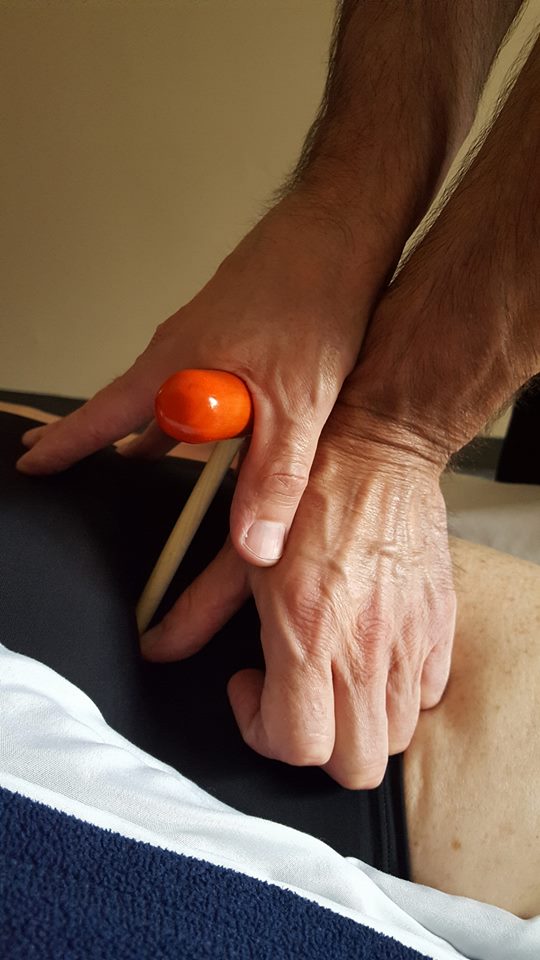
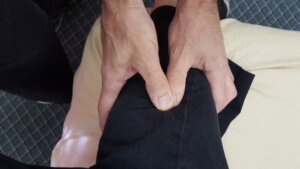
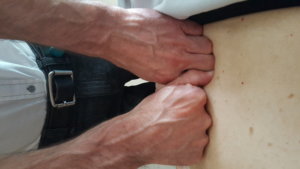
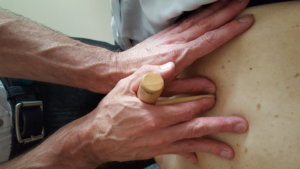
    Pictured below are my 3 favorite ways to deliver very-precise pressure.

    Stacked Fingers/Thumbs

    Try not to press. Instead lean into your fingers/thumbs. The bottom finger/thumb is the primary palpation vehicle.

    Knuckle-Thumb

    In this picture I’m directing my pressure into the middle finger of my left hand. You’ll notice that my right thumb is bent to fit in comfortably next to my left middle knuckle. This is not a mistake. In this case, my thumb’s primary role is for palpation, not for delivering pressure. My right thumb’s companion four fingers form a loose fist. They take most of the weight that I put on that hand, not my thumb.

    Tool-Thumb

    In this picture my thumb is a support, guide and the primary sensing instrument. I’m directing most of my “leaning” pressure into the tool, not my thumb.

    How to Find the Spots

    The way I find the tight and tender spots within the area of pain  is by creating contrast. I can create contrast by the direction, length and speed of my palpating stroke.

    When I’m palpating Ali’s levator scapulae attachment, I start by going across the grain of the muscle to give me enough distance to “flip” over a potential tight spot. My stroke is going to be fast enough and long enough so that I can feel the full shape of the tight/tender area. If I’m still having trouble feeling anything, I’m going to press deeper as I do the faster, longer stroke.

    Going Very Precise   

    Once I find the tender/tight spots, I’m going to systematically investigate the areas using combined body parts, stacked/braced body parts or a massage tool and finger/thumb combination.

    Next I’m going to use very precise pressure to work hyper-tender or hyper-tight spots within the pain area.

    When applying very precise pressure I usually 1. press, 2. press and pull or 3. press and reciprocate. A massage tool combined with finger or thumb is insanely precise. In this video, I demonstrate how to press, press and pull, and press and reciprocate using a massage tool: T-Bar and L-bar: 3 Ways to Work Muscles Video.

    Also, I like to work the pain area and the “That’s it!” spot from different angles. Lots of my clients love this.

    Too Much

    When you’re doing very-precise pressure, you run the risk of overworking the area. I usually can avoid this by revisiting the area instead of spending a long period of time there.

    I also use a pain scale system approach when I’m unsure of the therapeutic pressure that I should be using. Here’s a quick video tutorial: Pain Scale System Video.

    Lastly, I check in with the client to see how she’s feeling about the area I’m working on.

    Checking in is not foolproof. The client may not have a mental gauge as to what feels like good pain and what feels like bad pain. When in doubt, move off—unless the client knows exactly what works for her.

    Making Very Precise Happen

    Here’s the short version for working with very precise pressure:

    1. Find the pain/tight area by creating contrast.

    You can create contrast by making your exploratory stroke longer and faster than you normally would. If you need more contrast, press deeper as you do your exploratory strokes.

    1. Choose a body part combination that doesn’t cause you pain when you’re pressing.

    My favorites are 1. Stacked thumbs, 2. Knuckle and thumb, 3. Massage tool and thumb.

    1. Systematically work the pain area and the “That’s it!” spot (if there is one) by pressing, pressing and pulling or pressing and reciprocating.

    Being very precise can help your client with her pain condition and doesn’t have to cause you pain.

    Massage Tools Online CEU Course

    If you want to be able to use a massage tool with every massage so that you can save your hands and deliver focused, precise pressure like nobody else can, this online course will get you there.

    I taught it live for many years and now I’ve made the online version, There are lots of videos and if you have any questions while you’re taking the course, you can always ask me (mark@makethemostofmassage.com).

    Check it our here: How to Use Massage Tools (Fearlessly and Effectively).