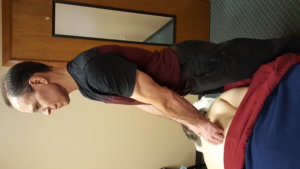
Category: Massage Pain-Free

  • How to Eliminate Pain When Massaging: Adaptation

    How to Eliminate Pain When Massaging: Adaptation

    Pause that hand stretch video! There are reasons why your body hurts when doing massage. One might be because you’re not adapting in an effective way.

    I know this sounds a little theoretical, but it’s not.

    I’m talking about making adjustments when working through a massage challenge.

    #1 Trying to Use all Your Body Weight to Lean When Your Table is too High

    You need to increase the pressure and your table is high. How do you adjust?

    You push using your upper body, right? (Been there, done that.)

    Besides being an inefficient way to get the job done, pushing with your upper-body stresses arms, shoulders and neck.

    Low Table Adaptation Response

    If you want to maximize using your body weight to generate force, lower your table.
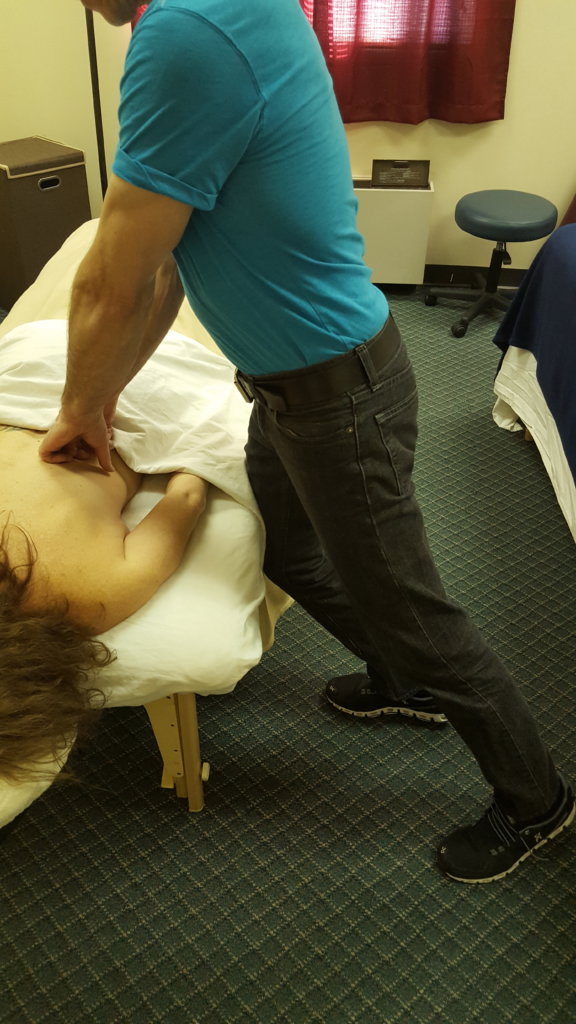
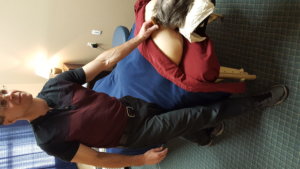
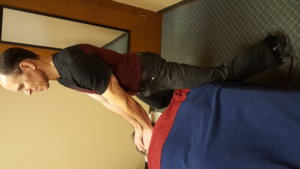
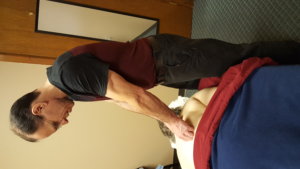
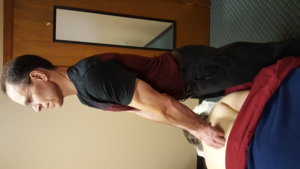
    The challenge with a low table is with light pressure, primarily because you can’t lean your body weight into the client. This means you’ll have to be more upright, and to get your hands on your client you’ll need to bend.

    Can I get an order of back pain to go, please?

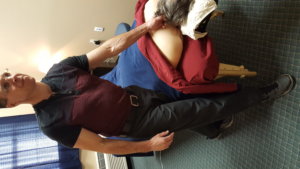
    However, there’s another way to adapt instead of bending from your back. It’s “bend your legs”.
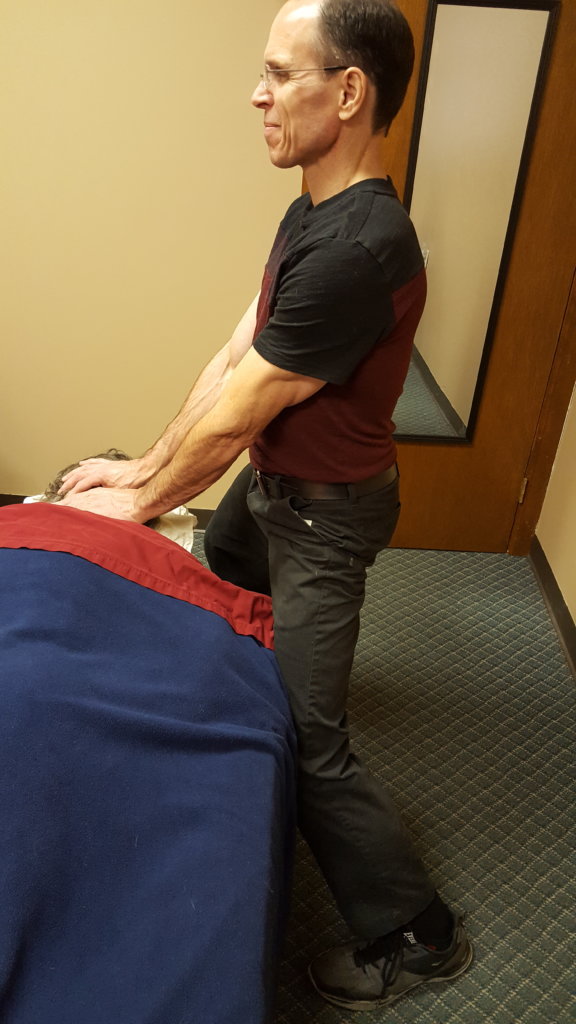
    My back is pretty much neutral in the pic, right? You can also sit and lean. That’s easy on the back, too.

    Don’t Need Fancy

    By the way, you don’t need an expensive table to maximize adaptation. I can do 1000 massages on an expensive table, then 1000 on an inexpensive one and I’m not going to lose a client as long as my massage is consistent.

    #2: Adapting to the T-bar

    Massage tools also require adaptation responses if you’re going to stay pain-free and improve massage efficiency.

    In the video below, I’m purposely using a long T-bar in areas of the body I’d normally use a shorter T-bar.

    The simplicity of the T-bar allows me to adapt to different situations in limitless ways. Specifically, I’m talking about the many ways I can hold the T-bar. Have a look:

    How to Experiment with Adaptation

    In massage, successful adaptation boils down to this:

    1. Use the strategy that allows for the best adaptation response.

    Here’s how I determine if the adaption was a success. As I’m adapting, I ask myself:

    1. Am I pain-free?
    2. Is it now easier to get the job done?

    Two yeses equals success.

    If your body hurts when doing massage and you want to dig deeper into the table height strategy, start here: Table Height Is Everything.

    Massage Pain-Free Online CEU Class

    And if you want to cut to the chase and learn how to massage pain-free while getting CEU credits, go here: How to Deliver Deep Pressure Without Hurting Yourself.

  • How to Palpate Like a Chiropractor

    How to Palpate Like a Chiropractor

    Early on in my massage career I cut my massage teeth in chiropractors’ offices. Over the years, chiros have become colleagues, and I’ve learned two very important things from them: 1. Don’t be afraid to work the muscles/ligaments on and around the spine, 2. Palpate the spine (and around the spine) for tight and tender areas. Now I palpate like a chiropractor but with a different purpose in mind.

    Squirting Massage Lotion

    There are differences between how MTs approach a body and how chiros approach a body. Once when taking a neuromuscular seminar I partnered up with a chiroprctor during the practice sessions. When it was his turn to work on me, he literally took the bottle of massage lotion, held it above my back and squeezed, as if he were squirting ketchup on a bun.

    Granted, most chiros wouldn’t squirt massage lotion on a patient. However, this example does illustrate that massage clients and chiropractic patients have different therapeutic touch expectations.

    A chiro can get away with being abrupt and mechanical with her touch because the expectation is primarily about correcting an issue, not relaxing the body. However, we need to maintain a sensitive touch and keep connectivity with the client in order to fulfill an expectation of relaxation.

    Though different in some ways, we’re similar in other ways. A big one is that we both deal with back pain. That means that both chiros and MTs need to know how to palpate back muscles and the spine.

    How to Palpate Like a Chiropractor

    Lesson #1: Don’t be afraid of the spine.

    The first hurdle to palpating the spine is to understand that we’re not going to hurt someone if we touch their spinuous processes. Chiros do it all the time. In fact, they are experts at palpating the spine.

    Becoming comfortable with palpating the spine simply comes down to getting reps in. I’ll show you how to do that in a minute.

    Lesson #2: Palpate the spine (and around the spine) for tight/tender areas.

    Palpating the spine can give us clues as to where we might want to work. For example, if I’m palpating the spinous processes and one is tender or seems off center from the spinous process above and below it, I would investigate for tenderness and/or tightness in the paraspinal muscles on either side of the misaligned and/or sensitive spinous process.

    When I investigate, I often find tight or tender spots in the paraspinal muscles, and in my experience, clients get pain relief when I work these areas.

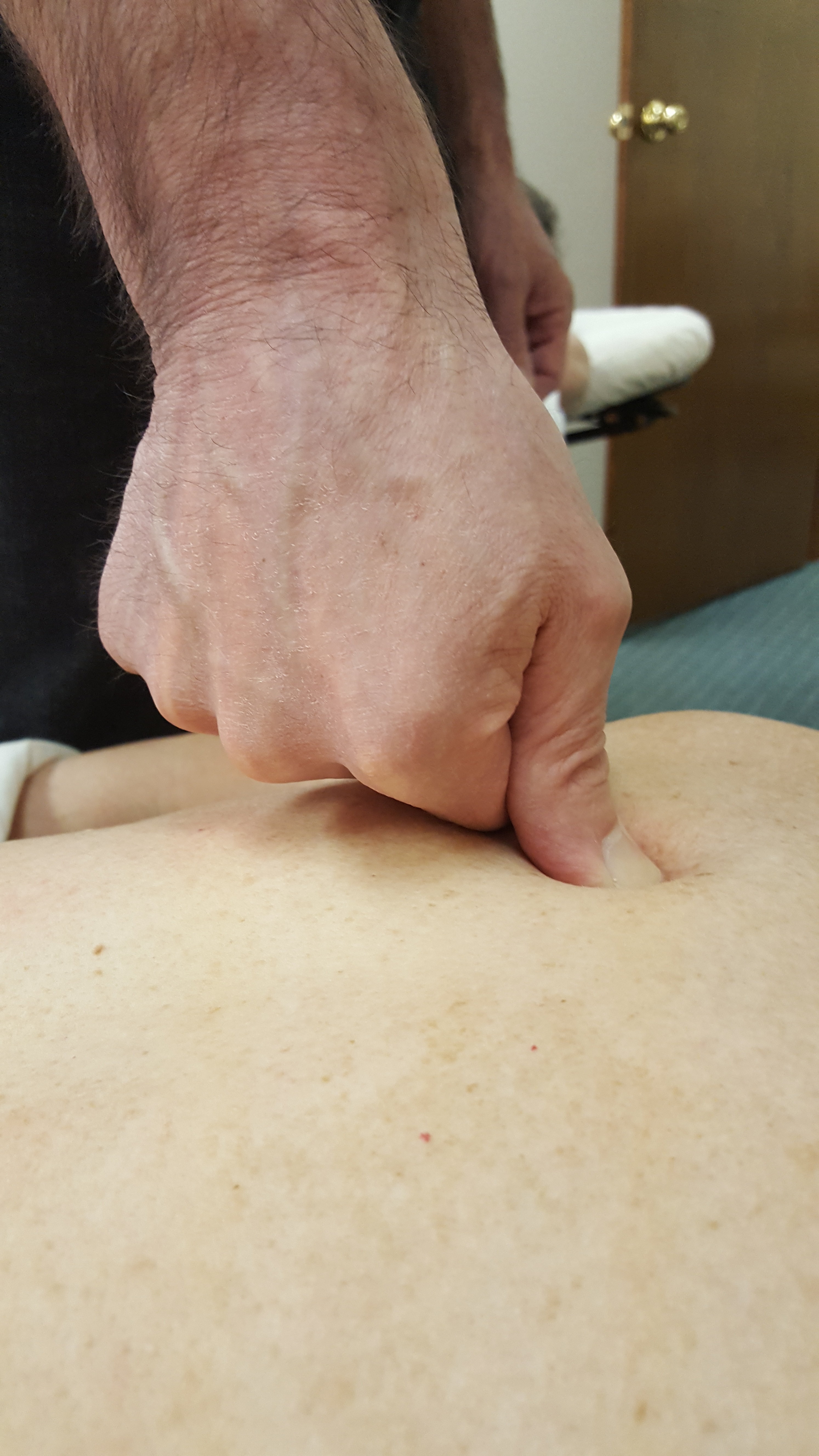
    Two Ways to Palpate Like a Chiropractor

    Here are two ways that I palpate like a chiropractor but in a relaxing way. One is with fingers on top of the spinous processes and the other is with fingers around the spinous processes.

    You don’t need to apply a lot of pressure with either technique, just enough to feel the spinous processes. When I apply pressure I also do a gentle and relaxing back and forth (perpendicular to the spine) motion.

    If I find a spinous process that is “off” and an area to either side of the spine that is tight and/or tender, I will apply focused and appropriate pressure. Check out this pain scale video for establishing appropriate pressure.

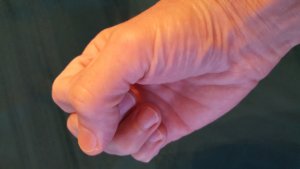
    I’ll use combination body parts (barred thumbs, thumb and fist of same hand, knuckle and thumb) and massage tools (specifically the T-bar and L-bar) to apply pressure.

    In this video I demonstrate the 2 spine palpation techniques: Massage Palpation Techniques for the Spine. (My massage model got sick. So the camera person is on the table and I’m filming myself doing the massage palpation techniques—so it’s a little shaky.)

    Small and Big Picture 

    Palpating the spine can give you a big picture and a detailed view of the client’s back. Go up and down the spine for a big picture view (e.g., reveal a scoliotic pattern) and when you find a spinous process irregularity, zero in on that area. By working the paraspinal muscles near the irregularity, you might just address that one area that has never been worked before. And you might give your client greater pain relief.

    How do you build a massage business with pain-relief clients?

    Go here: Jumpstart.

    Jumpstart is a free course that has everything you need to get to 30K a year working for yourself.

    Need to take a meh massage business to a dream massage business?

    Go here: Accelerator.

    This is how I took my 40K business to 80K+.


  • A Belief That Nearly Ruined My Hands

    A Belief That Nearly Ruined My Hands

    As students, we need to be sponges in order to master a skill or concept. But the sponge mindset becomes a problem when what we’ve learned, accepted and practice actually hurts us. This is when beliefs can end a career.

    Personally, I’ve had belief-ending-career encounters. My massage specialty is neuromuscular massage therapy (NMT). Though I’m not a strict NMT therapist now, there are many NMT beliefs that still impact how I do massage.

    Massaging the origin, insertion and body of the muscle is one of them.

    [bctt tweet=”Every massage specialty comes with beliefs that could be injurious to the practitioner.” username=”Mark LiskeyMarkLiskey”]

    Thank you, Joo

    Not so long ago, when I was teaching a massage tools class, Joo, an MT, asked me why I was always working muscle attachments as well as the body of the muscle. The question literally stopped me in my tracks.

    I hadn’t thought about it for 18 years, ever since I was certified in NMT. I couldn’t point to any credible research that said working attachments was better for pain relief than not working them. And even though I thought I got better results with my clients by working attachments, I couldn’t prove it.

    Here’s how I answered Joo: My clients seemed to appreciate the thoroughness of origin/insertion/body massage AND it’s ingrained in my brain to do it that way.

    As I thought about this some more, I had a flashback to about 5 years ago. My hands were really starting to bother me precisely because of the specific deep pressure needed to work small and deep attachments. I switched to forearms (when I could), then I developed a case of cubital tunnel syndrome.

    Find a New Way to Get ‘Er Done

    When my elbow and arm started to flare up, I was running out of body parts to deliver pressure. My instinct was to find different/new ways to execute my philosophy.

    So I started to experiment with combination body parts to deliver pressure and I greatly expanded my usage of massage tools. Those two changes along with learning how to lean to generate pressure did the trick (click here to see How to Do VERY Precise Pressure)—most of the time.

    But on those killer weeks when clients were coming out of the woodwork, the sheer volume of clients wore down my hands—until I remembered my conversation with Joo.

    Why was I working attachments—especially when doing a relaxation massage?

    Challenge Your Thinking

    It didn’t really make a lot of sense when I started to question my rationale. Was pressing the hammy attachments around the  ischial tuberosity going to make or break my relaxation massage?

    Probably not. In fact, when I broke from my do-muscle-attachments-at-all-costs mindset, none of my clients complained or probably even noticed—and my body thanked me.

    How to Handle Massage Beliefs

    Don’t wait 20+ years like I did to examine your massage beliefs. If you’re in pain when/after doing massage, check to see if the pain could be connected to your massage philosophy (e.g., get attachments at all costs) and conditioning. If so, here’s how you can help yourself out:

    1. Find a new way/technique to execute your philosophy.

    If you want to continue to execute your philosophy, look for different ways to get the job done. I expanded my use of massage tools and incorporated combination body parts to deliver pressure so that I could continue to work muscle attachments without causing myself pain.

    1. Challenge your thinking.

    Sometimes a belief just needs to be challenged. For instance, did I really need to massage muscle attachments all the time to do a good massage? As it turns out, it wasn’t necessary for me to work attachments with every massage, especially for a relaxation massage.

    You Can Change—And Not Lose A Client

    You can change how you do massage and not lost a client. I did.

    Five years ago, I was pooping my pants. I had to do something drastically different or get out of massage. But I was worried that clients–especially the ones who had been with me for 20 years–would walk if the massage felt different.

    So I cautiously went about changing my massage approach by getting in more massage tool reps with each massage and experimenting with my knuckles and fists for deep pressure in place of my forearms. In about a year, I had completely revamped my massage. Not one client walked. In fact, I think my massage got better.

    Here are some more other articles I’ve written to help you uncover and address beliefs that may hurt your body:

    The Question That Will Save Your Body

    I Broke a Massage Rule–And I Liked It

    Massage Pain-Free Online CEU Class

    If you want to cut to the chase and start massaging pain-free now, I’ve taken my bread-and-vegan butter class for massaging pain-free and converted it into an online, home-study course.

    There are lots of videos and you can email me any question anytime.

    Check it out here.


  • How to Stretch Your Back (While Doing a Massage)

    How to Stretch Your Back (While Doing a Massage)

    One of the great things about relaxation massage is that you can go on automatic pilot. And when you’re on automatic pilot, you can still do a good job even though you’re thinking about other things. Not so long ago, I discovered another benefit when I’m on automatic pilot: I can work on my posture.

    My Terms Didn’t Work 

    For the first decade and a half of my massage career, I did massage on my terms. I used my upper body to deliver deep pressure and stuck my elbow anywhere I felt like it. But eventually, “my terms” caught up with me, and, well, kicked my butt.

    As my body started to falter, I was forced to pay attention to how I was actually executing the massage. Over time I figured out massage strategies and techniques that didn’t aggravate the persistent conditions I had, like cervical radiculopathy.

    These strategies and techniques often involved establishing a neutral back (neither flexed or extended). When I was implementing these techniques, I’d notice that I was sometimes struggling to maintain good posture. That’s when I started to experiment with ways to re-establish a neutral back while doing a massage.

    Here are my 3 favorite improve-your-posture moves:

    Back Stretch/Reset When Working the Occiput

    One time a client wanted a ridiculous amount of pressure in his occiput. He was a big person and my thumbs weren’t cutting it. I was in the early stages of experimenting with leaning and had my table low. I decided to lean into his occiput with my knuckles (middle knuckle transmitting the most pressure).

    It was a huge success. It saved my thumbs, and I could generate more pressure. Here’s what it looks like:

    It works with a T-bar, too.

    With a lot of deep pressure techniques I have two hands on the client, but with this move I couldn’t have two hands on the client. What was I going to do with the other hand? Stretch, of course!
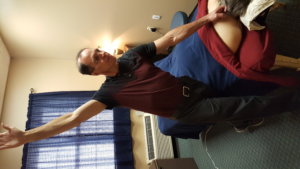
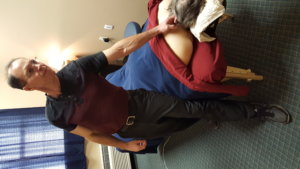
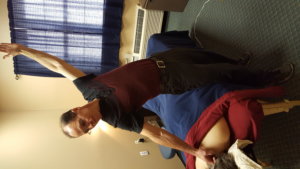
    Okay, so it’s a little dramatic. But I love this move because it’s a good stretch and a good reminder to stand tall when I can. Also, it feels like I’m getting away with something—like being paid to do yoga (a bastardized version of yoga) during a massage.

    If I switch my leg position so that the forward leg is the same side as the hand that is pressing into the occiput, I can generate even more pressure. I do this by leaning back over the table and into the client’s occiput. I simply regulate my pressure by shifting my weight between the heels and balls of my feet.

    Below is a picture of the back stretch from this position:

    Low-In-The-Saddle Reset

    There’s a challenge with setting a low table when working a specific area. It can be too low for other areas, like the neck. But there’s an easy solution—bend your legs instead of bending from the back.

    Often times I will find myself in a stance where my feet are roughly parallel to each other and my knees are bent. I call this stance Low-In-The-Saddle. (High-In-The-Saddle is when my knees are locked).

    In this picture I’m working the cervical erectors with double thumbs. My pressure is coming from my lean into the client’s cervical erectors. When I lean, my weight shifts to the balls of my feet and one or both legs lean into the table. The combination of being in a balanced stance and leaning into the table/client allows me to be in a well-supported position. In this well-supported position it’s easy to reset and maintain a neutral back.

    Back Reset Breath and Lift

    As I get absorbed in my work or get tired, I sometimes find myself bending from my back. When I feel my back flexing, I hit this reset move: I breathe in while lifting my rib cage up. Next I slightly suck in my stomach until I feel there is no rounding in my lower back, and then I relax my stomach.

    Starting to slouch.
    Raise rib cage.
    Relax your back.

    This move feels good and can be done in most any stance.

    It’s About You Too

    Twenty-five years ago, if you had said that I would be working on my posture while doing massage, I would have laughed out loud. For one, I thought I was indestructible and, two, I thought massage was all about the client.

    What I didn’t know was that the massage was actually about me, too. If I’m hurt, I can’t do massage. And if I’m in pain, I don’t want to do massage.

    When I was forced to face the bad habits that were contributing to my massage career demise, I discovered that I could save my body by minding my massage posture.  In addition, when my massage posture improved, the easier it became to do my work.

    Here are three quick ways you can work on your posture during a massage:

    1. While leaning into the occiput with your knuckles or a massage tool, raise the other hand up and stretch.
    2. Step into a Low-In-The-Saddle stance, lean into the table/client, and then reset your back to neutral.
    3. When you feel that your posture is slipping, breath in, lift your rib cage up and on the exhalation allow your back to relax.

    If you take of yourself, you can take care of your clients for a long time.

    Can you learn how to massage pain free AND get CEU credits?

    Yep.

    Go here.