I hear this all the time from massage therapists who have been around the block: I know I’m a good massage therapist, so why can’t I get more clients?
I have a theory—you’re not getting enough at-bats and you’re not converting enough newbies to repeats. It’s a theory that proved to be the correct for me.
A while back I looked around at more successful massage therapists and thought, If only I could get more massage clients to walk through my door, I know I could convert them to repeat clients.
That led me to a Groupon experiment where I was drowning in new clients. At the end of the experiment I was successful enough at converting new clients to repeat clients to make me wonder if I could be even more successful.
But the new client spigot was turned off. Groupon was over. It served its purpose to jumpstart my business, but I had no desire to run another one.
So, now I knew my mission for the next year: (1) drive more clients through my front door and (2) convert as many of them into repeat business.
Let’s talk about driving more clients through the front door. I’m about to say a word that is going to make you stop reading.
Ready?
Marketing.
Wait, here’s the thing, marketing isn’t out of your reach and it’s less painful once you see start seeing more clients walk through your door.
My first, big marketing foray after Groupon was demo massages. Demo massages are free massages, yes, free—please send all hate mail to mark@makethemostofmassage.com.
But before you do, I need to tell you that “free” is not forever. It’s one-and-done or structured in a way that has a strategic beginning and end. By strategic I mean that the beginning and end are determined in a way that maximizes your advertising return.
For example, if it’s an advertising benefit for you to offer free, 15-minute massages to a chiropractor more than once so that she really promotes your massage business, build in start and stop dates that give you enough in between time to hook the chiro, but not too much time to establish free massage as the norm.
The cool thing about demo massages is that you’re advertising in the most effective and easy way you know how to do—with your hands. By the way, having your hands on potential customers will help with your conversion rate.
Demo Massage
After the Groupon experiment, I picked out 4 categories of businesses to approach with demo massages—physical therapy, chiropractic, personal training, and specialty sports, like a bike or running store.
I sent emails to local businesses and landed demo massages in all 4 business categories.
I set up on-site, demo massages. During Covid-19 you can arrange to do the demo massages at your office. I gave 15 minute massages to the business’s clients/customers/patients and 30 minute massages to the business’s owners and employees.
The result?
Doing demo massages was a huge success that created on-going, referral sources of clients. I just needed to stay in touch with the owners and employees of these businesses to keep the referral source spigot turned on.
Doing demo massages wasn’t the only way I got more people walking through my door post-Groupon. I re-did and optimized my website.
Website and GMB
For a full website build-out from scratch or to do a redo, go here.
Once you’re done with your website you can set up your Google My Business page.
What exactly is Google My Business?
“Google My Business is a free and easy-to-use tool for businesses and organizations to manage their online presence across Google, including Search and Maps,” says Google. “If you verify and edit your business information, you can both help customers find your business and tell them your story.”
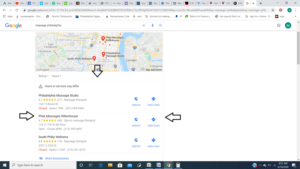
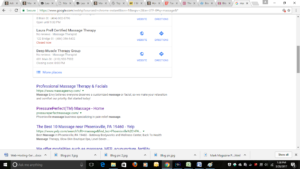
Mark says, turn on your computer. Google “massage near me”. The first thing that comes up is probably an ad(s). Then under that is a local search with massage businesses in the area. Right now (Google changes things around often) that local search has a map with 3 businesses underneath it and a “More Businesses” button is underneath that.
Google My Business is the way to input your business’s information so your business appears in the local search. Do the basics and you’ll get basic results. Do more than your competition and you can potentially climb higher on the local search page.
You can learn how I set up and optimize my GMB page by going to step #5 in this article.
Personally, I recommend jumping into my whole marketing program to get the phone ringing. It’s free and you’ll have all the information you need at one place, but don’t bug out too soon. We have one more important thing to talk about.
As you start your marketing, it’s a good time ask yourself this important question: How good am I at converting new clients to repeat clients?
Newbies to Regulars
Hellzyeah, I’m good, I thought when I asked myself that question before I ran the Groupon experiment. After all, I had been doing massage 20 plus years. But did I really know? What standard was I comparing myself to? Where were my stats?
When I did a deeper dive into my thoughts about my conversion rate, I discovered that “Hellzyeah” wasn’t always my response. The answer actually depended on when I asked the question.
If I’d ask myself on a day when I was booked with clients, I’d start humming Nobody Does it Better.
But if I asked myself on a bad day, I would sound like I was back in talk therapy: I take “suck” to a whole new level. How come everyone else has massage clients and I don’t? It’s my mom’s fault, right?
After some time I started to realize that the truth about my conversion rate was probably somewhere in between my good day perception and my bad day perception. In other words, I wasn’t as good as I thought I was on my good days, and I wasn’t as bad as I thought I was on my bad days. I was somewhere in between.
This was supported by the observation that I had proven that I could bring in clients because, after all, I did have a massage business, albeit not one overflowing with clients.
So, okay, I was competent at converting newbies into regulars, but I wanted to do better. Before I entered the Groupon experiment I thought about the things that made people want to come back to me.
It wasn’t a tidy office. I’m still working on that one.
What kept a client coming back to me could be boiled down to the work I did on and the connection I had with the client.
If I did a good massage and connected with the client it was likely that she would come back to me and not look for another massage therapist.
What is a good massage?
That can be a complicated question or not. Here’s how to make it “not” a complicated question.
I provide two services: relaxation massage and pain-relief massage. Often they are combined during a massage.
For instance, Leandro wants to be relaxed and he has pain in his neck. So, I give him a relaxation massage with pain-relief focus work on his neck.
How I relax Leandro and help him with his pain will be different than how you do it. But within that framework of relaxation and pain-relief is a common element that is essential to making Leandro happy—pressure.
If my pressure is too hard then the massage is not going to be relaxing. If it’s too light then the massage pressure could be irritating. Spot-on pressure is the pressure that Leandro likes best—and that’s the pressure I need to nail.
The same is true with pain relief massage—I don’t want to put the client in more pain so my pressure needs to be appropriate for the situation.
Around-the-blockers are thinking, Dude, my pressure is fine.
I’m sure it is, but could it be better?
I’ve been working with massage tools for 20 years, and I use them in practically every massage I do. I’ve gotten feedback when I’ve used massage tools and I’ve experienced massage tools as a massage recipient. But, and this is a big but, my information is old. The feedback is cumulative and has been acquired over years—less in the later years. In fact, when was last time I actually got a friend on the table and asked for feedback through the entire massage while I used all my massage tools?
I’m going to say never.
Hmm…guess what I’m going to do this week?
When I do the feedback session I don’t expect any great revelations, but I do think that I’m going to get valuable insights that will make my tool work better.
How about you? Have you assumed things about your massage that aren’t entirely accurate? Tweaking your massage can only help your conversion rate.
Good Therapists Getting More Clients in a Nutshell
My approach to building a massage business has changed over the years. After my Groupon experiment I realized that I needed to find ways to drive people into my office while maximizing my conversion rate.
But even now I still slip back into old marketing thinking that doesn’t serve me. A couple of years ago I wrote a blog post called How to Take My Clients (And Potential Clients). But here’s the thing, you’re not going to take my clients once they are my clients. That’s a done deal.
Why?
If they’re satisfied with my work, they have no reason to try someone else.
So, going back to the title of my blog post, the “How to Take My Clients” part is wrong. What’s in between the parenthesizes, “And Potential Clients”, is right.
You can take my potential clients.
How?
By not letting them get on my table. Intercept them. Get to them before I do.
Hey, no hard feelings here. Believe me, if you opened your business next mine, I’d so be trying to beat you to the punch. The reality is that we work in a competitive field.
I can name at least 3 massage therapists within 5 miles of my office who would absorb my clients if I closed my doors today. These therapists wouldn’t have to advertise to get my clients. My clients would find them. And if I pissed a client off, that client would eventually find one of these competitors. Yes, I have a unique relationship with each client that is special, but the bottom line is: I’m replaceable. And there are massage therapists near me who can replace me.
That said, I never, ever have to worry about my client, Toni, going Jeremiah on High or Sayo on Main, and now you know the reason why—because I got to Toni first.
Get to ‘em first. Convert ‘em. And keep ‘em for life or until you’re ready to let them go:-)
Demonstrate how you’re different to the referral sources.
Advertise how you’re different on your website.
Advertise how you’re different on your GMB page.
Advertise how you’re different on signs.
I know, you’ve been told to send out emails and to do health events and to hand out business cards and to join a network group and the list goes on and on.
You pick one thing and you start to do it and you don’t see any great results so you go to the next thing and it’s not much better and you keep picking things off your list until you get tired, discouraged and frustrated. Then you accept that you have and always will have a meh business or you find something else to do instead of massage.
But, honestly, what do you expect if you’re randomly picking marketing tips and don’t have a plan?
A plan has steps. A plan has goals. A plan provides opportunities where pivots can happen and a new course of action can ensue without having to start over.
Initially, a plan can seem like the long way because it requires a commitment, but ultimately randomly picking marketing tips is the long way or in some cases, the no way, because it’s a willy-nilly (half-assed) approach to growing a massage business.
The plan I outlined above has taken my meh business to a yay! business, and steps 1, 2, 3 and 5 are free (or close to free) to do. And step #4 can be done for free or for not much money.
The last step is the one that will cost some money, but you don’t need to do that one right away to have a steady stream of clients coming through your door.
So, let’s get crackin’ on this How to Get Massage Clients Plan.
How to Get Massage Clients Plan
1. Be different.
By different I don’t mean create a whole new form of massage that you can package and market.
In fact, I’m talking about something specific and not so flashy. I’m talking about differentiating yourself from the competition in relaxation and pain-relief massage.
That’s a difference, Mark?
Yes, to explain how it is a difference I need to back up first.
Tell me if I’m wrong: It’s hard to (if not impossible) to define the difference you bring to the table when you’re not sure what you do well as a massage therapist.
You may do some myofascial and reflexology and mix in some essential oils, but how do you put all of that on a website or a business card? And how does that look different than everyone else who does a lot of things?
Hey everybody, I’m the best massage therapist who combines myofascial work with reflexology and medical grade lavender oil in town.
By the way, I’m not going to tell you to whip out your credit card and get certified in a modality to standout from the crowd.
That’s not to say it wouldn’t work. That could be how you’re different if you get competent in that modality.
Actually, getting competent in one modality is what I did early on in my massage career. My specialty was neuromuscular therapy (NMT).
Back then I was all in with NMT. I subscribed to the philosophy and practiced the methodology—and it did help me build my first practice.
But as time went on I didn’t find the philosophy to be helpful or the methodology to be effective and I stopped treating clients in a NMT way.
Guess what happened to my business after I stopped practicing NMT?
It grew.
Granted, I didn’t kick all of my neuromuscular training to the curb. I kept what was helpful and discarded the rest.
For instance, I like anatomy, and NMT was big on anatomy. To this day I always show new clients the areas of concern that I addressed during the massage using my favorite text for muscle pictures—Myofascial Pain and Dysfunction (Amazon affiliate link) by Janet Travell.
But what I realized overtime as my business grew and I stopped practicing NMT was that I didn’t need any fancy credentials to bring in clients.
I just needed to give clients what they wanted. And what a majority of my clients wanted was a massage that was both (1) relaxing and (2) pain relieving at the same time.
And that is precisely the difference I’m talking about: Be the expert in the massage that is both relaxing and pain-relieving.
Okay, I think I need to address a little disappointment at this juncture. You probably were expecting something new and fancy, like a cool technique that would look great in a YouTube video—and instead you got old, boring “relaxation” and “pain relief”.
Not so sexy, I agree.
But here’s the thing, “relaxation” and “pain relief” are universal. People love to be relaxed and most everyone has a pain area.
But, Mark, is that going to be enough to bring in clients?
Yes.
And that is a confident “yes” because it has worked for me and it has worked for many massage therapists who I’ve trained for our business or who I’ve taught in our CEU classes.
Here’s how it goes down:
Your referral sources put clients on your table. Your better-than-the-competition ability to relax and provide pain-relief to your new clients brings these clients back and has them referring friends and family to you.
Does how you’re different have to be being good at relaxation and pain relief massage?
No.
It’s just a suggestion that is easily accessible because you’re probably already doing relaxation and pain relief massage.
If you don’t have how you’re different nailed down yet, don’t wait to figure it out before you go to step #2.
2. Find referral sources.
Why? Because the process of finding referral sources will turn the heat up for you to find what makes you different sooner than later.
Okay, here comes the bad news—finding referral sources is hard work. It requires you putting yourself out there, and sometimes that can be tough on your ego.
A while back I was determined to get a physical therapist as a referral source. I made my list of PT organizations in my area and I went to town contacting them and trying to set up an intro appointment.
I slammed up against roadblock after roadblock and it was hard not to take all this rejection personally. But finally I got a hit and I set up an appointment to do demo massages at a local PT office that was not regional or national brand.
Pay dirt.
Gold.
Can you say, I’m in the money?
One would think, but not so much.
My demo massage day was a lukewarm experience at best and when I tried to follow up, I got crickets.
Poor me, I know.
But that’s not the end of the story. Eventually, I realized that the cold call approach into the PT world was not working so I took a different tack.
When I had a client who was seeing a PT, I asked that client if I could coordinate care. All my clients said yes and once I was talking to the PT or PTA about a client’s case, I realized that I had instant credibility and an instant professional relationship with that PT or PTA—which, ultimately, resulted in unsolicited referrals.
By the way, cracking the code for referral sources is not always that hard. Personal trainers in my area responding quickly to my free demo massage offer. And one husband and wife team became a solid referral source and a true business ally.
If you’re introverted, like me, and struggle with the public side of your business, I’ve created a phone script and an email template that you can use to break the ice with potential referral sources.
You can find all that information in this free, growing a massage business program: Jumpstart.
As you start making connections, it’s then time to…
3. Demonstrate how you’re different to the referral sources.
How are you going to do that?
Demo massages.
I can explain how you can demo massages during COVID-19 in this article and yes, I said free massage.
But not free forever—just one time—and for short sessions.
Fifteen minutes for the referral sources customers/clients/patients.
Thirty minutes for the referral source and her employees.
Wait, free is bad, Mark. It cheapens my service.
Free is bad if you’re doing it all the time.
Strategic free to build a referral source base is good marketing because you’re advertising with your hands—the best tool you have for bringing in clients.
How do you go from free to your normal price?
Easy.
You say, I’m doing a free, fifteen massage.
The potential client says, Great, and gets on your chair or table.
You wow her with your work, care, concern and insights.
She says, Can I have a card?
You give her your business card.
She then asks, What’s your price?
You tell her.
Boom.
There’s no more free massage. There’s no negotiation. She got to experience your massage and if she wants to experience it again she knows it’s going to cost X number of dollars.
You reinforce that your price is your price on your website, which brings us to step #4.
4. Advertise how you’re different on your website.
Websites can be big, hairy deals or they can be little, hairy deals. I prefer the little hair deals. Haha.
Here’s how you make them little, hairy deals: First, don’t do the free website if you can spend $100 or so a year.
Free is not professional. It will have ads on it and you won’t have a domain name that you own.
If I went for a free massage website, my URL would be a subdomain of the free massage website platform, like: www. weebly.sites,free/mark64massage.com.
Doesn’t look so professional, right? And how do you put that on a business card? So, spring for the $100-ish/year if you can.
Which website builder should I go with?
Good question.
In this article I compare 3 website builders—Weebly, Wix and Hostgator.
All three are good. I give you the short version of my comparison in the opening paragraph.
If you’re looking to have a blog or are going to have more than one website and are willing to invest some time into learning a platform, I would recommend a WordPress website.
WordPress is free. You will pick a theme (website design) for your WordPress site. Some themes cost money. Some are free.
You can also add or change functionality on your WordPress website using plugins. As in the case with themes, some are free and some cost money.
In a minute I’m going to direct you to my Build a Massage Website (For Non-Techies) that will help you create a professional-looking, 3-page website on WordPress and other website platforms.
But before I do I want to circle back to advertising your difference on your website. It will be important for you to show what sets you apart from the competition on your Home and your About page.
Our difference is that we’re not a cookie cutter massage spa.
If you’re in the process of figuring out how you’re different, I have this article for you: How to Write an About Page. In the article I show you how to figure out your unique story.
And in How to Write a Homepage I provide ways for you to create a Homepage that will help you stand out from the crowd.
Links to these articles can be found in my How to Build a Website Guide (For Non-Techies). The Guide is comprehensive, so if you only want help with your Home and/or About pages, just click on the articles above.
One last thing about websites, don’t get lost in the sauce. In other words, keep it simple and don’t try to make it perfect, especially when it comes to the design. Instead, focus your efforts on the content—make the words and videos ring true to how you’re different.
For example, we have many years of massage experience and expertise in our company, so on our website I’m going to demonstrate that by providing instructional massage videos to clients and potential clients.
Here’s one:
Does the video have to be perfect?
Hellz no.
People will overlook the homemade nature of a video if the content of the video is helpful and/informative.
The video is one of many pieces of information on the website that helps to demonstrate that we are what I say we are—experienced massage therapists with expertise.
And no you don’t need a video on your website to have an effective website. If it’s in your wheelhouse, go for it. If it’s too much of a stretch now, save if for another day.
Remember, simple.
An engaging, 3-page website—Home/About/Services—will do the trick.
Once you have a website, it’s time to…
5. Advertise how you’re different on your Google My Business (GMB) page.
What exactly is Google My Business?
“Google My Business is a free and easy-to-use tool for businesses and organizations to manage their online presence across Google, including Search and Maps,” says Google. “If you verify and edit your business information, you can both help customers find your business and tell them your story.”
Mark says, turn on your computer. Google “massage near me”. The first thing that comes up is probably an ad(s). Then under that is a local search with massage businesses in the area. Right now (Google changes things around often) that local search has a map with 3 businesses underneath it and a “More Businesses” button is underneath that.
Google My Business is the way to input your business’s information so your business appears in the local search. Do the basics and you’ll get basic results. Do more than your competition and you can potentially climb higher on the local search page.
If you’re still wondering if this is a good time investment here are some stats from Hubspot that may help you decide.
Over 2 years there has been a 900% increase in “near me” or “close by” searches.
72% of consumers that did a local search visited a business within a 5 mile radius.
46% of all Google searches are looking for Local information.
Here’s how you get started with your GMB page.
From the get-go I want you to follow this one rule when inputting business information to GMB:
* Be consistent with Name, Address and Phone Number (NAP).
Your GMB NAP must match your website NAP.
Google is cross-referencing NAP. If your NAP is not exactly the same on both, it will screw up the local search results. So, it’s important that you take your time and make sure that your website NAP is the same as your GMB NAP.
Okay, onto your GMB page. For now, I’m going to show you the basic GMB registration and a couple of key optimization steps—because I want to spend most of the time showing you how I advertise my difference on my GMB page. If you want more tips for optimizing your GMB page, go here.
If you’ve never registered or claimed your business with GMB do this:
(1) CLAIM YOUR BUSINESS or go to GMB to register your business.
Here’s the thing, you may have never registered your business, but your business may already be tagged with GMB without you knowing it. Big brother Google does this. So, if you’ve never registered your business with GMB, first do a Google search to see if your business comes up in the local search.
If your business comes up, click on your name. A GMB box should appear with your business’s info in it. Scroll down until you see “Own this business?”. Click on that and go through the steps to claim the business. It’s not complicated.
If you don’t see your business in the local search then you’re going to have to register your business with Google. To do that, you’re going to:
(a) Sign in to your Gmail Account.
(b) Open Google My Business page.
(c) Follow steps to register a business.
Once registered you can start to input your business information.
*Later on whenever you want to get into your GMB account you can access it through this link: https://business.google.com/
Next…
(2) Pick the BEST CATEGORY that represents what you do.
Not sure which one to pick, then look to see what your competitors are doing.
Click on a competitor’s GMB listing and look right under their business name.
Add secondary categories by clicking on Additional Categories under Primary Categories. Just start typing in the box until your category comes up, like Sports Massage.
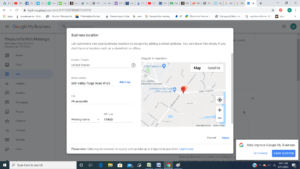
(3) Input ADDRESS and make sure it matches website address!
This step is important because if the address on your website doesn’t exactly match your business address, you won’t rank. So, take your time to be accurate and consistent with your name, address and phone number (NAP).
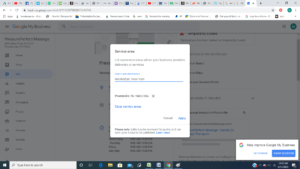
(4) Fill out SERVICE AREA.
When I first filled out Service Area for PressurePerfect Massage, I forgot to click on the Apply button and for years Google never 100% knew the area my business covered. Again it pays to go slow and make sure you do things correctly the first time.
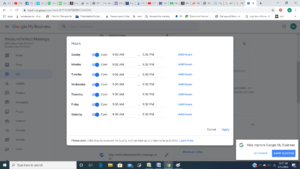
(5) Fill out HOURS.
Make sure website hours match GMB hours. If your hours change on your website make sure you change them on your GMB page.
Under HOURS is MORE HOURS where you can add hours for specific services or specials.
Going forward it’s important to keep your hours updated and remember to add special hours for holidays.
Okay, like I said before, go here for more GMB optimization tips, but for now I want to show you how I show my difference on my GMB page.
Show How You’re Different on Your GMB Page
Here’s the first way: I show it on our GMB posts.
Take a look.
The first post on the left helps establish me as being competent at relaxation and pain relief massage. The post next to it talks about our Covid-19 safety measures which shows that we care about our clients/potential clients and their safety.
How do you add a post to your GMB page?
Before you add, let’s talk about the type of post Google allows.
A GMB post can be an Information (Update), Event or an Offer post.
An Information post lasts for 7 days before Google removes it.
An Offer post lasts as long as the offer is valid.
An Event post lasts until the event takes place.
Okay, so, where do you write a post?
Click on Posts in the side panel.
Then click on the Update button (even if you have not written the post; I know, that’s a little confusing) to write an Information post.
I write in Word and then copy and paste into GMB posts.
What can you write about?
Information relevant to a potential client, like massage research, a massage tip, or wellness information related to massage—but make sure it’s connected to what you do in a massage (how you’re different).
For example, if you use essential oils in your massage you can talk about the potential benefits of a particular essential oil, but don’t stop there. Also explain how you incorporate that particular essential oil into a massage (that’s what makes you different).
GMB also lets you put short videos on your GMB page. So, you could also demonstrate your application of that particular essential oil.
Does that make sense?
Choose a topic that reflects something that you do in massage and connects to your massage experience or massage expertise (how you’re different).
Does how you’re different have to be a big, hairy deal on your GMB page?
No.
Why?
Because a viewer of you GMB page isn’t comparing you head-to-head with your competition on that particular topic.
If you write a post about focused pressure versus broad pressure, the potential customer is not comparing your post with other massage therapists who write about pressure.
The viewer is just trying to determine if what you offer is what he wants. So after reading your post about focused pressure versus broad pressure, the viewer may think something like this: Sabine knows her stuff about pressure.
To get him to think about you being the best person to deliver the perfect pressure to help him with his shoulder knot, you have to connect yourself to the post.
In the case of focused pressure versus broad pressure, the connection in the post might be: This is my favorite massage tool to deliver focused pressure in the shoulders and neck. It allows me to easily pinpoint tight and tender areas at the top of the shoulders.
You’re not saying outwardly: Hey, look at me! I’m an expert with pressure. Instead you’re providing details (specific pieces of information) about your work that demonstrate you’re an expert with pressure
So, from reading the post the potential customer knows that you’re experienced and probably competent with pressure. He also knows how you’re different: You use massage tools which allows you to pinpoint the pressure.
That said, don’t over-think your post.
Focus on one thing with each post.
For my business, I’m going to write posts about COVID-19 safety and pain relief/relaxation massage. And I will connect each post to me.
Here’s a list of potential topics for me and how they can connect back to me.
Air exchange in the massage room.
Connection: From the research that I did, I found that…
Why I look Hazmat-y in the massage room.
Connection: I’m doing total PPE to protect you.
Temperature checks.
Connection: We follow CDC guidelines and do temperature checks as a safety measure.
One therapist and one client in the office at a time.
Connection: We go above and beyond to keep you as safe as possible.
Relaxation and pain relief in the same massage.
Connection: We offer a massage that is both relaxing and pain relieving.
Focused pressure versus broad pressure.
Connection: Here’s how I do broad pressure and here’s how I do focused pressure.
Focused ischemic compression for tibialis posterior tendonitis.
Connection: Runners, I have a tib posterior massage for you.
You get the idea, right?
Other GMB Housekeeping Details
You can also add a COVID-19 Update. I like that feature and have been using that a lot during the pandemic.
If you want to add event post click on Add Event at the top of the post page. And if you want to add an offer post click on Add Offer at the top of the post page.
Lastly, I need to mention keywords.
You don’t need any SEO superpowers to choose your keywords.
Keep keywords simple and they should be the same keywords you used in your description and other areas: location, “massage” and type of massage you want to promote (if/when appropriate).
GMB posts done.
So far with the steps I’ve shown you there’s not a lot (if any) money that needs to go down to get clients walking through your door. The last step in this plan requires a little cash out—not crazy cash out, just some.
6. Put how you’re different on signs.
Signs bring in clients.
My first serious sign was a huge, OBNOXIOUS banner-sign at the front of a shopping center.
At the time, I had an office in a fitness center. The fitness center owner and I went in on a ginormous, yellow banner-sign with red lettering that said MASSAGE AT THE EDGE 610-935-5902.
The phone number was my office number (pre-cell), so all the calls were coming directly to me.
The sign was a fantastic success. I got newbies and some converted to repeats, but there was only one problem. The sign went against township code and the code officer, who was friends with my client/friend, told me, through my client/friend, to take the sign down.
Okay, so it wasn’t a total, slam dunk advertising story, but I completely took advantage of my client/friend’s relationship with the code officer, and I dragged my feet about taking the sign down and was able to squeeze out a few more months of killer advertising.
A more recent example of signs success happened at Phoenixville office. Our Phoenixville office is at a corner light with high traffic volume and our banner sign has great visibility.
The wind does beat the caca out our banner sign, and I have to replace it about once every 18 months, but that’s chump change when compared to all the new clients it has netted us.
Outside signs work. If you have an opportunity to put one up, do it.
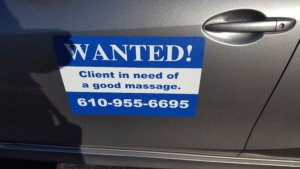
If you don’t, think outside the box. How about a sign on your car?
If your car is strategically parked in your work parking lot it connects your massage office with your business location.
By the way, besides bringing in more clients, a sign can also give you an emotional boost.
How?
Your sign is not only letting the world know that you’re here, it’s also letting you know that. So, every time you go to your office and you see your sign, you’re telling yourself that you’ve arrived. That can be motivating and uplifting.
We talked about the importance of signage, but what type of sign should you put up?
A sign that people notice.
Sign Types
The obnoxious one I had by the road at the shopping center was perfect for getting the attention of drivers.
But an obnoxious one at the corner of our current Phoenixville office is overkill and inappropriate.
Why?
The Phoenixville office is at intersection with a light. Cars are stopped at the light and have a chance to look around. Our sign doesn’t need to be screaming at them.
Also, since our business name is on the sign I don’t want our business name to be associated with obnoxious. The obnoxious banner sign at the shopping center just said MASSAGE.
Speaking of banner signs, your sign does not have to be a banner sign to be successful.
This A-frame that is also up at our Phoenixville office allows us to change our messaging and drives business though our door.
I have to admit that I was opposed to this A-frame sign initially. My wife, Lisa, bartered with a chiro in the area—massage for referrals and whatever else the chiro wanted to throw in. An A-frame sign was part of the deal. You probably saw it in the banner sign pic above.
I hated this A-frame sign because it required more work than the banner sign. And I bitched to Lisa about how dumb that sign was and how she got screwed in the deal.
Well, at one point when business was slow I decided to drag out that clunky, stupid A-frame sign and clean it up.
Then I put the pain relief pitch on it, instead of repeating our intro offer which was on the banner sign.
At the end of the day, two signs with two messages that show how we’re different from the competition produced more call-ins than one sign.
I love our stupid, clunky A-frame now and I’ve apologized to Lisa for bad mouthing her barter deal.
So, pain-relief and our intro special is what I put on our signs. What should you put on your sign?
Your Sign Message (Difference)
How you’re different may be different than how I’m different.
Again, what makes us different is our intro special. Another difference is that we do pain relief massage.
Remember, what makes you different from the competition doesn’t have to be earth shattering and space is limited on a sign.
If you’re stuck just go with price and what type of massage you do.
The potential client can always go to your website or GMB page to get more details.
For example, Tasha sees our sign for pain relief massage. She’s intrigued so she goes to our website and then reads this video blog post about pain relief massage. Sign gets her intention and the website gets her to call. Boom.
Speaking of getting calls, don’t forget to put your phone number and/or website on the sign.
Where Do You Get a Sign?
You can get a sign online or at a local sign shop.
Banner signs done online are usually cheap and fairly easy to design yourself.
When I have sign that really needs to be spec-ed out and I need some design input, I go to a local sign store. Some local sign stores have been great. Others have been bad. Ask other business allies where they get their signs done to make sure you find the one that works for you.
We’re through the plan. Let’s reccap.
How to Get Massage Clients in a Nutshell
Getting massage clients isn’t brain surgery, but it’s also not sheer luck. You can dink and dunk down the field, selecting marketing tips that may or may not be right for you, and spend unnecessary years building your business or you could follow a proven plan.
This is the plan that has taken my meh business to a yay! business:
Be different.
Articulate what makes you different from your competition. It doesn’t have to be something extraordinary. A special intro price could be it.
2. Find referral sources.
Establish relationships with other businesses that can send you referrals.
3. Demonstrate how you’re different to the referral sources.
Show your referral sources how you are different from the competition. Demo massages are a free and easy way to do that.
4. Advertise how you’re different on your website.
Start to make your marketing consistent across all media by stating how you’re different on your website.
5. Advertise how you’re different on your GMB page.
Rinse and repeat on your GMB page.
6. Put how you’re different on signs.
Be bold. Don’t back away from declaring how you’re different on signage.
You’ve read this article so pat yourself on the back, but don’t take your foot off the accelerator. Put the work in now, create the business you want and once you do then you can go on maintenance mode.
How to Keep Your Foot on the Accelerator
If you’re just starting your massage business, this free course that is designed to get you to 30K: Jumpstart.
To take your massage business to the next level, go here: The Accelerator.
Make a website that stands out from the competition
Follow Googles’s recommendations for optimizing a Google My Business (GMB) page to improve local search rankings.
If you do these 3 things you’ll have a comprehensive “promoting your business” plan that covers both word-of-mouth and online marketing.
By the way, these three strategies can be done at little to no cost.
Let’s start with demo massages because it requires the most amount of physical, emotional and mental energy.
1. Market with demo massages.
First, what I do I mean by demo massage?
I mean free massage.
For everyone?!
No. Offer demo massage to a targeted audience. It’s rule #1 for my marketing with demo massage plan.
My Demo Massages Rules
Rule #1: Not free for everybody.
Only offer free demo massage to strategic business allies, their employees and their clients. A strategic business ally is someone who can refer clients to you, like a hospital, MD, chiropractor, PT, personal trainer, running or bike store manager/owner, hotel concierge, or retirement community director.
Rule #2: Free for 15 minutes.
Limit the length of the massage to 15 or 30 minutes. Typically, I’ll offer a business ally, like a chiropractor, a free 30 minute massage, and I’ll offer her patients 15 minute massages.
I give the extra time to the chiropractor because I want to demonstrate that I’m a good fit with her practice. For her patients, 15 minutes is the perfect amount of time to find and treat pain/problem areas.
Rule #3: Limit the time of the offer.
Offer free massages for 3 months (12 weeks). For the first 6 weeks, do demo massage once a week. For the next 6 weeks, do demo massages once every 2 weeks. At the end of 3 months, reevaluate and decide if periodic demo massages in the future are important to keep you connected to your business ally and her clients.
The demo massage marketing plan was a key component to taking my meh massage business to a yay! massage business. It works because (1) you’re parlaying a skill (massage) into a marketing tool so there’s no real learning curve, (2) it’s practically free to do, and (3) and you can implement this marketing strategy immediately.
By the way, you can still do effective demo massage marketing during COVID-19.
Demo Massage During COVID-19
Instead of doing demo massages onsite, you’re going to do the demo massages in your office where you can maintain the safety measures you have in place. If you’re also selling safety as part of your marketing strategy as I do, then it’s a double marketing win—you get to sell with your hands AND the potential client gets to see how you go out of your way to keep her as safe as possible.
You can set up the demo massages by calling and emailing candidates that you’ve researched and think would be good referral sources.
If you need help with what you want to say as an introduction, I have call a script and a sample email in this free course that I offer: Jumpstart.
I should also mention that many of the health-related businesses that you court should be very receptive to relationship building (growing their business) during this time of economic uncertainty because they too are looking for ways to sustain their businesses during this pandemic.
What if the area that you live in has a high Covid case count and/or positivity rate?
Well then, just set up demo massages for a time down the road when it’s safer.
If you want to start with a more sedentary way to promote your massage business…
2. Make your website stand out from the competition.
How are you doing to do that?
You’re going to write an engaging Homepage and About page.
Wait, Mark, what about SEO?
If you want to pay someone to optimize your website or if you want to invest the gobs of time it takes to learn how to optimize your website yourself, go right ahead.
But I have a different strategy to getting someone to call me when she clicks on my website.
It’s this: Follow Googles’s rules on my GMB page to improve my local search rankings. Then when a potential client clicks on my website I pull him in with words (and videos). We’ll talk about your GMB page after we finish with writing engaging content for your Homepage and About page on your website.
A HomePage That Draws the User In
I learned about the importance of a homepage from new clients.
When a new client comes into our office it’s not uncommon for her to say:
“I like that your massages are 60 minutes long…” or “I saw your tennis ball video…” or “I never heard of anyone not accepting tips…”
Over time I made the connection that having an engaging homepage impacts our phone ringing.
Okay, Mark, how much is it going to cost to have someone write (or rewrite) my homepage for me?
Nothing.
Because you’re going to do it yourself.
Just follow this one simple rule: Don’t bore the reader. Here’s how you’re going to make your Homepage engaging.
Make Your Copy Pop
Ask yourself: What about my business is eyeball catching?
It doesn’t have to be radical.
In fact, radical can turn a lot of people off.
It just has to be truthful, something you are and/or stand behind.
Here are some examples:
Above-and-beyond customer care.
Specialty massage.
Expert with specific populations, like seniors, PTSD clients or cancer survivors.
Niche market, like tri-athletes, golfers, actors, dancers, office workers, EMTs, nurses, etc.
A special introductory rate.
A really nice and relaxing massage room.
Aromatherapy/essential oils.
Guided meditation with massage.
Massage and stretching.
Your own brand of massage.
So what if none of this is your deal or you just started doing massage, how else can you not be boring and engage the potential customer?
Provide non-boring, helpful information.
We have a self-massage video for neck and shoulders on our homepage.
When a customer comes in and says, “I tried the massage tool that you showed on your video…” all I can thing about is how awkward I look on camera.
But I know that the video was effective because the customer remembered it.
Use pictures to take the yawn out of a homepage.
I use a combination of free stock pics and ones that I have taken.
I’d prefer to do all homegrown pics, but some pics are beyond my pic-taking abilities.
Also, if you’re comfortable writing…
Write a short article on something important to the customer.
You can’t go wrong with massage as it relates to neck or back pain.
That article can be on your homepage itself or you could create another tab on your website, paste the article on that page and simply have a link to the article on your homepage.
Not too hard, right?
For more information about creating an engaging Homepage, go here or go to the free Jumpstart program.
Massage About Page
There’s a reason I say “massage About page” instead of “About page”.
Start writing an About page without tethering it to massage and the next thing you know it’s a Facebook post about how much you love poetry and stamp collecting.
Friends are interested that you like poetry and stamp collecting.
Customers?
Not so much.
In order to engage a customer on an About page, you need to create your massage story.
Wait, Mark, can’t I simply list my massage credentials and experience.
You could.
But if that’s all you do it doesn’t help the customer with her getting to know you.
And quite frankly, it’s boring.
A massage story engages the customer.
Engagement makes the cell ring and can help boost your website in the Google rankings.
Your massage story should reveal how you view and practice massage.
I wrote this fictitious About page to give you an example of a massage story.
In May of 2013, I was at my wits’ end. My dad had recently died from a long illness and I had just lost my job. I had read books on de-stressing and started to do yoga at home, but no matter what I did, I just couldn’t turn the worry off.
Then one day my friend Asha gave me a gift certificate to see her massage therapist. Honestly, I didn’t want to go. In fact, the thought of going created more anxiety. But I went.
Admittedly, the first 5 minutes of the massage were rough, but then when Jaylah, the massage therapist, pressed at the base of my skull, I felt all the tension leave my body. From that moment on, I was putty.
After carrying what felt like the weight of the world on my back for months, I suddenly felt unburdened. Yes, life’s stressors came back, but massage taught me that I could disconnect, power down and come out feeling recharged.
My goal in massage is to give each client what Jaylah gave me: total relaxation when I needed it the most.
You can read about how to get the I connected the dots here.
Okay, you have the word-of-mouth thing working and you’ve got a website that has engaging content, now you just need to appear at the top of the page in a local search when someone types in “massage therapist”.
Here’s how you do that:
3. Follow Googles’s recommendations for optimizing your Google My Business (GMB) page to improve local search rankings.
What exactly is Google My Business?
“Google My Business is a free and easy-to-use tool for businesses and organizations to manage their online presence across Google, including Search and Maps,” says Google. “If you verify and edit your business information, you can both help customers find your business and tell them your story.”
Mark says, turn on your computer. Google “massage near me”. The first thing that comes up is probably an ad(s). Then under that is a local search with massage businesses in the area. Right now that local search has a map with 3 businesses underneath it and a “More Businesses” button is underneath that (Google changes things around often).
Google My Business is the way to input your business’s information so your business appears in the local search. Do the basics and you’ll get basic results. Do more than your competition and you can potentially climb higher on the local search page.
If you’re still wondering if this is a good time investment here are some stats from Hubspot that may help you decide.
Over 2 years there has been a 900% increase in “near me” or “close by” searches.
72% of consumers that did a local search visited a business within a 5 mile radius.
46% of all Google searches are looking for Local information.
Here’s how you get started with your GMB page.
If you’ve never registered or claimed your business with GMB do this:
(1) CLAIM YOUR BUSINESS or go to GMB to register your business.
Here’s the thing, you may have never registered your business, but your business may already be tagged with GMB without you knowing it. Big brother Google does this. So, if you’ve never registered your business with GMB, first do a Google search to see if your business comes up in the local search.
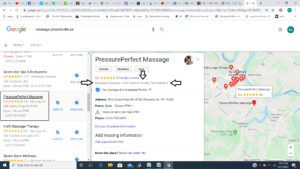
If your business comes up, click on your name. A GMB box should appear with your business’s info in it. Scroll down until you see “Own this business?”. Click on that and go through the steps to claim the business. It’s not complicated.
If you don’t see your business in the local search then you’re going to have to register your business with Google. To do that, you’re going to:
(a) Sign in to your Gmail Account.
(b) Open Google My Business page.
(c) Follow steps to register a business.
Once registered you can start to input your business information.
*Later on whenever you want to get into your GMB account you can access through this link: https://business.google.com/
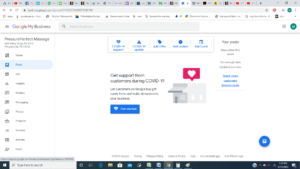
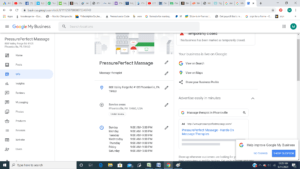
Now, I’m going to take you through GMB using our PressurePerfect account.
Here’s what the inside looks like:
PICK THE BEST CATEGORY that represents what you do.
Not sure which one to pick, then look to see what your competitors are doing.
Click on a competitor’s GMB listing and look right under their business name.
Add secondary categories by clicking on Additional Categories under Primary Categories. Just start typing in the box until your category comes up, like Sports Massage.
(3) Input ADDRESS and make sure it matches website address!
This step is important because if the address on your website doesn’t exactly match your business address, you won’t rank. So, take your time to be accurate and consistent with your name, address and phone number (NAP).
(4) Fill out SERVICE AREA.
When I first filled out Service Area for PressurePerfect Massage, I forgot to click on the Apply button and for years Google never 100% knew the area my business covered. Again it pays to go slow and make sure you do things correctly the first time.
(5) Fill out HOURS.
Make sure website hours match GMB hours. If your hours change on your website make sure you change them on your GMB page.
Under HOURS is MORE HOURS where you can add hours for specific services or specials.
Going forward it’s important to keep your hours updated and remember to add special hours for holidays.
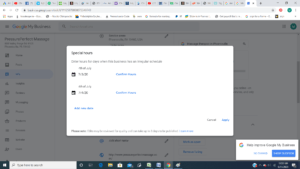
Speaking of special hours…
(6) Note SPECIAL HOURS.
You may not need to fill out Special Hours yet. This feature allows you to show your modified or extended hours during special events.
Google says that edits may be reviewed for quality and can take up to 3 days to be published. So, plan accordingly.
(7) Fill out PHONE NUMBER.
If you have a business phone number use that number.
Later on you can do more with your GMB page to help with optimization like filling out Questions and Answers. But for now, that’s good enough.
The Reality With Demo Massages/ Website Engagement/GMB
I don’t have to tell you that there are a lot of ways to promote your massage business. The problem is that you don’t have the time and/or money to do them all.
The answer to this problem is to pick the marketing strategies that meet you where you’re at—demo massages, website engagement, and an optimized GMB page do that because you can already sell with your hands and you don’t have to be techie to improve your website or fill out your GMB page.
That said, I’m not going to tell you that all of this is easy. These recommendations come with some challenges.
Demo massages will probably make you feel the most uncomfortable because you literally have to put yourself out there and sell with your hands.
An engaging website will require you to be creative. You’ll have to think like your potential customers and try things that you may have not considered trying before. For example, if writing isn’t your bag, you may have to experiment with videos.
An optimized GMB page requires adherence to the rules. This is the toughest one for me because I want to do things my way. But I also want my business to show up 1st in the local search. Guess who’s following the rules?
The good thing about putting yourself out there, being creative and adhering to the rules is that you don’t have to be an expert in any of this. You just have to be competent:-)
To get my latest info about building a massage business and making money, sign up for my email list. It’s free.
(1) Do a massage that sets you apart from the competition.
(2) Have solid therapeutic rapport.
(3) Have referral sources that send you new clients.
(4) Create a COVID-19 safe environment.
(5) Coordinate care.
(6) Follow up after the first massage.
Notice that none of the recommendations to get repeat massage clients had to do with discounting your price.
Why?
Because if you follow these recommendations, you’ll never need to entice clients to come back by shaving dollars off your price.
By the way, the recommendations above helped take my meh business to my Yay! business. You can read more about me here.
Okay, let’s get you some repeat clients by starting with:
(1) Do a massage that separates you from the competition.
Wait, don’t get your credit card out to sign up for the latest specialty massage class. When I’m talking about separating yourself from the massage therapists in your neighborhood, I’m talking about finding and highlighting what makes your massage unique.
That doesn’t mean you have to be a myofascial expert or have a firm understanding of reflexology. It means you have to find what people like about your massage and then take it to the next level.
If you want a shortcut to standing out from the crowd, try this: Get competent with pressure.
If your pressure is spot on (is appropriate and feels good to the client), clients will love your massage. Surprisingly, not all massage therapists get this. That is why nailing the pressure during a massage can be your differentiating factor.
And that’s the case for me. I’m competent with pressure and I’ve taken pressure to the next level by become competent with precise pressure, too.
Becoming competent with precise pressure gives me a leg up on my competition.
For one, I can specifically treat a tight/tender area with very precise pressure.
Also, precise pressure is sometimes the only way I can find the “That’s it!” spot. And precise pressure feels like more of complete and comprehensive treatment to clients as opposed to general pressure especially when working on specific tight and/or tender areas.
If you’ve backed off very precise pressure because it hurts your body or it feels intimidating, here’s how to change that.
Precise Versus VERY Precise
In general, I use general pressure to find areas of tender/tightness. To do this, I use a variety of body parts, from big (forearms and fists) to small (thumbs and fingers).
However, if I want to examine the tender/tight area in detail I use very precise pressure. And that’s often when I find the “That’s it!” spot. For precise pressure I use smaller body parts (thumbs, fingers, massage tools).
Here’s an example. Ali comes in with neck and shoulder pain. Using my knuckles around the scapula I find the locus of his pain area in his levator scapulae attachment (general pressure).
Next I start examining the area of pain in the levator scapulae attachment with my middle knuckle, looking for that exquisitely tender or tight spot (precise pressure).
What to Use to Find the “That’s It!” Spot
If it hurts your hands to work with precise pressure, I have three suggestions:
Combine body parts.
Stack and/or brace (support) body parts.
Combine a massage tool with a body part.
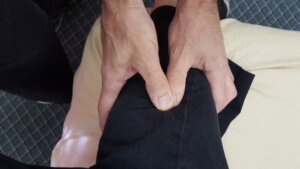
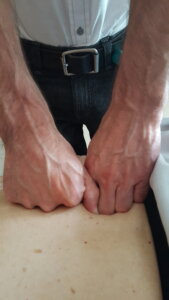
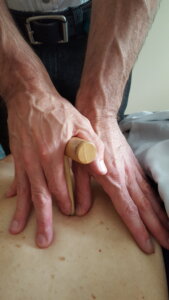
Pictured below are my 3 favorite ways to deliver precise pressure.
Stacked Fingers/Thumbs
Try not to press. Instead lean into your fingers/thumbs. The bottom finger/thumb is the primary palpation vehicle.
Knuckle-Thumb
In this picture I’m directing my pressure into the middle finger of my left hand. You’ll notice that my right thumb is bent to fit in comfortably next to my left middle knuckle. This is not a mistake. In this case, my thumb’s primary role is for palpation, not for delivering pressure. My right thumb’s companion four fingers form a loose fist. They take most of the weight that I put on that hand, not my thumb.
Tool-Thumb
In this picture my thumb is a support, guide and the primary sensing instrument. I’m directing most of my “leaning” pressure into the tool, not my thumb.
That’s a taste of precise pressure which helps to differentiate me from my competition.
More about how to use massage tools to deliver precise pressure here.
But as I said in the beginning, what uniquely makes you “you”, doesn’t have to be what makes me “me”.
Finding Your Uniqueness
So, does your uniqueness have to be precise pressure?
No.
But your pressure has to be spot on to make clients happy—and right there you have the beginning of a uniqueness formula. Adding precise pressure is an easy next step.
That said, you don’t have to go the precise pressure route. Your uniqueness could be specializing in a modality or combining modalities or your specific take on a modality or something as basic as doing a fantastic relaxation massage.
The point is to find your uniqueness and make sure that it’s connected to happy clients. Once you know the two are connected you can hone that skill.
Next, let’s talk about therapeutic rapport.
(2) Have solid therapeutic rapport.
Have you had the experience of being referred to an expert in a field and that expert turns out to be a complete a-hole?
Bye-bye, right?
In massage you don’t need to be an a-hole for someone not to come back. It could be that you didn’t show enough care towards the client.
For instance, if you’re having a bad day, thinking about yourself and not the person on the table, that could just be enough for your client to pass over you next time for Kiesha who is good at massage AND is present during the session.
Being a good listener and a good conversationalist (when the client wants to talk) are also ways that allow you to really connect with a client.
In fact, my wife, Lisa (also a massage therapist) and I agree that a big reason why our clients keep coming back is due to how we interact and connect with them.
Making your massage unique and having solid therapeutic rapport are two things that you must have to get a good flow of repeat clients, but if you want to make converting clients into repeat clients a whole lot easier, do this: Get referral sources to refer clients to you.
(3) Have referral sources that send you new clients.
A client who is referred to you from a referral source (a business/person who recommends your massage to her/his clients/customers/patrons) is primed to become a repeat client.
Why?
Because the referral source is endorsing you.
Don’t believe me?
Do a thought experiment. Margo does a Google search and you show up third in the local search. She goes down the list and calls the first two massage therapists but they don’t pick up. However, when she calls you, you do pick up. Do you expect that Margo will feel confident that she’ll get a good massage from you?
Maybe…I mean she only has your website to go on.
Okay, now imagine Tara the PT referred Margo to you because Tara personally knows you and respects your work—can you say potential client has been primed to come back to you?
It just makes sense that the more a referral source likes you and your work, the more she is going to talk you up to the person she’s sending your way, which makes that person a prime candidate to be a repeat client.
So, I talked about how to get repeat clients during normal times, but how about during abnormal times, like during a pandemic.
Specifically, what can you do get repeat clients during COVID-19?
Simple.
Do this:
(4) Create a COVID-19 work-safe environment.
Creating a COVID-19-safe-as-possible work environment is not only the right thing to do, it’s a way to expand upon care and further deepen your connection with the client.
Oh, by the way, this care connection starts before the client even walks though our door.
Think about when a potential client hits your website. With our website I want the client to know that we’re taking her safety more seriously than any other outfit in town.
I’m not going to overwhelm website visitors with policy. I’m going to point out key safety features we’re employing, like forehead temperature checks, masks, disinfecting and limiting the number of people we have in the office at one time.
And I’m going to give potential clients clear direction on how the appointment will go down so that there is no confusion or ambiguity in their minds.
This is the COVID-19 safety video that I made for our website:
So, with the video and the verbiage on our website I’m addressing safety barriers that may be preventing that person from calling:
(1) Is massage safe?
(2) Is this place safe?
(3) How safe is this place compared to other places?
This is the start of our care connection that will continue to build once the client arrives at our office.
Does above-and-beyond safety and care during COVID-19 guarantee a repeat client?
Not necessarily, but it makes the checkmark in the therapeutic rapport box a big one.
I have two more recommendations that have helped my repeat client average. The first is…
(5) Coordinate care.
By coordinating care I mean if the client comes to you for a specific pain issue, ask the client if it would be okay if you reach out to the other health professionals who are helping her with that specific issue.
That means you could be contacting orthopedists, podiatrists, PTs, PTAs, personal trainers, exercise physiologists and chiropractors.
The majority of health professionals that I coordinate care with are PTs, PTAs, chiropractors and personal trainers.
I get a huge positive response when I ask the client if I can coordinate care with the health professional on his pain issue case, and I often get referrals from that health professional.
Lastly, I need to mention…
(6) Follow up after the first massage.
By following up after the first massage (2 to 3 days after) you open the door for a dialogue about the massage session the client just had with you.
It’s at this point that you are more likely to get a candid reaction about the massage.
Nine out of ten times you will get a positive response. And the fact that you called after the massage shows the client that you care.
Again, think cumulative not specific. In other words, lots of caring actions add up. Keep heaping on the caring and the choice of where the client wants to go for a massage becomes a no-brainer.
How to Get Repeat Clients in a Nutshell
Getting repeat clients is not rocket science, but it does take some targeted actions.
First, you need to know what separates you from your competition. It doesn’t have to be a technique or modality. It can simply be that you deliver great pressure during a relaxation massage.
Also, throw in some good ole therapeutic rapport. Listen. Be a good conversationalist when appropriate. Coordinate care and follow up after the first massage session.
Find referral sources that consistently send you clients.
And during COVID-19 create a safe as possible environment and let clients know this on your website and in your advertising.
Getting repeat clients does not happen because you did one thing right. You get repeat clients by doing key things (what I mentioned above) competently.
Extra Help
If you’re just starting out and/or making less than 30K as a massage therapist, check out this free course to get your repeat clients rolling: Jumpstart.
If you’re trying to take your meh business to a Yay! business, go here: Accelerator Program.
If you want to get my latest info for free, sign up below:-)