Category: Uncategorized

  • Change Work Postures: Massage Therapy Foundation Ergonomics Project

    In February of 2022, the Massage Therapy Foundation posted the 1st phase findings of its Ergonomics Project (https://massagetherapyfoundation.org/mtf-ergo-project/). Three of the recommendations are to sit more, change work postures, and have adjustable tables and stools to vary work postures.

    These findings corroborated my experience which I teach and write about. Unfortunately, implementing these recommendations without understanding key body mechanics concepts comes with potential hazards. Let’s start with sitting.

    Massage Ergonomics: Sit and Lean

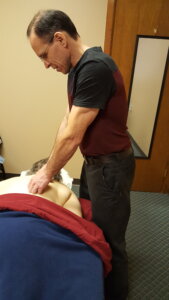
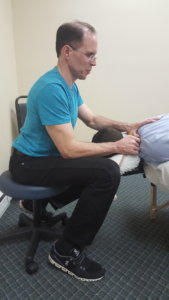
    If you sit more to massage in order to rest your legs, you could be potentially stressing your upper-body more if you don’t lean to generate force. Here’s how I lean to generate forces:

    Sit and Use a Massage Tool

    Since you can only use your upper-body to lean and generate force while you sitting, you might be tempted to press harder with your arms and hands. To prevent that I recommend using massage tools while sitting and pressing. The key to using massage tools is to lean, pin, add a guide finger and relax the hand holding the tool. Here’s how I do that:

    Change Stances

    Changing work posture doesn’t only have to be from standing to sitting and vice versa. I change stances constantly throughout a massage. Why? To break static posture and give areas of my body that are more taxed than other areas of my body a break. In this rough-cut video I demonstrate how to change stances (work postures) without interrupting the massage:


    Massage is both static and dynamic. There are times you’ll be in the same position for a while as you hold a point or work an area. The dynamic part takes a little more conscious effort. As you’re in a static posture and before the taxed muscles start to figure, make the massage dynamic by changing positions, techniques or moving on to a different area.

    If you need help figuring out which body-mechanics strategies and massage ergonomics work best for you, shoot me an email (mark@makethemostofmassage.com), and I’ll be happy to help:-)

    Other help is here: book and online classes.

    If you don’t take care of you, at some point, you won’t be able to take care of them.

    Ways to Save Money and Build Your Practice:

    Massage Insurance: Who has the Cheapest Massage Insurance

    Website: Cheapest Way to Build a Website.

    Rent a Massage Room: How to Rent a Massage Room for Cheap.

    Questions?

    I am here. Email me a mark@makethemostofmassage.com! 🙂

  • Protected: Why “People Posts” on Facebook and Instagram Work Best for Your Massage Business

    Protected: Why “People Posts” on Facebook and Instagram Work Best for Your Massage Business

    This content is password-protected. To view it, please enter the password below.

  • How to do Short Stroke Massage

    How to do Short Stroke Massage

    If you have iffy shoulders, elbow or thumbs, then try short stroke massage.

    Yep, I made up the name “short stroke massage”.

    Think of it as a strategy. Basically, you’re going to cover less distance in a stroke—a lot less distance.

    WTF, Mark, that’s going to be the choppiest massage ever!

    Not after you make one adjustment. I’ll get into that later.

    The Bad News

    First, I need to tell you that if you do short stroke massage, you’re probably going to abandon some go-to moves that you’re really good at.

    Why?

    Because some of those go-to moves are beating the snot out of your body.

    Dr. Liu and Chinese Massage

    Early on in my career, I learned this vicariously. I had a back injury and went to see an acupuncturist, Dr. Liu.

    I admired Dr. Liu. He was born in China, became a US citizen, had a medical degree, did research at a prestigious university and was well-known in our area.

    He knew I was a massage therapist, and one day he started to lecture me about how Chinese massage was sooooooooooo much better than American massage.

    I was curious and asked him if he could show me some Chinese massage techniques.

    But instead of showing me techniques, he simply explained how Chinese massage strokes are done.

    But I’m a massage therapist, right? Less talky and more showy, Dr. Liu.

    So I pushed him: Can you show me how it’s done?

    That’s when he confessed that he didn’t do Chinese massage any longer because it kills his wrists and hands.

    Moral of the story: Make sure you’re a licensed acupuncturist if you continue to do massage techniques that hurt your body.

    Short Stroke Massage Rules

    Short stroke massage is a body-saver because no matter where you’re working (arm, back or leg), you’re always in a position to keep your joints stacked (aligned).

    Leaning with stacked joints is an efficient way to deliver pressure and is easy on your body.

    More about leaning here: How to Do Deep Tissue Pressure Without Hurting Yourself.

    Short Stroke Massage Steps

    Here’s how you do short stroke massage:

    1. Stand facing a side of the table with the body part you’re using to deliver pressure down. (In this position, you will NOT be facing the direction of the stroke. Fist, knuckles and thumbs work great with short stroke massage.)

    1. Lean and glide (or use static pressure) going left or right, but don’t travel more than a few inches either way.
    2. Pause at the end of your mini-stroke. (By the way, that was my other option for a name for this strategy: mini-stroke massage. You can see why I went with “short”.) Move your feet. Then continue to glide.

    Pretty easy, huh?

    Short Stroke Massage Secret

    Oh, and this how you can make short stroke massage NOT choppy: Slow down.

    Think Zen. Think turtle. Think almost falling asleep. That’s the pace you want.

    If your pressure is consistent and focused and you’re moving slowly, 20 short strokes from foot to head will seem like one continuous long stroke.

    If you’re new to the idea of shortening your stroke, check out: How to Do a Longitudinal Massage Stroke When Your Shoulder Hurts.

    One More Time

    If you’re ready to give short stroke massage a shot, here are the steps again:

    a. Stand facing a side of the table.

    b. Lean and glide a few inches to the left or right.

    c. Pause at the end of the stroke, move your feet to position yourself for the next short stroke, then continue the stroke.

    Here’s how I stop my traps from aching during a massage: How to Stop Your Traps From Aching During a Massage.

    Massage Pain-Free Online CEU Class

    If you want to learn how to massage pain-free while getting CEU credits, go here.


  • Massage Body Mechanics – A New View

    Is there a bad body-mechanics position when doing massage?

    I used to think so. But the answer to me now is more nuanced.

    Instead of “good” and “bad” or “correct” and “incorrect”, I view body mechanics positions as “short term” and “long term” positions.

    A “short term” body position will cause you pain sooner than later. That means you don’t want to hang out in this position for too long. For example, if you are hunching over to work an area, you will want to change that position before it starts hurting your back.

    You probably see where I am going here: A “short term” body position is okay to do as long as you don’t stay in the position to the point of pain.

    Ultimately, you want to be in “long term” body positions. Long term body positions are supported positions where there is minimal strain to keep your body upright and minimal strain for you to do your work. Examples of support while massaging are sitting while you’re working or leaning into the massage table while you’re standing. The picture below shows a long-term body position.

    I’m sitting; so there is less strain in my back. My working arm is resting on my knee which translates into less strain in my neck, shoulders and arm.

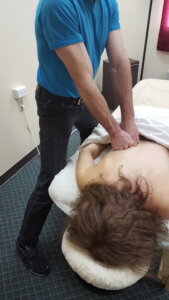
    Below I’m standing and leaning my body weight into the client and the massage table.  Notice the front of my legs which are in contact with the massage table. This position is very easy on my body.

    Are there body positions that you should never be in?

    Yes. Those are the body positions that hurt you immediately or you can feel the negative effects of being in them while you massage or after you massage.

    Time for New Thinking

    Body mechanics happen in the massage room, not in the text book.

    “Correct” and “Incorrect” body positions don’t accurately reflect what goes on in the massage room. Thinking about your body positions as non-starter (hurts you immediately), short term (can stay in the position for a short period of time) and long term (can stay in the position indefinitely) allows you to have an arsenal of body positions so that you’re not in any one position too long.

    In the video below, I show you my long term body positions (forever positions). Let me know what you think:-)

    The Pain-Free Massage Therapist

    Check out my book about how to massage pain-free  here.

    I have online classes, too:

    (1) Delivering Pressure Without Hurting Yourself

    (2) How to Use Massage Tools

    (3) Advanced Massage Tools

    And the Pain-Free Massage Therapist Package (all 3 classes).

    Ways to Save Money and Build Your Practice:

    Massage Insurance: Who has the Cheapest Massage Insurance

    Website: Cheapest Way to Build a Website.

    Rent a Massage Room: How to Rent a Massage Room for Cheap.