Category: Massage Injury Prevention

  • Pain-Free Massage Therapist: The Common Sense Way to Make You a Pain-Free, Durable Massage Therapist – Chapter 1 (Free)

    The first conversation that I had with a massage therapist didn’t go well. I was 20-something, working out like crazy, and was dinged up with some overuse injuries.

    I really wanted to try massage, but massage in the 1980s wasn’t main stream, and finding a legitimate massage person in the Philadelphia, PA suburbs required some work.

    At the time I had a gardening business and a client recommended Brenda. I trusted the client. So, why not call?

    When I did, let’s just say it was an interesting conversation.

    Brenda, speaking in a thick Slavic accent, was annoyed.

    Who is this?, she demanded.

    Mark Liskey, I said.

    Who gave you my number?

    Juanita Simpson.

    What do you want?

    A massage.

    Ahhh! I have seven massages tomorrow. Six on Saturday. My God! My hands! You have to have massage?

    I thiiink so…

    There were sounds of Brenda looking through her schedule book, then she barked: What’s wrong with you?

    My knee is bothering me.

    What else?

    Well, my back hurts some.

    That’s it?

    I guess.

    I heard Brenda’s schedule book slam shut as she said: You can wait. Call back in two months.

    Click.

    It’s not surprising that this conversation pops up in my mind whenever I experience pain from doing massage.

    Massage is physical work. If you do massage for any length of time, you will experience a Brenda moment. My Brenda moment was actually a Brenda year.

    Time to Hang Up Your Hands, Dude

    It was June of 2013, and I was sweating bullets. I had severe pain in my neck, shoulder and arm, and at the orthopedist’s office, I got some seriously bad news.

    An old football injury compounded by years of working out and lots of massage left me with a banged up left shoulder joint, cervical radiculopathy and cubital tunnel syndrome.

    “Find a new career,” said Dr. IHaveNoIdeaWhatFindingANewCareerActuallyMeans.

    I was no stranger to being in pain from doing massage. Early on in my massage career, I was blowing out my thumbs because of all the detail work I was doing. Why all the detail work? I was certified in and practiced neuromuscular massage therapy (NMT).

    One NMT concept was that you must work the origin, insertion and body of the muscle for the best release. As thorough of a massage this was for the client, it was equally thorough in beating up the MT’s hands.

    I guess I should have seen this coming. When I was going through the NMT program I would do exchanges with my friend, Maggie, who was also going through the program with me. One day she walked in with all her distal finger joints taped. She looked like she could have been in the Spirit of 76 Revolutionary War painting next to the fife player with the head-bandage and carnage all around him.

    I’m not knocking NMT. It was a comprehensive program that launched my massage career, but it was also client-centric, meaning it was focused on the client’s well-being with little attention given to the therapist’s durability.

    NMT was not alone in this category. Pfrimmer had a reputation of sending MTs to a very early retirement because the techniques severely stressed the practitioner’s hands. And sacrificing your hands to get the job done didn’t seem to be exclusively an American idea either.

    Once an acupuncturist from China who I shared office space with told me that I should learn the Chinese massage he did because it was so much superior to the massage I did.

    I said, Okay, can you show me some techniques?

    He said, No.

    Initially, I was ticked because I thought he was withholding information that could help me be a better therapist. But as the conversation went on he eventually confessed that the massage he did—that was so superior to my massage—hurt his hands way too much for him to show me.

    Right, the operative word was “did” and the message to me continued to be that in order to be a rock-star MT you needed to kill your hands.

    When I look around at new MTs coming into the business today, I don’t think the idea of sacrificing your body to do your job has gone away. It’s an idea that when you look at it more closely, doesn’t make a lot of sense.

    Granted, you sometimes have to do things that make your body temporarily uncomfortable to get the job done. But if you’re consistently and blindly throwing a body part into harm’s way, you’re not going to last. And you’re going to start resenting your work and your clients.

    The T-bar Paradox

    Fortunately for me, I had an entry point for experimenting with ways to massage in less pain. NMT was big on massage tools, like the T-bar.

    The T-bar is a simple tool, shaped like a T with a plastic or rubber tip.
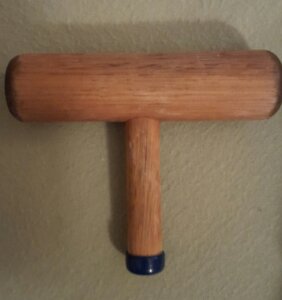
    The function of the T-bar in NMT was to help the MT reach and apply pressure to muscle attachments and a byproduct of using a T-bar was that it could be a thumb replacement.

    In other words, get the spot with the T-bar and if it helped your thumbs, great. If not, oh well.

    Eventually, the “sacrificing your body to get the job done” mindset started to crack because the longer I did NMT and the more clients I saw, the more the T-bar hurt my fingers.

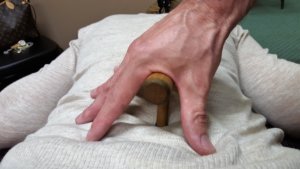
    There’s an easy explanation for why the T-bar hurt my fingers. In NMT we were taught to grip the tip of the T-bar to control it, sort of like how you hold a pen or pencil.
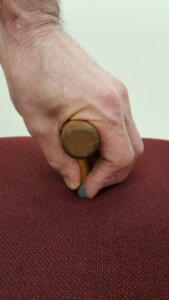
    That gripping put serious stress in the 1st, 2nd and 3rd distal finger joints. A little gripping, a light client-load for the day, was okay. But if I had a normal or heavy client-load for the day, my fingers hated me.

    My next thought was that I could design a massage tool that would be easier on my hands.

    There was inherent problem with this idea which is I’m pretty good at destroying things, but not so good at building things. Just ask my wife, Lisa.

    Fortunately, my dad, a Depression era kid, who could build a house with toothpicks, old newspapers and discarded dental floss was up for the job and together we created a lot of massage tools, like the monster tool.

    The monster tool is aptly named. The tip of the monster tool was over 2 inches long and looked liked like a drill bit.
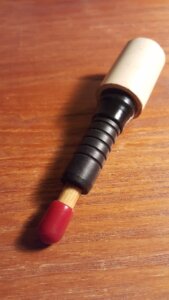
    The handle was about 14 inches long, and the butt of the handle would rest in the front of my armpit.

    The monster tool soon became my favorite tool, but no client every saw it. Could you imagine being on the massage table and seeing what looked like a drill bit coming at you forearm?

    Over the next ten years I brought all my Dad-made, massage tools into the massage room with me, but to my dismay none of the tools, including my beloved monster tool, saved my hands.

    And as my business grew, my body started racking up more damage, like the cervical radiculopathy, cubital tunnel syndrome, and unstable left shoulder that I mentioned in the opening.

    The Massage Pain-Free Experiment

    In one last attempt to save my massage career, I gave myself an ultimatum: You have a year to fix your body or you quit massage.

    The good news was that I wasn’t starting from scratch. I knew that there was no perfect tool that was going to solve my hand pain issue, and I also learned that using a variety of massage tools reduced some hand pain because I wasn’t stressing the same muscles in my hands all the time.

    The question was why didn’t using a variety of massage tools stop my hand pain altogether?

    The answer had literally been staring me in the face for years and the monster tool held the key.

    Though the monster tool looked like it should be part of a dawn-of-dentistry tool kit, it had one advantage over all the other tools. It was designed so that the handle fit into the front of an armpit. To exert pressure you pinned the monster tool between the front of your armpit and the tissue you were working on and then leaned. You could then relax your holding-hand because you only needed to steady the massage tool since your body weight was doing all the work.

    So, what if I took the monster tool “lean and pin” concept and applied it to all massage tool usage? It was my “it’s not the dog, it’s the dog owner” revelation. The tool wasn’t the problem, it was how I was holding the tool.

    Instead of using the NMT “grip the tip” approach to holding the T-bar, I tried the monster tool “lean and pin” idea to hold the T-bar and sure enough, I was able to relax my grip. In fact, I could even open my hand.
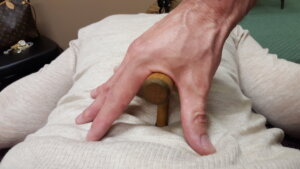
    As I experimented with the lean and pin technique I soon discovered that I could steady the massage tool in many different ways. I was like a kid in a candy store as I explored the different holds.

    I have to admit that at the same time of experiencing this breakthrough joy, I also sort of wanted to cry. The joy part was that I essentially figured out how to save my hands. The crying part was, Seriously, dude, it took you this long to figure that out?

    But I wasn’t out of the woods yet—my shoulder, elbow and neck still hurt.

    Fixing my other body parts required some introspection, which wasn’t as straightforward as leaning and pinning a massage tool.

    Maria Konnikova, author of the The Biggest Bluff, says that life can be boiled down to making decisions with incomplete information. If you want to make the best decision you not only need the best information that can be known, you also need to know the person making the decision—you.

    Here’s a piece of self-information that took me a while to get: I’m a smiley-face collector. I want to please people. If I make someone happy, I get a shot of dopamine—boom!—and life is good.

    It’s not surprising that I chose a career where I can get shots of dopamine all day long. When a client gets off my table, she’s happy (most of the time, haha), and that means Markie is not only going to get paid, he’s also going to get a shot of dopamine. Sweet. And this goes on all day long.

    What other job gives you that many opportunities for collecting smiley faces? Not many. And by the end of a massage work day, my internal pharmacist is saying, Let me guess, another order of dopamine.

    I’m thinking that being a people pleaser is one of the reasons you do massage and that your internal pharmacy is also cranking out the dopamine.

    But here’s a potential problem: If you’re like me, all that people-pleasing dopamine can override the pain tolerance or self-preservation mechanism. In other words, we get the dopamine reward for jamming our thumb into Maria’s lamina groove to help her back pain go away, but we also get a thumb that hurts more and more with each deep tissue massage we do, which is a set up for a major showdown between their pain versus my pain.

    Their Pain Versus My Pain

    I remember a “their pain versus my pain” showdown that had a major impact on how I do massage to this day. Jamar was my last massage of a long day. I was a month or so into my year long experiment to eliminate pain when doing massage, and though I had been experimenting with different ways to hold massage tools, my fingers were still a little cranky.

    I was about to do supine work on Jamar’s tight neck, and I could feel myself tensing as I anticipated the pain that was about to occur in my hands when a voice in my head said: Why are you doing supine neck work when you know it hurts your fingers?

    The question stunned and exhilarated me at the same time. The stunning part was the question revealed that I wasn’t really looking out for my body because I was continuing to do techniques that hurt my body. The exhilarating part was that I recognized this was a choice.

    So, I picked up a T-bar with a thin stem.
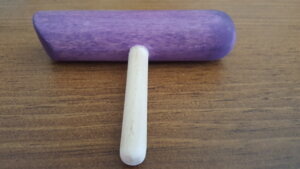
    And with guide finger down next to the tip I started to do prone neck work. When I felt that I was losing sensitivity I switched to a thumb, and when that thumb started to feel a little discomfort I switched to two thumbs bracing each other. I went back and forth between massage tool, thumb and barred thumbs without every working on Jamar’s neck in the supine position. And at the end of the massage, my fingers felt good.

    The horse was out of the barn—forever. Never again was I going to do a technique that hurt my body.

    If you’re thinking “yay, massage pain-free”, but “boo, massage tools”, don’t worry, you don’t have to use massage tools to massage pain-free.

    Using massage tools is only one strategy to massage pain-free. There are more.

    Here are all the strategies that I use to stay out of pain when doing massage:

    (1) think pain-free first,

    (2) lock, stack and lean to generate pressure,

    (3) use the massage table to support your body weight and to regulate pressure,

    (4) break static postures,

    (5) combine body parts,

    (6) become ambidextrous,

    (7) use a variety of techniques and strategies.

    Some of these strategies seem fairly straightforward, like become ambidextrous. And some like, think pain-free first, seem a little more esoteric. But I promise you that by the end of this book all these strategies will make sense without you having to burn extra brain glucose.

    By the way, you don’t have to master all the strategies to massage pain-free.

    Take in these strategies like how Bruce Lee, the famous martial artists, approached new information,  “Absorb what is useful, discard what is useless and add what is specifically your own”.

    That said, this book is about strategies, not axioms. Work a strategy. If it’s a fit for your body, problem solved. If not, modify it or move on to the next one. My goal is not to be your trail blazer. My goal is to give you the tools so that you can blaze your own trail to massaging pain-free.

    Well, we can’t talk our way to pain-free. So, put your helmet on and buckle your seat belt because the first thing we’re going to do is to break some unconscious rules and challenge the entrenched and non-useful ways of thinking that are preventing you from massaging pain-free.

    Go here for more help: Pain-Free Massage Therapist. You can also purchase the book there.

    Ways to Save Money and Build Your Practice:

    Massage Insurance: Who has the Cheapest Massage Insurance

    Website: Cheapest Way to Build a Website.

    Rent a Massage Room: How to Rent a Massage Room for Cheap.

  • When You’re Most Likely to Get Hurt

    When You’re Most Likely to Get Hurt

    I was taught in neuromuscular therapy that if you were having trouble identifying a potential gait distortion you should have the person walk faster. This works because when the person is walking faster she doesn’t have time to adjust to an imbalance (e.g., pronating foot ) before she takes the next step.

    A while back, I drastically increased the amount of massage I did per day. In a way, this was similar to having someone walk faster to accentuate a gait distortion. Doing the extra massages without a break put me in a situation where everything was magnified including warning signs that I might be in danger of injuring myself. Though this is not an experiment that I’d like to repeat, I’m glad that I was able to learn from it. Here are my top four “When You’re Most Likely To Get Hurt” scenarios:

    When You’re Tired

    We can all relate to the mental effort it sometimes takes to get through the last massage of a long night—and it’s precisely at this time that body mechanics fall by the wayside. Why? Because it’s easier to reach (low energy expenditure), potentially compromising a shoulder joint, instead of moving (higher energy expenditure) to be in a better position to apply pressure.

    Suggestion: Move your feet. No matter how tired you are, keep telling yourself to move your feet. Once you move your feet and are in a good position for your next move, you can lean all you want on the table (or the client, depending on the amount of pressure she wants) and “catch your breath”.

    When You’re Drifting Drift Off

    Admittedly, I sometimes have gone off into la-la land during a massage. I’m usually brought back to reality by pain. The pain is often a result of me overusing a body part (thumb, fingers, knuckles, elbow-forearm) because I hadn’t been paying attention to what I was doing.

    Suggestion: Practice with all of your body part tools to the point where you are changing them without thinking. So when you drift off, your automatic pilot (body-part tool-changing pilot) will kick in before the pain does.

    When You’re Brain-Glucose Is Low

    In 2015, I wrote an article for Massage & Bodywork Magazine (Minimizing Injuries: Some Common and Uncommon Advice ) and an article for Spirituality & Health (The Fuel of Good Decision Making) where I talk about how brain-glucose lows can lead to poor decision-making. I also go on to explain that complex carbohydrates can immediately reverse this condition.

    Here’s how a brain-glucose low could play out in the massage room. You’re on your 3rd back-to-back massage of the day, but you didn’t have time to eat before your first massage. The last person you worked on talked constantly and towards the end of the massage you found it very difficult to both carry on a conversation and do the massage. Now, at the beginning of your 3rd massage you’re having trouble remembering what your client wanted you to focus on. At this point, there’s no way that you brain has enough mental energy to worry about body mechanics.

    Suggestion: Have healthy, complex carb snacks, like an apple or granola bar, available to eat between clients so that you can recharge your brain. Personally, when I have a back-to-back client day, I make sure that I have an ample meal before I start massaging for the day. Then it only takes a few bites of a healthy snack to avoid a brain-glucose low.

    When You’re Determined

    When I was first starting massage, I would disregard technique/form because I was determined to get the job done no matter what. For example, if I was working the pec minor and my thumb was killing me I would simply ignore the pain. But over time, my thumbs started to bother me.

    Suggestion: Practice good technique/form to the point where it becomes automatic and overrides your determination to get the job done. Good technique to me starts with being comfortable with all the tools (body parts to press and glide with) in my tool kit so that I can switch out a tool before I burn it out. My idea of good form includes a neutral back whenever possible, joints stacked over each other when delivering pressure, and stances that take the strain out of my upper body. Because of different body types and pre-existing conditions, you’ll have to define good form for yourself.

    The 10 Massage Challenge

    You can probably get away with not paying attention to these four scenarios for a short time, but eventually things will catch up to you. And if you ignore a few at once, there’s a potential for some serious pain.

    So here’s my challenge to you: For the next 10 massages note when you feel pain. Each time you do, ask yourself if you’re tired, hungry, foggy, drifting or overly determined? If you answer “yes”, on average, one out four times then try some of my suggestions.

    Please let me know how it goes and I’d love to hear your top “Most Likely to Get Hurt” scenarios!

    Can you massage pain-free?

    Take the pain quiz and get an instant video that will help you with your pain problem.

    PAIN QUIZ

  • Don’t Be Chuck (Don’t Stay In Pain)

    Don’t Be Chuck (Don’t Stay In Pain)

    Is massage causing you pain? Don’t let it. Here is a way that I’ve found to be super effective in changing the pain game: Recognize and eliminate perpetuating factors.

    Save Yourself $5000

    You may have read an earlier post of mine—I Saved My Client $5000 (By Using My Most Important Neuromuscular Tool)—where I explain how to help a client get out of pain by eliminating perpetuating factors. I define a perpetuating factor as anything one does (bad work posture to bad decision making) or has (a structural imbalance) that activates, aggravates or prolongs a pain condition.

    The same is true for you and me. If we can eliminate perpetuating factors while doing massage, we can stay out of pain.

    The trick is to pay attention to the little things. Because the little things can add up to a big reason why you’re in pain.

    The Little (But Costly) Perpetuating Factors

    I’d like you to meet Chuck. Chuck is a handyman who did work at my mom’s house. He has pain issues. One day Chuck and I teamed up to paint my mom’s basement. Midway through Chuck started to complain about his knees. I looked over and saw that he was kneeling on concrete.

    When I suggested rolling up a blanket for a knee cushion, he declined. Later when I saw him using a paint roller on the wall, I noticed that instead of bending from his knees, he was bending awkwardly from his back. (Probably because his knees hurt from kneeling on concrete.)

    Guess what his next complaint was about? You got it—his back.

    These incidents may not seem traumatic enough to cause Chuck pain, but I guarantee you that Chuck kneels on hard surfaces and bends in a way that’s bad for his back over and over every day. And the cumulative effect is enough to keep him in pain.

    Become Aware of Your Pain

    Now instead of picturing Chuck in my mom’s basement, imagine you’re in your massage room. If you were able to watch yourself do a massage you, like I watched Chuck paint, you’d probably see yourself doing something (perpetuating factor) over and over that’s activating a pain issue.

    You can start to figure out what may be causing you pain during a massage by simply paying attention to when the pain occurs and noting what you’re doing when it happens.

    Change How You Do Things

    Next, I’m going to ask you to do something a little more difficult. Ready? Stop doing whatever it is that you’re doing when the pain occurs AND think of another way to get the job done.

    For example, if your right thumb is bothering you when you start to use it for firm detail work, then try your left thumb. If a thumb starts to bother me in the middle of a glide stroke, I will often switch to a knuckle or a power tool, like a knuckle braced by a fist, or a T-bar.

    The key is to get comfortable with as many tools (fingers, thumbs, knuckles, fists, elbows/forearms) as possible. That way you will never run out of options. In this rough-cut, YouTube video—Massage Techniques–Deep Tissue Basics (Tools and Power Tools)—you can see what I mean.

    Change How You Think

    As your pain area starts to feel better, it will be tempting to stop self-monitoring. Don’t.
    My right shoulder had bothered me every since high school football. When I had eliminated a key perpetuating factor, reaching too far during a glide stroke, my shoulder pain disappeared.

    But then I got used to feeling good and I reintroduced the perpetuating factor (extending too far when gliding). It didn’t take me long to activate my right shoulder pain again. But this time my other shoulder was bothering me from working out. It was a dicey month or two before I was able get back to the “feeling good” baseline.

    It was all absolutely avoidable if I had continued to self-monitor.

    Remember Chuck

    I know that in other areas of my life I can be Chuck. I think something is unfixable because I don’t have or am not willing to accept the information that will help me.

    But when it comes to my body, I can’t afford to be Chuck. Neither can you.

    During a massage, note what you’re doing when the pain occurs. Then eliminate the perpetuating factors that are activating the pain issue and find another way to get the job done. Continue to self monitor. Feel better!

    My Best Body-Mechanics, Online, CEU Course

    A while back I almost quit massage because of pain and injuries.

    Then I spent a year revamping my massage to see if I could massage pain-free. That’s where incorporating the lower half of my body into the massage came in along with a bunch of other strategies that ultimately saved my massage career.

    I pulled all that first-hand experience together and made a live CEU class which I taught for about 5 years. During those 5 years I listened to the massage therapists taking the course and worked out the learning kinks.

    Now I have an online version of the live body mechanics class that will help you massage pain-free.

    Check it out here.

  • Take the Strain Out of Occiput Work

    Take the Strain Out of Occiput Work

    Over the years occiput work beat up my fingers and thumbs. At one point, my hands ached so bad that I thought about taking occiput work out of my massage.

    But instead I experimented for about a year and discovered that when I changed one bad habit and found other ways to get the job done, my hands felt better. Here’s what I did.

    The Supine Habit

    In massage school I learned how to do occiput work when the client was supine. The idea was this: the weight of the client’s head on your fingertips would be the force that “generated” the pressure. Do it this way and there would be less strain on your hands.

    But my hands told a different story. They ached from years of supine occiput work. When I started to pay attention to my hands, I realized that supine occiput work wasn’t just about supporting the weight of the client’s head with my fingers. More times than not it also involved pressing up into the client’s skull in order to generate enough pressure.

    It was time to try prone.

    Go Prone

    I was first introduced to prone detail work while training to be a neuromuscular massage therapist. We used a T-bar in the lamina groove.

    I liked prone work because I could generate the pressure I needed by simply leaning into the client with my body weight. Using the T-bar in the lamina groove inspired me to experiment with my thumbs and knuckles in the lamina groove.

    1. Thumbs and Knuckles

    A middle knuckle is a wonderful thing. It’s especially helpful for prone occiput work. Why? Because you can generate all the pressure you’ll ever need (and then some) by leaning in with your knuckle.

    Another great prone occiput technique is double thumbs braced together. I use double thumbs for light to medium pressure and I use my middle knuckle when I have to apply deeper pressure.

    The key to these techniques is to use the massage table to help support your body weight.

    In this video, 2 Prone Occipital Massage Techniques, I show you how to work the occiput using double thumbs and a middle knuckle.

    1. T-bar or L-bar

    6 Finger Pic

    A great way to give your fingers a break is to you use a T-bar or a L-bar. In the occiput, you can use a T-bar or L-bar even more precisely than you could use your thumb.

    In addition, you don’t need to exert a lot pressure because the tips of these massage tools are small and the pressure is focused. And when you position your hand so that it rests against the client’s upper trap, it couldn’t be easier on your hands.

    In this video, T-bar for Occiput and Back Muscles, I show you some easy-to-pick-up T-bar techniques for the lamina groove and occiput.

    1. Fourth and Fifth Fingers

    Take a look at your hands. Which fingers do you use most during a massage?

    My finger usage rating, from most used to least used, goes like this: 1. Thumb, 2. 2nd finger, 3. Middle finger, 4. Fourth finger, 5. Pinky.

    Another way to gauge finger usage during a massage is to ask yourself: if I only had time to cut three fingernails on each hand before I did a massage, which ones would they be? My guess is that your fourth finger and pinky would not make the cut. (Pardon the pun.)

    If you really love supine occiput work and don’t want to remove it entirely from your massage repertiore, try using your middle, fourth and 5th (pinky) fingers when doing supine occiput work.

    It will feel weird at first, but after a couple of times, you’ll fingers will adapt. Once they do, you can give your go-to fingers a break when doing supine occiput work.

    Where There’s a Will There’s a Way

    You can do some great occiput work without killing your hands. Here are my three favorite techniques:

    1. Prone occiput work with a knuckle or double-barred thumbs.
    2. Prone occiput work with a T-bar or L-bar.
    3. Occasional supine occiput work with non-dominant fingers (for me my 3rd, 4th and 5th fingers).

    I am 100% convinced that by breaking bad habits and thinking creatively you can do a great massage and stay out of pain.

    Save-Your-Body, Online, CEU Course

    A while back I almost quit massage because of pain and injuries.

    Then I spent a year revamping my massage to see if I could massage pain-free. That’s where incorporating the lower half of my body into the massage came in along with a bunch of other strategies that ultimately saved my massage career.

    I pulled all that first-hand experience together and made a live CEU class which I taught for about 5 years. During those 5 years I listened to the massage therapists taking the course and worked out the learning kinks.

    Now I have an online version of the live body mechanics class that is kink-free and will help you massage pain-free.

    Check it out here.