Category: Massage Injury Prevention

  • Work Hard-to-Reach Attachments Pain-Free

    Work Hard-to-Reach Attachments Pain-Free

    As a neuromuscular massage therapist, I would do anything to reach a muscle attachment—even if it meant sacrificing a thumb or a finger. But after many years of “going for attachments”, I started to run out of thumbs and fingers.

    For the next decade I worked on figuring out how I could massage hard-to-reach attachments without killing myself.

    Here’s my general formula. Later in this article, I’ll show you how I apply this formula to hamstring attachments.

    1. Don’t glide up to the attachments.

    We are gliding machines. Gliding is relaxing. Customers love it and gliding provides a lot of continuity to a massage. However, gliding, especially without moving your feet, can put you in a bad position to access a muscle attachment.

    [bctt tweet=”We, MTs, are gliding machines, but gliding could hurt us when working attachments. ” username=”Mark LiskeyMarkLiskey”]

    I’ve found that it’s better to get over an attachment and then drop down. In, I Broke a Massage Rule and I Like It!, I explain how to pause, keep your place and reposition your feet without making the stroke feel interrupted.

    1. Use a variety of tools—thumbs, knuckles and fingers.

    If you’re only using your thumbs to work muscle attachments, you’re going to burn them out. In this video, I demonstrate how to use thumbs, fingers, fists and knuckles in a variety of ways: Tools and Power Tools video.

    1. Use non-dominant hand.

    If you’re go-to tool is your right thumb, start using your left thumb more. It will feel awkward at first, but here’s a quick way to get started.

    For the next 50 massages, every time you use a dominant-side tool for attachment work (e.g. right thumb), use a non-dominant-side tool (left thumb), too.

    Make it easy when you first start by only placing a non-dominant-side tool down for 1 or 2 seconds. Gradually add more time. As you add time, you’ll naturally explore and get better with the non-dominant-side tool.

    After 50 massages, you’ll be on your way to creating a habit of using a non-dominant-side tool for attachment work.

    1. Use a hand-held massage tool.

    This is my favorite. Why? Because, to some extent, I can give all my fingers a break when I’m using a hand-held tool. Getting started using a hand-held tool is like getting started using your non-dominant side: you need to create a habit of reaching for the massage tool.

    So for 50 massages use a massage tool every time you work an attachment—even if it’s just for a second. For a primer on using hand-held massage tools, check out this video: Save Your Hands Using a T-bar/L-bar video.

    Going for Hammy Attachments

    Here’s how I would use these 4 suggestions to work hammy attachments.

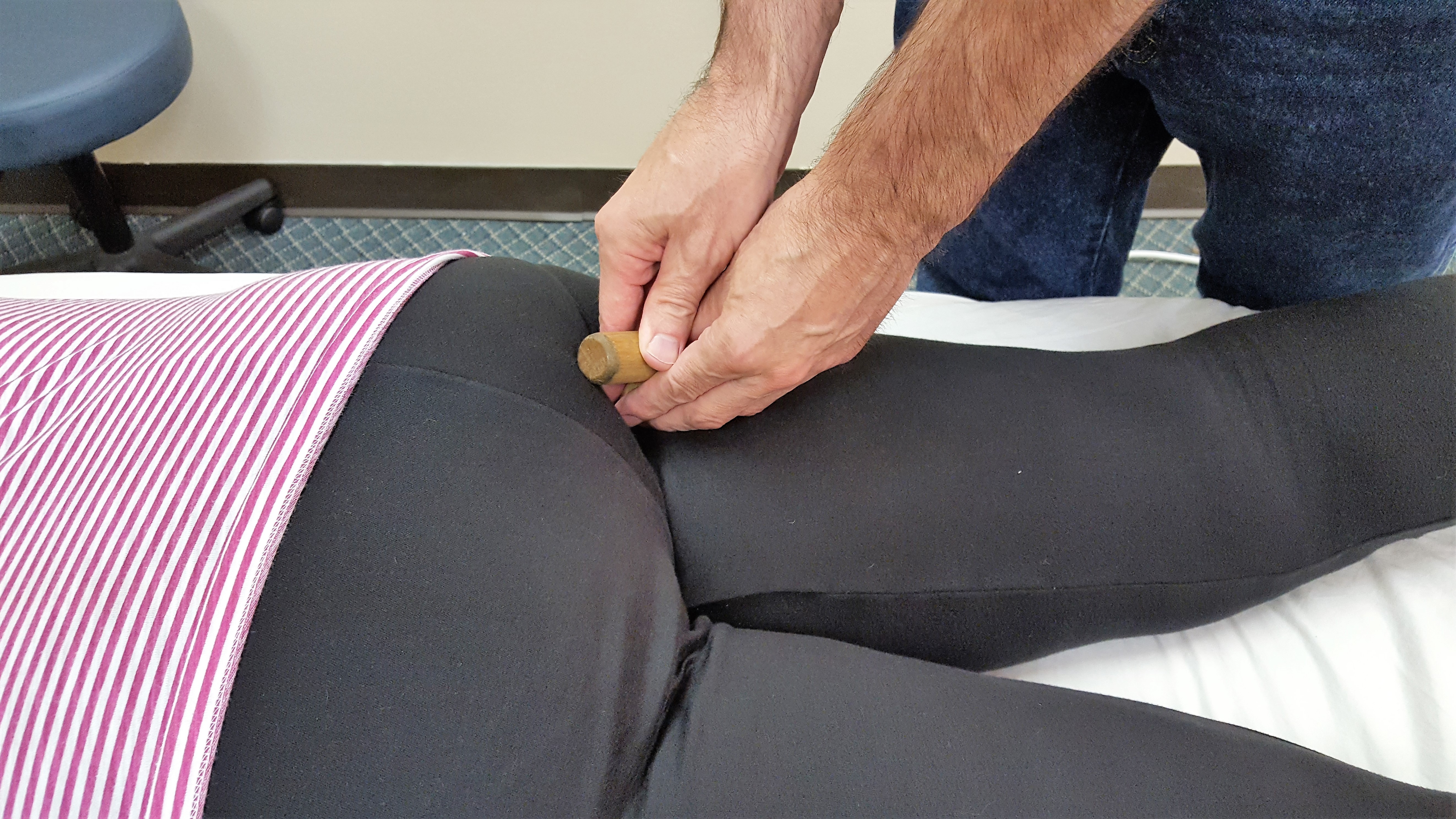
    First, I’d relax the client with gliding strokes on the hamstrings. Then when I was ready to work the attachments, I’d position myself over the ischium.

    Next, I’d explore the attachment area with my knuckles and thumbs to pinpoint the areas I want to work.

    Then I would use my T-bar and L-bar to precisely work the areas that my fingers have identified as “in need of work”. I’d also change my body position so that I can approach the attachment areas from different angles.

    I show you what I mean in this video: How to Work Muscle Attachments Without Hurting Your Hands video.

    Cut to the Chase

    Here are the Cliff’s Notes to working hard-to-reach attachments.

    1. Position your body over the attachment and then begin.
    2. Use a variety of tools—fingers, knuckles, fists.
    3. Incorporate your non-dominant side.
    4. Use a hand-held massage tool.

    If you only have time to check out one video, this one will serve you best: How to Work Muscle Attachments Without Hurting Your Hands video.  Let me know how it goes!

    My Best Massage Tools Online CEU Course

    A while back I almost quit massage because of pain and injuries.

    Then I spent a year revamping my massage to see if I could massage pain-free. Massage tools help saved my hands and upper-body.

    Most massage therapists shy away from using massage tools because, less face it, it’s hard to be sensitive with a piece of plastic or a hunk of wood–that is unless you have work-arounds.

    I use massage tools in every massage from focused pressure work to total relaxation. I can do this because the work-arounds work and are easy to implement.

    So, if you’re ready to take the plunge and delve into massage tools, I have an online, home-study course that will make your learning life easier.

    Here it is: How to Use Massage Tools (Fearlessly and Effectively).
     

  • Eliminate Neck & Shoulder Pain When Working Deep

    Eliminate Neck & Shoulder Pain When Working Deep

    Joanne had been a client of mine for many years and loved deep pressure. One day she asked: “Does your body ever hurt after doing massage?” To this day I wonder if my head actually cocked to the side like a confused puppy. Wasn’t the obvious answer: Hell, yes?!

    I responded with something like: “I have ways to manage.” But, at the time, the truth was that I didn’t. In fact, my left arm felt like it was going to fall off. Eventually, I got to the point where I needed to take action: fix what hurt or find a new job. And after a year or so of experimentation, I discovered if I keep my work below, close to, and in front of me, I could essentially eliminate my shoulder and neck pain.

    Keep Your Work Below You

    My neck issue (cervical radiculopathy) was causing pain in my upper back and down my arm. I could see a connection between using my left elbow and an increase in pain down my arm. If I were going to use my left elbow less, I needed a replacement. I chose my knuckles. But I couldn’t generate enough pressure with my knuckles at my normal table height. That’s when I began experimenting with lowering my table.

    When I lowered my table, my neck/shoulder/arm started to feel better, but now I was raising my shoulders to generate more pressure. What would happen if I lowered my table even more? My neck condition got even better!

    Oops, Too Low

    The next question was how low should I go? My lower back provided the answer. After a period of “ups and downs” with my table, I discovered the other two ingredients that allowed me to keep my table low enough to save my neck/shoulders/arms without bothering my lower-back.

    Close To You

    It’s the best feeling in the world when a youngin’ asks YOU to pick him up. Unfortunately, as he grows, it gets harder to do so and tougher on your back. But you may have noticed that if you can keep the child close to your body as you squat and lift him, you can reduce back strain by maintaining a neutral (not flexed) back.

    I found the same to be true when doing deep pressure. The closer I can get to the table (without touching the client with my body), the easier it was for me to keep my back neutral. I also had better leverage.

    In Front of You

    The “below” and “close to” was working well for eliminating the pain down my arm—but I’d still get the sharp pain in my levator scapulae area. I noticed that it seemed to occur more frequently when I was reaching to a side while pressing—and I didn’t have to reach too far off center to trigger the pain. To keep my work in front of me I needed to move my feet so that I would always be in a position to lean straight ahead.

    Move Your Feet

    Moving your feet may seem like a lot a work—but it probably takes more energy to press with your upper body when you’re not in a position to simply use your body weight to generate pressure than it does to move your feet and lean.

    And I promise you, in the long run, the pay-off is worth the practice it takes to make “moving your feet” a habit. I demonstrate “moving your feet” here.

    Change Your Pain Today

    For me, there’s nothing worse to my psyche then when my philosophy, who I think I am and/or who I want to be, doesn’t match my reality. I used to think that being in pain from working deep was the price I had to pay for helping someone get out of pain. But as my pain compounded, my martyrdom philosophy stopped working for me. If I couldn’t lessen the pain for myself, I’d have to find a new career.

    I was able to reduce/eliminate shoulder and neck pain when doing deep pressure—and I know you can, too. Start experimenting with keeping your work below, close to and in front of you. Don’t worry if you find that what works best for your body is different then what worked best for me. It can vary.

    My Best Body-Mechanics, Online, CEU Course

    A while back I almost quit massage because of pain and injuries.

    Then I spent a year revamping my massage to see if I could massage pain-free. That’s where incorporating the lower half of my body into the massage came in along with a bunch of other strategies that ultimately saved my massage career.

    I pulled all that first-hand experience together and made a live CEU class which I taught for about 5 years. During those 5 years I listened to the massage therapists taking the course and worked out the learning kinks.

    Now I have an online version of the live body mechanics class that is kink-free and will help you massage pain-free.

    Check it out here.