Category: Massage Injury Prevention

  • The Question That Will Save Your Body

    The Question That Will Save Your Body

    If you’re not asking yourself this question – How can I do massage without being in pain?– then you’re probably in pain (and/or have a massage injury).

    Pain from doing massage is a big. hairy deal.

    Pain = loss of income.

    Pain = potential massage injury.

    Pain = an uncertain work future.

    My Massage Injury Story

    In June of 2013 I was in pain from my neck to my fingers.

    The orthopedist said that I had an unstable shoulder joint, cervical radiculopathy and cubital tunnel syndrome.

    He also told me to quit massage.  And part of me agreed with him. A future of working with increasing pain was not sustainable.

    But then part of me was like: Hey, buddy, you’ve gotten through a low back massage injury and plenty of pain issues before without having to hang up your hands. Figure it out.

    As you may have guessed, I went with plan B–figure it out.

    Working Plan B to Heal My Massage Injury

    At first I wasn’t optimistic because the pain didn’t budge. But as time went on, I saw small improvements. The small improvements added up and I started to see that I was making progress towards making my massage injury and pain syndromes non-issues.

    What was the catalyst for improvement?

    You guessed it. Before and during each massage I’d ask myself “How do I get the job done without causing or increasing the pain?”.

    Sounds a little obsessive, I know. But until you know what causes or exacerbates pain during a massage, you can’t fix it.

    And by asking the question you’re setting yourself up to experiment with new strategies and techniques. By the way, when you experiment some of your old massage rules will be broken.  That’s a good thing! Because they were causing you pain. (If you’re nervous about breaking massage rules read this.)

    Here are two rules that I permanently broke: I always have to release the traps by squeezing AND I always have to do my signature effleurage stroke down the entire back.

    (Warning: Your brain is going to rebel at the thought of changing some of the things that make your massage you BUT the return is “no pain”. And the new things you do will soon become your new signature moves.)

    It took me about a year for me to answer the question “How do I do a good job without being in pain?”.

    And after that year I could do more massages in a day without being in pain at 50 than I could at 30.

    Needless to say, the way I do massage has forever changed–and continues to be changed as I ask that important question during each massage.

    Why We Stay in Pain

    The reason why most of us stay in pain when doing massage is not because our mothers were mean to us. By the way, my mom was the nicest mom ever. (She reads my blog.)

    It’s actually quite simple: We’re comfortable with doing massage a certain way. And once we’re in the habit of doing massage a certain way, it’s hard to break that habit.

    [bctt tweet=”We (MTs) stay in pain because we don’t change the massage habits that hurt us.” username=”Mark LiskeyMarkLiskey”]

    But because of my dire situation, I was forced to look at my massage habits. This is what I discovered.

    How I Eliminated Neck, Shoulder, and Arm Pain

    There was a song in the 1970s by Bill Withers called Lean on Me. The famous chorus line is: Lean on me when you’re not strong.

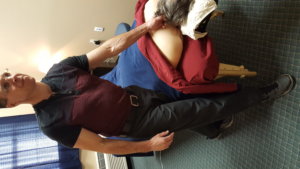
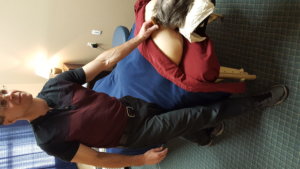
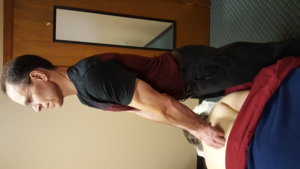
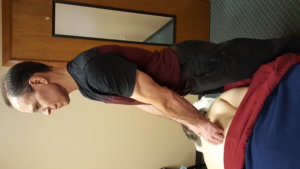
    In massage, I found the opposite to be true: Lean on the client when you ARE strong. The more you lean, the stronger you will stay.

    I discovered this when I started to pay close attention to my neck and shoulder pain while massaging. First, I noticed that using my left elbow/forearm made my arm pain worse. So I stopped using my elbows/forearms for deep pressure. This meant I was left with knuckles and fists to generate deep pressure.

    At my normal table height, knuckles and fists were killing my neck and shoulders. And I would stand on my tip-toes to get more leverage. That led me to experiment with lowering my table. And that’s when the magic began. The more pressure I could generate from simply leaning instead of pressing with my shoulders and arms, the better my upper-body felt.

    Here are the keys that I learned for leaning:

    1. Have your table low enough so that you’re generating pressure from your lean, not your shoulders and arms.
    2. Stack your joints over top each other.
    3. Keep your work below, in front of and close to you.

    In this video, I show how I lean to generate pressure.

    The good news was that my upper body pain went away because of my lower table height. The bad news was that my lower back was now starting to feel a little funky. Ruh roh…

    Getting Rid of Lower Back Pain

    I didn’t want to give up the tremendous gains I had main for my upper-body because my table was now lower. So I experimented with potential back-saving techniques at a low table height. Eventually, I found that I could eliminate lower-back pain if I followed these 2 keys:

    1. When doing medium to deep pressure, maintain 2 to 4 points of contact with the table/client.

    An example of 2 points of contact could be a leg against the table and a hand on the client. Three points of contact could be a leg against the table and 2 hands on the client. Four points of contact could be 2 legs against the table and 1 hand on the client and one on the table.

    When you lean against the table/client, you’re back is doing less work to keep you upright. In this supported position, you can then relax your lower back into a neutral (not flexed or extended) position.

    In addition, when I lean against the table, I can easily regulate my pressure with my legs. When I shift my weight to my toes (table and client), I generate more pressure. And I when lean back towards my heals, I generate less pressure.

    2. Bend your legs to support your weight when doing light pressure.

    Light pressure requires minimal (if any) leaning. So that means you can’t let all or most of your body weight rest on the client/table. Without the support, you’re back muscles are working hard again and it will be difficult to keep your lower back in a neutral position.

    However, if you bend your knees you can center your weight and maintain a neutral back. Check out this video, Low and High in the Saddle, to see what I mean. I call the lean stance for medium to deep pressure  “high in the saddle” and the bent knee stance for light pressure “low in the saddle”.

    Kicking Hand, Wrist and Forearm Pain To The Curb

    Since I started using my knuckles and fists for deep pressure, I worried that I was going to burn out my hands, specifically my thumbs and middle knuckles.

    So I asked myself: what else could I use in muscle attachments, like the levator scapular attachment, besides my go-to thumb?

    When I gave myself time to experiment, the answer was mind blowing. Ready?
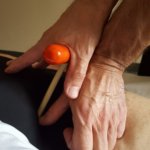
    T-bar and Thumb Combo

    My non-dominant thumb, two thumbs barred together, a knuckle on my dominant hand, a knuckle on my non-dominant hand, a knuckle and thumb together, the other knuckle and thumb together, dominant elbow, non-dominant elbow, an L-bar (my favorite massage tool), a T-bar (my second favorite massage tool), an L-bar and my middle finger, an L-bar and my other middle finger, a T-bar and a thumb, T-bar and the other thumb, an L-bar and a knuckle…believe it or not, there are more.

    Having as many pressing options allowed me to rotate body parts so that I wasn’t wearing one out.

    In addition, squeezing by pressing between massage tools, hands and/or fingers is another great way to save your hands. Here’s a squeeze by pressing video: Trap Release Using a T-bar.

    Heal Your Massage Injury and Eliminate Pain

    The way to having a happy body starts with the question: How can I do a good massage without beating up my body?

    By asking that question you establish the mindset to experiment with different strategies and techniques.

    Once you find a move that bothers your body, you can than begin to find different ways to get the job done.

    Here are some strategies and techniques that have worked for me:

    Hand, Wrist and Forearm Pain

    To eliminate hand, wrist and forearm pain think  non-dominant fingers, thumb and elbow/forearm. Use combination tools, e.g, knuckle and thumb together. And instead of squeezing with one hand, try pressing between both hands.

    Lower Back Pain

    To knock out lower back pain: for medium to deep pressure, lean into the client and table. Having 2 or more points of contact on the client/table, make it easier on your back. For light pressure, bend your legs.

    Neck, Shoulder and Arm Pain

    To stop neck, shoulder, and arm pain: keep your work below, in front of and near you.

    Once you start feeling better, you’ll never go back to the old way of doing massage. And if you do backslide, you won’t stay there for long.

    Need help with your massage injury or pain issue?

    Take the massage-pain free quiz and get an instant recommendation on what you should do next.’

    PAIN QUIZ

  • How to Eliminate Pain When Massaging: Adaptation

    How to Eliminate Pain When Massaging: Adaptation

    Pause that hand stretch video! There are reasons why your body hurts when doing massage. One might be because you’re not adapting in an effective way.

    I know this sounds a little theoretical, but it’s not.

    I’m talking about making adjustments when working through a massage challenge.

    #1 Trying to Use all Your Body Weight to Lean When Your Table is too High

    You need to increase the pressure and your table is high. How do you adjust?

    You push using your upper body, right? (Been there, done that.)

    Besides being an inefficient way to get the job done, pushing with your upper-body stresses arms, shoulders and neck.

    Low Table Adaptation Response

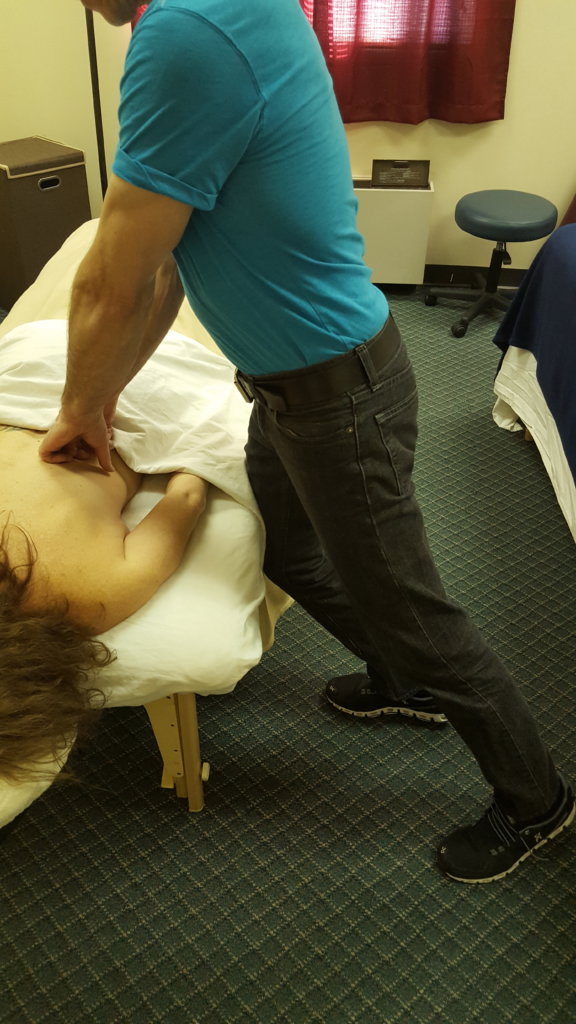
    If you want to maximize using your body weight to generate force, lower your table.

    The challenge with a low table is with light pressure, primarily because you can’t lean your body weight into the client. This means you’ll have to be more upright, and to get your hands on your client you’ll need to bend.

    Can I get an order of back pain to go, please?

    However, there’s another way to adapt instead of bending from your back. It’s “bend your legs”.

    My back is pretty much neutral in the pic, right? You can also sit and lean. That’s easy on the back, too.

    Don’t Need Fancy

    By the way, you don’t need an expensive table to maximize adaptation. I can do 1000 massages on an expensive table, then 1000 on an inexpensive one and I’m not going to lose a client as long as my massage is consistent.

    #2: Adapting to the T-bar

    Massage tools also require adaptation responses if you’re going to stay pain-free and improve massage efficiency.

    In the video below, I’m purposely using a long T-bar in areas of the body I’d normally use a shorter T-bar.

    The simplicity of the T-bar allows me to adapt to different situations in limitless ways. Specifically, I’m talking about the many ways I can hold the T-bar. Have a look:

    How to Experiment with Adaptation

    In massage, successful adaptation boils down to this:

    1. Use the strategy that allows for the best adaptation response.

    Here’s how I determine if the adaption was a success. As I’m adapting, I ask myself:

    1. Am I pain-free?
    2. Is it now easier to get the job done?

    Two yeses equals success.

    If your body hurts when doing massage and you want to dig deeper into the table height strategy, start here: Table Height Is Everything.

    Massage Pain-Free Online CEU Class

    And if you want to cut to the chase and learn how to massage pain-free while getting CEU credits, go here: How to Deliver Deep Pressure Without Hurting Yourself.

  • A Belief That Nearly Ruined My Hands

    A Belief That Nearly Ruined My Hands

    As students, we need to be sponges in order to master a skill or concept. But the sponge mindset becomes a problem when what we’ve learned, accepted and practice actually hurts us. This is when beliefs can end a career.

    Personally, I’ve had belief-ending-career encounters. My massage specialty is neuromuscular massage therapy (NMT). Though I’m not a strict NMT therapist now, there are many NMT beliefs that still impact how I do massage.

    Massaging the origin, insertion and body of the muscle is one of them.

    [bctt tweet=”Every massage specialty comes with beliefs that could be injurious to the practitioner.” username=”Mark LiskeyMarkLiskey”]

    Thank you, Joo

    Not so long ago, when I was teaching a massage tools class, Joo, an MT, asked me why I was always working muscle attachments as well as the body of the muscle. The question literally stopped me in my tracks.

    I hadn’t thought about it for 18 years, ever since I was certified in NMT. I couldn’t point to any credible research that said working attachments was better for pain relief than not working them. And even though I thought I got better results with my clients by working attachments, I couldn’t prove it.

    Here’s how I answered Joo: My clients seemed to appreciate the thoroughness of origin/insertion/body massage AND it’s ingrained in my brain to do it that way.

    As I thought about this some more, I had a flashback to about 5 years ago. My hands were really starting to bother me precisely because of the specific deep pressure needed to work small and deep attachments. I switched to forearms (when I could), then I developed a case of cubital tunnel syndrome.

    Find a New Way to Get ‘Er Done

    When my elbow and arm started to flare up, I was running out of body parts to deliver pressure. My instinct was to find different/new ways to execute my philosophy.

    So I started to experiment with combination body parts to deliver pressure and I greatly expanded my usage of massage tools. Those two changes along with learning how to lean to generate pressure did the trick (click here to see How to Do VERY Precise Pressure)—most of the time.

    But on those killer weeks when clients were coming out of the woodwork, the sheer volume of clients wore down my hands—until I remembered my conversation with Joo.

    Why was I working attachments—especially when doing a relaxation massage?

    Challenge Your Thinking

    It didn’t really make a lot of sense when I started to question my rationale. Was pressing the hammy attachments around the  ischial tuberosity going to make or break my relaxation massage?

    Probably not. In fact, when I broke from my do-muscle-attachments-at-all-costs mindset, none of my clients complained or probably even noticed—and my body thanked me.

    How to Handle Massage Beliefs

    Don’t wait 20+ years like I did to examine your massage beliefs. If you’re in pain when/after doing massage, check to see if the pain could be connected to your massage philosophy (e.g., get attachments at all costs) and conditioning. If so, here’s how you can help yourself out:

    1. Find a new way/technique to execute your philosophy.

    If you want to continue to execute your philosophy, look for different ways to get the job done. I expanded my use of massage tools and incorporated combination body parts to deliver pressure so that I could continue to work muscle attachments without causing myself pain.

    1. Challenge your thinking.

    Sometimes a belief just needs to be challenged. For instance, did I really need to massage muscle attachments all the time to do a good massage? As it turns out, it wasn’t necessary for me to work attachments with every massage, especially for a relaxation massage.

    You Can Change—And Not Lose A Client

    You can change how you do massage and not lost a client. I did.

    Five years ago, I was pooping my pants. I had to do something drastically different or get out of massage. But I was worried that clients–especially the ones who had been with me for 20 years–would walk if the massage felt different.

    So I cautiously went about changing my massage approach by getting in more massage tool reps with each massage and experimenting with my knuckles and fists for deep pressure in place of my forearms. In about a year, I had completely revamped my massage. Not one client walked. In fact, I think my massage got better.

    Here are some more other articles I’ve written to help you uncover and address beliefs that may hurt your body:

    The Question That Will Save Your Body

    I Broke a Massage Rule–And I Liked It

    Massage Pain-Free Online CEU Class

    If you want to cut to the chase and start massaging pain-free now, I’ve taken my bread-and-vegan butter class for massaging pain-free and converted it into an online, home-study course.

    There are lots of videos and you can email me any question anytime.

    Check it out here.


  • How to Stretch Your Back (While Doing a Massage)

    How to Stretch Your Back (While Doing a Massage)

    One of the great things about relaxation massage is that you can go on automatic pilot. And when you’re on automatic pilot, you can still do a good job even though you’re thinking about other things. Not so long ago, I discovered another benefit when I’m on automatic pilot: I can work on my posture.

    My Terms Didn’t Work 

    For the first decade and a half of my massage career, I did massage on my terms. I used my upper body to deliver deep pressure and stuck my elbow anywhere I felt like it. But eventually, “my terms” caught up with me, and, well, kicked my butt.

    As my body started to falter, I was forced to pay attention to how I was actually executing the massage. Over time I figured out massage strategies and techniques that didn’t aggravate the persistent conditions I had, like cervical radiculopathy.

    These strategies and techniques often involved establishing a neutral back (neither flexed or extended). When I was implementing these techniques, I’d notice that I was sometimes struggling to maintain good posture. That’s when I started to experiment with ways to re-establish a neutral back while doing a massage.

    Here are my 3 favorite improve-your-posture moves:

    Back Stretch/Reset When Working the Occiput

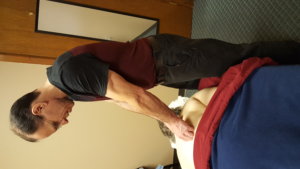
    One time a client wanted a ridiculous amount of pressure in his occiput. He was a big person and my thumbs weren’t cutting it. I was in the early stages of experimenting with leaning and had my table low. I decided to lean into his occiput with my knuckles (middle knuckle transmitting the most pressure).

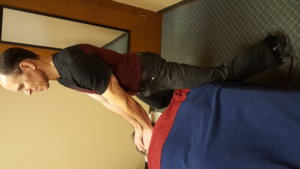
    It was a huge success. It saved my thumbs, and I could generate more pressure. Here’s what it looks like:

    It works with a T-bar, too.

    With a lot of deep pressure techniques I have two hands on the client, but with this move I couldn’t have two hands on the client. What was I going to do with the other hand? Stretch, of course!
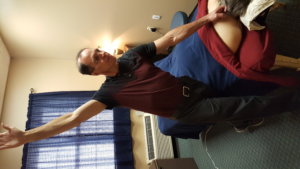
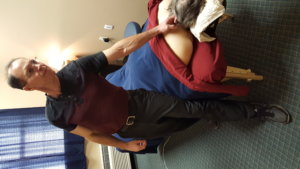
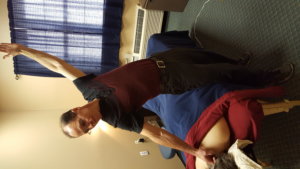
    Okay, so it’s a little dramatic. But I love this move because it’s a good stretch and a good reminder to stand tall when I can. Also, it feels like I’m getting away with something—like being paid to do yoga (a bastardized version of yoga) during a massage.

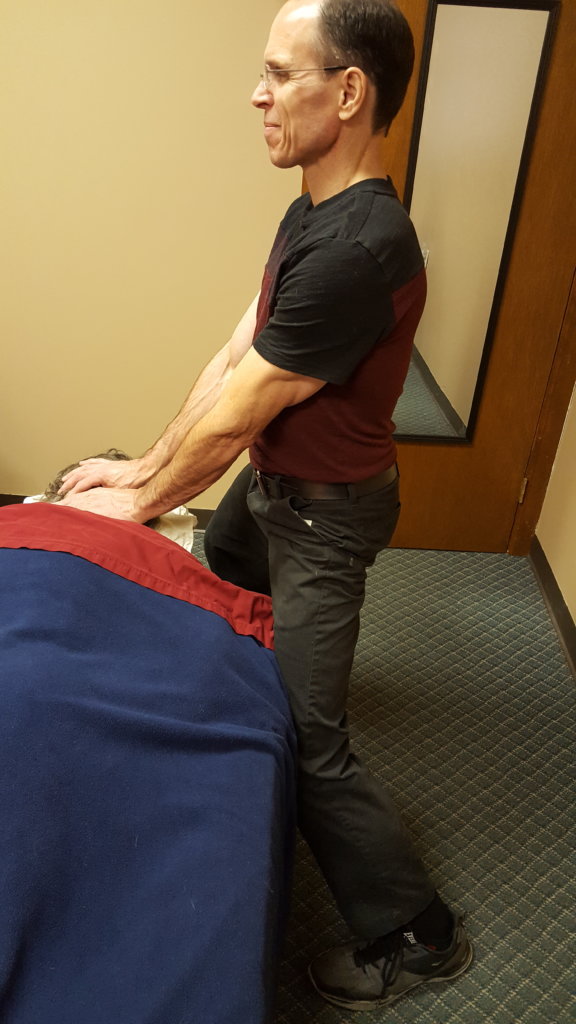
    If I switch my leg position so that the forward leg is the same side as the hand that is pressing into the occiput, I can generate even more pressure. I do this by leaning back over the table and into the client’s occiput. I simply regulate my pressure by shifting my weight between the heels and balls of my feet.

    Below is a picture of the back stretch from this position:

    Low-In-The-Saddle Reset

    There’s a challenge with setting a low table when working a specific area. It can be too low for other areas, like the neck. But there’s an easy solution—bend your legs instead of bending from the back.

    Often times I will find myself in a stance where my feet are roughly parallel to each other and my knees are bent. I call this stance Low-In-The-Saddle. (High-In-The-Saddle is when my knees are locked).

    In this picture I’m working the cervical erectors with double thumbs. My pressure is coming from my lean into the client’s cervical erectors. When I lean, my weight shifts to the balls of my feet and one or both legs lean into the table. The combination of being in a balanced stance and leaning into the table/client allows me to be in a well-supported position. In this well-supported position it’s easy to reset and maintain a neutral back.

    Back Reset Breath and Lift

    As I get absorbed in my work or get tired, I sometimes find myself bending from my back. When I feel my back flexing, I hit this reset move: I breathe in while lifting my rib cage up. Next I slightly suck in my stomach until I feel there is no rounding in my lower back, and then I relax my stomach.

    Starting to slouch.
    Raise rib cage.
    Relax your back.

    This move feels good and can be done in most any stance.

    It’s About You Too

    Twenty-five years ago, if you had said that I would be working on my posture while doing massage, I would have laughed out loud. For one, I thought I was indestructible and, two, I thought massage was all about the client.

    What I didn’t know was that the massage was actually about me, too. If I’m hurt, I can’t do massage. And if I’m in pain, I don’t want to do massage.

    When I was forced to face the bad habits that were contributing to my massage career demise, I discovered that I could save my body by minding my massage posture.  In addition, when my massage posture improved, the easier it became to do my work.

    Here are three quick ways you can work on your posture during a massage:

    1. While leaning into the occiput with your knuckles or a massage tool, raise the other hand up and stretch.
    2. Step into a Low-In-The-Saddle stance, lean into the table/client, and then reset your back to neutral.
    3. When you feel that your posture is slipping, breath in, lift your rib cage up and on the exhalation allow your back to relax.

    If you take of yourself, you can take care of your clients for a long time.

    Can you learn how to massage pain free AND get CEU credits?

    Yep.

    Go here.