Category: Massage Tools

  • Massage Therapy Hand Pain – NOPE

    Massage Therapy Hand Pain – NOPE

    How do you eliminate hand pain when doing massage?

    1. Incorporate your non-dominant hand. 
    2. Add in bracing/combination techniques.
    3. Use hand-held tools.

    I bet you thought I was going to say use your elbows/forearms as substitutes for your hands.

    Elbows can be good substitutes for hands, but if you start to rely on your elbow too much you could develop overuse problems, like cubital tunnel syndrome. 

    In addition, an elbow is great for a back, but how about if you’re doing detail work, like in the neck? For most of us massage therapists, using an elbow to do detail work in cervical erectors is not going to work.

    Enter your non-dominant-hand, bracing and combination techniques and massage tools.

    1. Massage Therapist Hand Pain – Be Ambidextrous 

    About 10 years ago, my right thumb started to bother me.

    When I think back it makes perfect sense that it would. I used it a lot—especially when doing deep, detail work. For a long time, I simply accepted thumb pain as the price to pay for doing massage.

    But as the pain increased I realized that if I didn’t change something soon I was going to be in trouble.

    One day during a massage my right thumb was really aching and I had to give it a break. So I stuck my left thumb in the cervical erectors.

    It was awkward BUT my left thumb didn’t ache. (Hey, I could get used to this!)

    Then I experimented with my left thumb so often that it started to hurt, too.

    Eventually, I found that if I followed a thumb workload formula of 60/40 (60% dominant thumb/40% NON-dominant thumb) my thumbs felt great.

    2. Massages Therapist Hand Pain – Combine and Brace

    Splitting the workload to 60/40 between my thumbs was a big improvement for reducing pain in my right thumb. However, it didn’t solve my problem of achy and stiff fingers.

    There was one move in particular that really made my hand ache. The move involved squeezing and rolling the upper trap edge between my thumb and fingers.

    One day I was doing that move and my hand ached. Without thinking I reached over with my other hand to help with the squeezing.

    Hmm…it sure was a lot easier squeezing with two hands.

    And that is when I really started to experiment with combining and bracing.

    What happens if I put a thumb over top a thumb and pressed down with both thumbs?

    Well, I’ll be damned if that didn’t make the work for my dominant thumb easier.

    There are no right or wrong bracing techniques. It depends on the individual and is influenced by anatomy (e.g., big knuckles versus small knuckles) and preexisting conditions.

    My favorite hand-saving, bracing combinations are

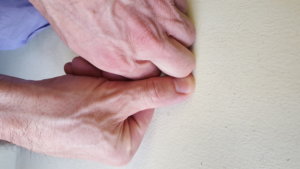
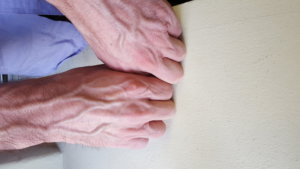
    Braced thumbs:Braced Thumbs pic
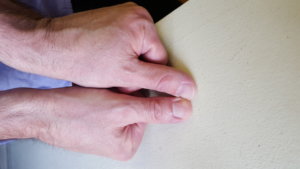
    Third knuckle and thumb:Braced Thumb and Third Knuckle pic
    Braced knuckle and fist:Braced Knuckle with Fist pic

    Check out this video for more in-depth bracing and combination techniques: 

    Here’s my favorite eliminating hand pain solution—massage tools.

    3. Massage Therapist Hand Pain – Massage Tools

    Becoming ambidextrous and bracing my fingers, thumbs, knuckles and fists together made my hands feel better. But adding in hand-held tools allowed me to increase my massage volume big-time without injuring my hands.

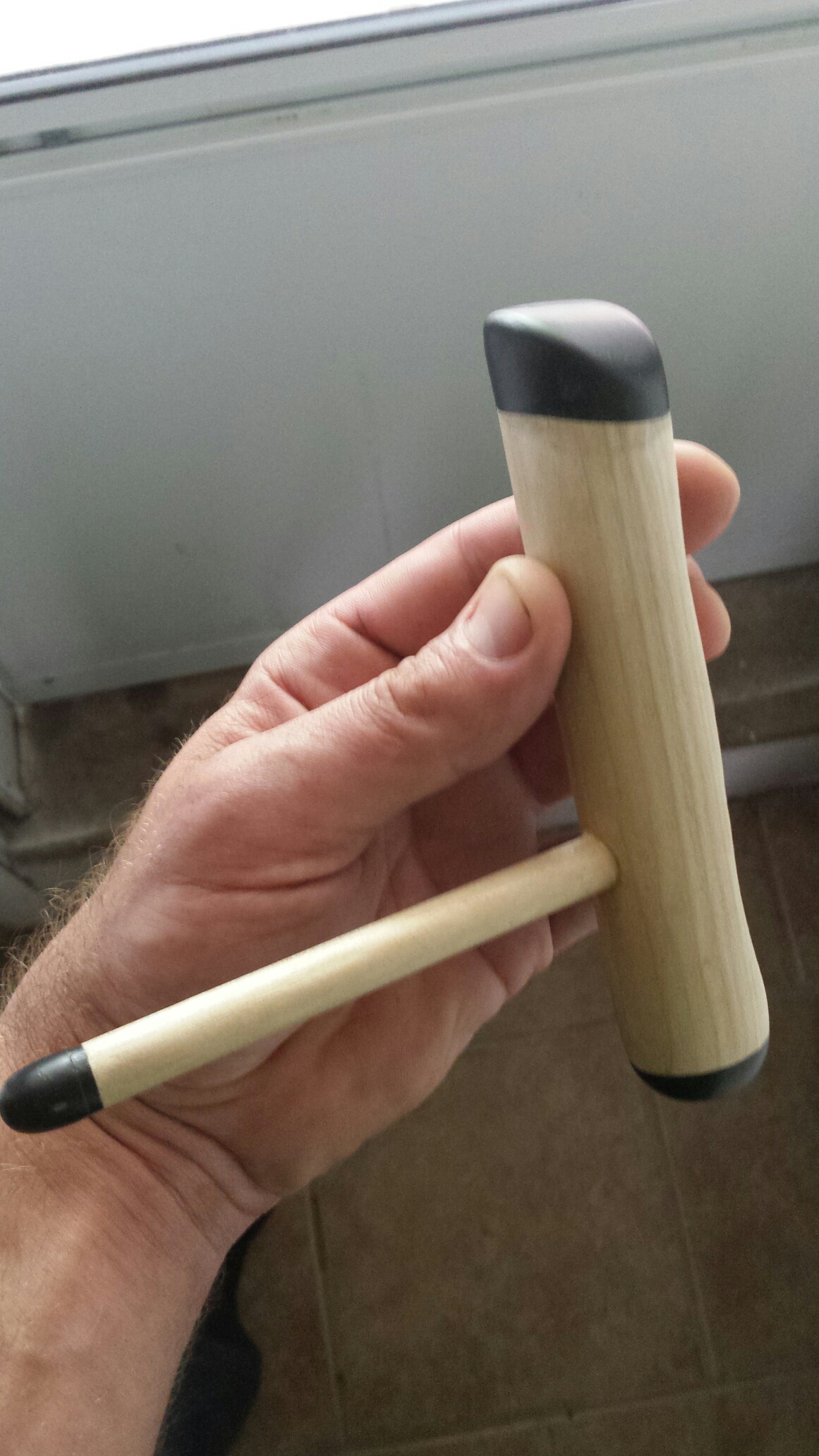
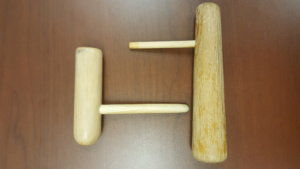
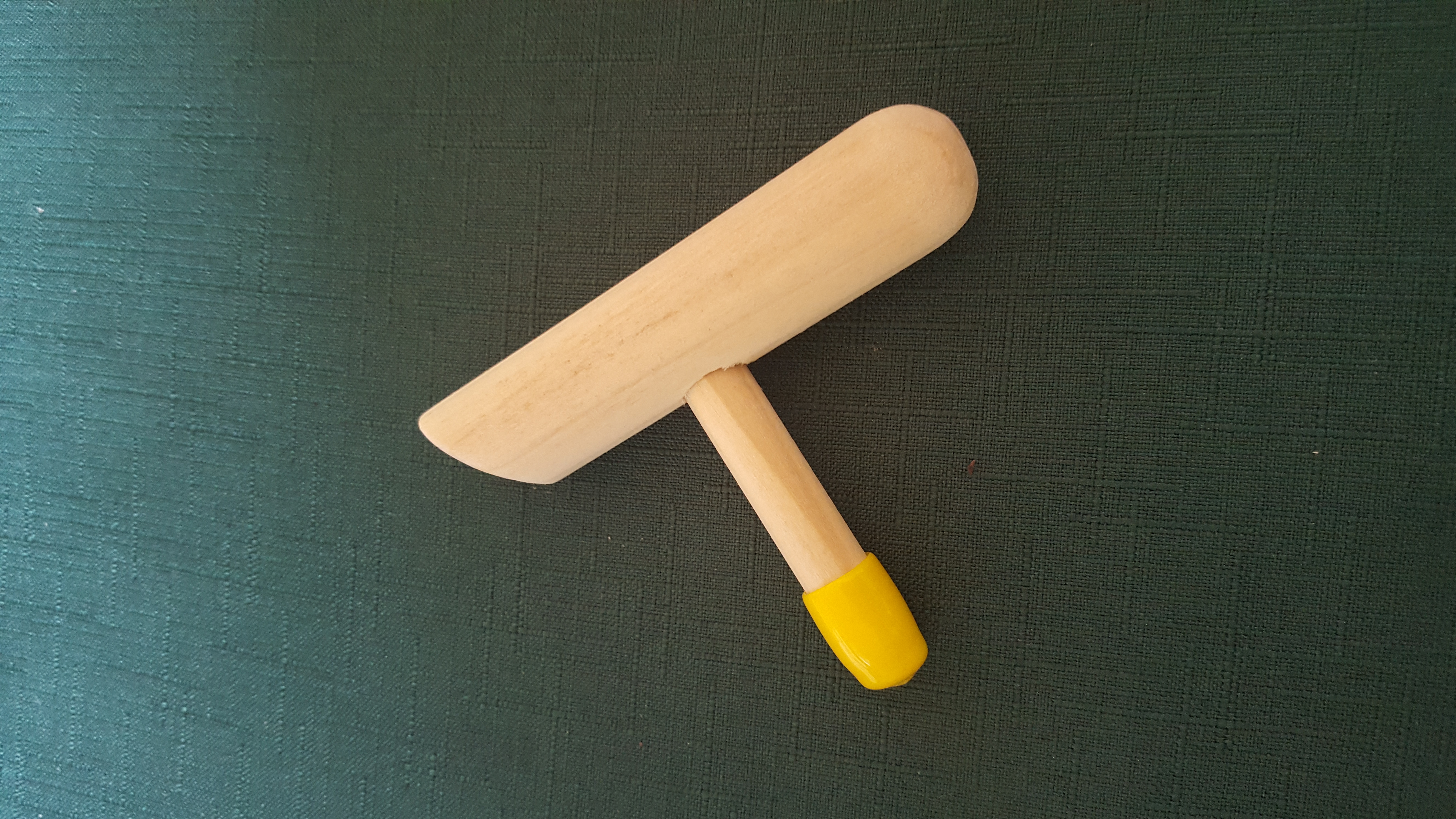
    Here are 2 basic types of wooden hand-held tools that I use:T-bar and L-Bar pic
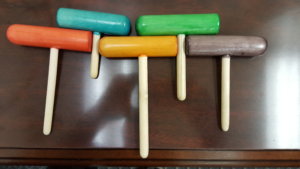
    These tools were designed by my massage colleague and friend, Matt Johnson.

    Let’s take a closer  look.

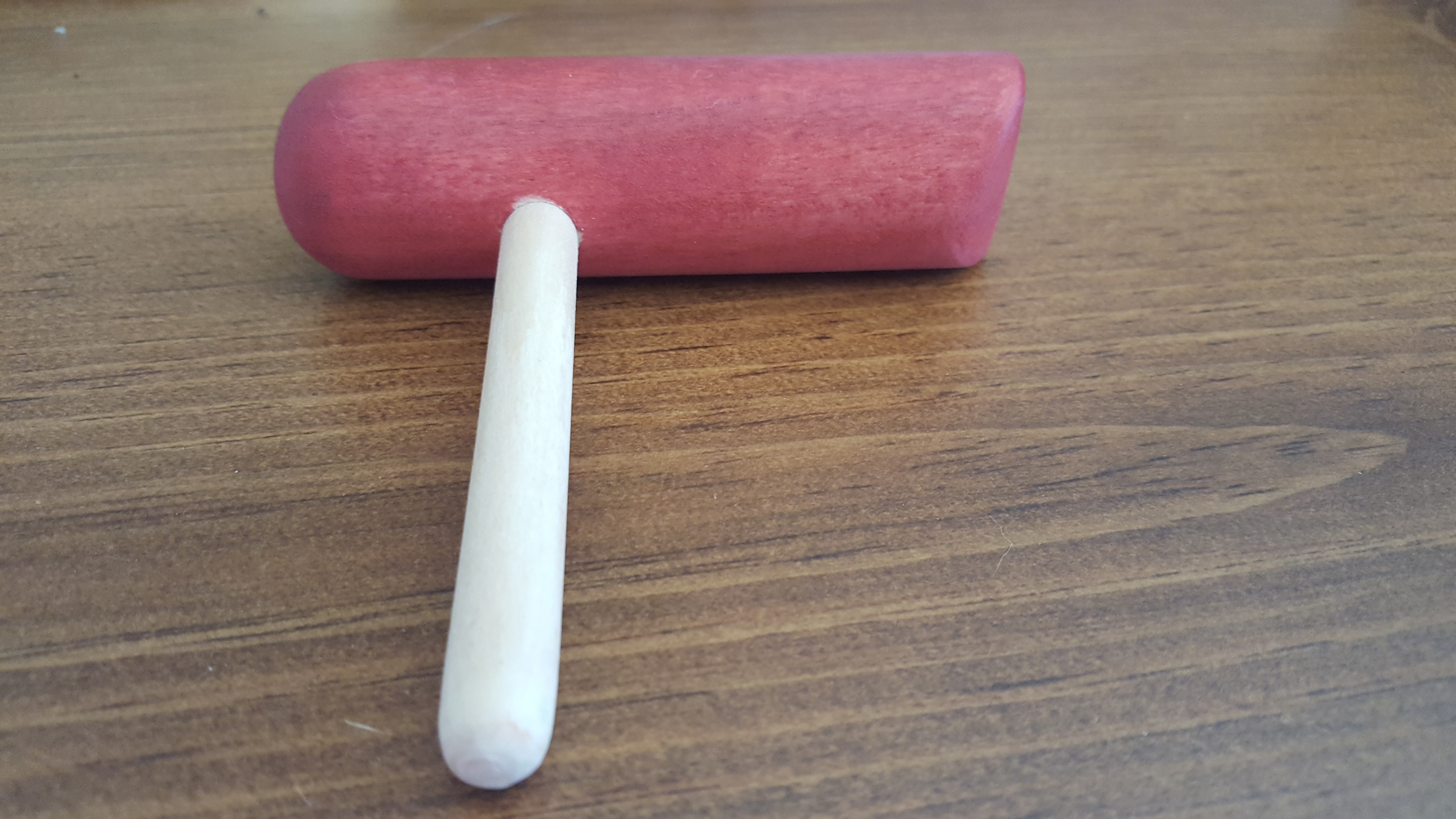
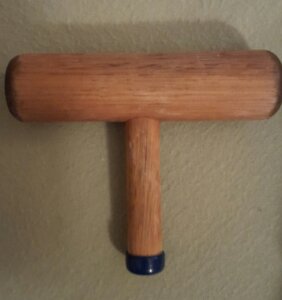
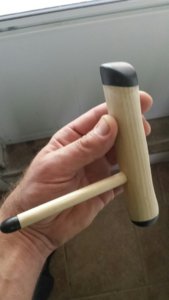
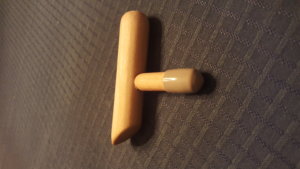
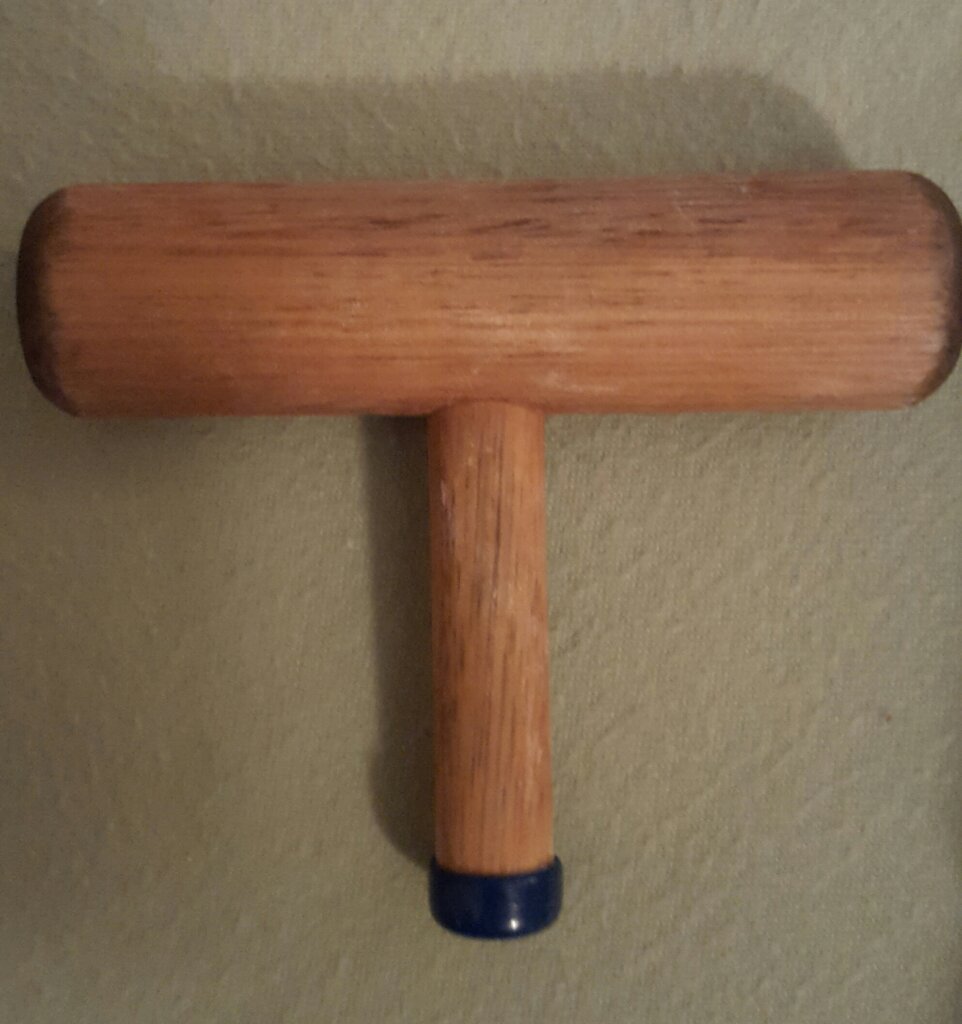
    This is a T-bar.
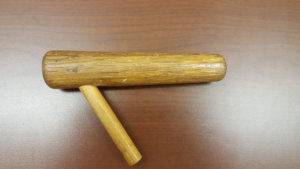
    And this is an L-bar.
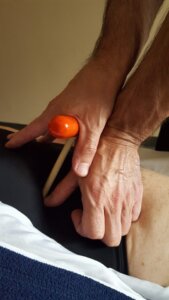
    A little intimidating looking, right?

    But if you start with baby-steps you’ll get used to them, and then you’ll never want to do another massage without them!

    Here’s what you need to do to get competent with massage tools.

    Adjustment #1: Relax Your Hand

    This is how we were taught to grip a T-bar in NMT class.
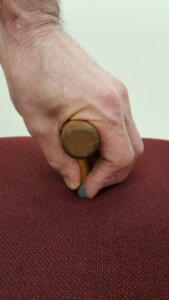
    Take note of my fingers gripping the stem and tip to control the T-bar.

    This hold allowed you to have fine-tuned control of the T-bar when working a tight/tender spot, but it also encouraged you to grip the T-bar tightly, even when applying light pressure.

    Hmm, I wondered, what would happen if I just loosened my grip some?

    Actually, nothing happened. The T-bar didn’t slip out of my hand, and I was still able to control the tip with a lighter grip.

    This begged the question: How loose can I hold the T-bar without it actually falling out of my hand? I started experimenting and found that my hands were very happy when I simply steadied the T-bar with the minimal amount of pressure required to keep the T-bar from dropping  or slipping from my hand.

    This is a loose-hand hold: 
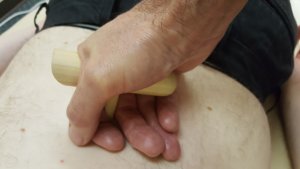
    My fingers are relaxed and I’m using just enough of a grip so that T-bar doesn’t slip out of my hand.

    At the end of a month or so, I got pretty good with light and medium pressure, but when I ratcheted up to deep, I had to tighten the grip to keep the tool steady.

    I wish I could say that I figured out the pain-free method of holding a T-bar for deep pressure within a month or so, but I can’t.

    In fact, I went in a different direction altogether. I started experimenting with other massage tools for deep and precise pressure. And it wasn’t until 15 years later that I figured out how to use the T-bar for deep pressure without hurting my hands.

    At that time, shoulder and neck conditions forced me to radically change my massage body mechanics. One of the big changes that I made was to set my table lower than I normally had it. And when I did, the T-bar missing puzzle piece fell into place.

    Adjustment #2: Pin the T-bar

    With a lower table, my work was below me. This meant that I could take full advantage of leaning my body weight into the client to generate pressure.

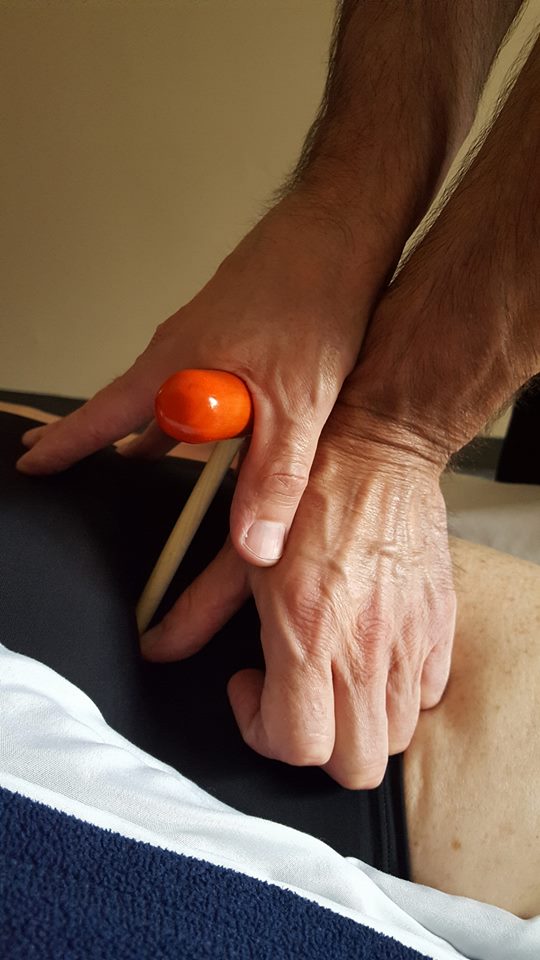
    When I leaned in with a T-bar to do deep pressure, I could pin the T-bar between my hand and the client’s body. There was no need to grip hard to hold the T-bar in place. In fact, I really didn’t have to grip at all. This is an open-hand hold.
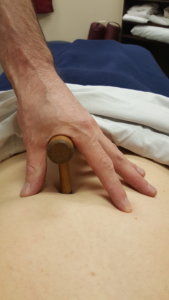
    Open hand hold.

    To execute this hold the table has to be low enough so that you can lean in to generate pressure and pin the T-bar. Here’s what it looks like when the camera steps back.

    The pin technique made it easy to hold the T-bar, but there were times when a one-handed pin wasn’t possible and/or my pinning hand needed a break. This leads us to the third adjustment.

    Adjustment #3: Use A Guide Hand Next to the T-bar

    Using a guide hand next to a T-bar is my preferred way to hold a T-bar.

    For one, I’m contacting the client with more surface area than I would with the T-bar alone. This gives the massage more of a relaxation feel.

    Two, it’s really easy to stabilize the T-bar with a guide hand, maintain sensitivity and regulate pressure.

    Three, I can shift the emphasis of pressure from tool to guide hand (hand not holding the T-bar) without having to pull my hands off the client.

    In this picture my guide hand is a relaxed fist. 
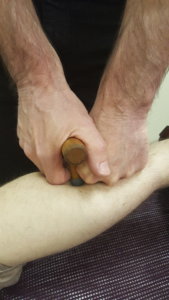
    The relaxed-fist, guide hand that’s next to the T-bar serves as a stabilizer. For broader pressure, I would direct more of my body weight into my fist. For precise pressure, I’d lean more into the T-bar. This hold is great for calves and forearms.

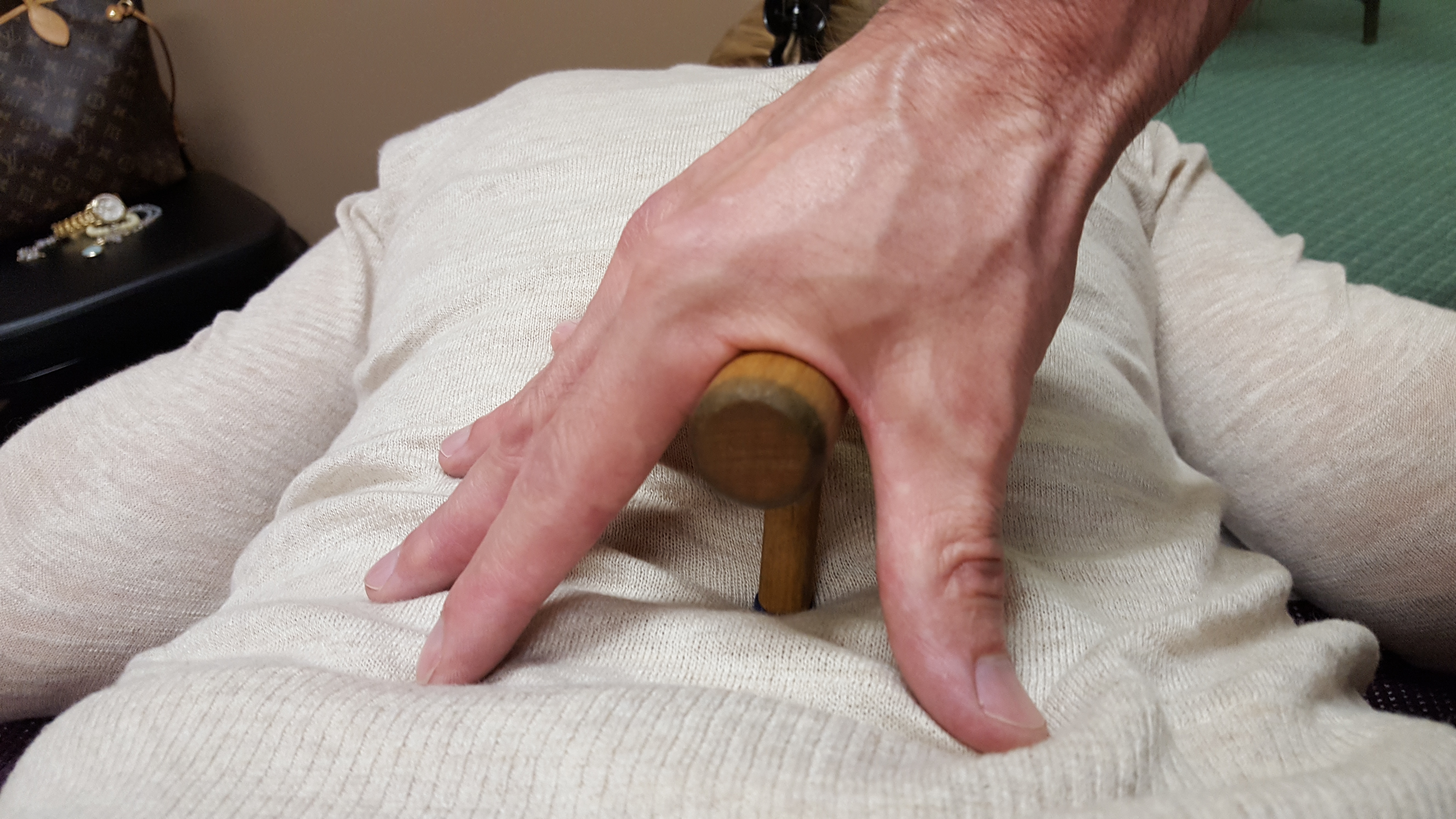
    This next example is a double-handed hold.
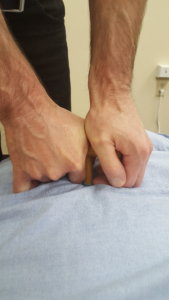
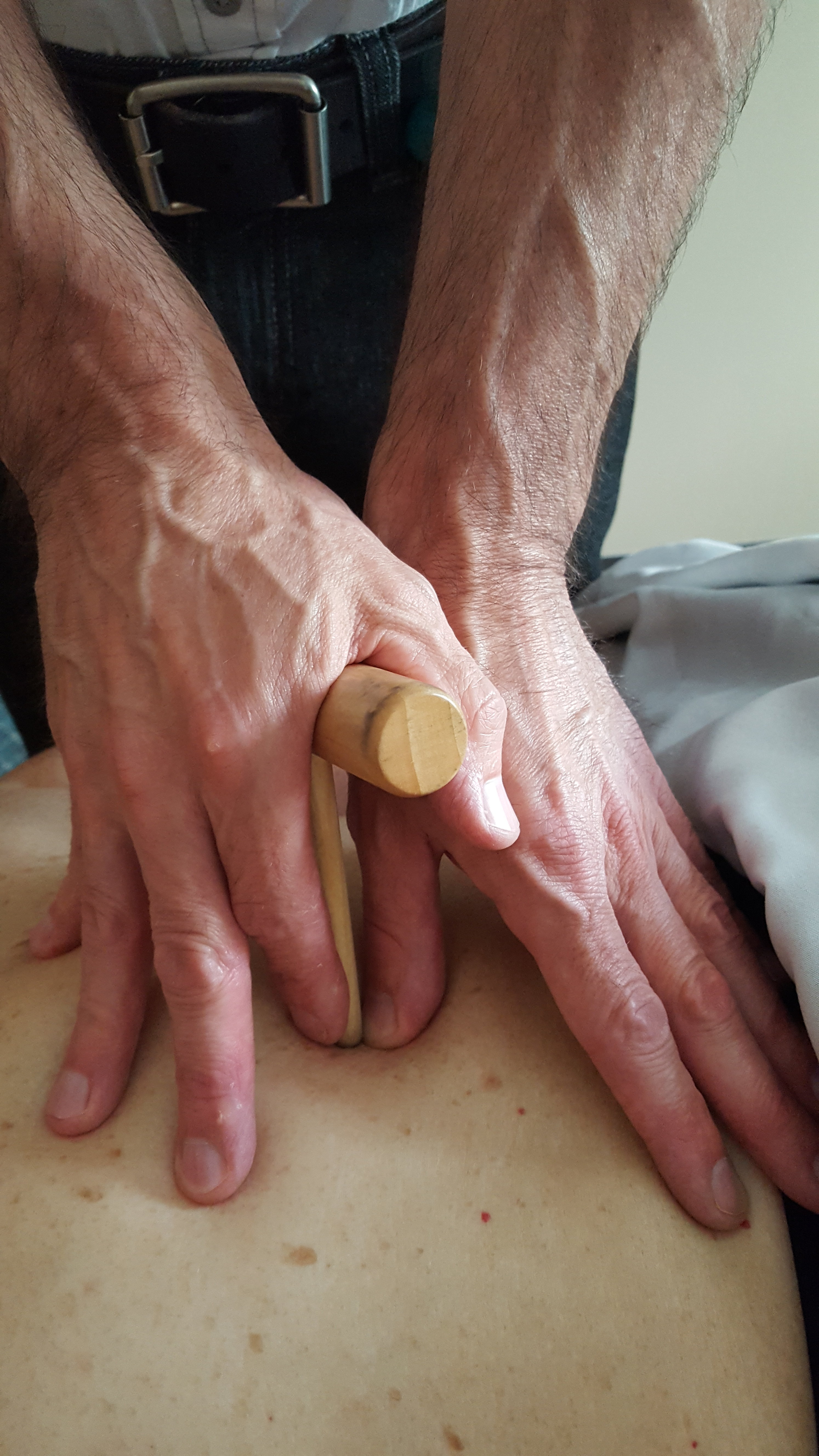
    Two hands on the handle hold.

    Note that both hands are contacting the handle. Having two hands on the handle allows me to lean in with my body weight. I use this hold when I need to deliver more pressure to influence deep muscles.

    The double-handed hold is good for when you’re working thick areas, like back, hamstrings and quads.

    Also, can you see that my hands are relaxed? That’s really important because you’ll instinctively want to tighten your grip to steady the T-bar as you lean in to deliver deeper pressure.

    But that’ll be completely unnecessary. Look at all the points of contact my fingers and knuckles make with my client’s back. That T-bar is not going anywhere!

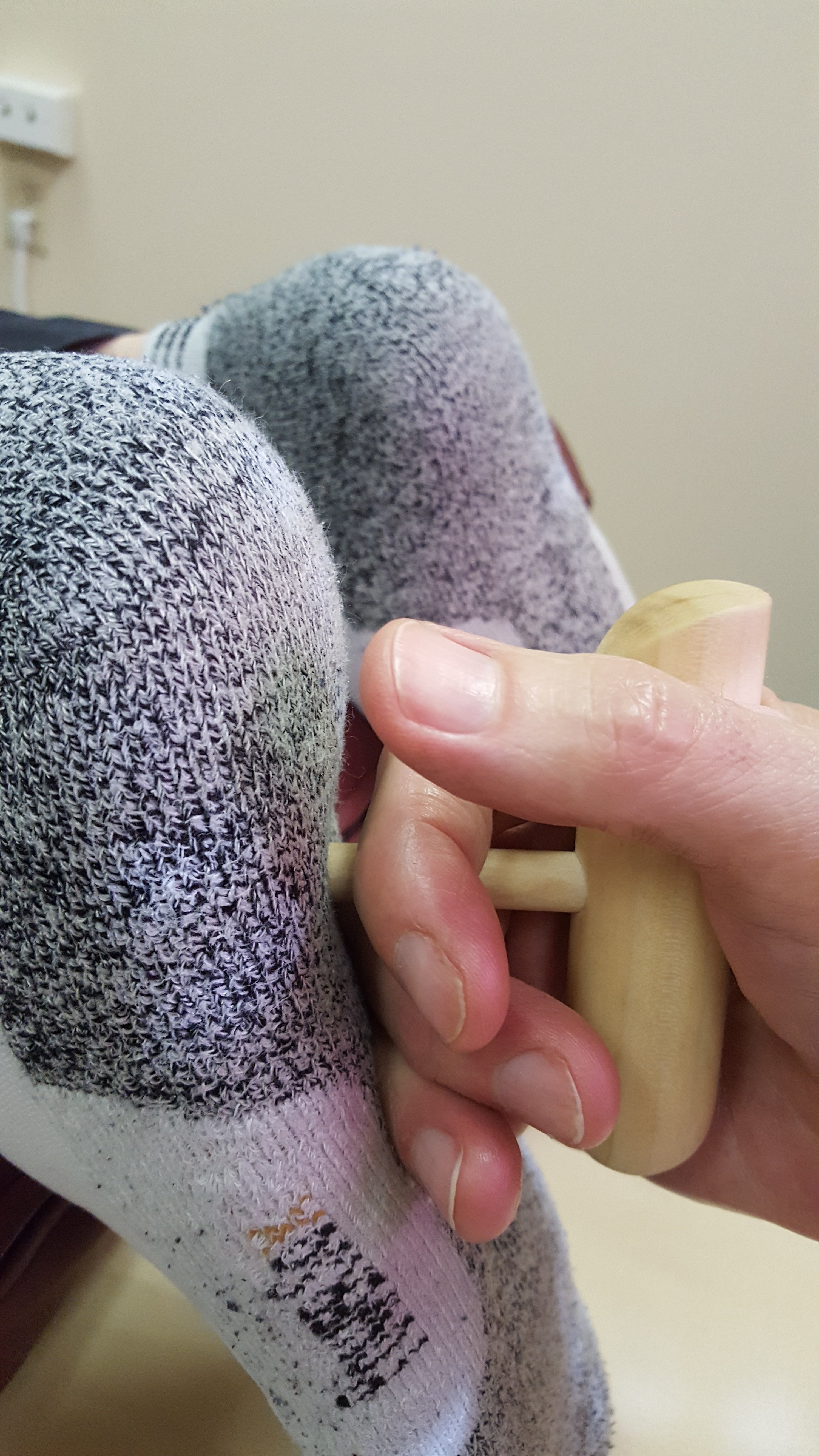
    This last hold is a wrap-around technique that works well feet.
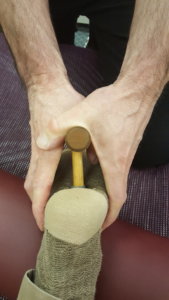
    The great thing about the wrap-around hold is that it’s easy to control your pressure. You simply lean in. 

    The guide-hand and two-handed holds worked great for me, but I had a tendency to get really comfortable with one or two holds and I then I’d feel the overuse pain again. This tendency led to me to adjustment #4.

    Adjustment 4: Vary Your Holds

    There are countless ways to hold a T-bar. Here’s how I recommend you experiment. First, pin the T-bar between your hand and the client’s body. Then place your other hand next to the T-bar and allow that hand do whatever it wants to in order to support the T-bar.

    Just remember to keep your hands relaxed and you’ll be amazed at how many different holds you’ll come up with.

    Easier than You Think

    There’s a potential irony in massage that we all desperately try to avoid. It goes like this: We put ourselves in pain to get someone else out of pain.

    Thumb pain is not a byproduct of doing massage.

    Kick thumb pain to the curb by using a T-bar when doing deep and precise work. But first you have to learn how to hold the T-bar without gripping it.

    Here are the keys for holding a T-bar:

    1. Hold the T-bar with a relaxed hand.
    2. Pin the T-bar between your hand and the muscle by leaning in. You may have to lower your table. You can lean when you’re sitting, too.
    3. Use a guide hand, thumb, finger next to the T-bar for stability, sensitivity and as a pressure gauge.
    4. Use two-handed holds to spread the workload.
    5. Vary your holds so that you don’t overuse a body part.

    Once you get these basic things down, you’ll never have to worry about developing chronic thumb pain again.

    This video will help you, too:

    Eliminate Hand Pain Recap

    The great thing about massage is that you can get paid for on-the-job training.

    With a paying customer you can experiment with your non-dominant hand.

    Once you do that add in a bracing combination, like thumb on thumb.

    With hand-held massage tools take it a little slower.

    First,  practice on friends, colleagues and family.

    Once you get positive feedback with your tool work test out a massage tool  on a client. 

    Slowly increase the time you use a massage tool with that client on subsequent sessions.

    Online, Save-Your-Body CEU Course

    Need more help saving your hands?

    I have an online course that can help you eliminate hand pain (and shoulder, neck and back pain, too).

    A while back I almost quit massage because of pain and injuries.

    Then I spent a year revamping my massage to see if I could massage pain-free. That’s where incorporating the lower half of my body into the massage came in along with a bunch of other strategies that ultimately saved my massage career.

    I pulled all that first-hand experience together and made a live CEU class which I taught for about 5 years. During those 5 years I listened to the massage therapists taking the course and worked out the learning kinks. 

    Check out the kink-free, massage-pain-free course here

    Online, Massage Tools CEU Class

    Massage tools help saved my hands and upper-body.

    Most massage therapists shy away from using massage tools because, less face it, it’s hard to be sensitive with a piece of plastic or a hunk of wood–that is unless you have work-arounds.

    I use massage tools in every massage from focused pressure work to total relaxation. I can do this because the work-arounds work and are easy to implement.

    So, if you’re ready to take the plunge and delve into massage tools, I have an online, home-study course that will make your learning life easier.

    Here it is: How to Use Massage Tools (Fearlessly and Effectively).
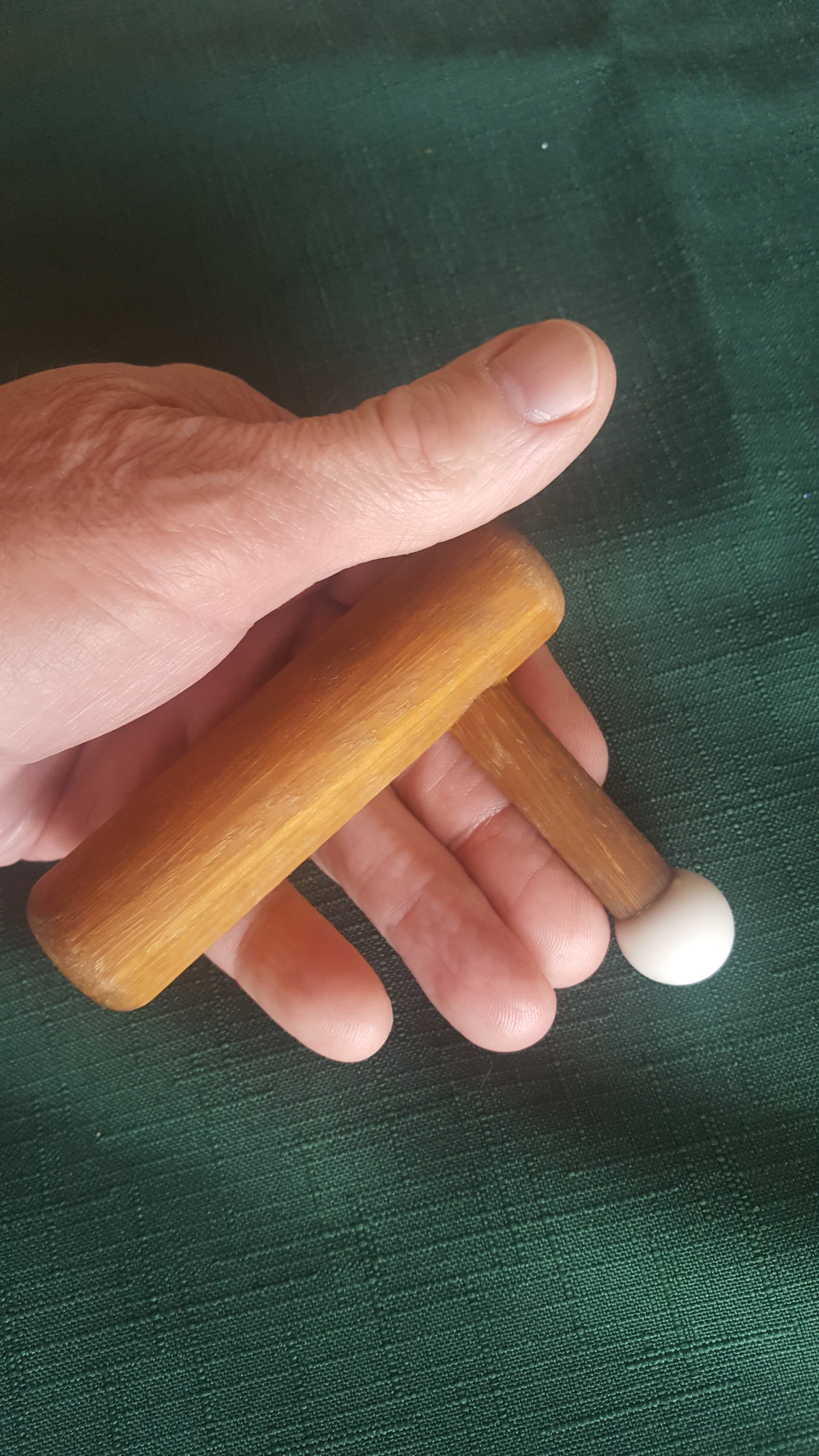
  • How to Use Your 11th & 12th Fingers

    How to Use Your 11th & 12th Fingers


    How do you save your thumbs as a massage therapist?

    Add more thumbs to you hand by incorporating massage tools.

    But not just any massage tool.

    I’m specifically talking about massage tools that have a handle and a stem.

    Why?

    Because a handle makes the tool easy to hold, and a stem does a fantastic job of simulating a thumb.

    Here what tools with handles look like:

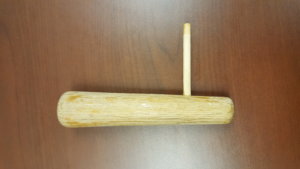
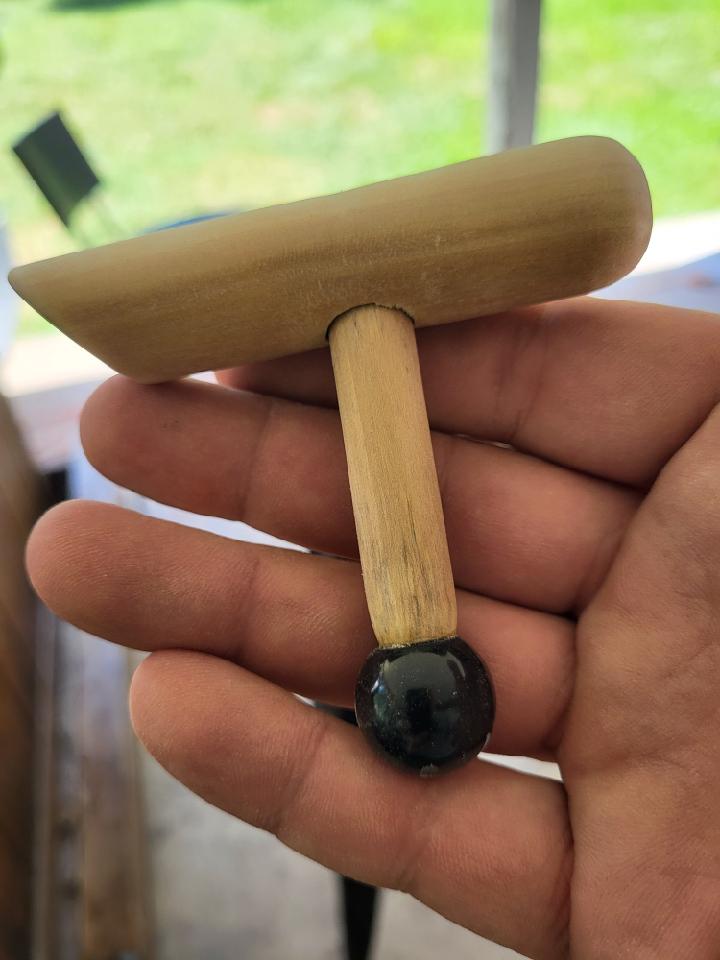
    That’s a round tip L-bar.

    Here’s a T-bar:

    And here’s a long stem L-bar:

    (Thank you Matt Johnson for designing and making these T-bars and L-bars tools!)

    The T-bar stem is in the middle of the handle and the L-bar stem is offset.

    Having the stem in the middle of the handle or as an offset provides different options to access muscles and muscle attachments that are tough to reach.

    More about stems later. Let’s jump back to handles.

    The Importance of a Handle

    At the beginning of the post I had said that a handle makes it easy to hold a massage tool. Now I need to do some explaining because I’m not talking about holding a handle in the traditional sense–wrapping your hand around the handle and gripping.

    I’m talking about using the handle to support your body weight. Think of parallel bars or push-up stands where you’re simply supporting your body weight on an apparatus. 

    Holding a Massage Tool

    With a massage tool you are directing some of your body weight onto the handle of the tool.

    If the massage tool is pinned between your hand and the tissue you’re working on, you can loosen your grip.

    And if you add a guide finger/thumb next to the end of the stem of the massage tool, you can actually relax your “holding” hand.

    Here’s what that looks like:

    See how relaxed my hands are?

    My guide fingers is helping to stabilize the tool. I’m also sensing how much pressure I am applying with my guide finger.

    This all looks great, right? But when you actually go and try to hold a T-bar or L-bar without gripping you’re going to say–Mark, you’re a freakin’ liar–because it’s not going to work.

    Why isn’t it going to work?

    Because your table won’t be low enough. And that means you’re not going to be able to lean onto the massage tool handle with enough pressure to keep the tool upright without gripping.

    This will help you figure out your table height.

    Okay, I’ve hammered away about the handle thing enough.

    Now, let’s bounce back L-bar and T-bar stems.

    T-bar and L-bar Stems

    Stems come in varying lengths and diameters.

    They can simulate wide thumbs or small fingers.

    The stems and end tips are what makes these tools extra fingers because if you use these tool you won’t have to use your own fingers to do precise detail work.

    One afternoon I really jammed my middle finger.

    But I worked the next morning because I used a very long T-bar for detail work and it allowed me to keep my injured finger straight. 

    Short stems work great in areas where it’s easy to access muscles, like feet…

    …or multifidus and rotatores.

    6 Finger Pic

    I have tons of massage tools with stems lengths that range from shorter than my thumb to longer than my 3rd finger.

    Mark Liskey

    But understand, I am a massage tool addict.

    You don’t need a thousand massage tools.

    Just using one will be a game changer.

    If you not sure which one, email me.

    By the way, Matt Johnson will make you anything you want and it won’t cost you an arm and a leg. Let me know and I’ll put you in touch with Matt.

    How to Save Your Thumbs as a Massage Therapist Quick Sketch

    (1) Select a massage tool with a handle and a stem.

    (2) Lean into the massage tool so that you can pin it between your hand and the tissue you’re working on.

    (3) Relax your hand.

    (4) Add a guide finger/thumb to help stabilize the tool and regulate pressure.

    (5) Experiment with stems of different lengths and diameters.

    Once you start using tools for detail work, you’ll never go back to burning out your thumbs and fingers:-)

    Oh, and I have an email group. It’s free. Just sign up below.


  • Deep, Detail Work—Bring It On!

    Deep, Detail Work—Bring It On!

    How do you do a TFL massage that’s detailed without killing your thumbs and fingers?

    1. Pinpoint the exact area in the TFL that you want to work with a massage tool.

    2. Guide the massage tool with your non-holding hand as you press, pull, reciprocate and/or vibrate that exact area until you create the desired effect that you’re looking for.

    My favorite massage tools for the TFL are simple (and inexpensive), but effective.

    They are a T-bar…

    …and an L-bar.


    1/3 of the Trick

    The T-bar is an important tool for neuromuscular massage (NMT), and is waaaay better than thumbs for doing detail work on tough to reach muscles like the multifidi and rotatores deep in the lamina groove.

    But when I started practicing NMT, I soon learned that if I gripped the tool too hard, my hand hurt.

    Over the years, I’ve developed ways to grip the T-bar that are easy on my hands. You can check them out on this post, Tools Can Save Your Hands.

    The T-bar was better than thumbs for precision for sure, but I’m greedy and I wanted something even more precise. 

    2/3 of the Trick

    So I went to my dad and asked him to make some tools for me that would allow me to work muscles super-precisely. Here’s an early model of something that he made that didn’t work out so well.

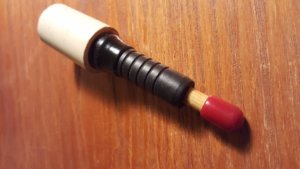
    PopPop V-Bar Pic

    Not pictured is the massage tool that was about 18 inches long and rested between my shoulder and armpit. This was a removable tip that you could put on the end of it.

    Scary looking, huh?

    Promise I never made anyone bleed.

    However, this one was a winner!

    Pop TBar Pic

    The stem diameter was narrower than the T-Bar which gave me greater precision.

    And the stem was offset (the tool sort of looks like an “L”; that’s why I call it an L-Bar).

    That allowed me to get into tight spaces like the neck.

    The Whole Trick

    As my Dad’s health deteriorated over the years, I backed off asking him to help me with new designs. Then one day I was teaching a class on delivering deep pressure without hurting yourself.

    I was demonstrating the tools and explained that I use a massage tool as if it were an extension of my hand.

    Matt Johnson, who was taking the class, took me up on what I had said—literally. He designed a tool with a longer stem that actually extended beyond my finger tips and thumbs. This modification allowed me to access hard to get to areas, like the TFL, with precision and ease.

    PopPop&Matt LBars

    By the way, Matt makes customized massage tools. If you want him to make one for you, let me know, and I’ll put you in touch with him.

    Now, I had the whole trick: a T-Bar and L-Bar that allowed me to deliver precise pressure with my fingers simply acting as guides (no strain).

    Detail work—deep work included—was now a walk in the park.

    TFL Massage

    So, let’s put these tools into action. In this video I’m using a long stem T-bar to pinpoint tender spots in the TFL.

    Wait, Mark, isn’t that supposed to be an L-bar?

    It doesn’t matter if it’s a T-bar or L-bar as long as the stem is long enough to provide enough clearance between the handle and the TFL so that the tool can be held effortlessly.

    Here we go!

    [embedyt] https://www.youtube.com/watch?v=-G7QQuM8V4s[/embedyt]

    Rotatores and Multifidi Massage

    The deep rotatores and multifidi are no are no problem with a T-bar or L-bar.

    In this video I tackle traps and rhomboids, too.

    [embedyt] https://www.youtube.com/watch?v=3yoHT9EM0Lw[/embedyt]

    Using a massage tool, like the T-bar or L-bar is not hard, but it does take some practice.

    Here’s a recap of what you need to do:

    TFL Massage and Rotatores/Multifidi Massage Recap

    1. Pinpoint the area you want to work with a T-bar, L-bar or massage tool of your choice.
    2. Use a guide hand to sense pressure and support the massage tool as you press, pull, reciprocate, and/or vibrate the area with the massage tool.

    The Massage Tool Era

    I believe it’s a new era in massage. We no longer have to accept that pain, injury and burnout are the natural consequences of working hard at massage.

    Massage tools like the T-bar and L-bar are go-to tools for me.

    But they are not the only tools that save my hands and help me do better work.

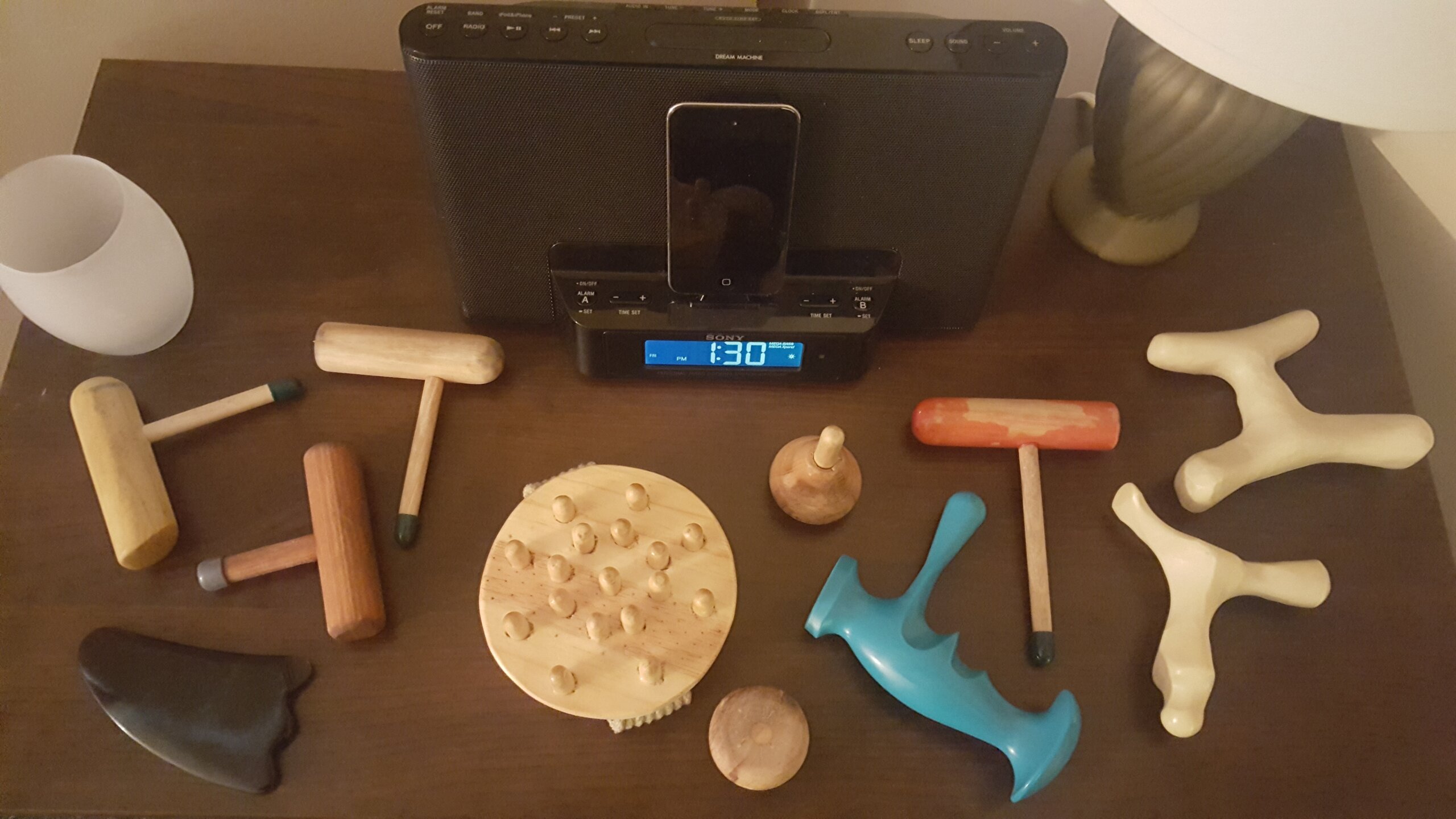
    In fact, I take no less than 7 tools into a massage with me, like this one:

    Okay, so I’m a massage tool addict.

    But here’s the advantage that massage tools give me:

    1. They save my fingers and thumbs.
    2. I can access difficult areas that require a precise and focused pressure better than I can with fingers.
    3. I have more tissue contact options than I do with fingers.  

    How to Use Massage Tools Fearlessly and Effectively (2.5 CEU)

    If you want to learn how to use massage tools so that you can do more massages, make more money and save your fingers and upper-body, then check out How to Use Massage Tools (Fearlessly and Effectively).
    It’s an online, home-study course that you can take at your own pace. In other words, you can practice what you learn in the class as you go along because you have life-time access to the course.

    Yes, it is a NCBTMB-approved 2.5 CEU course, so you can get some of your continuing education credits, but more importantly, it’s a practical course with lots of videos and real massage-life applications. Let me know what you think:-)


  • Advanced Massage Tools: Finger, Thumb & Elbow Substitutes

    Advanced Massage Tools: Finger, Thumb & Elbow Substitutes

    Do you have an elbow substitute?

    I do (it’s a massage tool), but that wasn’t always the case.

    I started my massage tool journey 25 years ago with one massage tool: The T-bar.

    The T-bar was awesome. It allowed me to easily work deep muscles, like the rotatores and multifidus in the lamina groove.

    The diameter of the tip was also perfect for arches of feet, shins, calves, hamstrings, TFLs, IT bands, forearms, rhomboids and traps.

    BUT the diameter of the tip was too big for areas like the cervical erectors and too small for bigger muscles like the glutes.

    Over the years I had developed some hacks for using the T-bar in areas where it was too small or too big. But it was never quite the same as having the best diameter-sized tool for the job.

    Finger, Thumb, and Elbow Substitutes

    There are 3 pressing tools with different diameter tips that go with me into the massage room every day.

    The L-bar has the smallest diameter.

    The T-bar is in the middle.

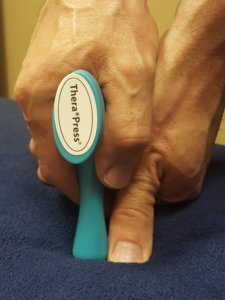
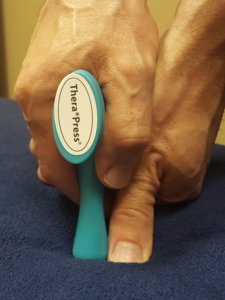
    And a Round-Tip Bar or TheraPress Trigger Point has the biggest tip.

    I think of these 3 massage tools as body parts substitutes.

    The L-bar is an extra finger.

    The T-bar is an extra thumb.

    And the Round-Tip bar or TheraPress is an extra elbow.

    Finger Substitute

    Now I bet you’re thinking, okay, Mark, I can see how the T-bar can be an extra thumb, but how can the L-bar (smallest diameter) be an extra finger?

    Here’s how: When the client is prone and you’re working the cervical erectors, try using an L-bar instead of a finger.

    Elbow Substitute

    Here Sarah is using the Round-Tip Bar as an elbow substitute:

    Here’s a TheraPress used like an elbow:

    Also, if I’m doing a two-handed hold with the Round-Tip Bar or TheraPress, I make additional contact around the tip of the tool. To the client this makes the tool tip feel broader than it is.

    Below I’ve made a list of my favorite ways to use the different diameter tools.

    Finger

    (L-bar)

    Thumb

    (T-bar)

    Elbow

    (Round Tip Bar or TheraPress )

    Cervical erectors Thoracic erectors Hamstring attachments
    Levator scapular Lumbar erectors Gluteus maximus, medius, minimus
    TFL Upper trapezius Hip rotators
    Forearms Foot flexors IT band
    Thumb adductor IT band Calves
    TFL
    Forearms

    Do you need all 3 tools to save your hands?

    No.

    But it’s nice to have all the substitute options, especially if you’re doing a lot of massage or  if you’re having a busy day.

    Okay, one more time. Try using these tools for body part substitutes:

    1. Finger substitute: L-bar.

    2. Thumb substitute: T-bar.

    3. Elbow substitute: Round-Tip Bar or TheraPress.

    Check out the videos in this article to get competent with these massage tools. If you’re new to massage tools, start here.

    If you are looking to purchase a custom-made, wooden massage tool, I can make that happen.

    Round-Tip T-bar with Contoured Edge – $20 plus shipping

    T-Bar with Contoured Edge – $20 + shipping

    T-Bar Small Tip with Contoured Edge – $20 plus shipping


    All three for $45 plus shipping.

    Just email me to order or if you have questions: mark@makethemostofmassage.com

    Massage Tools Online, Home-Study CEU Classes

    Massage tools have extended my massage career and increased my massage productivity. Specifically, I do more massages in a day/week/month/year in 50s than I did in my 30s.

    I’ve spent years developing and teaching the massage tools techniques and strategies that have allowed me to effectively incorporate massage tools into any massage, from relaxation to deep tissue. Now, I’ve taken the lives classes and turned them into online, home-study classes with lots of videos and guides.

    If you’re new to massage tools and want to be able to incorporate them into your massage quickly, I recommend: How to Use Massage Tools (Fearlessly and Effectively), 2.5 CEUs.

    And if you’re familiar with using massage tools, but want to take your massage tool skill level up to the point where you not only save your body but also brand yourself as a massage therapist who is an expert with precise massage, check out this course: Advanced Massage Tools, 2.5 CEUs.