Category: Massage Pain-Free

  • How to do Fall and Catch Massage

    How to do Fall and Catch Massage

    Fall and catch massage sounds very judo-y. But I promise that you won’t have to make your client tap out.

    Fall and catch massage is a way to do massage without squeezing and pressing a client’s muscles with all your might.

    Instead you “fall” into the client, and the client’s body “catches” you.

    Your body weight provides the pressure. And with good body mechanics there’s minimal strain to your neck and shoulders.

    I should mention that we’re talking about controlled falling. No black and blue clients.

    Here’s what I mean by controlled falling.

    You’re going to…

    1. Initiate the fall with your feet.

    By simply shifting your weight from your heels to the balls of your feet you begin the fall.

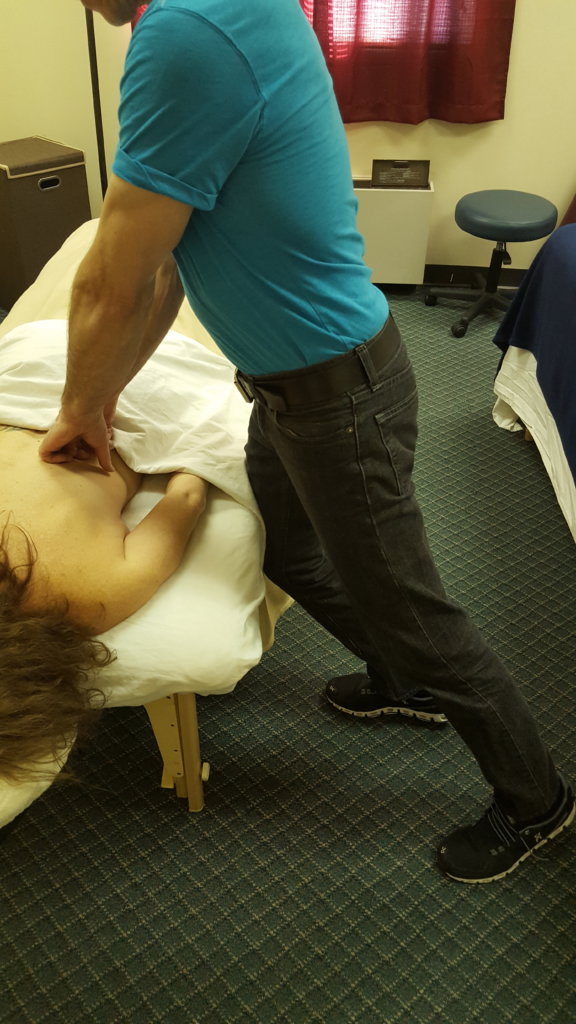
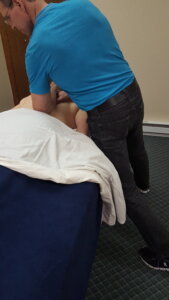
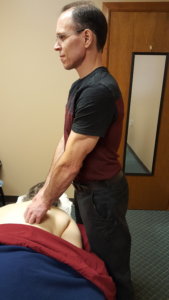
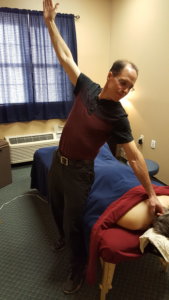
    In this pic I’m positioned to fall with my fists. My weight is towards my heels.
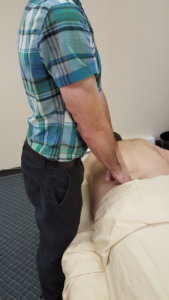
    Here I’ve fallen by shifting my weight to the balls of my feet.

    .
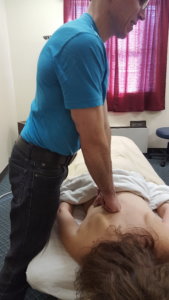
    2. Catch your weight on the table and/or client.

    The catching part is practically imperceptible because the body parts you’re massaging with (palms, fists, forearms, thumbs, or knuckles), should be in contact with the person.

    You’re simply transferring your body weight forward by shifting your weight from your heels to the balls of your feet.

    Light to Medium Pressure

    To do light to medium pressure, direct some of your body weight into the table as well as the client.
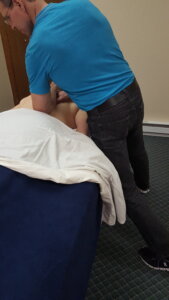
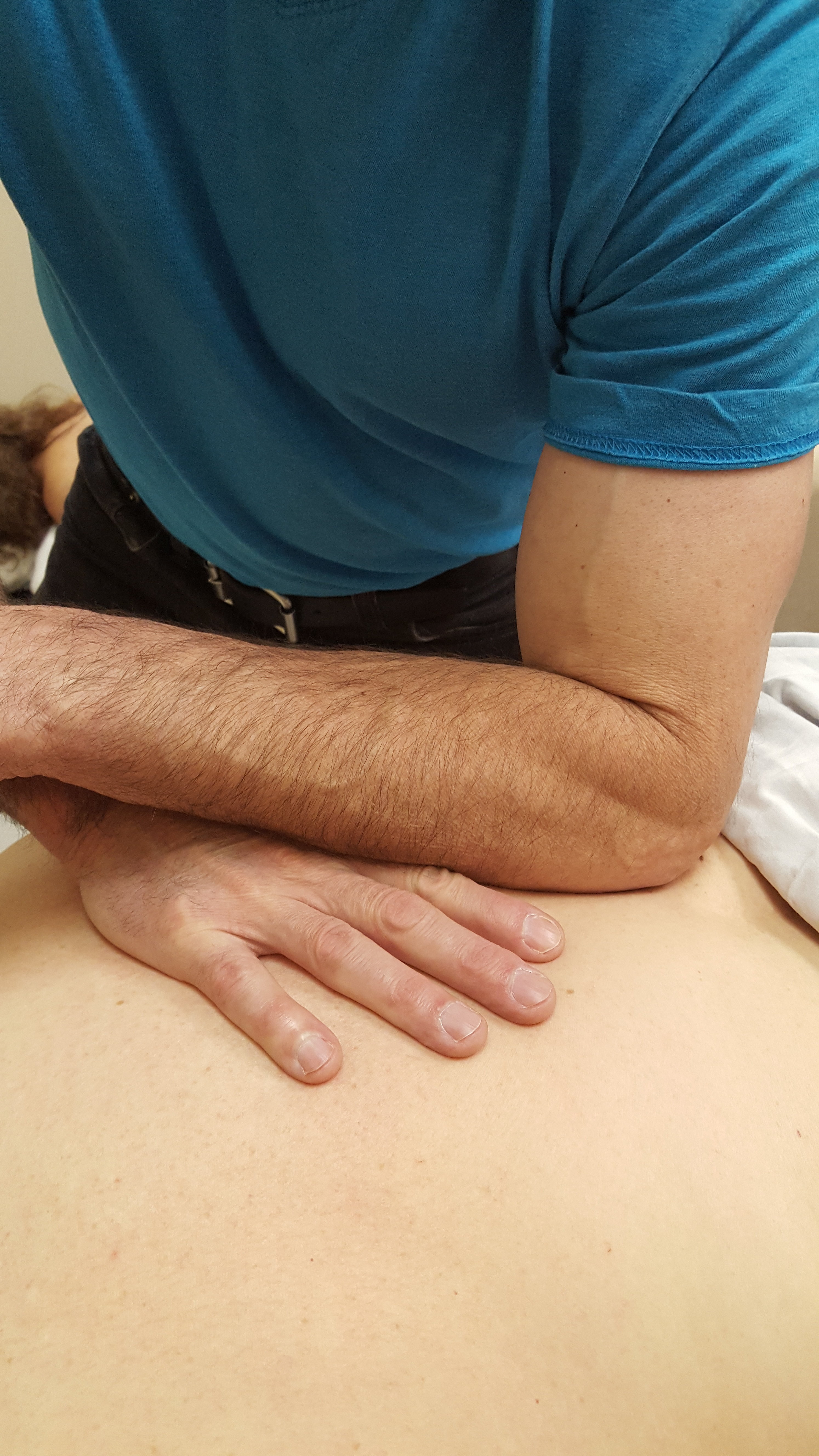
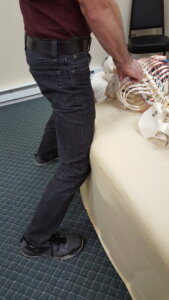
    See my leg leaning against the table in this pic? I’m primarily leaning into the table and exerting light pressure through my forearm. (80% into the table; 20% into the client).

    For deep pressure direct all of your body weight into the client.
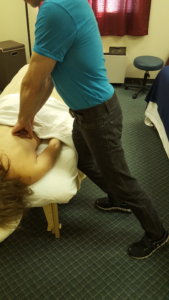
    If you “fell” too deep, shift some of your weight back off the balls of your feet.

    Here are some other keys for deep pressure.

    Fall and Catch Massage Stances

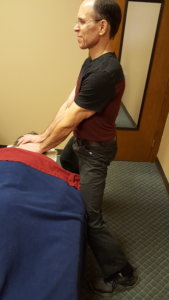
    When using fists, thumbs, palms and knuckles, a narrow stance will allow you to transfer all of your body weight onto the client.
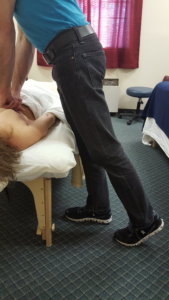
    Whereas, a wider stance won’t.
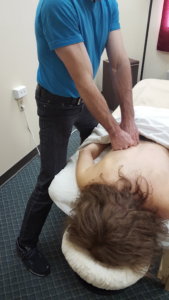
    Also, in general, for deep pressure step farther away from the table.

    For light pressure, step closer.

    Advanced Falling

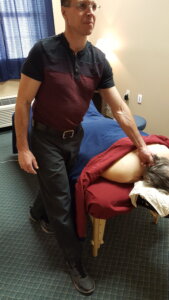
    You can also fall into your client with one hand.

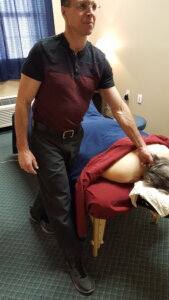
    Here’s a little fall.
    A bigger fall.
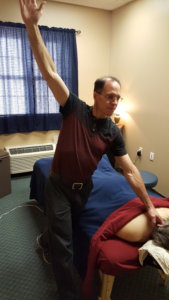
    You can see in the picture that my back heel has come up and I’ve shifted my weight to the front of my feet.

    And a client-wants-ridiculous-pressure fall.
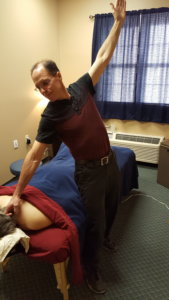
    Here I’ve switched stances so that I can get directly over the area I want to lean into with my body weight.

    Falling Sounds Like Leaning

    At this point, if you’ve read my other articles, you get that I’m using “fall” and “lean” interchangeably.

    But there’s a reason I chose “fall” this time.

    To me, “fall” conveys the feeling of letting go.

    Watch out below! Here I come with my fists!

    Okay, I’m not talking about jumping out of a plane letting go.

    I’m talking about the more subtle letting go that happens when you’re in a good mental space.

    Here’s how it works for me with fall and catch massage.

    The Zen of Fall and Catch Massage

    Once I got a few reps in of falling, I got good at controlling the fall (and landing).

    In other words, I became competent with (1) transferring my weight on my feet, (2) being in the right stance to deliver the desired pressure, and (3) knowing how to direct my body weight into the table and/or client.

    The result was that massage suddenly became easier to do. I went from eyeballs-popping-out-of-their-sockets strain to effortless work.

    And when massage is that effortless to do, it’s almost impossible NOT to completely relax.

    Definitely a “wax on, wax off, grasshopper” moment.

    Pardon the mixed analogy, but fall and catch massage gets me stoked. Cuz it’s a little slice of zen while you’re on the clock.

    For a deeper dive into falling (leaning), check out Table Height is Everything. 

    And don’t forget, if you need to make more money, build a business or get out of pain, join my email group. I’ll send you all my latest stuff. It’s free and you can unsubscribe anytime. Sign up below:-)
  • How to Do More Massages: Ask Why

    How to Do More Massages: Ask Why

    Want to be able to do more massages and not be in pain?

    Then ask: Why am I doing this?

    Wait, not: Why am I doing massage?

    I’m talking about these “why(s)”:

    Why am I doing a particular technique every massage?

    Why am I using my palms to effleurage?

    Why do I use my thumbs to do focus work all the time?

    The “why am I doing this?” doesn’t always have a straightforward answer, and sometimes you may have to do some sleuthing in the recesses of your brain to find the whole answer.

    But once you start investigating “why”, how you do massage will forever change. And your body will thank you for that.

    Let’s start with thumbs.

    Why do you use your thumbs for detail work and trigger point therapy?

    One reason is that a thumb is the perfect size tool for precise work.

    But there’s a problem when you have a human tool that’s perfect for a job.

    It wears out.

    Okay, so I have the perfect tool for the job but it’s wearing out, is there anything else I could use to replace my thumbs? Why yes there is.

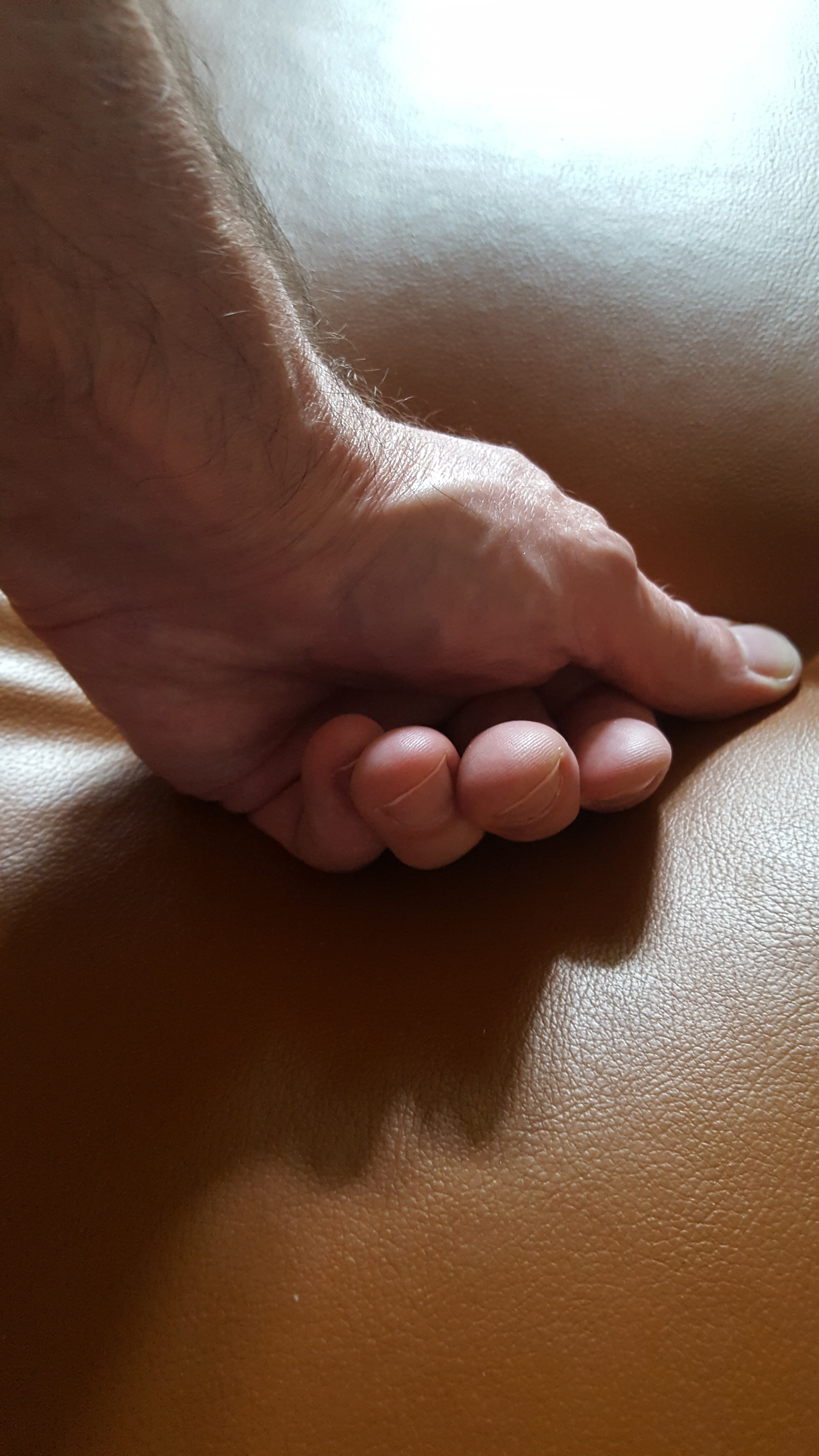
    A middle knuckle.

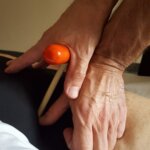
    In this picture the middle knuckle of my left hand is the thumb replacement.

    The companion knuckles support the middle knuckle and the fist of the other hand act as a stabilizer.

    I want to point out that I’m not directing my body weight into my thumb. My thumb is acting as my sensing device and telling me where to press.

    If you’re using a knuckle as a thumb replacer, drop your table lower than you normally would so that you have enough distance to lean and use your body weight to generate pressure. More about that here.

    So that’s one way you can save your thumbs so that you can do more massages. Here’s another good replacement for a thumb.

    A massage tool, like this T-bar.

    But I can’t feel anything with a piece of wood or plastic, Mark!

    I hear ya.

    That’s another reason why a thumb is the perfect tool for detail work because it has a lot of nerve endings and is great  for palpating.

    Here’s the thing, that hunk of wood that’s replacing your thumb can be “sensitized” by simply putting a finger or thumb next to the tip.

    More about that here.

    That’s great, Mark, but I tried a massage tool as a thumb replacement and it didn’t work for me.

    I experienced the same thing when I first tried massage tools. Using a massage tool to massage was like using boxing gloves as oven mitts to take my vegan mac and cheese out of the oven.

    Remember when I said we have to dig deep when we ask why?

    This is the time to do that.

    Here’s what I think we’re stuck on using thumbs: We’re taught to rely on our thumbs, and our experience in the massage room (thumbs work great) conditions us to never stop using them.

    Breaking away from something that works (even at a cost) is scary.

    I’m going to lose clients.

    I’m going to hurt someone.

    Someone is going to complain.

    But like anything you want to change, you simply have to keep working through the hard times.

    This video will help you get reps in with a massage tool to get you through the hard times.

    [embedyt] https://www.youtube.com/watch?v=lBYhV9tDaBM[/embedyt]

    Okay, that’s thumbs. But there’s  a lot more we can do to save our bodies so that we can AND want to do more massages.

    Just take the “why” question and apply it to everything you do in massage.

    How the Why Helped Me Do More Massages

    I’m certified in neuromuscular massage therapy.

    A core belief of the NMT program that I went through was that if you worked the totality of the muscle (origin, insertion and body), you’d get a better “release”.

    Unfortunately, working into the attachments of muscles is tough on your hands and upper body.

    But I continued to do it with each massage.

    Then many years later when I was teaching a back class an MT participant challenged me: Why should I do origin/insertion massage?

    Huh…there was no research to support it.

    And clinically, I didn’t see a difference between those I treated with static pressure on tight and pain spots and those I treated with origin and insertion massage.

    To be honest, I was only doing origin and insertion massage because that’s what I was taught to do and I was comfortable doing it.

    That’s when I decided to change how I did massage.

    Though I still work attachments at times I don’t do origin and insertion massage as part of my regular pain relief massage.

    The results are that my clients are still happy, and my upper-body is very happy!

    Do More Massage By Asking Why

    Stand up for your body.

    Don’t unnecessarily sacrifice your body parts to the cause.

    Ask “why” all the time when doing massage.

    When a specific technique is killing you, I’m positive you can find a way to get the job done without hurting your body.

    It’s time to stand up for your website, too.

    Because you can do more massages now doesn’t mean you have more massages to do.

    You need to bring in clients.

    A good website can do that for you.

    And a good website is not hard to do.

    Here’s how: How to Build a Good Website Fast.

    Need more help?

    Sign up for my email group.

    Every week I’ll send you my latest everything about saving your body, making more money and building a massage business.

    It’s free.

    Sign up below:-)


  • Massage Body Mechanics 201: Relax Your Hands

    Massage Body Mechanics 201: Relax Your Hands

    I didn’t understand massage body mechanics when I was a massage student, and I thought every MT had hand pain.

    My hands got to be such a problem that I went to my teacher, Telema, for help. She watched me work on a fellow student.

    What she told me to do seemed too subtle to be important at the time, but it’s actually a cornerstone to keeping my body pain-free when doing massage today.

    It was “relax your hands”.

    I know, “relaxing your hands” hardly seems like an advanced massage body mechanics strategy, but there are layers. And the deepest layer can actually make your whole body feel better.

    Layer#1: Relax the Hand that’s Working

    The first layer is to relax the hand(s) that’s doing the work.

    Back in the day, Telema would tap me on the shoulder when I was tensing my hands in a glide stroke or when I was over-squeezing.

    As time went on, I realized that I tensed my working hands out of anxiousness because I was wasn’t confident in my massage. Once I gained confidence, I was able to relax my working hands.

    Layer #2: Relax the Hand that’s NOT Working

    Next, Telema addressed my non-working hand. To my surprise, whenever I had a hand to my side, it was tense, too.

    Not sure why. Maybe it was playing Simon Says with my other hand.

    Regardless, paying attention to the non-working hand, and then relaxing it if it was tense, was an easy fix.

    The Advanced Massage Body Mechanics Tip

    The bonus to relaxing your hands while massaging is that it will help you stay pain-free when delivering pressure.

    It works like this. The act of relaxing your hands becomes a trigger for you to relax your body.

    When you relax your body you can be super-efficient at delivering pressure.

    Layer #3: Relaxing Hands to Relax Your Body

    There’s a big parallel between sports and massage here.

    If you’re tense playing a sport, you’re performance will probably suffer.

    Think of the times you’ve played in a game, competed in an event, performed on stage where having a tense body helped?

    Okay, so you can’t be Gumby and ooze all over the place. There needs to be a certain amount of tension in your body. But excess tension wastes energy, is unnecessary and gets in the way of efficient execution.

    Don’t Take My Word for It  

    Try this. Hold your arms out in front of you as if you were going to lean into someone on the massage table. Now make really tight fists.

    Do you feel the contraction of those hand, forearm, arm and shoulder muscles?

    With the tightened fists, lean forward as if you’re going to apply deep pressure to gluteus maximus and friends.

    Keep those fists tight!

    You should feel that your power (and strain) is coming from your arms and shoulders. That’s a lot of muscle work going on.

    Advanced Body Mechanics: Relaxed Lean

    Now, straighten back up. Keep the fists, but make them loose fists. Relax your forearms, arms and shoulders.

    Think of each arm, from loose fist to shoulder, as one connected unit. Now lean, but stay relaxed.

    Where does your power feel like it’s coming from?

    It should feel like it’s coming from your lean with no strain in your shoulders and arms. And you should feel like you’re able to lean all your body weight easily.

    The relaxed lean is super-efficient and easy on your body.

    [embedyt] https://www.youtube.com/watch?v=s2GcDbM0R5I[/embedyt]

    There’s another benefit to having relaxed hands. “Relaxed hand” leads to a “relaxed lean” which leads to you falling asleep on your client…haha…joking…where I’m going with this is that a relaxed body helps with palpation, too.

    Relaxed Body for Better Palpation 

    Did you ever have a client who wants you to work a particular tight or tender area and you can’t find it?

    You’re looking and pressing and looking and pressing and the next thing you know your client is kicking his feet like he’s trying to swim across the English Channel.

    Do you remember what your body was doing when you were searching so intensely?

    It was probably straining and tightening and working hard, right?

    Next time you feel your body tightening, especially your upper-body, try this: Relax your hands. 

    That will signal you to relax your body.

    When your body relaxes the only way you are going to be able to deliver pressure is to lean.

    Once you’re leaning you can put all of your attention into what you’re feeling as opposed to having your attention divided between what you’re feeling and how you’re going to get there.

    It All Starts with the Hand

    The idea behind having relaxed hands is simple—conserve energy and tax you body less. You can do that in three ways:

    1. Relax the hand that’s working.
    2. Relax the hand that’s not working.
    3. Relax your hand to relax your body.

    When you relax your hands, your forearms, arms and shoulders automatically relax, too.

    That can be a signal for the rest of your body to relax. Once you’re in that relaxed zone you can become hyper-efficient at leaning to deliver pressure with a minimal amount of effort.

    If you’re just plain done with being in pain when doing massage, this course that I’ve developed over my 25+ year career as a massage therapist will forever change how your body feels when doing massage.  

    No, it’s not going to make your body hurt worse. Haha.

    It’s going to make your body feel better AND you’re going to be able to do more massages than you could ever do before. 

    Promise.

    Have a question?

    DM me on Messenger.

    Chat box is to the right:-)

    P.S. You can get more body saving tips by signing up for my email group. I’ll let you know when new articles, tutorials, downloads and videos are out. The subscription is free and you can unsubscribe anytime.


  • Will a Low Massage Table Hurt Your Back?

    Will a Low Massage Table Hurt Your Back?

    Will working on a low massage table hurt your back?

    Not if you adopt these strategies:

    (1) use the table for support,

    (2) take wider stances when doing lighter pressure,

    (3) incorporate seated work and

    (4) avoid static posture positions.

    When you do those four things you’ll be able to deliver all ranges of pressure efficiently and with minimal strain on your body.

    I know, I sound pretty confident with that answer.

    Here’s why: For about 20 or so years my massage table height was normal.

    Hold on there, Mark, what’s normal?

    Good question.

    Normal to me was setting my table height so that the first knuckle of my middle finger would touch the top of the table.

    Edward Mohr recommends figuring out your table height by first trying your table at half your height.

    Bottom line, there is no consensus on what normal should be, but we can say this about normal: It has recognizable boundaries.

    In other words, we all recognize when a massage table height is out of the normal range.

    All least my clients do: “Hey, Mark, is your table too low? Isn’t that gonna hurt your back?”

    So, for about 20 years I set my massage table height within the normal range and clients weren’t worried about my back.

    Then about 5 years ago all hell break loose. I was diagnosed with cervical radiculopathy, cubital tunnel syndrome and shoulder instability.

    The way I was doing massage was killing my body, and I needed to find another way to get the job done.

    Here’s the short version of what happened next. Because my neck and shoulder hurt when I did deep work with my forearm, I needed to find an alternative to my forearm.

    Enter fists.

    Massaging with Fists

    But there was a problem with fists at the normal table height. I couldn’t transfer my body weight onto the client. So, I’d have to use a whole lot of pressing action with my upper-body to generate deeper pressure which meant more stress in my neck and shoulder.

    So, I lowered the table so that I could lean (transfer) my body weight through my fists onto the client.

    Bingo!

    Deep pressure was easy do when I did that.

    But no one is just going to use fists throughout an entire massage, right? And when fingers and palms and forearms start to come out, the table is going to be too low. One case of back strain coming up!

    That’s 100% true UNTIL you learn how to adapt to a low massage table.

    My adaptation process was accelerated last year when I decided to do a Can My Massage Table Be Too Low? experiment. For 7 days, I set my table on the lowest setting possible for each client I saw, no matter if they were big or small, thick or thin.

    Guess what happened to my body?

    Nothing.

    Now I’ve taken it even a step further and two months ago I set my massage table at the lowest setting possible for each and every massage.

    I don’t plan on ever changing that.

    Why Stay Low?

    I’m sticking with low for two reasons. One, I can generate pressure effortlessly by simply transferring my body weight onto the client.

    And, two, I know how to adapt to a low table so that my back is fine.

    Here’s a quick primer on how to lean when using a low massage table.

    [embedyt] https://www.youtube.com/watch?v=NhBh2cdGz6A[/embedyt]

    And here’s how you adapt to a low massage table.

    Low Massage Table Hurt Your Back NOT – Adaptations

    A low table looks scary, like it’s going to hurt your back–but it won’t.

    The Can My Massage Table Be Too Low? experiment put a spotlight on 4 things that had to be done in order to successfully adapt (no strain in your back) to a lower table.

    Let’s tackle these four things right now.

    1. Bend your legs.

    Here I’m delivering deep pressure with my knuckles and fists. The table is low so that I can lean into client.

    But when I want to lighten the pressure it gets more complicated. I can either bend at the back and cripple myself OR bend my legs like I’m the Karate Kid.

    It will feel a little weird at first when you start doing Karate Kid stances, but you’ll love the results. No back pain.

    During the experiment I took bending my legs to whole new level. But I didn’t fatigue because of thing number #2.

    2. Use the table for support.

    Think of the table as a wall to lean against. Use it to support your weight.

    Look at my back leg in this pic. A lot of my weight is being directed into the table through my leg.

    Here I’m leaning into the table in a Karate Kid stance. (Notice how I can really get into the lamina groove on this person….haha…)

    Once you get that “the table can help hold you up”, you start looking for ways to rest against the table. And you begin to…

    3. Approach massage as dynamic work, not static work.

    By dynamic I mean moving and flowing with a purpose in mind–to effortlessly do a good massage.

    Here’s a movement sequence that happens naturally when you bend your legs and use the table as support.

    Deep pressure first.

    Relax your back.

    Then I bend my legs for light pressure on the neck.

    In this light pressure situation I switch to one hand and get vertical. Notice my leg against the table. I’m still using the table as support.

    And at the end I throw in a stretch.

    It may look like a lot of work, but if you’re at one with your massage table (using the table to support some of your weight), massage becomes effortless.

    4. Sit when you can.

    I have to come clean. The reason I perfected seated massage was because my toe hurt at the end of long work days and I was tired of adjusting the massage table for each client.

    So, one day I kept my table height on the lowest setting for everyone. And when a light pressure client came in guess what I did?

    You got it. I sat down for a lot of the massage.

    It worked great. (And later with other clients I discovered how to generate deeper pressure when sitting, especially in areas like the traps.)

    Want to know more about sitting on your butt to do massage? Check out How to Use a Massage Stool.

    A Low Massage Table Won’t Hurt Your Back in a Nutshell

    After you use the strategies that I’ve talked about for working on a low table the question actually changes to: Can your massage table be too high?

    And my answer is yes.

    If your massage table is too high for you to lean to generate pressure then you’re going to have to press really hard with your upper-body.

    You may be able to get the job done, but at what cost?

    Your hands, arms, shoulders and neck will let you know.

    Whereas, if you have a low massage table, medium and deep pressure is a slam dunk.

    And during times when a low table is not optimal for your back (like thin people and light pressure), you can easily adapt to a low table by bending your legs, using the massage table for support, breaking up static posture positions and sitting to do massage when you can.

    This video brings it all together:

    Read my articles and watched my videos, but deep pressure still kicks your butt?

    I can help.

    From 1,000 miles away?

    Actually, yes. Click here.